

Discover how centralized content control boosts efficiency for SaaS and e-commerce teams. Enhance consistency, reduce costs, and build trust.
TL;DR:
- Centralized content control manages all content through a single system that enforces consistent workflows and permissions. It improves collaboration, reduces costs, and supports scalable governance models like hybrid approaches. Regular maintenance and thoughtful implementation are essential for sustainable, effective content governance.
Centralized content control is the practice of managing all your organization’s content through a single unified system that enforces consistent workflows, access permissions, and publishing standards. The industry term for this practice is content governance, and the two concepts work together: governance defines the rules, while centralized control enforces them at the platform level. Without this structure, duplicate content and brand inconsistency multiply fast, eroding customer trust and driving up operational costs. Platforms like Aprimo and Liferay have built entire product lines around solving this exact problem. For SaaS and e-commerce teams managing content across multiple channels, regions, and product lines, getting this right is not optional.
What is centralized content control and why does it matter?
Centralized content control gives your team one place to create, approve, store, and publish content. That single source of truth prevents the fragmentation that happens when writers use Google Drive, designers use Dropbox, and marketers publish directly from email threads.
Organizations using AI for content report a 68% increase in ROI, but 63% of them struggle to attribute that return without a formal governance framework. That gap is the cost of skipping centralized control. You get the output, but you cannot measure it, repeat it, or defend it.
The business case is even clearer on the cost side. Unified governance platforms reduce content production costs by more than 50% while increasing output by up to 10 times when AI automation is paired with human oversight. That is not a marginal efficiency gain. It is a structural shift in how content teams operate.
For e-commerce teams specifically, inconsistent product descriptions across channels directly hurt conversion rates. For SaaS teams, off-brand messaging in onboarding emails or help docs creates confusion that increases churn. Centralized governance fixes both problems at the source.
How does centralized content control improve collaboration and workflow efficiency?
The biggest collaboration killer in content teams is not a lack of talent. It is a lack of structure. When approvals live in email threads and assets are scattered across tools, every project requires someone to manually track down the right version of the right file.

Centralized repositories act as the single source of truth for all approved content assets. Role-based permissions mean writers see drafts, editors see review queues, and publishers see approved content ready to go live. Nobody touches what they should not touch.
The workflow gains get even bigger when you add automation. Transitioning from email-based approvals to rule-based, metadata-driven workflows reduces bottlenecks and compliance risks significantly. A content piece tagged with the right metadata routes itself to the right reviewer without anyone sending a Slack message asking “hey, can you take a look at this?”
Key workflow improvements centralized systems deliver:
- Single asset library. One location for all approved images, copy, and templates eliminates version confusion.
- Automated approval routing. Content moves through review stages based on type, region, or channel without manual handoffs.
- Role-based access. Permissions match job function, reducing errors and unauthorized publishing.
- Audit trails. Every edit and approval is logged, which matters for compliance-heavy industries.
- Reusable content blocks. Modular content cuts production time for teams publishing across multiple channels.
Pro Tip: Before you pick a platform, map your current approval workflow on a whiteboard. Most teams discover three to five redundant steps they can eliminate before they ever write a line of configuration.
For SaaS teams running multichannel content management, this structure is what separates teams that scale from teams that scramble.
What are the common models for centralized content governance?
Not every team needs the same governance structure. The right model depends on your team size, how many markets you serve, and how much brand risk you can tolerate.
| Model | Brand consistency | Speed | Scalability | Best for |
|---|---|---|---|---|
| Centralized | High | Slow | Limited | Regulated industries, small teams |
| Decentralized | Low | Fast | High | Agile startups, regional teams |
| Hybrid | High | Moderate | High | Growth-stage SaaS, global e-commerce |
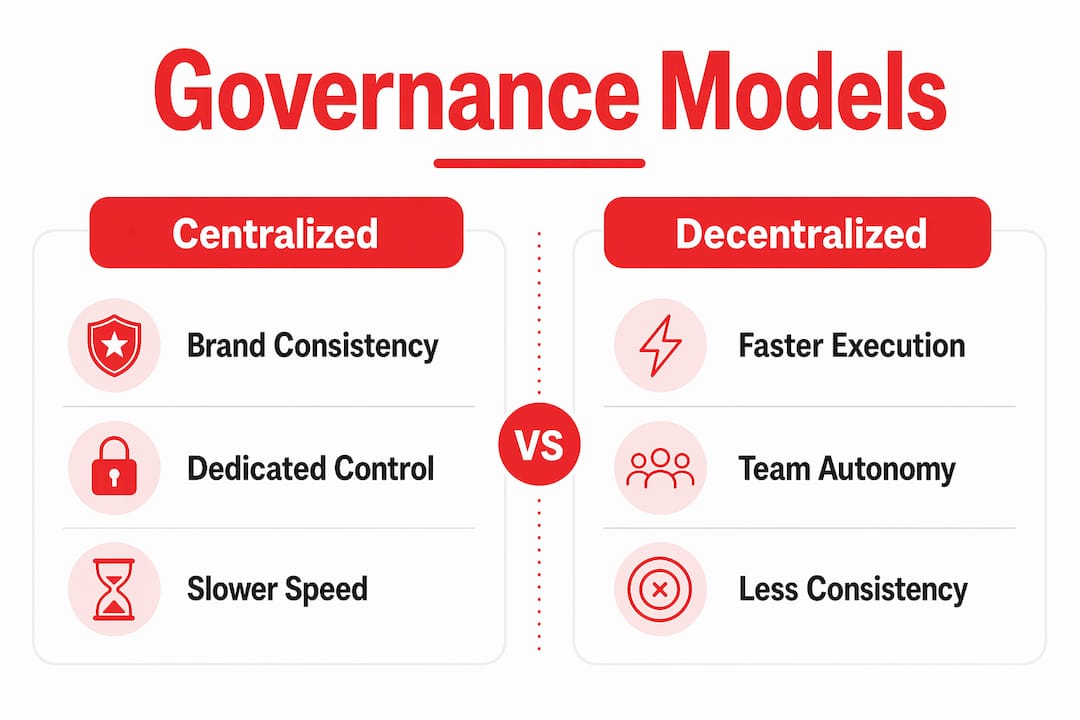
Centralized governance concentrates control with a dedicated team, which delivers strong brand consistency but creates bottlenecks when that team is under-resourced. One editor reviewing 200 pieces of content per month is a single point of failure.
Decentralized governance distributes control to individual teams or regions. Speed goes up, but brand consistency goes down. An e-commerce brand with 15 regional teams publishing independently will eventually end up with 15 different voices and 15 different visual standards.
Hybrid governance solves this by combining centralized standards with decentralized execution. The central team owns the brand guidelines, templates, and approval policies. Regional or product teams execute within those guardrails. This model is the right default for most growth-stage SaaS and e-commerce companies.
What are the essential components of effective content governance?
Sustainable content governance is built on four components, commonly called the 4 Ps. Governance frameworks that integrate People, Process, Policy, and Platform are the ones that actually scale.
Here is how each component works in practice:
-
People. Define who owns what. Every content type needs a named owner responsible for quality, updates, and archiving. Without ownership, content goes stale and nobody notices until a customer finds a broken product page.
-
Process. Build a structured content lifecycle. Effective content management requires a 7-stage lifecycle: planning, drafting, editing, approving, publishing, maintaining, and removing. Skipping the “removing” stage is how outdated pricing pages stay live for two years.
-
Policy. Document your brand guidelines, legal requirements, SEO standards, and quality benchmarks in one place. Policy is not a style guide PDF nobody reads. It is a living document embedded into your workflow tools so writers see the rules when they need them.
-
Platform. Choose a content management system with workflow automation, metadata tagging, version control, and role-based permissions. Platforms like Liferay and Aprimo are built for enterprise teams. For growth-stage companies, CMS features for SaaS teams do not need to be enterprise-grade to be effective.
Pro Tip: Treat governance as an operational system, not a one-time policy rollout. Schedule a quarterly review of your workflows, permissions, and content lifecycle rules. Teams that do this catch problems before they become expensive.
The 4 Ps framework also clarifies where most governance failures happen. Teams that skip the People component end up with great tools and no accountability. Teams that skip Policy end up with fast workflows producing inconsistent content.
How to apply centralized content strategies in SaaS and e-commerce
SaaS and e-commerce teams face a specific challenge: they need to move fast and stay consistent at the same time. A centralized content strategy built for a slow-moving enterprise will create more problems than it solves.
Enterprise CMS platforms like Liferay enable centralized multi-site and multilingual content management while letting local teams adapt within brand standards. Shared templates, versioning, and compliance controls give the central team visibility without requiring them to approve every single asset.
Practical recommendations for SaaS and e-commerce teams:
- Start with your highest-risk content. Product descriptions, pricing pages, and legal disclosures carry the most brand and compliance risk. Centralize those first before tackling blog content or social posts.
- Use AI for auditing, not just creation. AI-powered content workflows can flag outdated content, identify duplicate assets, and surface underperforming pages faster than any manual audit.
- Build metadata into your taxonomy from day one. Metadata-driven routing is what makes automated workflows possible. Retrofitting metadata onto an existing content library is painful and slow.
- Give regional teams templates, not blank pages. E-commerce teams serving multiple markets need the ability to localize content without rebuilding it from scratch. Modular templates with locked brand elements and editable local fields solve this cleanly.
- Avoid common pitfalls. The most common content management mistakes SaaS teams make include skipping the governance model decision entirely and letting tool sprawl fill the gap.
The goal is not perfect central control. The goal is a system where the right people can publish the right content quickly, and the wrong content cannot accidentally go live.
Key Takeaways
Centralized content control works because it combines a single source of truth with automated workflows, clear ownership, and a governance model matched to your team’s actual speed and scale.
| Point | Details |
|---|---|
| Governance drives ROI | AI content gains are measurable only when a formal governance framework tracks and attributes output. |
| Hybrid models prevent bottlenecks | Combining central standards with decentralized execution keeps brand consistency without slowing teams down. |
| The 4 Ps framework scales | People, Process, Policy, and Platform must all be defined for governance to hold up as teams grow. |
| Metadata enables automation | Rule-based, metadata-driven workflows replace email approvals and reduce compliance risk significantly. |
| Start with high-risk content | Centralizing product pages and legal content first delivers the fastest measurable return. |
Why governance is a system, not a project
Most content teams I have worked with treat governance as a one-time setup task. They document the brand guidelines, configure the CMS, and move on. Six months later, the workflows are ignored, the permissions are outdated, and the content library looks exactly like it did before.
The teams that actually get this right treat governance as an operational system that needs regular maintenance. They schedule quarterly reviews. They update policies when the product changes. They add new workflow rules when new content types appear. It sounds obvious, but almost nobody does it.
The other thing I have seen trip up SaaS teams specifically is the culture piece. You can build the best content management system in the world, and writers will still paste content directly into WordPress if the governance system feels like extra work. The platform has to be faster and easier than the workaround, or people will find the workaround.
My honest recommendation: start smaller than you think you need to. Pick one content type, one workflow, and one team. Get that working cleanly before you roll it out to the whole organization. Phased implementation is not a sign of weakness. It is how you build something that actually sticks.
The AI-powered marketing ROI conversation is directly connected to this. Teams that cannot attribute content performance to specific workflows cannot make the case for better tools or bigger budgets. Governance is what makes that attribution possible.
— Josh
How Rule27design builds content systems that actually work
Rule27design builds custom content management systems and admin tools for growth-stage SaaS and e-commerce companies. The focus is on systems that match how your team actually works, not how a software vendor assumes you work.
If your team is dealing with scattered assets, manual approval chains, or inconsistent publishing across channels, Rule27design can help you design a governance structure and platform that fits your scale. Clients typically see a 40% improvement in operational efficiency after implementation. The work covers everything from CMS architecture and workflow automation to AI integration and metadata taxonomy design. Visit Rule27design to see current projects and start a conversation about what your team needs.
FAQ
What is centralized content control?
Centralized content control is the practice of managing all content creation, approval, storage, and publishing through a single unified system with defined workflows and access permissions. It is the operational layer that makes content governance work in practice.
How is content governance different from content strategy?
Content strategy defines what content you create and why. Content governance defines how that content is managed, maintained, and kept compliant after it is published. The two are distinct but depend on each other.
What is the best governance model for a SaaS team?
Hybrid governance is the best fit for most SaaS teams. It combines centralized brand standards and approval policies with decentralized execution by individual product or regional teams, which prevents bottlenecks without sacrificing consistency.
How does a CMS support centralized content governance?
A content management system with role-based permissions, metadata tagging, version control, and automated workflow routing enforces governance rules at the platform level. Platforms like Liferay are built specifically for multi-site and multilingual governance at scale.
What are the biggest risks of skipping content governance?
Without governance, teams face duplicate content, inconsistent brand messaging, compliance exposure, and an inability to measure content ROI. These problems compound as team size and content volume grow.

About the Author
Josh AndersonCo-Founder & CEO at Rule27 Design
Operations leader and full-stack developer with 15 years of experience disrupting traditional business models. I don't just strategize, I build. From architecting operational transformations to coding the platforms that enable them, I deliver end-to-end solutions that drive real impact. My rare combination of technical expertise and strategic vision allows me to identify inefficiencies, design streamlined processes, and personally develop the technology that brings innovation to life.
View Profile

