

Discover what is continuous content delivery and how it streamlines your content lifecycle, maximizing engagement and efficiency in 2026.
TL;DR:
- Continuous content delivery automates the full publishing cycle in short, repeated loops, increasing efficiency and engagement. It relies on structured pipelines and automation tools to produce, validate, and distribute content consistently across channels. This approach reduces errors, speeds up production, and responds quickly to audience needs and market changes.
Continuous content delivery is the automated process of producing, testing, and publishing content in short, repeating cycles to keep audiences engaged and marketing teams efficient. Unlike traditional publishing, where content goes live in large, infrequent batches, this method treats content like software. It moves through a structured pipeline from creation to validation to distribution, continuously. Content creators and marketers who adopt this approach spend less time on manual tasks and more time on strategy. If you want to understand multichannel content management in 2026, continuous delivery is the engine underneath it.
What is continuous content delivery and how does it work?
Continuous content delivery is defined as a method of automating the full content lifecycle, from drafting and review through testing and publishing, so that fresh content reaches audiences on a predictable, repeating schedule. The term borrows directly from software engineering, where continuous delivery is a practice of building, testing, and releasing software in short cycles that can be shipped at any time. Marketers adapted the same logic. Instead of code, the asset is a blog post, a product page, a social update, or a video script.

The industry term you will see in technical documentation is CI/CD, which stands for continuous integration and continuous delivery. CI/CD embodies operating principles and practices that enable teams to deliver changes more frequently and reliably through automation. For content teams, “integration” means pulling together drafts, assets, and metadata. “Delivery” means pushing that package through review and out to the right channels.
A content pipeline is the specific sequence of automated steps that makes this possible. Think of it as an assembly line. Raw content enters at one end, passes through quality checks, gets formatted for each channel, and exits as a published piece. Content delivery platforms, or CDPs, sit at the center of this pipeline. CDPs collect content from multiple sources, process it, and push it to every channel simultaneously. That is what keeps a product description consistent across a website, an app, and a help center at the same time.
How the pipeline actually runs
The process follows a clear sequence:
- Content creation. A writer, designer, or AI tool produces a draft inside a content management system like WordPress, Contentful, or a custom CMS.
- Automated validation. The system checks for formatting errors, broken links, missing metadata, and brand compliance. No human needs to catch these manually.
- Staging and review. The content moves to a staging environment that mirrors the live site. Editors review it in context, not in a raw editor.
- Approval gate. A human approves the final release. This is the key difference between continuous delivery and continuous deployment. Continuous deployment removes this human step entirely and pushes to production automatically after tests pass.
- Scheduled or immediate publish. The approved content goes live on a set schedule or instantly, depending on the campaign.
Pro Tip: Set up your approval gate as a single-click action inside your CMS dashboard. The faster the gate, the faster the cycle. Friction at the approval step is the most common reason content pipelines stall.
What are the benefits of continuous content delivery?
Continuous content delivery produces measurable gains across three areas: audience engagement, team efficiency, and operational risk.
Audience engagement improves because content arrives more frequently and stays current. Audiences respond to relevance. A weekly article beats a monthly one, and a daily social post beats a weekly one, as long as quality holds. Dynamic content delivery takes this further by using real-time audience signals and customer data to personalize what each reader sees. That level of responsiveness is only possible when the delivery pipeline is already automated.
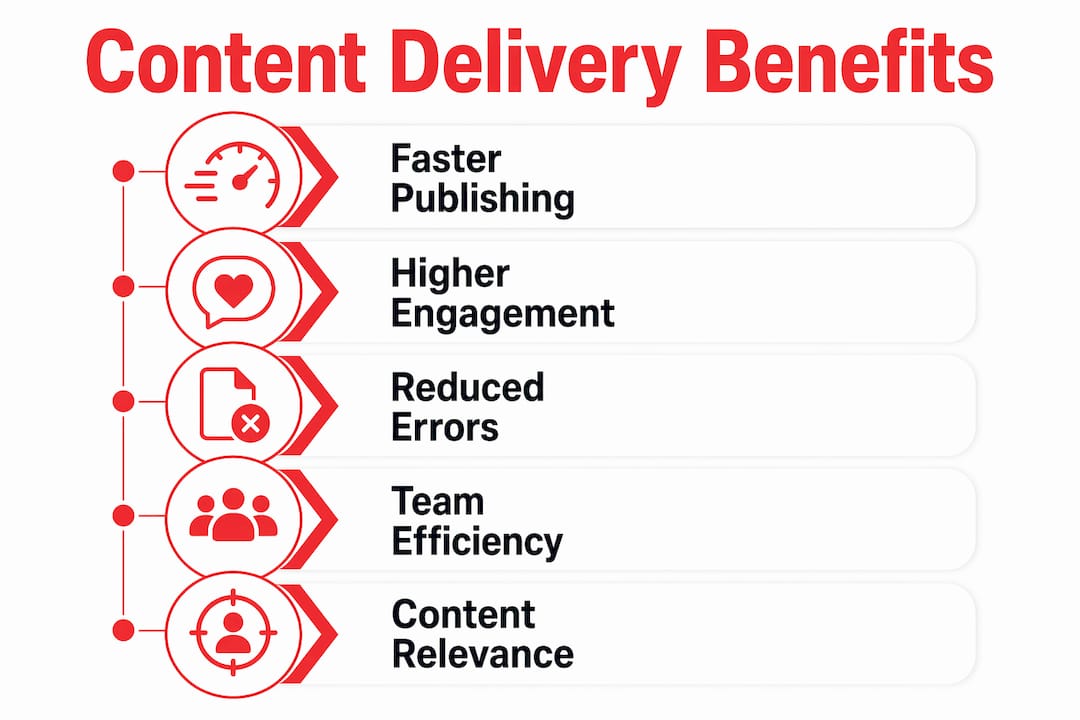
Team efficiency rises because automation removes the repetitive work. Automation in content delivery minimizes errors, reduces operational costs, and speeds up production cycles for content teams. When a writer does not need to manually format a post for five channels, they can write more posts. When an editor does not need to chase down metadata, they can focus on quality.
Operational risk drops because smaller, more frequent releases are easier to fix than large, infrequent ones. Continuous delivery reduces the cost, time, and risk of delivering changes by allowing incremental updates with a repeatable process. If a published piece has an error, you catch it fast and push a fix in the next cycle. A quarterly content drop with a mistake lives with that mistake for months.
Key benefits at a glance:
- Faster feedback loops from audiences and analytics
- Fewer manual handoffs between writers, editors, and developers
- Consistent brand voice across every channel
- Lower cost per published piece as volume increases
- Reduced chance of large-scale publishing errors
How does continuous content delivery compare to traditional publishing?
Traditional content publishing runs on a campaign model. A team plans a content calendar weeks or months in advance, produces a batch of pieces, and publishes them all at once or on a rigid schedule. Continuous delivery replaces that batch model with a flow model.
| Factor | Traditional publishing | Continuous content delivery |
|---|---|---|
| Release frequency | Weekly, monthly, or quarterly | Daily or on-demand |
| Automation level | Mostly manual | Mostly automated |
| Error correction speed | Slow, next batch | Fast, next cycle |
| Channel consistency | Often inconsistent | Consistent by default |
| Team workload | Peaks and valleys | Steady and predictable |
| Audience responsiveness | Low | High |
The table above shows the practical gap. Traditional publishing creates workload spikes. A team scrambles before a launch, then goes quiet. Continuous delivery spreads that work evenly. Continuous delivery keeps code always deployable, and the same principle applies to content. Your content is always ready to publish, which means you can respond to a news event, a product update, or an algorithm change within hours, not weeks.
One common confusion is between a content delivery network, or CDN, and a content delivery pipeline. A CDN like Cloudflare or AWS CloudFront is a distribution network that serves files faster by caching them closer to the reader. A content pipeline is the workflow that produces and publishes the content itself. They work together but solve different problems.
Pro Tip: Audit your current publishing workflow and count every manual step. Each one is a candidate for automation. Most teams find they can cut their time to publish by more than half just by automating formatting, tagging, and channel distribution.
What are the practical steps and tools for implementing a content pipeline?
Setting up a continuous content delivery system does not require rebuilding everything at once. A phased approach works best.
Step 1: Map your current workflow. Write down every step from brief to published post. Include who touches it and how long each step takes. This map shows you where the bottlenecks are.
Step 2: Choose a CMS that supports automation. Platforms like Contentful, Sanity, and custom-built systems built on React and Supabase allow you to connect workflows, trigger actions on content state changes, and push to multiple channels from one place. Rule27design builds custom CMS solutions specifically for teams that have outgrown off-the-shelf tools.
Step 3: Add automated validation. Use tools like Grammarly for writing quality, custom scripts for metadata checks, and link validators to catch errors before a human reviewer ever sees the draft.
Step 4: Connect your delivery pipeline. CI/CD tools like Jenkins, CircleCI, AWS CodeBuild, and Azure DevOps automate build, test, and deploy stages in software delivery. Content teams can use the same tools or lighter marketing automation platforms to trigger publishing actions based on approval status.
Step 5: Set up monitoring and iteration. Track publish frequency, error rates, and audience engagement metrics after each cycle. Use that data to adjust your content strategy. The workflow automation ideas that work for SaaS teams apply directly here: automate the repeatable, measure the results, and refine the process.
- Use a content calendar tool like Airtable or Notion to manage the editorial queue
- Connect your CMS to your analytics platform so performance data feeds back into planning
- Build a staging environment that mirrors your live site exactly
- Define clear approval criteria so editors can approve in one pass, not three
- Review your pipeline metrics monthly and cut any step that does not add value
A well-built pipeline also supports content marketing automation at scale. When the infrastructure is solid, adding AI-assisted drafting or personalization layers becomes straightforward rather than chaotic.
Key Takeaways
Continuous content delivery works because it replaces slow, manual publishing cycles with automated pipelines that keep content flowing, errors low, and audiences engaged.
| Point | Details |
|---|---|
| Core definition | Continuous content delivery automates the full cycle from creation to publishing in short, repeating loops. |
| Pipeline structure | Content moves through creation, validation, staging, approval, and publish stages automatically. |
| Delivery vs. deployment | Continuous delivery keeps a human approval gate; continuous deployment removes it entirely. |
| Key benefits | Automation cuts errors, reduces costs, and speeds up production for content teams. |
| Implementation start | Map your current workflow first, then automate one stage at a time starting with validation. |
Why most content teams are still thinking about this wrong
Most content teams treat continuous delivery as a technology problem. They buy a new CMS, set up a few automations, and call it done. The technology is the easy part. The hard part is changing how the team thinks about publishing.
Traditional publishing trains people to think in campaigns. You plan, you produce, you launch, you rest. Continuous delivery requires a different mindset. Publishing is not an event. It is a state. Your content is always either in the pipeline or live. There is no “launch day” because every day is a launch day.
The teams I have seen succeed with this approach share one habit. They treat every published piece as a draft that will be updated, not a finished product that is done. That shift changes everything. It removes the pressure to make each piece perfect before it goes live. It makes iteration feel normal. And it keeps the pipeline moving instead of stalling at the approval gate while someone waits for perfection.
The 2025 content trends that matter most in 2026 all point in the same direction: speed, personalization, and frequency win. Continuous delivery is not a trend. It is the infrastructure that makes those trends possible.
— Josh
How Rule27design helps teams build real content pipelines
Content teams that want to move from batch publishing to continuous delivery need more than a checklist. They need systems that actually fit how their team works.

Rule27design builds custom content management systems, admin panels, and delivery pipelines for growth-stage companies that have outgrown basic tools. The team has built AI-optimized content systems that help clients rank better in ChatGPT, Claude, and Perplexity responses, along with marketing automation setups that cut manual work and speed up publishing cycles. If your team is ready to stop managing content by hand and start running a real pipeline, Rule27design is the place to start.
FAQ
What is continuous content delivery in simple terms?
Continuous content delivery is an automated method of publishing content in short, repeating cycles rather than large, infrequent batches. It keeps content current and reduces manual work for marketing teams.
What is the difference between continuous delivery and continuous deployment?
Continuous delivery keeps a human approval step before content or code goes live. Continuous deployment removes that step and pushes automatically after all tests pass.
What tools support a content delivery pipeline?
CI/CD tools like Jenkins, CircleCI, AWS CodeBuild, and Azure DevOps automate build and deploy stages. Content teams also use platforms like Contentful, Sanity, and custom CMS solutions built for their specific workflows.
How does a content pipeline differ from a CDN?
A content pipeline is the workflow that produces and publishes content. A CDN like Cloudflare or AWS CloudFront is a distribution network that serves already-published files faster by caching them closer to readers.
What are the main benefits of continuous content delivery for marketers?
The main benefits are faster audience feedback, fewer manual handoffs, consistent brand voice across channels, and lower cost per published piece as publishing volume increases.

About the Author
Josh AndersonCo-Founder & CEO at Rule27 Design
Operations leader and full-stack developer with 15 years of experience disrupting traditional business models. I don't just strategize, I build. From architecting operational transformations to coding the platforms that enable them, I deliver end-to-end solutions that drive real impact. My rare combination of technical expertise and strategic vision allows me to identify inefficiencies, design streamlined processes, and personally develop the technology that brings innovation to life.
View Profile

