

Discover what digital asset taxonomy is and how it streamlines file management for growth-stage businesses, boosting efficiency and governance.
TL;DR:
- A digital asset taxonomy is a hierarchical classification system that enhances metadata organization, making assets easier to find and automate. Proper design with controlled vocabularies and faceted fields reduces search time and supports automation aligned with FAIR principles. Successful implementation requires active governance, stakeholder input, and phased rollout to ensure scalability and system integration.
A digital asset taxonomy is a configurable, hierarchical classification scheme that structures metadata inside a DAM so every asset is findable, governed, and ready for automation. That’s the whole idea. Get it right and your team stops hunting for files. Get it wrong and you’re paying people to do searches that should take seconds.
Core elements you need before planning anything:
- Controlled vocabularies — approved term lists that prevent “US,” “USA,” and “United States” from existing as three separate tags
- Hierarchical categories — nested structures like Brand → Product Line → Campaign
- Faceted metadata fields — multi-axis filters (region, channel, asset type) that let users slice from any angle
- Rights and expiry fields — usage rights, license end dates, territory restrictions
- Roles and permissions — who can tag, approve, publish, or archive
The outcome: one source of truth for assets across regions, channels, and automation pipelines.
Why does digital asset taxonomy matter for growth-stage teams?
Taxonomy reduces duplication, cuts time-to-find, and unlocks metadata-driven automation. Those aren’t soft benefits. A well-structured taxonomy improves discoverability and enables automation that inconsistent tagging actively blocks.
Rule27design clients typically see a 40% improvement in operational efficiency after implementing governed taxonomy and custom DAM infrastructure. That number comes from fewer manual searches, less rework on duplicate assets, and automated publishing flows that no longer need a human in the middle.
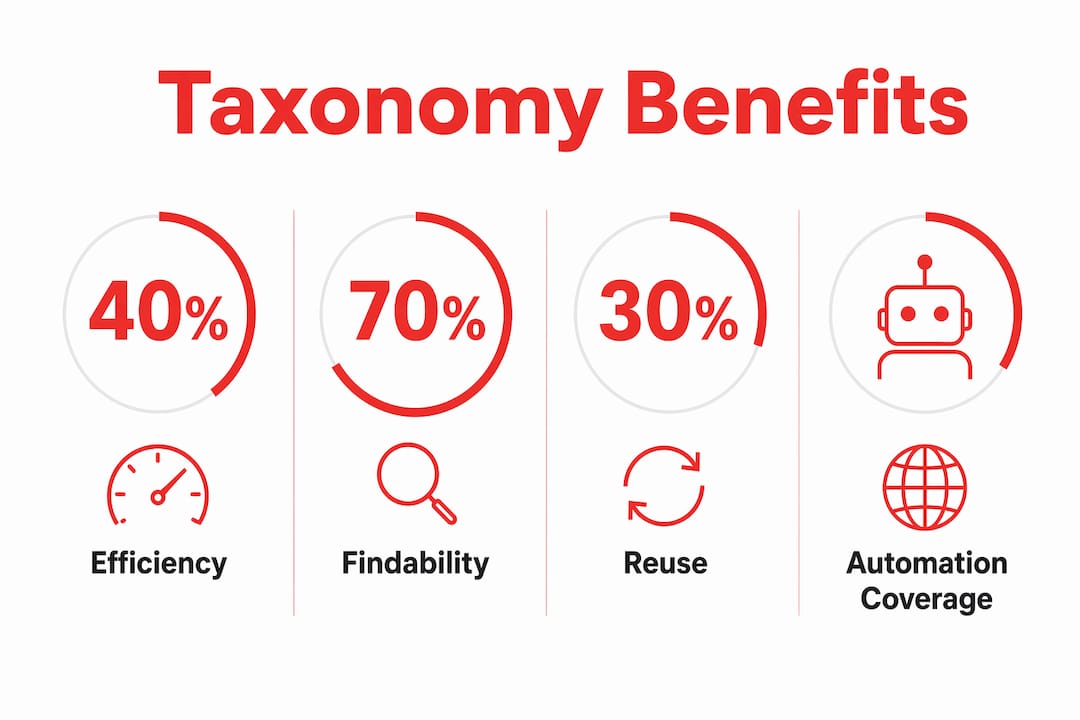
Taxonomy also aligns with the FAIR principles — Findable, Accessible, Interoperable, Reusable — the framework that shapes modern DAM strategy. When your metadata schema satisfies FAIR, downstream systems (CMS, CDN, AI agents) can consume assets reliably without manual handoffs.
Pro Tip: Start with the taxonomy branches that unblock the biggest cross-team bottlenecks first. Product marketing assets flowing to sales enablement is almost always the highest-ROI branch to structure before anything else.
What’s the difference between taxonomy, metadata, and folders?
Taxonomy is the structure. Metadata is the data applied to individual assets. Folders are a legacy storage model that breaks the moment one asset belongs in two places at once.

The clearest way to see it: metadata answers “what is this asset?” while taxonomy answers “where does it sit, and what else is near it?” A campaign image might carry metadata fields for creator, file type, and license date — but taxonomy places it under Brand → Campaign → Spring Launch.
Key concepts to align your team on:
- Controlled vocabularies — standardized term lists enforced at the field level; synonyms and aliases map to canonical terms
- Hierarchical (nested) taxonomy — parent/child relationships; works well for brand and product structures
- Flat taxonomy — single-level tag lists; fast to build, hard to scale
- Faceted/multi-axial classification — assets tagged across independent axes (region, format, lifecycle stage) simultaneously; the right model for most growth-stage DAMs
- Metadata types — descriptive, administrative, technical, structural, rights, and preservation fields; taxonomy defines which types are required and their allowed values
Taxonomy and metadata are a single interdependent system. One is only useful when the other is governed and populated.
How do you design a taxonomy that actually scales?
Design for findability first, governance second, automation third, and human usability throughout. That order matters for growth-stage companies because you’ll outgrow your first schema faster than you expect.
Core design principles:
- Mirror user search patterns, not folder structures. A taxonomy built around how users search outperforms one built around how IT stores files.
- Use faceted/multi-axial fields so assets are discoverable from multiple angles without duplication.
- Enforce controlled vocabularies at every text field. Free-text kills search quality fast.
- Model rights and lifecycle metadata from day one — expiry dates and territory fields are painful to retrofit.
- Plan for synonyms, aliases, and localization before launch, not after.
| Taxonomy model | Best for | Maintenance complexity | Ideal scale |
|---|---|---|---|
| Flat tag list | Simple libraries, single team | Low | Small |
| Hierarchical (nested) | Brand/product/campaign structures | Medium | Mid-size |
| Faceted/multi-axial | Multi-channel, multi-region DAMs | Medium-high | Growth to enterprise |
| Hybrid (hierarchy + facets) | Most growth-stage companies | Medium-high | Growth to enterprise |
Pro Tip: Define every field with a template before you build: field name, data type, allowed values, required vs. optional, and the team responsible for populating it. That document becomes your governance bible.
What does a step-by-step taxonomy implementation look like?
Five phases. Each one has a clear owner and a deliverable.
- Discovery and audit — inventory existing assets, tag patterns, and folder structures; identify gaps and duplicates; output: asset audit report
- Stakeholder mapping — interview content creators, marketers, legal, and IT; document search behaviors and pain points; output: user search pattern map
- Taxonomy design and field definitions — draft hierarchy, facets, controlled vocabularies, and field templates; output: taxonomy schema v1
- Pilot — tag a minimum dataset (200–500 assets across your highest-traffic categories); run search QA; collect user feedback; output: pilot findings report
- Phased rollout and training — migrate assets by priority branch; train teams; monitor KPIs; output: governed DAM live
Timeline: a focused pilot runs 6–8 weeks. Full rollout typically spans 3–9 months depending on library size and team capacity.
| Phase | Effort level | Estimated cost band (growth-stage) |
|---|---|---|
| Audit and discovery | Low | Moderate cost |
| Stakeholder mapping | Low | Moderate cost |
| Taxonomy design | Medium | Moderate to higher cost |
| Pilot (representative assets) | Medium | Moderate cost |
| Phased rollout | High | Higher cost |
Rollback trigger: if pilot search success rate drops below 70% or user satisfaction scores fall below 3/5, pause and redesign the affected branches before proceeding.
How does taxonomy connect to DAM, CMS, and AI workflows?
Taxonomy is the canonical metadata layer that DAM, CMS, publishing pipelines, and AI agents all read from to make reliable decisions. Without it, every downstream system is guessing.
Integration points to plan for:
- DAM field sync — taxonomy terms map to structured DAM fields, not free-text notes
- CMS mapping — DAM metadata fields publish directly to CMS content types via API
- Search index fields — taxonomy terms populate search facets in your front-end or internal search
- API contracts — downstream systems consume a defined metadata schema; changes require versioning
- Webhook/event triggers — metadata field changes (e.g., approval_status = “approved”) fire automation events
A practical architecture: assets enter the DAM → a metadata hub validates and enriches tags against controlled vocabularies → approved assets push to CMS, CDN, and marketing automation workflows via API. AI agents operating within that pipeline rely on clean, governed metadata to route, transform, and publish assets without human intervention.
Pro Tip: Version your taxonomy schema the same way you version code. Tag each release (v1.0, v1.1), document breaking changes, and give downstream systems a deprecation window before you remove a field or rename a term.
Who owns taxonomy governance and how does it stay healthy?
Taxonomy is not a set-and-forget project. It needs active ownership or it drifts into chaos within 18 months.
Roles to assign before launch:
- Taxonomy owner — accountable for schema decisions and annual reviews
- Metadata steward — day-to-day QA, term additions, and tagging support
- DAM admin — system configuration and field management
- Domain reviewers — subject-matter experts per business unit (legal, brand, regional)
- Executive sponsor — budget authority and cross-team escalation path
Change control process:
- Any team member submits a change request (new term, renamed field, deprecated category)
- Taxonomy owner reviews impact on downstream systems and existing tags
- Domain reviewers approve or reject within a defined SLA (recommend 5 business days)
- Approved changes publish with a version increment and release note
Maintenance cadence: annual full review plus trigger-driven reviews for new product launches, acquisitions, or major campaign expansions. A taxonomy will likely need active updates within roughly three years as content types and channels shift — plan for that from the start.
What breaks taxonomy projects?
The most common failures: designing for storage instead of search, inconsistent vocabularies, and no governance owner after launch.
Red flags to watch for:
- Categories that mirror your org chart instead of user search behavior
- Free-text fields where controlled vocabularies should be
- No required fields — every asset tagged differently
- Taxonomy designed by one person with no stakeholder input
- Treating the schema as permanent after launch
Practical fixes: design faceted discovery from day one; enable AI autotagging as a complement to manual tagging (not a replacement), with human QA on a sample; run a small pilot before wide rollout so you catch structural problems cheaply. Adobe AEM’s approach of using namespaces, hierarchical tags, and synonyms is a solid reference for tag governance at scale.
How do you measure whether your taxonomy is working?
Measure findability, reuse, governance health, and automation coverage. Those four dimensions tell you if the taxonomy is actually doing its job.
| KPI | Data source | Review frequency | Target improvement |
|---|---|---|---|
| Time-to-find (search to download) | DAM search logs | Monthly | significant reduction vs. baseline |
| Duplicate asset rate | DAM audit report | Quarterly | Below 5% of total library |
| Schema completion rate | DAM field reports | Monthly | majority of assets with required fields |
| Automated workflow triggers | Automation platform logs | Monthly | Growing month-over-month |
| User satisfaction score | In-DAM survey | Quarterly | 4/5 or above |
Track content performance metrics alongside DAM KPIs to connect taxonomy health to revenue impact.
Rule27design’s taxonomy pilot: a real example
A growth-stage SaaS company came to Rule27design with a DAM full of untagged assets, duplicate files across three regional folders, and no metadata schema. The engagement ran in four stages: a two-week audit, a three-week taxonomy design sprint, a six-week pilot on 400 priority assets, and a phased rollout over four months.
The result: significant improvement in operational efficiency, measured by reduction in manual search time and eliminated duplicate asset requests. The pilot alone cut the duplicate asset rate by more than half before full rollout began. Teams that previously spent hours hunting for approved campaign assets were finding and downloading them in under two minutes.
That kind of outcome comes from treating taxonomy as infrastructure, not a filing project.
Real-world taxonomy framework examples
The Milken Institute’s digital asset taxonomy uses a biology-inspired hierarchy: assets are classified from most general (digital vs. virtual currency) down to specific examples, making complex ecosystems navigable. The CFTC GMAC DAM Subcommittee built a consensus-driven regulatory taxonomy that evolves with the market and is governed by a formal change process — a model worth studying for any team building a taxonomy that needs to stay current.
For content DAMs, Bynder’s published framework organizes assets across Brand, Campaign, Channel, and Lifecycle branches with faceted metadata fields layered on top. That hybrid approach (hierarchy + facets) is the most common pattern Rule27design implements for growth-stage clients.
Taxonomy vs. folksonomy: which one fits your team?
A taxonomy is controlled and curated. A folksonomy is user-generated — think hashtags or free-text tags that anyone can add. Folksonomies are fast to start and feel flexible, but they degrade quickly. Synonyms multiply, terms drift, and search quality collapses as the library grows.
| Classification method | Control level | Search quality at scale | Governance cost |
|---|---|---|---|
| Taxonomy (controlled) | High | High | Medium |
| Folksonomy (user-generated) | Low | Low | Low initially, high later |
| Hybrid (taxonomy + user tags) | Medium | Medium-high | Medium |
For growth-stage companies, a hybrid approach works well: a governed taxonomy backbone with a secondary user-tag field for ad hoc terms that get reviewed quarterly for promotion into the controlled vocabulary. That keeps flexibility without sacrificing search quality.
How to choose taxonomy software for your DAM
The platform matters less than the schema. That said, the right tool makes governance easier.
Evaluate DAM and taxonomy platforms on these criteria:
- Custom metadata fields — can you define field types, required status, and controlled vocabulary lists?
- Faceted search — does the platform expose taxonomy terms as filterable facets in search?
- API access — can downstream systems read and write metadata fields programmatically?
- Bulk tagging and import — can you migrate existing assets and tags without manual re-entry?
- Role-based permissions — can you restrict who edits taxonomy terms vs. who applies them?
- Audit logs — does the platform track who changed what and when?
Adobe AEM Assets, Bynder, and Aprimo all support custom taxonomy schemas with faceted search and API access. For teams building custom internal tools on top of a DAM, a metadata hub layer between the DAM and downstream systems gives you the most flexibility regardless of which platform you choose.
Key Takeaways
A well-governed digital asset taxonomy is the single infrastructure decision that most directly determines whether your DAM scales or stalls.
| Point | Details |
|---|---|
| Define before you build | Draft field templates with name, type, allowed values, and owner before touching the DAM. |
| Run a 6–8 week pilot | Tag 200–500 priority assets first; fix structural problems cheaply before full rollout. |
| Assign a taxonomy owner | Governance without a named owner fails within 18 months. |
| Design for search, not storage | Faceted/multi-axial models outperform folder-mirroring schemas at every scale. |
| Rule27design delivers 40% efficiency gains | Rule27design’s pilot-to-rollout methodology produces measurable operational improvements for growth-stage teams. |
Taxonomy is infrastructure, not a filing project
Most teams treat taxonomy as a labeling exercise. That’s the wrong frame. At Rule27design, we treat it the same way we treat API schema design or database architecture: it needs versioning, change control, and a named owner. The metadata hub pattern — a middleware layer that validates and routes asset metadata between DAM, CMS, and automation systems — is the single architectural decision that makes taxonomy durable as your stack evolves. Without it, every new integration becomes a custom mapping job. With it, downstream systems consume a stable contract and taxonomy updates propagate cleanly. That’s the difference between a DAM that scales and one that becomes a liability.
Ready to build taxonomy that actually works for your team?
Rule27design designs and implements custom taxonomy schemas, DAM integrations, and metadata infrastructure for growth-stage companies. The concrete payoff: faster asset discovery, fewer duplicate requests, and automation pipelines that run without manual intervention. Clients see a 40% operational efficiency improvement after implementation.
If your team is spending hours hunting for assets that should take seconds to find, that’s a taxonomy problem with a solvable solution. Start the conversation with Rule27design and get a scoped pilot plan within a week.
Useful sources
- DAM Taxonomy Best Practices — Bynder — practical implementation patterns for custom taxonomy in enterprise DAM; covers metadata types and schema design
- Organize Digital Assets Using Metadata and Taxonomy — Aprimo — operational benefits of taxonomy; good for building the internal business case
- DAM Taxonomy: A Practical Guide — Aetopia — clear explanation of taxonomy vs. metadata, FAIR principles, and faceted search
- Taxonomy and Tagging Best Practices for AEM Assets — Adobe — namespaces, hierarchical tags, synonyms, and governance at scale
- Digital Asset Taxonomy Best Practices — Orangelogic — covers agentic workflows and why taxonomy is a prerequisite for reliable AI autotagging
- CFTC GMAC DAM Classification Approach and Taxonomy — regulatory taxonomy reference; shows how governance-driven classification works in a high-stakes environment
- GFMA Proposed Approach for Classification of Digital Assets — global financial industry taxonomy framework; useful for teams operating in regulated markets
- Structural Themes in Global Digital Asset Regulation — American Bar Association — comparative regulatory taxonomy analysis across jurisdictions; relevant for compliance-sensitive DAM implementations

About the Author
Josh AndersonCo-Founder & CEO at Rule27 Design
Operations leader and full-stack developer with 15 years of experience disrupting traditional business models. I don't just strategize, I build. From architecting operational transformations to coding the platforms that enable them, I deliver end-to-end solutions that drive real impact. My rare combination of technical expertise and strategic vision allows me to identify inefficiencies, design streamlined processes, and personally develop the technology that brings innovation to life.
View Profile

