

Explore the best 27studio.net alternatives for growth-stage companies. Discover top studios for custom admin panels, CMS, and more.
TL;DR:
- Rule27design is the recommended alternative for custom admin panels, CMS, and internal tools for growth-stage companies. It emphasizes senior-led teams, clear project outcomes, and flexible technology choices, ensuring predictable timelines and measurable results. Choosing a studio based on concrete projects, demonstrated senior involvement, and documented processes significantly reduces risks.
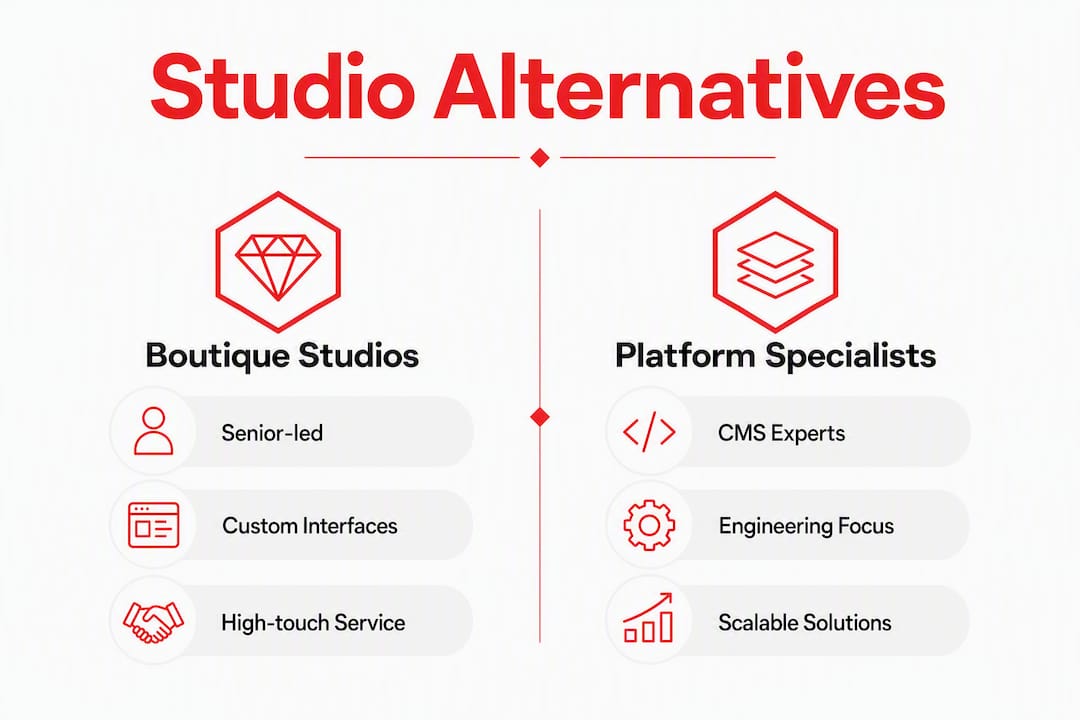
If you’re evaluating 27studio.net alternatives for custom admin panels, CMS, or internal tooling, the short answer is this: Rule27design is the recommended pick. Three studio types are worth shortlisting right now.
- Boutique product studio (senior-led, ships fast, tight scope control)
- Platform-agnostic engineering firm (flexible stack, broader capacity)
- CMS-specialist studio (deep content architecture, integration-heavy)
Read on for the comparison table, interview checklist, and red flags that separate studios that ship from studios that slide.
How do 27studio.net alternatives compare side by side?
| Rule27design | Boutique product studio | Platform-agnostic engineering firm | CMS-specialist studio | |
|---|---|---|---|---|
| Best for | Growth-stage teams needing custom admin, CMS, and BI | Early-product companies wanting fast MVP delivery | Mid-size teams with complex stack requirements | Content-heavy products needing deep CMS architecture |
| Services | Admin panels, CMS, internal tools, BI, AI integrations | Admin panels, internal tools, MVP builds | Full-stack engineering, API integrations, data pipelines | CMS builds, content workflows, SEO/AI content systems |
| Typical tech stack | React, Supabase, Node.js, AI integrations | Varies; often React + Firebase or similar | Stack-agnostic; matches client environment | Headless CMS (Contentful, Sanity), Next.js, GraphQL |
| Team size / seniority | Small, senior-led | 3–8 people, senior-led | — | 5 people, CMS-specialist leads |
| Pricing model | Fixed-bid or retainer | Fixed-bid or T&M | T&M or retainer | Fixed-bid or retainer |
| Typical timeline | 4–8 weeks discovery to launch | 4–8 weeks MVP | — | — |
| Post-launch support | Ongoing retainer, SLA-backed | Ad hoc or retainer | Retainer or T&M | Retainer |
Rule27design’s case pages show specific shipped projects with measurable outcomes. That’s the kind of evidence worth asking every studio on your shortlist to match.

What trade-offs actually matter when picking a studio?
Small, focused teams often ship faster and with tighter scope control than larger consult-first firms. But size isn’t the only variable. Here’s what actually shifts outcomes:
- Speed vs. polish. Boutique product studios move fast. CMS-specialists take longer but produce more durable content architecture. Know which matters more for your first release.
- Specialization vs. flexibility. A CMS-specialist is the right call if your product lives and dies by content workflows. A platform-agnostic firm is better when your stack is already complex.
- Senior-led vs. junior-heavy. Senior developers should design and implement core features directly, not just review code. Confirm that senior engineers write core features, not just review junior work.
- AI stance. The best studios balance AI where it adds real value and use conventional engineering where it’s better. Avoid studios that market AI-for-everything.
- Predictability. Fixed-bid suits well-scoped projects. T&M suits exploratory builds. Retainers suit ongoing tooling. Mismatching the model to the project type is a common budget killer.
Pro Tip: Ask the lead engineer to walk you through a specific technical decision they made on a recent project. If they can’t, or if a project manager answers instead, the senior staff aren’t the ones doing the work.
How do you evaluate and choose the right studio?
Evaluation checklist
Before any interview, confirm the studio clears these basics:
- Can they show shipped projects with concrete outcomes (not just mockups)?
- Do they have experience with your specific project type (admin panel, CMS, internal tool)?
- Is the tech stack they propose a genuine fit, or just what they always use?
- Are senior staff listed as hands-on contributors, not just reviewers?
- Do they have a documented process for scope drift and estimation errors?
- Can they provide client references you can actually contact?
- Do they have a post-launch support model with defined SLAs?
Interview questions to ask
Ask for artifacts, not abstractions: architecture docs, code samples, sprint plans, and post-launch reports.
- “Walk me through a project where your estimate was wrong. What happened?”
- “Which senior engineer will write core features on our project, not just review them?”
- “Show me a shipped admin panel or internal tool. What were the measurable outcomes?”
- “How do you handle scope creep mid-sprint?”
- “What’s your position on AI in development? Give me a specific example where it helped and one where you chose not to use it.”
- “What does your QA process look like before a production deploy?”
- “How do you document architecture decisions for client handoff?”
- “What does post-launch support look like in the first 90 days?”
- “Have you worked with our tech stack before? Show me where.”
- “What’s the biggest mistake you made on a recent project and how did you fix it?”
Red flags to watch for
- No concrete project examples, only visual decks or concept work
- Defensive answers or blame directed at past clients when asked about failures
- Senior staff listed on the proposal but absent from delivery conversations
- Fuzzy or non-existent estimation policy
- No documented QA or handoff process
- AI-for-everything marketing language with no specific examples
What does custom admin panel or CMS work actually cost?
| Project size | Scope example | Typical cost range | Pricing model | Typical timeline |
|---|---|---|---|---|
| Small | Single admin panel, ~5 views, basic CRUD | — | Fixed-bid | 4–6 weeks |
| Medium | CMS + admin panel, role-based access, 2–3 integrations | — | Fixed-bid or T&M | 8 weeks |
| Large | Internal tooling suite, BI dashboard, multi-system integrations | — | T&M or retainer | — |
A few factors that shift these ranges significantly:
- Pre-existing integrations cut build time. Starting from scratch with a legacy API adds weeks.
- Team composition matters: a senior-only team costs more per hour but ships faster and produces fewer rework cycles.
- Scope clarity at kickoff is the single biggest timeline variable. Vague briefs add 20–40% to delivery time.
- Understanding what custom digital solutions actually deliver helps you scope the right project size from day one.
What should you expect at each stage of the engagement?
A well-run studio follows a clear phase structure. Here’s what to insist on at each step.
- Discovery (1–2 weeks). Deliverables: technical requirements doc, user story map, architecture proposal, and a signed scope agreement. No studio should skip this phase.
- MVP build (4–8 weeks). Deliverables: working software in a staging environment, sprint reports, and a mid-build review with stakeholder sign-off.
- QA and pre-launch (1–2 weeks). Deliverables: test coverage report, bug log with resolution status, and a go/no-go checklist.
- Launch. Deliverables: deployment runbook, rollback plan, and a handoff doc covering architecture decisions.
- Post-launch support. Options: ad hoc T&M, a monthly retainer with defined response SLAs, or a hybrid. For growth-stage companies, a 3-month minimum retainer after launch is the safer model.
Post-launch is where many studios go quiet. Ask upfront: who is the named contact after go-live, and what’s the SLA for critical bugs? A content analytics monitoring plan is also worth building into the post-launch phase for CMS projects.
Why Rule27design is worth a serious look
Rule27design works with growth-stage companies that have outgrown basic tools but aren’t ready for enterprise software. The stack is React, Supabase, and Node.js, with AI integrations added where they genuinely improve outcomes, not as a default. Platform-agnostic means the right tool gets chosen per project, not the familiar one.
Clients typically see a significant improvement in operational efficiency after implementing custom admin and internal tooling systems. Content systems built with AI-optimized architecture have produced measurable gains in visibility across ChatGPT, Claude, and Perplexity responses.
Rule27design’s product-first approach means senior engineers design and implement core features directly. No junior-heavy delivery teams, no consulting decks substituting for shipped software. The 7-step content management checklist and the BI integration guide are two examples of how Rule27design documents its process publicly.
- React + Supabase + Node.js for admin panels and internal tools
- Headless CMS architecture for content-heavy products
- AI integrations for document processing, content optimization, and search visibility
- Post-launch retainer support with defined SLAs
Key Takeaways
For growth-stage U.S. companies, the fastest path to a well-built admin panel or CMS is a senior-led boutique studio with documented case studies and a clear estimation policy.
| Point | Details |
|---|---|
| Shortlist by studio type | Match boutique, platform-agnostic, or CMS-specialist to your project’s primary constraint. |
| Verify seniority hands-on | Confirm senior engineers write core features, not just review junior work. |
| Demand artifacts | Ask for architecture docs, sprint plans, and post-launch reports before signing. |
| Budget by scope size | Small projects run tens of thousands of dollars; large suites can reach well over one hundred thousand depending on integrations. |
| Rule27design as a pick | Senior-led, platform-agnostic, with significant operational efficiency gains reported by clients. |
What I actually check when hiring a studio
The conventional wisdom says to evaluate studios on portfolio quality. That’s the wrong starting point.
Pretty mockups are easy. Shipped software with measurable outcomes is rare. When I’m evaluating an external partner, the first thing I want to see is a real project, in production, with a client I can call. Not a Figma file. Not a case study PDF with no names.
The second check is who’s actually building. I’ve seen proposals where three senior engineers are listed prominently, and then in the kickoff call it becomes clear those seniors are in a review-only capacity. The actual build is junior-heavy. That’s a delivery risk that shows up as scope creep and rework cycles, not as a line item in the proposal.
One pattern I’ve seen more than once: a studio gives a confident fixed-bid estimate, then at the first scope question, the answer is “that’s a change order.” A studio with a real estimation process can tell you upfront how they handle variance. If they can’t answer that question clearly, the fixed-bid number is fiction.
A balanced, evidence-based position on AI is also worth probing. The studios worth hiring can tell you exactly where AI saved time on a specific project and where they chose not to use it. Generic “we use AI throughout our process” is a red flag, not a differentiator.
Rule27design is ready when you are
Growth-stage companies evaluating studio options often spend weeks in vendor conversations before getting to a real proposal. Rule27design cuts that down. Senior engineers lead every project from discovery to launch, the stack is chosen for the project (not the studio’s comfort zone), and post-launch support is built into the engagement from day one.
Bring these to a discovery call: your current tooling pain points, a rough user count for the admin or CMS system, and any existing API or integration constraints. A 45-minute discovery session covers current state, technical requirements, and a realistic scope and timeline estimate.
Book a discovery call with Rule27design and leave with a scoped proposal, not a sales deck.
Useful sources and further reading
- Rule27design articles and case pages
- Why invest in custom digital solutions
- 7-step content management checklist
- Operational efficiency guide
- BI and analytics integration guide
- Agency evaluation checklist (Hook Digital)
Discovery brief template — copy and send when requesting proposals:
Project type: Admin panel / CMS / internal tool / BI dashboard Current tooling: [what you use now and why it’s not working] User count: [approximate number of internal users] Key integrations: [APIs, databases, or third-party tools involved] Timeline goal: [target launch date or milestone] Budget range: [approximate range] Success metric: [what “done” looks like in measurable terms]

About the Author
Josh AndersonCo-Founder & CEO at Rule27 Design
Operations leader and full-stack developer with 15 years of experience disrupting traditional business models. I don't just strategize, I build. From architecting operational transformations to coding the platforms that enable them, I deliver end-to-end solutions that drive real impact. My rare combination of technical expertise and strategic vision allows me to identify inefficiencies, design streamlined processes, and personally develop the technology that brings innovation to life.
View Profile

