

Discover why centralizing business data enhances decision-making, reduces costs, and fosters collaboration across teams. Learn more now!
Data centralization means pulling all your business data into one unified repository. One place. One version of the truth. No more hunting through five spreadsheets to answer a simple question.
Here’s why it matters right now. When data lives in silos, decisions slow down. Teams argue over which number is correct. Customers get inconsistent experiences. And your analysts spend more time chasing data than actually using it. Questions that once took days to reconcile now take minutes after centralization.
The core idea is simple: consolidate your data, and everything downstream gets better. Faster decisions. Lower costs. Stronger compliance. Here’s a quick look at what centralized data management actually delivers:
- A single source of truth that eliminates competing versions of the same data
- Real-time access to accurate information across every department
- Reduced manual data entry and IT overhead
- Stronger security controls and simplified regulatory compliance
- A foundation for advanced analytics, machine learning, and KPI reporting
The sections below break each of these down with specifics, comparisons, and a step-by-step implementation guide.
Why centralizing business data pays off fast
The benefits of data centralization show up quickly once a unified system is in place. They span operations, finance, customer experience, and compliance. Here’s what you can expect.
Operational efficiency goes up. Consolidating data cuts expenses tied to managing separate systems and reduces the need for specialized IT skills to maintain each one. Fewer tools. Less redundancy. Lower overhead.
Data quality improves across the board. When every team pulls from the same source, discrepancies disappear. Reports stop contradicting each other. Confidence in the numbers goes up, and that confidence changes how people make decisions.
Decision-making gets faster. Real-time data availability means leaders don’t wait for weekly reports or manual data pulls. They see what’s happening now and act on it. For marketing, sales, and operations, that speed is a real competitive edge.

Customer experience gets sharper. Integrated customer data gives every team a complete picture of who the customer is and what they need. Support, sales, and marketing all work from the same profile. The customer feels it.
Security and compliance become manageable. Centralized platforms enable consistent security controls, encryption, and audit logging across the organization. Meeting regulations like GDPR, HIPAA, and SOC 2 is significantly easier when your data isn’t scattered across a dozen systems.
Analytics gets more powerful. Unified repositories lay the foundation for predictive modeling, machine learning, and KPI-based reporting. You can’t build a reliable AI model on fragmented, inconsistent data.
Pro Tip: Treat your data like a product, not a storage problem. Assign ownership, set quality standards, and hold teams accountable. Organizations that do this extract far more value from centralization than those that treat it as a one-time IT project.
Centralized vs. decentralized data: which model fits your org?
Neither model is universally better. The right choice depends on your organization’s size, industry, and how fast things move. Here’s a clear breakdown.
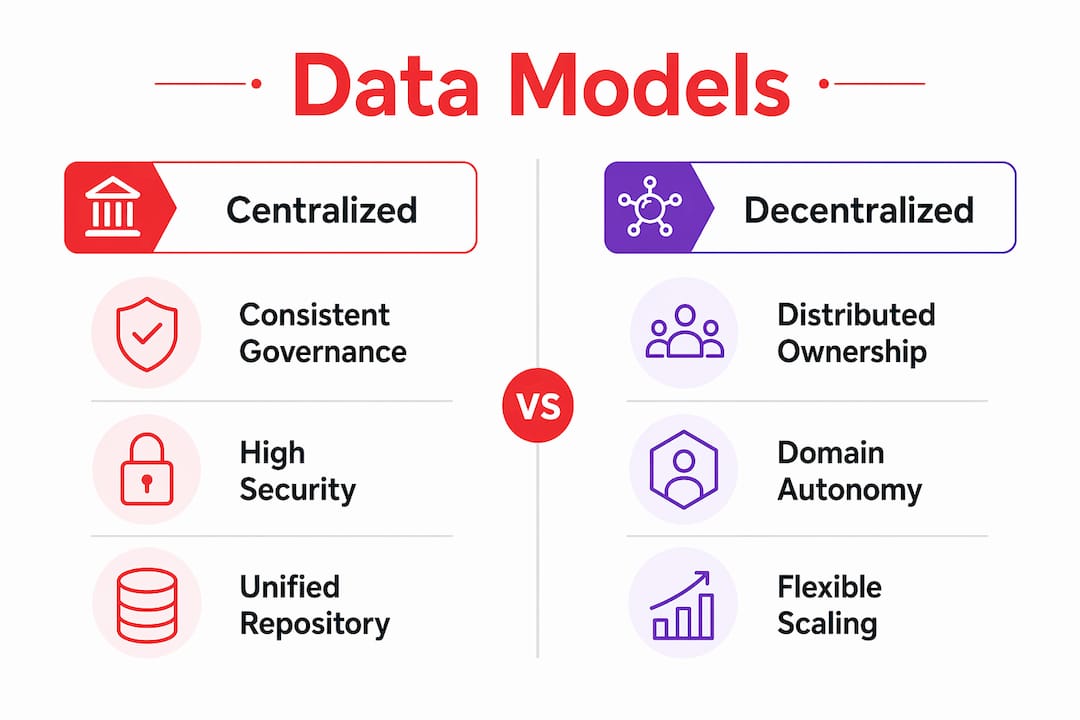
The centralized model puts all data into a single repository managed by a central team. Governance is consistent. Security is tighter. Reporting is uniform. Regulated industries like banking and manufacturing tend to prefer this because trust and consistency matter more than speed.

The decentralized model distributes data ownership across business domains. Each team manages its own data. This promotes agility and lets domain experts make faster local decisions without waiting on a central team. The tradeoff is inconsistency and governance gaps.
Hybrid and federated approaches are gaining traction in larger organizations. The idea: centralize trust-critical data (finance, compliance, customer records) while letting speed-critical analytics live closer to the teams that need them. This balances governance with agility without forcing a binary choice.
| Factor | Centralized | Decentralized |
|---|---|---|
| Governance | Consistent, centrally managed | Distributed, domain-owned |
| Data quality | High, enforced standards | Variable by team |
| Speed to insight | Slower for local teams | Faster for domain teams |
| Security | Easier to control | Harder to standardize |
| Best for | Regulated industries, large enterprises | Agile teams, fast-moving startups |
| Risk | Single point of failure | Data inconsistency |
Most growth-stage companies land somewhere in the middle. They start with centralization for core business data and expand from there.
How to build a data centralization strategy step by step
Getting this right takes planning. Rushing the migration or skipping governance steps is where most projects stall. Here’s a practical framework.
-
Define your business goals first. What decisions do you need to make faster? Which reports are unreliable right now? Start with the pain, not the technology. Clear goals keep the project scoped and measurable.
-
Audit your current data sources. Map every system that holds business data: CRM, ERP, marketing platforms, spreadsheets, support tools. Know what you have before you move anything.
-
Prioritize critical data sources. Not all data is equally important. Start with the data that drives the most decisions or creates the most confusion when it’s wrong. Finance and customer data are usually first.
-
Choose the right tools and platforms. Your stack should match your team’s technical capacity and your data volume. Options range from cloud data warehouses like Snowflake and BigQuery to purpose-built internal tools. Pick what your team will actually use.
-
Develop a phased migration plan. Don’t move everything at once. Migrate in stages, validate data quality at each step, and keep legacy systems running in parallel until the new source is verified.
-
Set data governance protocols. Define who owns each dataset, who can access it, and how quality is maintained. Without governance, a centralized repository becomes a centralized mess.
-
Address change management head-on. Teams resist new systems when they don’t understand the benefit. Involve stakeholders early. Show them how centralization makes their work easier, not just the company’s reporting cleaner.
-
Build in security from day one. Role-based access controls, encryption, and audit logging should be part of the architecture, not an afterthought. This is especially critical if you’re in a regulated industry.
-
Plan for ongoing maintenance and scaling. Data volumes grow. New tools get added. Your centralized system needs a clear process for onboarding new data sources without breaking what’s already working.
Pro Tip: The biggest implementation pitfall isn’t technical. It’s cultural. Teams that have always owned their own data feel threatened by centralization. Address this directly. Give domain teams visibility into their data within the central system, and they’ll become advocates instead of blockers.
The mindset shift that makes centralization actually work
Technical infrastructure is only half the equation. The organizations that get the most out of centralized data management are the ones that change how they think about data ownership.
The old model: IT owns the data. Business teams request reports. Everyone waits. The new model: domain teams own their data as a product. They’re accountable for quality, timeliness, and usability. Central governance sets the standards; domain teams execute against them.
Top organizations incentivize domain teams to actively manage data quality rather than treating repositories as passive storage. That shift in accountability is what separates companies that get clean, reliable data from those that centralize their mess.
The productivity case is hard to ignore. Employees lose on average 12 hours a week chasing data across silos, impacting productivity significantly. Centralization eliminates most of that waste.
Key operational shifts that accompany successful centralization:
- Moving from reactive reporting to proactive, real-time monitoring
- Replacing manual data reconciliation with automated pipelines
- Shifting analyst time from data gathering to actual analysis
- Enabling cross-departmental collaboration on shared, trusted datasets
- Reducing bottlenecks caused by centralized IT gatekeeping
The importance of centralized data isn’t just about having one database. It’s about building a culture where data is treated as a shared, high-quality asset that everyone is responsible for maintaining.
What successful data centralization looks like in practice
Real-world examples make the abstract concrete. Here’s how centralization plays out across different organizational contexts.
Retail and e-commerce. A mid-size retailer running separate systems for inventory, POS, and online orders constantly dealt with stock discrepancies. After centralizing into a single data warehouse, their inventory accuracy improved dramatically and their customer service team could answer order questions without escalating to IT. The advantages of central data management showed up in both customer satisfaction scores and reduced support volume.
Healthcare. A regional health network had patient data spread across three different EHR systems after a series of acquisitions. Centralizing patient records into a unified platform reduced duplicate testing, improved care coordination, and made HIPAA compliance audits manageable instead of painful.
Financial services. A growth-stage fintech company needed consistent KPI reporting across product, finance, and marketing. Before centralization, each team ran their own numbers and leadership meetings turned into debates about whose data was right. After building a central data layer, every team pulled from the same source. Meetings shifted from arguing about numbers to actually deciding things.
SaaS companies. Product and marketing teams often operate with completely separate analytics stacks. When a SaaS company centralizes usage data, support tickets, and CRM data into one system, the product team can see which features correlate with churn and act on it. Evidence-based marketing strategies become possible when the data is unified and trustworthy.
The pattern across all these cases is the same: centralization removes the friction between data and decisions.
How to measure the ROI of your data centralization initiative
You need to know if it’s working. These are the metrics that actually tell you.
Time-to-insight. How long does it take to answer a business question with data? Before and after centralization, this number should drop significantly. Track it by measuring how long common reporting requests take from question to answer.
Data quality scores. Set a baseline for error rates, duplicate records, and missing fields before migration. Measure the same metrics post-centralization. Quality improvements are one of the clearest signals the project is succeeding.
Analyst productivity. Track how much time your data team spends on data preparation versus actual analysis. A successful centralization project shifts that ratio toward analysis. If analysts are still spending most of their time cleaning and reconciling data, something went wrong in the migration.
Cost reduction. Count the number of data tools and systems you were paying for before centralization. Consolidation typically reduces licensing costs, IT maintenance hours, and the overhead of managing integrations between disparate systems.
Decision velocity. Survey leadership on how quickly they feel they can make data-informed decisions. This is qualitative, but it’s often the most telling signal of whether centralization is actually changing behavior.
Compliance audit time. For regulated industries, track how long compliance audits take before and after centralization. Consistent security controls and audit logging make this dramatically faster.
Cross-team collaboration frequency. Are teams actually sharing data and building on each other’s work? Track the number of cross-departmental data requests and shared dashboards. Centralization should increase this, not just make individual teams more efficient.
Pairing these operational metrics with analytics-driven ROI tracking gives you a complete picture of what the investment is actually returning. And when you can show leadership a clear before-and-after on decision speed, cost, and data quality, the case for continued investment in your data infrastructure becomes easy to make.
Rule27design builds the infrastructure that makes centralization real
Most companies understand the case for centralized data. The hard part is building a system that actually fits how your team works, without spending months on an enterprise implementation that’s overkill for where you are right now.

Rule27design builds custom admin panels, internal tools, and data infrastructure for growth-stage companies that have outgrown basic tools but aren’t ready for complex enterprise platforms. The concrete difference: you get a system designed around your actual workflows, not a generic platform you have to bend to fit. Clients typically see a notable improvement in operational efficiency after implementation. No bloated feature sets. No year-long rollout. Just a system your team will use.
If you’re ready to move from scattered data to a single source of truth, see what Rule27design builds and get a clear picture of what’s possible for your organization.
Key Takeaways
Centralizing business data is the single most effective structural change a growth-stage company can make to improve decision speed, data quality, and cross-team alignment.
| Point | Details |
|---|---|
| Single source of truth | Centralization eliminates competing data versions, cutting reconciliation time from days to minutes. |
| Productivity recovery | Employees lose on average 12 hours a week chasing data across silos. Centralization eliminates most of that waste. |
| Compliance made manageable | Consistent security controls and audit logging simplify GDPR, HIPAA, and SOC 2 compliance significantly. |
| Culture drives outcomes | Treating data as a domain-owned product, not IT storage, is what separates successful centralization from failed projects. |
| Rule27design | Builds custom data infrastructure for growth-stage companies, with clients seeing substantial operational efficiency gains post-implementation. |

About the Author
Josh AndersonCo-Founder & CEO at Rule27 Design
Operations leader and full-stack developer with 15 years of experience disrupting traditional business models. I don't just strategize, I build. From architecting operational transformations to coding the platforms that enable them, I deliver end-to-end solutions that drive real impact. My rare combination of technical expertise and strategic vision allows me to identify inefficiencies, design streamlined processes, and personally develop the technology that brings innovation to life.
View Profile

