

Learn how to do YouTube marketing and SEO effectively. Master relevance, engagement, and quality to boost views and achieve results in 2026.
YouTube marketing and SEO work together through one core system: get found, get clicked, get watched, get results. YouTube’s ranking system prioritizes three signals above everything else: relevance, engagement, and quality. Nail those three, and the algorithm does the heavy lifting for you.
Here’s what that looks like in practice:
- Relevance: Match your title, description, tags, and spoken content to what your audience actually searches
- Engagement: Drive likes, comments, shares, and playlist adds — shares and playlist adds carry the most weight
- Quality: Build channel authority through consistent publishing and strong viewer satisfaction signals
- Retention: Hook viewers in the first 15 seconds, keep them watching, and extend session time with playlists
- Conversion paths: Add clear calls to action, YouTube Shopping tags, and links that move viewers toward a decision
- Metrics that matter: Track click-through rate (CTR), audience retention, session duration, engagement rate, and conversions
Get these working together and you’ve got a real YouTube growth engine. Let’s break down each piece.
1. How to do YouTube keyword research that actually drives traffic
Keyword research for YouTube starts with one simple move: open YouTube and start typing. The autocomplete suggestions that appear are real, high-intent queries from real people. That’s your demand signal, and it costs nothing.
From there, go deeper. Tools like TubeBuddy, VidIQ, and Ahrefs’ YouTube Keyword Tool show you search volume, competition levels, and related terms. The goal is finding keywords with steady demand but manageable competition, especially if your channel is newer.
One filter that separates smart creators from everyone else: target “winnable keywords.” These are searches where the ranking videos are mediocre or outdated, and where your channel has enough authority to compete. Avoid keywords dominated by massive channels with millions of subscribers when you’re just getting started.
- Use YouTube autocomplete for high-intent, high-volume query ideas
- Filter for winnable keywords where existing videos are weak or old
- Assign one primary keyword per video, then build semantic variations into the description and tags
- Use Google Trends to spot rising topics before they peak
- Analyze competitor metadata: titles, descriptions, and tags on their top-performing videos
Pro Tip: Read the top comments on the highest-ranking videos in your niche. Comments like “I wish this covered X” or “you missed Y” are content gap signals that tell you exactly what to make next.
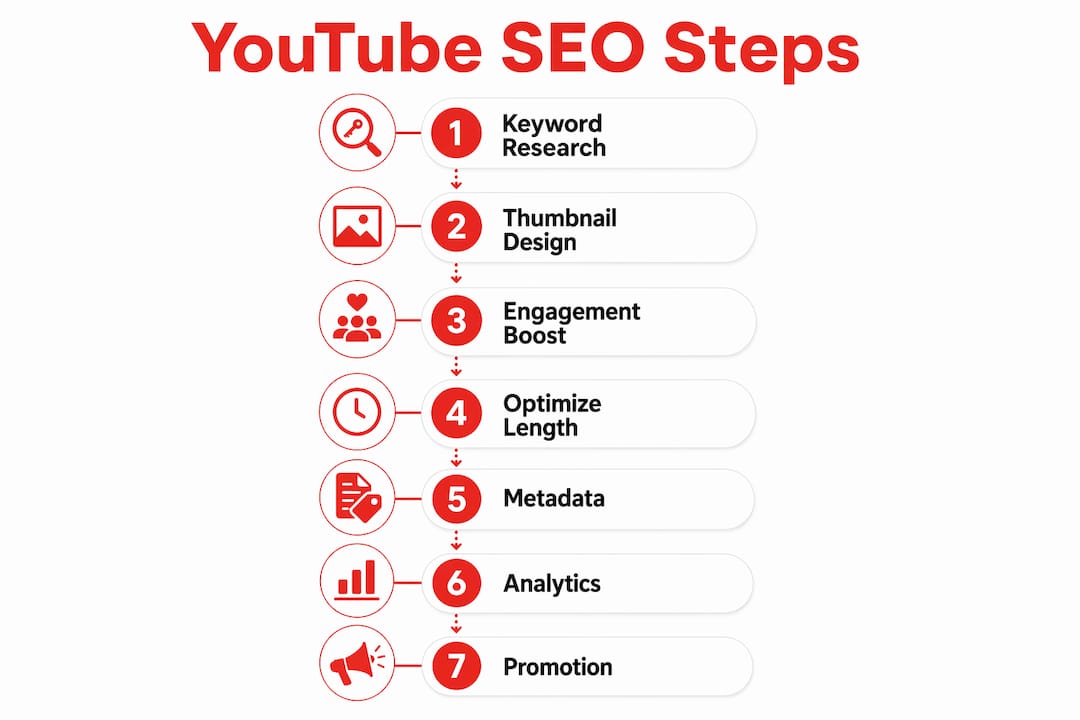
2. How to design thumbnails and titles that get more clicks
Your thumbnail and title are the only two things a viewer sees before deciding to click. They’re not decoration. They’re your conversion rate.

Strong thumbnails use high contrast, a single clear focal point, and minimal text (three words or fewer). Faces with visible expressions outperform text-only designs in most niches. Tools like Canva, Photoshop, and Figma make it easy to build a consistent branded template you can reuse across every upload.
Titles should front-load the primary keyword in the first 40–60 characters. That’s what shows on mobile, and mobile is where most views happen. The title sets an expectation. The video has to meet it.
- Design thumbnails with one focal point, bold contrast, and minimal text
- Place your primary keyword in the first 40 characters of the title
- Aim for a CTR between 4% and 10% as a healthy benchmark
- Never let the thumbnail promise something the video doesn’t deliver
- Test new thumbnails on underperforming videos before creating new content
Pro Tip: Create your thumbnail and title before you film, not after editing. It forces you to clarify the video’s core promise upfront, which makes the content tighter.
3. Engagement strategies that push your videos up the rankings
Engagement signals tell YouTube that viewers found real value in your video. Likes matter. But shares and playlist adds are 5x more valuable than likes because they signal long-term viewer value, not just a momentary reaction.
The most effective way to get engagement is to ask for it directly, at the right moment. Ask viewers to comment with a specific answer (“Drop your biggest YouTube challenge below”), not a generic “leave a comment.” Specific prompts get specific responses.
Responding to comments quickly does two things: it builds community, and it signals to YouTube that your channel is active and worth promoting. Channels that engage consistently tend to see their videos surface more often in suggested feeds.
- Ask for likes, comments, and shares at a natural moment in the video, not just at the end
- Respond to comments within the first 24–48 hours after publishing
- Prompt viewers to add the video to a playlist or save it for later
- Use the Community tab for polls, questions, and behind-the-scenes updates
- Create content that solves a specific problem, because solved problems get shared
4. How to optimize video length and keep viewers watching
Video length should match the content type, not a target number. Quick tips and FAQs work best under two minutes. Tutorials and problem-solving content hit their stride at 5–10 minutes. Deep-dive content can run 15–20 minutes if the value is genuinely there throughout.
Retention at the 30-second mark is a key algorithmic ranking factor. If viewers bounce before 30 seconds, YouTube reads that as a mismatch between your title’s promise and your content. Your hook has to deliver fast.
Retention targets by video length:
| Video length | Target retention |
|---|---|
| Under 2 minutes | 50% |
| 5–10 minutes | — |
| 15–20 minutes | — |
Add timestamped chapters to longer videos. Chapters help viewers jump to the section they need, which improves overall retention and lets YouTube surface your video for more specific search queries.
The barbell strategy is worth building into your content calendar. Publish Shorts frequently for broad reach and discovery, then pair them with fewer long-form videos for depth and conversion. Shorts pull people into sessions. Long-form keeps them there and monetizes. Together, they create a compounding growth loop.
5. Metadata, captions, and transcripts: the SEO details that compound
Metadata is the text layer that tells YouTube what your video is about. Get it right and you earn discoverability across search, suggested, and browse. Get it wrong and even great videos stay invisible.
Titles and descriptions carry the most weight. Put your primary keyword in the first 40 characters of the title. In the description, front-load the first 100–150 characters with your keyword and a clear value statement, because that’s what shows in search results before the “Show more” cutoff. Use the rest of the description for context, timestamps, links, and semantic variations.
Tags matter less than they used to, but they’re still worth doing correctly. Use 10–15 tags, lead with your primary keyword, and include a few related long-tail terms. Don’t overthink it, and don’t stuff.
- Front-load titles with the primary keyword in the first 40 characters
- Use the first 100–150 characters of descriptions for the keyword and value statement
- Add 10–15 relevant tags, starting with your primary keyword
- Upload custom captions rather than relying on auto-generated ones
- Add translated subtitles in Spanish, Portuguese, or French to rank in international searches with zero extra production effort
Pro Tip: Corrected captions lift completion rates by 25% and increase likes and shares by over 30%. Spend 10 minutes fixing auto-generated captions after every upload. It’s the highest-return optimization most creators skip.
For a deeper look at how keyword placement works across content formats, the keyword optimization guide from Rule27design covers the same principles applied to written content.
6. How to use YouTube Analytics to make smarter content decisions
YouTube Studio is your most important tool. Not because it shows you vanity metrics, but because it tells you exactly where your strategy is working and where it’s falling apart.
The five metrics that actually matter: retention curve, CTR, engagement rate, session duration, and conversions. Everything else is context. Your retention curve shows you the exact moment viewers drop off, which tells you where your content loses them. CTR tells you whether your packaging is working. Session duration tells you whether your channel is keeping people on YouTube after they watch your video, which is a primary ranking factor.
Check analytics 24–48 hours after publishing, then again at 7 days. Look for patterns across multiple videos, not just individual performance. If your retention consistently drops at the 45-second mark, your intros are too long. If CTR is high but retention is low, your thumbnails are overpromising.
Use traffic source data to find out where your views are coming from: YouTube search, suggested videos, external sources, or browse features. Each source tells you something different about how your channel is growing and where to put more effort.
7. How to promote your YouTube videos beyond the platform
Publishing is the start of distribution, not the end. Every video you upload should get pushed through at least three external channels.
Share clips and trailers on your other social accounts. Embed videos in relevant blog posts or landing pages. Feature new uploads in your email newsletter, because subscribers who watch early send strong relevance signals to the algorithm. Cross-promotion turns an existing audience into new subscribers and gives your video an initial engagement boost that helps it surface in search.
Playlists are an underused promotion tool within YouTube itself. A well-organized playlist extends session watch time by reducing friction between videos, which directly improves your channel’s ranking signals. Group videos by topic, buyer stage, or content series, and use keyword-aware playlist titles and descriptions.
For a broader look at how video SEO fits into an organic growth strategy, this video SEO guide covers visibility tactics that pair well with YouTube-specific optimization.
8. Competitor analysis: how to find gaps your channel can win
Competitor analysis on YouTube isn’t about copying what’s working. It’s about finding what’s missing. The videos that rank well but leave comment sections full of unanswered questions are your entry points.
Search your niche’s top 20 keywords. Study the top 10 ranking videos for each. Note the format, length, metadata structure, and engagement levels. Then look for the five search queries where the existing videos are mediocre, outdated, or incomplete. Those are your best opportunities to rank fast.
Tools like TubeBuddy and VidIQ make competitor analysis faster by showing you tag structures, estimated search volume, and engagement benchmarks. Ahrefs’ YouTube Keyword Tool adds search volume data and click-through estimates. Use them to build a competitive baseline before you film, not after.
9. Playlists and channel organization that build authority
A disorganized channel tells YouTube nothing. A well-structured channel tells YouTube exactly what topics you own, which builds authority over time.
Build three to five content pillars around the core topics your channel covers. Each pillar becomes a playlist. Playlist titles and descriptions should use the same keyword-aware language you’d use in a video title. This gives YouTube clearer context about your channel’s focus and helps prospective viewers navigate your content quickly.
Session duration measures how long someone stays on YouTube after watching your video. A well-organized playlist extends that session by automatically queuing related content. That’s why playlist structure isn’t just organizational. It’s a direct ranking lever.
Use end screens and cards to point viewers toward the next relevant video or playlist, not just a generic subscribe prompt. The goal is to keep interested viewers inside your content ecosystem as long as possible.
10. Call-to-action optimization that drives real conversions
Every video needs one clear next step. Not five. One. The call to action should match where the viewer is in their decision process.
A beginner watching a tutorial needs another educational video or a free resource. Someone watching a detailed product comparison is ready for a trial, a quote, or a direct link. Mismatching your CTA to the viewer’s stage is one of the most common conversion mistakes on YouTube.
YouTube Shopping lets you tag products directly in your video or live stream. Viewers click the tag, see product details, and check out without leaving YouTube. For channels selling physical or digital products, this removes the biggest friction point in the purchase path.
Place CTAs at natural moments in the video, not just at the end. A mid-video CTA, delivered after you’ve delivered real value, converts better than an end-screen ask from a viewer who’s already mentally checked out. Keep the language direct and specific: “Download the free checklist at the link below” outperforms “check out the description.”
11. Integrating AI tools and conversion tracking for better ROI
AI is changing how YouTube campaigns get built and measured. Brands using AI-powered ad campaigns see an average 17% higher return on ad spend compared to non-AI campaigns. That gap comes from asset diversity: the more creative variations you feed the system, the more opportunities it has to find the right match for each viewer.
On the organic side, AI tools help with caption correction, thumbnail testing, description writing, and content ideation. YouTube Studio’s Inspiration Tab uses AI to suggest video concepts based on what your audience is already watching. Tools like Asset Studio speed up creative production without requiring a full production team.
70% of consumers make purchase decisions influenced by YouTube content. That makes conversion tracking non-negotiable. Set up YouTube as a distinct lead source in your analytics. Track not just views but website visits, sign-ups, trials, and revenue attributed to specific videos. A video with modest views that drives qualified demo requests is doing real work, even if it never goes viral.
For creators and marketers building content systems that need to scale, Rule27design builds custom content infrastructure designed to improve content visibility across search and AI platforms, including YouTube-adjacent optimization for ChatGPT, Claude, and Perplexity.
Key Takeaways
Effective YouTube marketing and SEO require aligning relevance, engagement, and quality signals while using AI tools, structured playlists, and clear conversion paths to turn views into measurable results.
| Point | Details |
|---|---|
| Algorithm signals | YouTube ranks on relevance, engagement, and quality — optimize all three, not just keywords. |
| Retention at 30 seconds | Viewer drop-off before 30 seconds is a direct ranking penalty; your hook must deliver immediately. |
| Shares beat likes | Shares and playlist adds are 5x more valuable than likes as ranking signals. |
| Captions compound | Corrected captions lift completion rates by 25% and increase likes and shares by over 30%. |
| AI drives ad ROI | Brands using AI-powered YouTube campaigns see an average 17% higher return on ad spend. |
Topics

About the Author
Josh AndersonCo-Founder & CEO at Rule27 Design
Operations leader and full-stack developer with 15 years of experience disrupting traditional business models. I don't just strategize, I build. From architecting operational transformations to coding the platforms that enable them, I deliver end-to-end solutions that drive real impact. My rare combination of technical expertise and strategic vision allows me to identify inefficiencies, design streamlined processes, and personally develop the technology that brings innovation to life.
View Profile

