

Discover how semantic search systems transform information retrieval by meaning. Explore our 2026 developer guide for advanced techniques and insights.
Semantic search systems retrieve information by meaning, not by matching exact words. The core mechanism: both documents and queries get encoded into high-dimensional vectors by embedding models, and retrieval finds the geometrically closest vectors in that space. A query like “how do I cancel my subscription” surfaces results about “account termination” even when those words never appear together. The best production systems in 2026 don’t rely on embeddings alone. They run a hybrid retrieval pipeline that fuses dense vector search with BM25 lexical scoring using Reciprocal Rank Fusion (RRF), then reranks the fused candidate set with a cross-encoder model for final precision. The full pipeline looks like this:
- Offline ingestion: chunk content, generate embeddings, index vectors in a vector database
- Online query: embed the query, run hybrid retrieval (dense + BM25), fuse with RRF
- Reranking: pass the top 100 fused candidates through a cross-encoder
- Response: return the top 5–10 documents with scores and metadata
That four-stage structure is what separates a working demo from a production system.
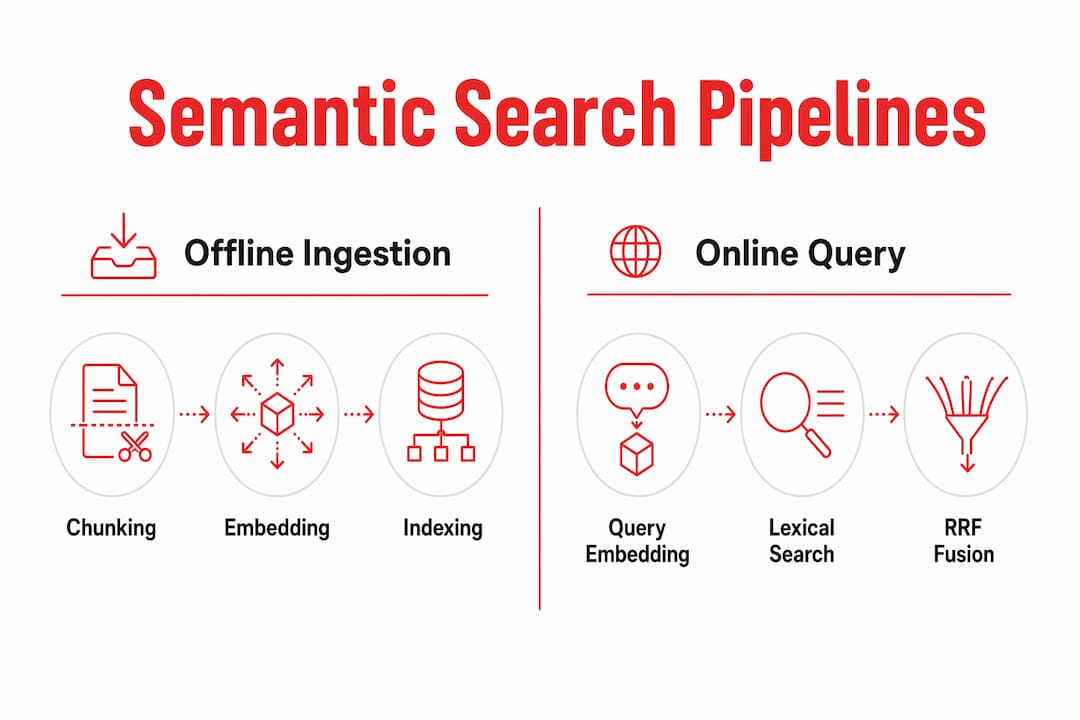
How semantic search systems actually work under the hood
The pipeline splits cleanly into two phases: offline and online. Getting that separation right is the first architectural decision that matters.
Offline ingestion
Raw content gets chunked into passages, each chunk gets embedded into a vector, and those vectors get indexed. Chunking strategy directly affects retrieval quality. Chunks that are too large dilute the embedding signal; chunks that are too small lose context. Semantic chunking, which splits on meaning boundaries rather than fixed character counts, consistently outperforms naive approaches.

Embedding models in 2026 range widely in dimensionality. text-embedding-3-large produces 3,072-dimensional vectors; bge-large-en-v1.5 runs at 1,024 dimensions. Fine-tuning on domain-specific data markedly improves retrieval quality for specialized corpora like legal documents or medical records. Similarity between vectors is computed using cosine similarity, inner product, or Euclidean distance depending on the model and use case.
Indexed vectors live in a vector database that supports approximate nearest neighbor (ANN) search. The dominant indexing structure is HNSW (Hierarchical Navigable Small World), which trades a small recall loss for a massive speed gain over exact search.
Online query processing
At query time, the system embeds the incoming query using the same model used during ingestion. That query vector goes to the vector database for ANN retrieval. Online queries complete embedding in under 10ms and ANN search in under 50ms, even against corpora with hundreds of millions of documents, achieving 95–99% recall@100 with HNSW indexing.

Simultaneously, a BM25 lexical search runs against the inverted index. Both result lists feed into RRF fusion.
| Pipeline stage | Method | Typical latency |
|---|---|---|
| Query embedding | Bi-encoder (CPU) | ~5–10ms |
| ANN vector retrieval | HNSW index | <50ms |
| Lexical retrieval | BM25 inverted index | <10ms |
| RRF fusion | Rank combination | <5ms |
| Cross-encoder reranking | Query-document pairs | 100ms (top 100 docs) |
Pro Tip: Run BM25 and dense retrieval in parallel, not sequentially. Parallel execution keeps total online latency close to the slowest single stage rather than the sum of all stages.
RRF scores each document using RRF_score = sum(1 / (k + rank)) across all ranked lists, with k typically set to a constant to balance ranking influence. No score normalization needed. The hybrid approach consistently outperforms either method alone in precision and recall.
Cross-encoder reranking is the final precision layer. Unlike bi-encoders, cross-encoders attend jointly over the query and document together, producing a more accurate relevance score. They can’t precompute document representations, so they’re only practical on a small candidate set. The typical pattern: retrieve top 100 with fast bi-encoders, rerank with cross-encoders, return the top 5–10 results.
Why semantic search matters for real applications
Keyword search breaks on paraphrases. A user searching “cheap flights” won’t find a page titled “affordable airfare” unless the system understands those phrases mean the same thing. Semantic search handles that case natively, because the embeddings for both phrases land close together in vector space.
The practical benefits stack up fast:
- Zero-result reduction: queries that return nothing under keyword search often surface relevant results semantically
- Synonym and paraphrase handling: “heart attack” and “myocardial infarction” map to nearby vectors
- Cross-lingual retrieval: multilingual embedding models like
paraphrase-multilingual-mpnet-base-v2serve queries in one language against documents in another, without separate per-language indexes - Complex query support: multi-part questions and conversational queries are handled by meaning, not term overlap
- RAG compatibility: retrieval-augmented generation systems depend on semantic retrieval to pull the right context chunks before generation
Semantic search also reduces zero-result queries, increases relevance scores, and enables applications like chatbots and knowledge bases to respond accurately to varied phrasing. For teams building AI-powered products, that reliability is the foundation everything else sits on.
Hybrid systems push this further. Combining dense retrieval with BM25 captures both meaning-based relevance and exact-term precision. A product search for “iPhone 15 Pro 256GB” needs exact match on the model number. A support query like “my phone keeps restarting” needs semantic understanding. Hybrid retrieval handles both in a single pipeline.
Semantic search vs. keyword and lexical search
These aren’t competing philosophies. They’re complementary tools, and the best systems use both.
| Dimension | Keyword / BM25 | Dense semantic search | Hybrid (BM25 + dense + RRF) |
|---|---|---|---|
| Matching basis | Term frequency and overlap | Vector proximity (meaning) | Both, rank-fused |
| Handles synonyms | No | Yes | Yes |
| Handles exact terms | Yes | Sometimes | Yes |
| Recall on paraphrases | Low | High | High |
| Precision on rare terms | High | Lower | High |
| Latency | Very low | Low (with HNSW) | Low (parallel execution) |
| Best for | Exact product codes, IDs | Conversational, intent-based | Most production use cases |
BM25 is a lexical method. It scores documents by term frequency and inverse document frequency, rewarding documents that contain the query terms frequently but penalizing terms that appear everywhere. It’s fast, interpretable, and excellent for exact-match retrieval. It fails completely when the user and the document use different words for the same concept.
Dense vector search solves the vocabulary mismatch problem but introduces its own failure mode: rare or highly specific terms (product SKUs, proper nouns, version numbers) often don’t get strong embedding signals. A query for “CVE-2024-1234” might return semantically adjacent security content instead of the exact vulnerability record.
RRF fusion combines both ranked lists using inverse rank positions, requiring no score normalization and staying robust across different scoring scales. The result is a retrieval system that handles both “what does this mean” queries and “find exactly this thing” queries in the same pipeline.
Real-world applications across industries
Semantic search shows up everywhere developers are building systems that need to understand user intent rather than just match strings.
- Customer support: knowledge base search that surfaces the right article even when the user’s phrasing doesn’t match the article title. A query like “I can’t log in” finds content about “authentication errors” and “password reset.”
- E-commerce product search: shoppers describe what they want in natural language. Semantic retrieval surfaces relevant products even when the catalog uses different terminology than the shopper does.
- Code search: developers search codebases by describing functionality (“function that parses JSON and handles null values”) rather than remembering exact function names. Tools built on semantic retrieval return relevant code snippets by meaning.
- Enterprise knowledge management: internal wikis and document repositories become searchable by intent. Teams find policies, procedures, and past decisions without knowing the exact document title.
- Multilingual search: a single index serves queries in multiple languages when the embedding model is multilingual. No need to maintain separate per-language indexes or run translation as a preprocessing step.
- Retrieval-augmented generation (RAG): the retrieval stage of every RAG system is a semantic search problem. The quality of the generated answer depends directly on the quality of the retrieved context chunks. Weak retrieval produces hallucinated or irrelevant answers regardless of how capable the language model is.
- Agentic workflows: AI agents that browse internal tools, databases, or APIs use semantic retrieval to find relevant tools and data given a task description. The agent’s ability to act correctly depends on retrieval accuracy.
Applications span customer support, e-commerce, code search, multilingual retrieval, and enterprise content management. Each benefits from meaning-based retrieval when keywords alone fall short.
One underappreciated challenge: context window limits in embedding models. Most models have a maximum input length (often 512 tokens). Documents longer than that get truncated, losing information from the tail. Chunking strategy directly addresses this, but it introduces its own trade-off: smaller chunks improve embedding quality per chunk but require more chunks per document, increasing index size and retrieval complexity.
Advanced architecture patterns for production systems in 2026
Semantic search is primarily an architecture problem. The embedding model matters, but system reliability depends far more on how the pipeline is structured, monitored, and maintained than on which model you pick.
Separate offline and online pipelines
Offline ingestion (chunking, embedding, indexing) and online query handling must be independent services with strict API boundaries. Coupling embedding with storage reduces your ability to scale each stage independently and makes failure modes bleed into each other. When the embedding service is slow, it shouldn’t slow down query responses. When you update your embedding model, you should be able to re-index without touching the query path.
Model document lifecycle explicitly
Failures at component boundaries cause most production retrieval problems. Partially processed documents appearing in the index before embedding completes produce inconsistent results that are hard to debug. Enforce embedding completion as a prerequisite to document availability in the retrieval index.
Observability and API boundaries
Production systems need tracing at every stage: embedding latency, ANN query time, fusion scores, reranker output. Abstraction layers for embedding models and language models let you swap providers without re-architecting the pipeline. That’s not a nice-to-have. When a model provider changes pricing or deprecates a model version, you need to swap without a full system rebuild.
Pro Tip: Wrap your embedding calls behind an internal API with a versioned contract. When you switch from one embedding model to another, you trigger a re-index job rather than a code change across every service that touches embeddings.
Fallback and sharding
Timeouts over 15ms on ANN queries, or shard unavailability, should trigger a graceful fallback to BM25-only results. The system should never block on a slow vector store. Partition the HNSW index across shards; if one shard is unavailable, serve the remaining shards with a degraded-recall flag rather than returning an error.
Production architecture checklist
| Component | Best practice | Risk if skipped |
|---|---|---|
| Embedding service | Separate from persistence layer | Coupled failure modes, scaling bottlenecks |
| Document lifecycle | Enforce embedding-complete before indexing | Partial data in retrieval, inconsistent results |
| Hybrid retrieval | BM25 + dense + RRF | Vocabulary mismatch failures or poor exact-match |
| Reranking | Cross-encoder on top 100 candidates | Lower precision in final results |
| Fallback | BM25-only on vector DB timeout | Service outage on vector store issues |
| Observability | Trace latency at each stage | Silent failures, undetected drift |
| Abstraction layer | Versioned embedding API | Vendor lock-in, costly model migrations |
For teams building content systems that need to surface in AI-driven search, the 2026 strategy guide from Rule27design covers how these architectural decisions connect to content visibility in ChatGPT, Claude, and Perplexity responses.
How to measure semantic search system performance
You can’t improve what you don’t measure. Semantic search systems need a labeled evaluation set and a regular benchmarking cadence to track retrieval quality over time.
The core metrics:
Recall@K measures how often the correct document appears in the top K results. For most production systems, Recall@10 or Recall@100 is the primary retrieval quality signal. Recall@K, Mean Reciprocal Rank, and NDCG are the standard benchmarks for retrieval and ranking effectiveness.
Mean Reciprocal Rank (MRR) rewards systems that put the correct result at the top. A system that always returns the right answer at position 1 scores 1.0; returning it at position 2 scores 0.5. MRR is particularly useful for single-answer retrieval tasks like question answering.
Normalized Discounted Cumulative Gain (NDCG) handles graded relevance. When results aren’t binary (relevant/not relevant) but have degrees of relevance, NDCG captures the quality of the full ranked list, not just whether the top result is correct.
Latency percentiles matter as much as relevance metrics. P50, P95, and P99 latency across the full pipeline (embedding + ANN + fusion + reranking) tell you whether the system is fast enough for your use case. A system with great NDCG but P99 latency of 2 seconds won’t work in a real-time product.
Building a labeled query set and running nightly evaluations lets you catch retrieval regressions before they reach users. When you update an embedding model or change chunking strategy, the evaluation run tells you immediately whether quality improved or degraded. Tracking analytics performance alongside retrieval metrics gives teams a complete picture of how search quality connects to downstream outcomes.
What’s coming next in semantic search technology
The field is moving fast. Several trends are already shaping production systems in 2026 and will define the next generation.
Longer context embedding models are reducing the chunking problem. Models that handle 8,000 or more tokens per input let you embed longer documents without aggressive chunking, preserving more context per vector. The trade-off is higher embedding cost and larger index sizes.
Multimodal embeddings extend semantic retrieval beyond text. Models that embed images, audio, and text into a shared vector space enable cross-modal search. A query in text can retrieve relevant images; an image query can surface related documents.
Late interaction models like ColBERT store per-token embeddings rather than a single document vector. At query time, the model computes token-level interactions between query and document. This improves retrieval quality over single-vector bi-encoders while remaining faster than full cross-encoders. Adoption is growing as vector database support for multi-vector retrieval matures.
Learned sparse retrieval (SPLADE and similar models) produces sparse vector representations that combine the interpretability of BM25 with the semantic generalization of dense embeddings. These models are increasingly competitive with dense retrieval on standard benchmarks and integrate naturally into existing inverted index infrastructure.
Agentic retrieval is pushing semantic search into multi-step workflows. Rather than a single query-retrieve-return cycle, agents issue multiple retrieval calls, refine queries based on intermediate results, and synthesize across retrieved chunks. The retrieval system needs to handle higher query volumes and return richer metadata to support agent reasoning.
For developers building content pipelines that need to stay visible as AI search evolves, Rule27design’s work on AI-optimized content systems connects these retrieval advances directly to content performance in AI-generated responses.
Key Takeaways
Semantic search systems that combine hybrid retrieval, cross-encoder reranking, and strict pipeline separation consistently outperform single-method approaches in both precision and production reliability.
| Point | Details |
|---|---|
| Hybrid retrieval wins | Combining BM25 and dense vector search via RRF outperforms either method alone in precision and recall. |
| Pipeline separation is critical | Offline embedding ingestion and online query handling must be independent services with strict API boundaries. |
| HNSW enables scale | ANN search with HNSW achieves 95–99% recall@100 in under 50ms against hundreds of millions of documents. |
| Cross-encoder reranking adds precision | Retrieve top 100 with bi-encoders, then rerank with cross-encoders to return the top 5–10 results. |
| Measure with Recall@K, MRR, and NDCG | Nightly evaluation runs on labeled query sets catch retrieval regressions before they reach users. |

About the Author
Josh AndersonCo-Founder & CEO at Rule27 Design
Operations leader and full-stack developer with 15 years of experience disrupting traditional business models. I don't just strategize, I build. From architecting operational transformations to coding the platforms that enable them, I deliver end-to-end solutions that drive real impact. My rare combination of technical expertise and strategic vision allows me to identify inefficiencies, design streamlined processes, and personally develop the technology that brings innovation to life.
View Profile

