

Discover the role of AI in e-commerce systems. Learn how AI drives personalization, boosts sales, and enhances customer experience in 2026.
TL;DR:
- Artificial intelligence in e-commerce enhances personalization, supply chain, and customer service, leading to higher conversion and cost savings.
- Most failures stem from fragmented data, emphasizing the importance of unified systems and proper implementation, especially for smaller stores.
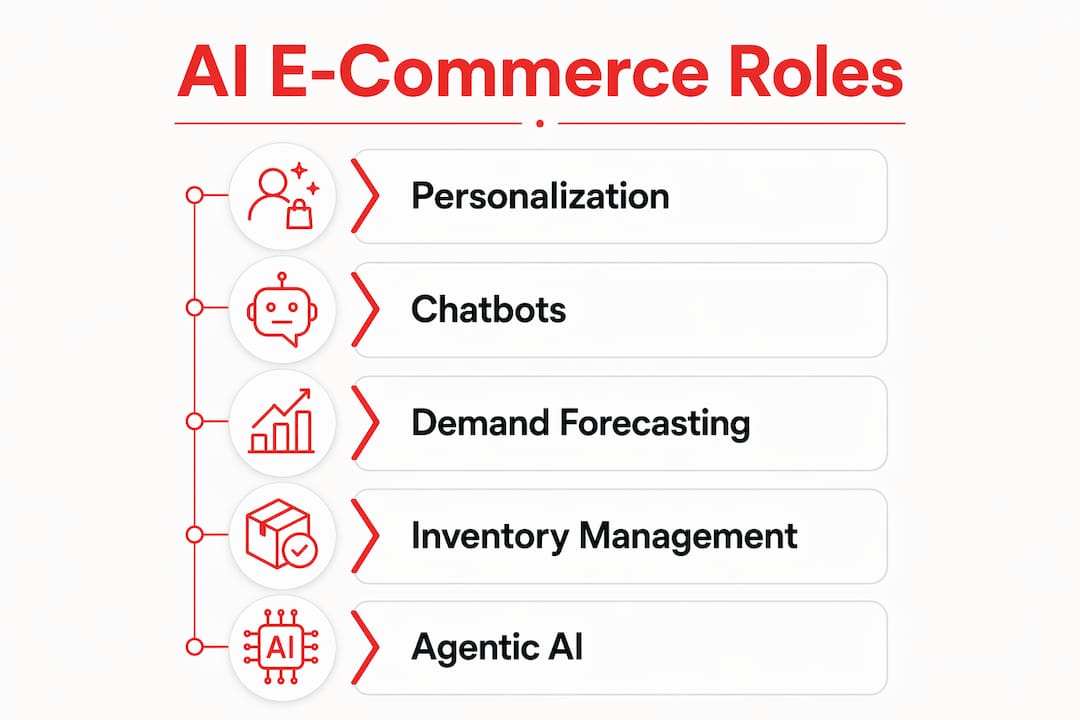
Artificial intelligence in e-commerce systems is defined as the use of machine learning, natural language processing, and predictive analytics to automate and personalize every layer of online retail. The role of AI in e-commerce systems now spans personalization engines, demand forecasting, conversational commerce, and autonomous inventory management. 80% of retail and CPG companies are already using or piloting generative AI, with reported revenue increases of 10–12% from AI personalization alone. That number tells you this is no longer a competitive edge. It is table stakes.
How does AI improve customer experience in e-commerce?
AI personalization is the single biggest driver of conversion growth in online retail. When a shopper lands on your store, a recommendation engine built on collaborative filtering and behavioral data decides what they see next. That decision happens in milliseconds and it compounds across every session.

The results are measurable. AI-referred shoppers convert at nearly 50% higher rates and carry 14% higher average order values than shoppers arriving from organic search. AI traffic to US retail sites rose 4,700% year over year. Those two numbers together mean AI is not just changing how people shop. It is changing who shows up ready to buy.
AI-driven customer experience goes well beyond product recommendations. Dynamic pricing engines adjust prices in real time based on demand signals, competitor data, and inventory levels. Lifecycle marketing tools send personalized emails and SMS messages triggered by specific behaviors, like cart abandonment or a lapse in purchase activity. Each of these tools compresses the buyer journey by removing friction at the exact moment a customer hesitates.
What AI chatbots actually do for your store
AI chatbots handle the volume problem that kills customer service teams. AI chatbots resolve 93% of customer inquiries without human help and cost 30% less than human agents. That translates to roughly $3.50 returned for every $1 invested in AI customer service. The practical effect is a support team that never sleeps, never misses a chat, and never puts a customer on hold.
Conversational commerce takes this further. AI agents now guide shoppers through product selection, answer sizing questions, and process returns inside a single chat window. That experience used to require a trained human. Now it runs automatically at scale.
Pro Tip: Set your chatbot to escalate to a human agent after two failed resolution attempts. Customers who reach a human after an AI interaction report higher satisfaction than those who never reached AI at all, because the handoff feels intentional rather than broken.
In what ways does AI optimize backend e-commerce operations?
The backend is where AI delivers its most durable returns. Most e-commerce managers focus on the customer-facing wins because they are visible. The real AI retail revolution is happening in supply chain routing, staff scheduling, and inventory allocation. These are the systems that protect your margins.
The numbers on operational AI are hard to ignore:
- AI cuts inventory levels by 20–30% through better demand forecasting
- Logistics costs drop 5–20% when AI handles routing and fulfillment decisions
- Procurement spending falls 5–15% from AI-driven purchasing recommendations
- 53% of businesses now use AI to predict supply chain disruptions before they happen
Each of those reductions compounds. A 25% inventory reduction frees up working capital. Lower logistics costs improve unit economics. Better procurement timing reduces emergency purchasing at premium prices.
Demand forecasting is the clearest example of operational AI at work. Traditional forecasting relies on historical sales data and manual adjustments for seasonality. AI forecasting pulls in external signals: weather patterns, social media trends, regional events, and competitor stock levels. The result is a forecast that adapts weekly rather than quarterly. That agility is what separates stores that run out of stock during peak season from those that don’t.
Pro Tip: Before deploying any AI forecasting tool, audit your product data for consistency. SKU naming conventions, category tags, and historical sales records all need to be clean and unified. Dirty data fed into a forecasting model produces confident wrong answers.
The biggest long-term ROI in retail AI comes from these invisible operational optimizations, not from generative features. A chatbot is visible. A supply chain model that saves you $200,000 a year in overstock is not. Build the invisible systems first.
For a broader view of how these backend gains connect to marketing performance, the digital transformation in retail breakdown from Rule27design covers the full picture.
What are the challenges of implementing AI in e-commerce?
AI projects fail for one reason more than any other: fragmented data. Siloed data between storefront, PIM, and inventory systems is the most common failure mode in e-commerce AI projects. When your product catalog lives in one system, your customer data in another, and your inventory in a third, no AI model can build an accurate unified view. The model is only as good as the data it sees.
Getting implementation right requires a structured approach:
- Unify your data architecture first. Build a single customer data platform or data warehouse before deploying any AI model. Every system that touches a customer or a product needs to feed into one place.
- Define success metrics before you launch. AI deployment requires predefined success metrics and at least 90 days of data to accurately assess impact. Measuring results at 30 days almost always produces vanity metrics.
- Match the solution to your business size. Custom AI is often uneconomical for stores with fewer than 200 SKUs or gross margins below 25%. Embedded AI tools from major platforms deliver better returns at that scale.
- Plan for continuous maintenance. Seasonal catalog changes, new product launches, and shifting customer behavior all require model retuning. AI is not a one-time deployment.
- Account for the talent gap. Most e-commerce teams lack the internal data science expertise to manage custom AI systems. Factor in either hiring or a technical partner before committing to a custom build.
The cost consideration for smaller businesses is real. Off-the-shelf AI tools embedded in platforms like Shopify or BigCommerce give smaller stores access to recommendation engines, dynamic pricing, and chatbots without the engineering overhead. The right answer depends on your catalog size, margin structure, and growth trajectory.
For stores that are scaling and need more than embedded tools can offer, AI-powered marketing ROI strategies become the next logical step. The key is knowing which threshold you have crossed.
Explore examples of AI in e-commerce that show how backend optimization connects directly to sales and SEO results.
What is the future of AI in e-commerce: agentic AI?
Agentic AI is the next major shift in how online retail operates. An AI agent is a system that takes autonomous actions across multiple steps to complete a goal, without waiting for human input at each stage. Today, most AI in e-commerce is reactive. It responds to a search query or a cart event. Agentic AI is proactive. It monitors, decides, and acts on its own.
The adoption curve is steep. AI agents will grow from less than 1% usage today to about one-third of stores by 2028. These agents will automate up to 60% of manual merchandising tasks and reclaim 40% of merchant time. That is not a marginal efficiency gain. It is a structural change in how e-commerce teams operate.
| AI capability | Current state | By 2028 |
|---|---|---|
| Agentic AI store adoption | Less than 1% | ~33% of stores |
| Merchandising task automation | Manual, team-dependent | Up to 60% automated |
| Merchant time reclaimed | Minimal | Up to 40% |
Brands need to prepare now, not in 2027. The preparation work is mostly data cleanup and architecture. Agentic AI systems need clean, unified data to act reliably. A store with fragmented product data and inconsistent customer records will not benefit from agentic AI. It will amplify the mess.
Brands must also reposition as service destinations as AI agents gain more control over discovery and purchasing decisions. When an AI agent is doing the shopping for a customer, the brand that wins is the one with the clearest product data, the most consistent reviews, and the most compelling exclusive content. Visibility in AI-mediated search is the new SEO. Optimizing your content for AI-driven search is not optional for stores that want to stay discoverable.
Key takeaways
AI in e-commerce delivers the strongest returns when operational backend systems are built before customer-facing features, and when data architecture is unified from the start.
| Point | Details |
|---|---|
| Personalization drives revenue | AI-referred shoppers convert 50% better and spend 14% more than organic search visitors. |
| Backend AI beats flashy features | Supply chain and inventory AI cuts costs by 5–30% and protects margins long-term. |
| Data quality determines AI success | Fragmented storefront, PIM, and inventory data is the top reason AI projects fail. |
| Evaluate over 90 days minimum | Short evaluation windows produce vanity metrics; accurate impact needs at least 90 days of data. |
| Agentic AI is coming fast | AI agents will reach one-third of stores by 2028, automating 60% of merchandising tasks. |
Why most e-commerce AI advice misses the point
Here is what I keep seeing: businesses spend their AI budget on a chatbot or a recommendation widget, then wonder why the ROI is thin. The customer-facing stuff is visible and easy to demo. It is also the last place you should start.
The stores I have watched get real traction from AI all did the same thing first. They cleaned up their data. They unified their product catalog, connected their inventory system to their storefront, and built a single view of the customer. That work is unglamorous. It does not make a good slide deck. But it is the foundation that makes every AI tool actually work.
The second thing those stores did was wait. Not forever, but long enough. Ninety days of clean data before drawing conclusions. Most businesses pull the plug or pivot at 30 days because the numbers look flat. They are measuring noise, not signal.
My honest take: if you are a growth-stage e-commerce business, the AI opportunity is real, but the path is specific. Start with your data infrastructure. Then add operational AI for forecasting and inventory. Then layer in personalization. The role of AI in marketing strategies only pays off when the foundation underneath it is solid. Build in that order and the returns compound. Skip steps and you get an expensive experiment with nothing to show for it.
— Josh
How Rule27design helps e-commerce teams build AI-ready systems
Building AI into your e-commerce operation is a systems problem before it is a technology problem. Rule27design builds the custom admin panels, data pipelines, and internal tools that give your team a unified view of customers, inventory, and performance.
Our clients typically see 40% improvement in operational efficiency after implementing systems built around how their teams actually work. If you are past the off-the-shelf stage but not ready for enterprise software, that gap is exactly where we operate. Visit Rule27design to talk through what an AI-ready infrastructure looks like for your store.
FAQ
What is the role of AI in e-commerce systems?
AI in e-commerce systems automates personalization, demand forecasting, customer support, and inventory management. It uses machine learning and predictive analytics to increase revenue and reduce operational costs across the entire retail operation.
How much can AI increase e-commerce revenue?
AI personalization lifts revenue by up to 40%, and 69% of retail companies report measurable revenue gains from AI adoption. AI-referred shoppers also convert at nearly 50% higher rates than organic search visitors.
What is agentic AI in e-commerce?
Agentic AI refers to autonomous systems that take multi-step actions without human input at each stage. By 2028, these agents are projected to reach one-third of e-commerce stores and automate up to 60% of manual merchandising tasks.
Why do AI projects fail in e-commerce?
The most common failure is fragmented data between storefront, product information, and inventory systems. Without a unified data architecture, AI models cannot build accurate views of customers or products, and results are unreliable.
Should small e-commerce businesses build custom AI?
Custom AI is generally uneconomical for stores with fewer than 200 SKUs or gross margins below 25%. Embedded AI tools from major e-commerce platforms deliver better returns at that scale without the engineering overhead.

About the Author
Josh AndersonCo-Founder & CEO at Rule27 Design
Operations leader and full-stack developer with 15 years of experience disrupting traditional business models. I don't just strategize, I build. From architecting operational transformations to coding the platforms that enable them, I deliver end-to-end solutions that drive real impact. My rare combination of technical expertise and strategic vision allows me to identify inefficiencies, design streamlined processes, and personally develop the technology that brings innovation to life.
View Profile

