

Discover why embrace continuous deployment in 2026 can boost your team's efficiency. Learn how faster releases can give you a competitive edge.
TL;DR:
- Continuous deployment automatically releases code changes to production after passing tests, without manual approval. It reduces risk, improves quality, and accelerates feedback for growth-stage teams by enabling frequent, small releases.
Continuous deployment is defined as the practice of automatically releasing every code change to production the moment it passes predefined automated tests, with no manual approval gate. That definition matters because it separates continuous deployment from continuous delivery, where a human still clicks “release.” For growth-stage software teams, the distinction is everything. Faster learning cycles and tighter feedback loops are the competitive edge that separates teams shipping weekly from teams shipping hourly. The DORA metrics framework confirms that elite teams deploy on demand, multiple times per day, and experience fewer production incidents than teams releasing monthly. This article explains why embrace continuous deployment is the right question for any growth-stage team to be asking right now.
Why embrace continuous deployment: the core benefits
Continuous deployment compresses the time between writing code and getting user feedback. That compression is not a convenience. It is a structural advantage. Teams that ship smaller changes more often catch problems earlier, learn faster, and build better products.
Organizations using feature flags experience 6x more frequent deployments and 50% fewer production incidents than teams relying on manual releases. That gap does not come from working harder. It comes from removing the manual gates that batch up risk into large, infrequent releases.
The benefits of continuous deployment cluster into four areas:
- Speed. Code ships the moment tests pass. User feedback arrives in hours, not weeks.
- Quality. Smaller changes are easier to test, review, and debug. Automated pipelines catch regressions before they reach users.
- Risk reduction. Small, frequent deployments dramatically reduce incident impact and recovery times compared to large release batches.
- Developer experience. Teams stop managing release queues and start focusing on building. That shift improves morale and retention.
Pro Tip: Start tracking deployment frequency and change failure rate before you adopt continuous deployment. Baseline numbers make the improvement visible and build the internal case for continued investment.
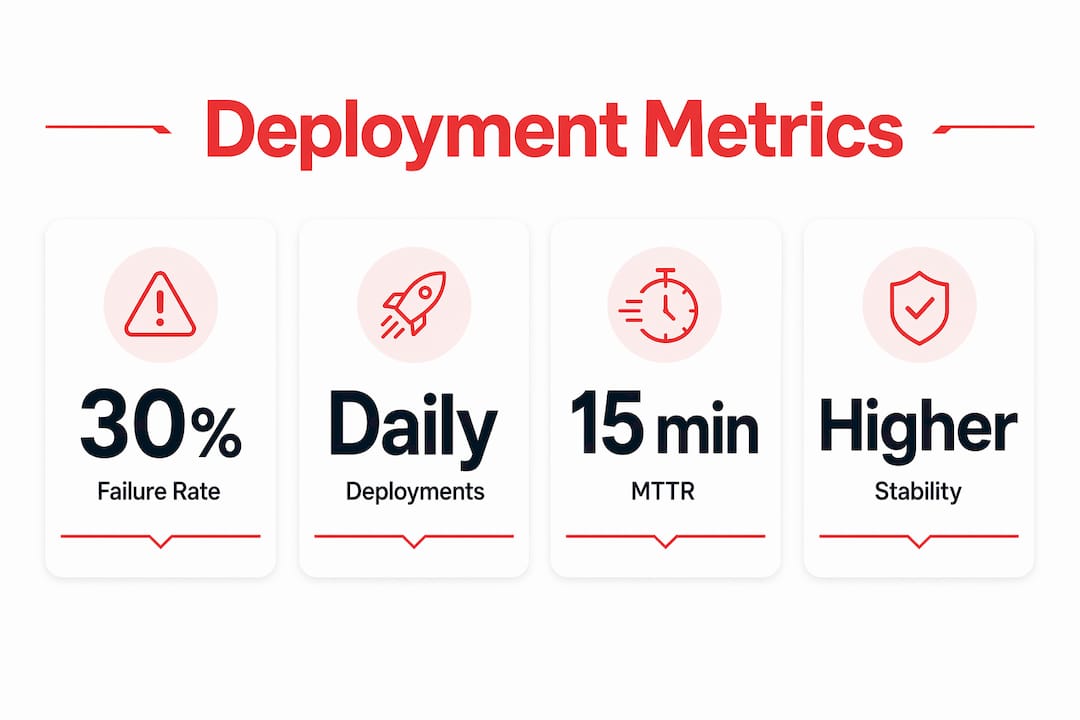
The importance of CI/CD becomes clearest when you compare deployment cadences. Teams deploying daily have shorter Mean Time to Restore (MTTR) and lower change failure rates than teams deploying monthly. The relationship is not coincidental. Smaller batches mean smaller blast radius when something goes wrong.
| Deployment frequency | Typical change failure rate | Typical MTTR |
|---|---|---|
| Multiple times per day | Low | Minutes to hours |
| Once per week | Moderate | Hours |
| Once per month | High | Hours to days |
How does continuous deployment improve risk management and recovery?
The most counterintuitive truth about continuous deployment is that shipping more often makes production safer, not riskier. The mechanism is batch size. A monthly release bundles hundreds of changes. A daily release bundles a handful. When something breaks, the daily team knows exactly which change caused it.

Most continuous deployment failures trace back to weak release design, not automation itself. Insufficient environment modeling, missing health checks, and undefined rollback ownership are the real culprits. Automation does not create those gaps. It exposes them.
The operational practices that make continuous deployment safe include:
- Automated health checks that verify deployment success before traffic shifts
- Automated rollbacks triggered by error rate thresholds or failed health checks
- Feature flags that let teams disable a broken feature without redeploying
- Canary releases that expose new code to a small percentage of users before full rollout
- Monitoring and alerting tied directly to deployment events
“Continuous deployment is best treated as a release-governance system rather than just automation. The focus belongs on operational controls: workflow triggers, health signals, and rollback ownership. Automating release decisions with clear ownership and automated health monitoring is what builds trust in the pipeline.”
Change Failure Rate and MTTR are the two DORA metrics that reveal whether your deployment process is actually safe. Daily deploys enable surgical rollback and faster problem identification. Monthly deploys force teams to debug large changesets under pressure, which extends MTTR and increases user impact.
What are the implementation challenges for growth-stage teams?
Adopting continuous deployment is not a weekend project. Effective transitions typically require 4–6 months and achieving 60–80% automated test coverage on critical paths before teams reach elite performance. Teams with less than 30% test coverage struggle to deploy reliably at high frequency.
The challenges are real and predictable. Here is how to address each one:
- Low test coverage. Build automated tests for your highest-risk paths first. You do not need 100% coverage to start. You need enough coverage to trust the pipeline on the code that matters most.
- Manual toil in pipelines. Standardized “golden paths,” meaning reusable pipeline templates, reduce the manual work that slows deployments and introduces inconsistency. Building standardized pipeline templates is the single highest-leverage investment a platform team can make.
- AI-driven velocity without matching controls. 81% of engineering leaders warn that high-velocity workflows lacking standardized automation and governance are unsustainable. AI-generated code ships faster than most teams can review it. Operational controls must scale with velocity.
- Cultural resistance. Continuous deployment requires smaller, more frequent commits. Developers accustomed to large feature branches need time and coaching to shift habits.
- Missing rollback procedures. Define rollback ownership and triggers before you go live. A pipeline without a tested rollback plan is not production-ready.
Pro Tip: Do not try to adopt continuous deployment across your entire codebase at once. Pick one low-risk service, instrument it with monitoring and rollback, and prove the model before expanding. The workflow automation patterns that work for SaaS teams follow the same incremental logic.
The cultural shift is often harder than the technical one. Teams need to trust that small, fast changes are safer than large, slow ones. That trust comes from visible data, not from management mandates.
How do feature flags decouple deployment from release?
Feature flags are the mechanism that makes continuous deployment safe at scale. A feature flag is a configuration toggle that controls whether a specific feature is visible to users, independent of whether the code is deployed. Deploying code without exposing it to users decouples the technical act of deployment from the business decision of release.
This separation changes everything about how teams manage risk. A team can deploy new payment logic on monday, test it internally on tuesday, roll it out to 5% of users on wednesday, and expand to 100% on thursday. If something breaks at any stage, the flag turns off instantly. No full redeploy required.
The agile development advantages here are concrete:
- Canary releases route a small percentage of traffic to new code before full rollout
- A/B testing lets product teams compare two versions with real users before committing
- Instant rollback via flag toggle eliminates the delay of a full redeploy cycle
- Dark launches let teams test backend behavior in production without user exposure
| Release strategy | Rollback speed | User impact control | Deployment complexity |
|---|---|---|---|
| Big bang release | Slow, full redeploy | None until after release | Low setup, high risk |
| Feature flags | Instant toggle | Granular, percentage-based | Moderate setup, low risk |
| Canary release | Fast, traffic reroute | Percentage-based | Moderate setup, low risk |
The separation of deployment and release stages using feature flags is now a recognized best practice in platform engineering. It gives growth-stage teams the control of a large enterprise without the bureaucracy. Teams exploring how AI shapes deployment governance in adjacent fields like marketing technology will find the same principle applies: automate the mechanics, keep humans in control of the business decision.
Key Takeaways
Continuous deployment reduces release risk by shrinking batch size, automating health checks, and decoupling deployment from user-facing release through feature flags and progressive delivery techniques.
| Point | Details |
|---|---|
| Batch size drives safety | Smaller, more frequent releases reduce incident impact and cut MTTR significantly. |
| Test coverage is the prerequisite | Teams need 60–80% automated test coverage on critical paths before reaching elite deployment frequency. |
| Feature flags separate deployment from release | Toggling features independently of deployment gives teams instant rollback without a full redeploy. |
| Golden paths reduce toil | Standardized pipeline templates cut manual bottlenecks and make high-frequency deployment sustainable. |
| Cultural change is required | Continuous deployment demands smaller commits, faster feedback loops, and shared ownership of rollback procedures. |
Continuous deployment is a discipline, not a shortcut
Here is the thing most articles get wrong about continuous deployment. They frame it as a speed play. Ship faster, win faster. That framing sets teams up for failure.
The teams I have seen succeed with continuous deployment treat it as a risk management discipline first. Speed is the byproduct. The real goal is building a pipeline you trust so completely that deploying on a friday afternoon feels boring. That level of trust does not come from automation alone. It comes from tested rollback procedures, clear ownership, and a team culture where small commits are the norm.
The 2026 AI velocity problem makes this more urgent, not less. AI-generated code ships faster than most teams can review it. Without standardized pipelines and governance, that velocity becomes a liability. The teams winning right now are not the ones generating the most code. They are the ones with the operational structures to ship it safely.
I have also seen the cultural piece underestimated repeatedly. Developers who have spent years working on large feature branches do not naturally shift to committing multiple times per day. That shift requires coaching, visible data on deployment health, and leadership that celebrates small, safe changes over heroic big releases. The digital systems that support scaling teams share the same principle: good infrastructure makes the right behavior the easy behavior.
Continuous deployment is worth it. But only if you invest in the full system, not just the automation layer.
— Josh
Rule27design builds the systems that make continuous deployment stick
Growth-stage teams often have the ambition to ship continuously but lack the internal tooling to make it sustainable. Rule27design builds the custom admin panels, pipeline dashboards, and internal governance tools that give your team visibility and control without enterprise-level complexity.

Our work with growth-stage companies focuses on reducing DevOps toil, building developer-friendly governance, and creating the monitoring infrastructure that makes high-frequency deployment feel safe rather than stressful. If your team is ready to move from monthly releases to daily ones, explore our approach to building the systems that support that shift. You can also see how continuous content delivery applies the same principles to marketing and content workflows.
FAQ
What is continuous deployment vs. continuous delivery?
Continuous deployment releases every passing build to production automatically, with no manual approval. Continuous delivery requires a human to trigger the final release step.
How long does it take to implement continuous deployment?
Effective transitions typically take 4–6 months and require reaching 60–80% automated test coverage on critical paths before teams achieve reliable high-frequency deployment.
Is continuous deployment safe for production systems?
Yes, when paired with automated health checks, feature flags, and tested rollback procedures. Most failures trace to weak release design, not automation itself.
What are feature flags and why do they matter for continuous deployment?
Feature flags are configuration toggles that control feature visibility independently of code deployment. They give teams instant rollback capability without a full redeploy, which is the core safety mechanism for continuous deployment at scale.
What DORA metrics should teams track when adopting continuous deployment?
Track deployment frequency, change failure rate, and Mean Time to Restore. These three metrics reveal whether your pipeline is actually improving safety and speed, not just shipping more code.

About the Author
Josh AndersonCo-Founder & CEO at Rule27 Design
Operations leader and full-stack developer with 15 years of experience disrupting traditional business models. I don't just strategize, I build. From architecting operational transformations to coding the platforms that enable them, I deliver end-to-end solutions that drive real impact. My rare combination of technical expertise and strategic vision allows me to identify inefficiencies, design streamlined processes, and personally develop the technology that brings innovation to life.
View Profile

