

Discover what is metadata management in 2026. Learn how it enhances data trustworthiness and usability for IT teams. Explore best practices today!
TL;DR:
- Metadata management organizes, governs, and maintains data about data to ensure trustworthiness and usability. It enables automated enforcement of data policies, improves data discovery, and supports compliance and AI initiatives. Implementing active, standardized, and centralized systems prevents metadata from becoming outdated and insecure.
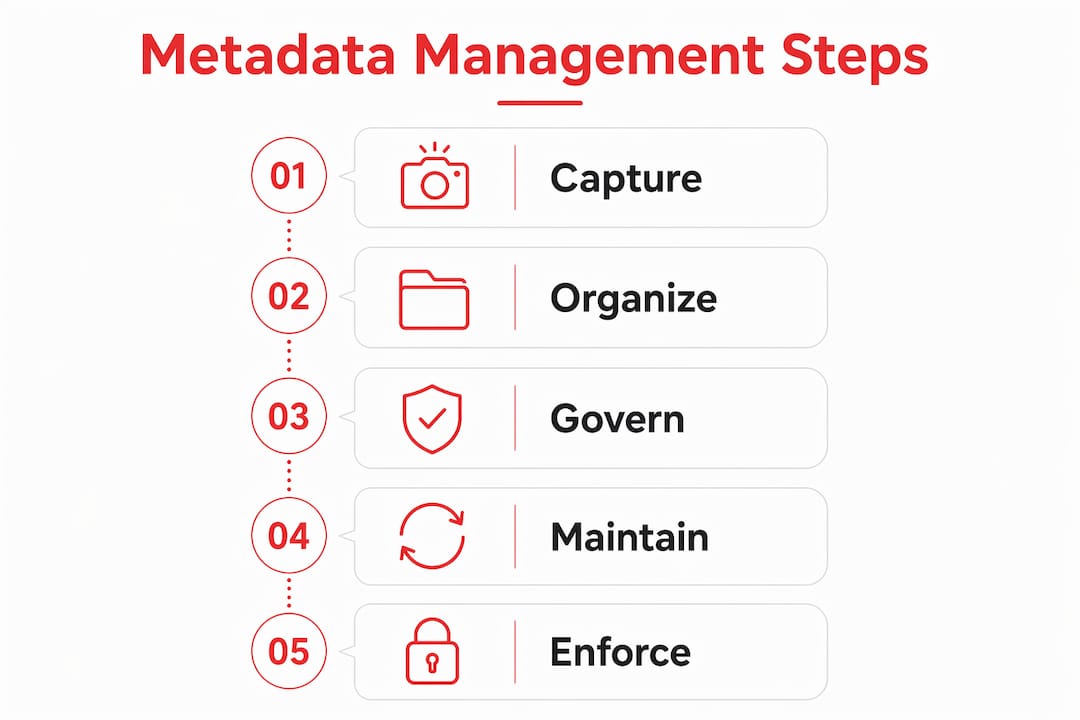
Metadata management is the systematic practice of capturing, organizing, governing, and maintaining metadata to ensure data is findable, understandable, trustworthy, and usable throughout its lifecycle. The industry term for this discipline appears in standards like ISO/IEC 11179:2023, which defines the framework for registering and governing data elements across enterprises. What is metadata management at its core? It is the operational backbone that transforms data governance from a set of manual policies into automated, auditable enforcement. Without it, organizations cannot reliably know what data they have, where it came from, or whether they can trust it.
What is metadata management and why does it matter?

Metadata is data about data. A database table has column names, data types, and update timestamps. A report has an owner, a refresh schedule, and a source system. Metadata management is the practice of collecting all of that context, keeping it current, and making it accessible to the people who need it.
The four essential categories of metadata are technical, business, operational, and lineage. Managing all four is what separates a functioning data program from a chaotic one.
- Technical metadata covers schemas, data formats, storage locations, and system configurations. It tells engineers where data lives and how it is structured.
- Business metadata includes glossary terms, data ownership, business rules, and definitions. It tells analysts what a field actually means in plain language.
- Operational metadata tracks performance metrics, job execution logs, and processing times. It tells teams whether a pipeline ran successfully and how long it took.
- Lineage metadata records where data originated and every transformation it passed through. It answers the question “can I trust this number?” by showing the full chain of custody.
Each type supports a different dimension of data health. Technical metadata prevents integration failures. Business metadata prevents misinterpretation. Operational metadata surfaces pipeline problems before they reach dashboards. Lineage metadata supports compliance audits and root cause analysis. Managing all four together gives your organization a complete, trustworthy picture of its data assets.
What are metadata management best practices?
Proven metadata management programs share a consistent set of structural choices. Getting these right early prevents expensive rework later.
-
Centralize your metadata repository. Siloed metadata stored in spreadsheets, wikis, and individual tool catalogs creates inconsistency. A single authoritative repository gives every team the same definitions and lineage records. Centralized repositories reduce duplication and make governance enforcement possible at scale.
-
Automate metadata harvesting. Manual documentation falls behind the moment a pipeline changes. Automated scanners that pull metadata directly from databases, BI tools, and SaaS applications keep records current without relying on human memory.
-
Adopt recognized standards. ISO/IEC 11179:2023 governs metadata registries and data element definitions. ISO 8000-210:2024 addresses data quality characteristics. Aligning your program to these standards gives you a defensible baseline for audits and a shared vocabulary across teams.
-
Define quality criteria and measure them. Metadata quality has four measurable dimensions: accuracy, completeness, consistency, and timeliness. Set thresholds for each and monitor them continuously. Metadata that is 60% complete is not useful metadata.
-
Treat governance as an ongoing operational responsibility. Metadata management is not a one-time project. Ownership, definitions, and lineage records change as systems evolve. Assign data stewards who are accountable for keeping records current.
Pro Tip: Build automated alerts that fire when metadata completeness drops below your defined threshold. Catching gaps in real time is far cheaper than discovering them during a compliance audit.
How does metadata management connect governance to business insights?
Metadata management operationalizes the policies that data governance programs define. Governance sets the rules. Metadata management enforces them automatically by capturing classifications, access logs, quality scores, and lineage for every data asset.
“Without active metadata management, organizations risk creating data swamps of redundant, non-compliant data that actively harm AI readiness and analytics efficiency. Proper metadata is the prerequisite for self-service analytics, not an optional add-on.”
That distinction matters enormously for AI initiatives. A language model or analytics engine trained on untracked, undocumented data produces unreliable outputs. Metadata management ensures that every dataset feeding an AI system has a verified origin, a known quality score, and a documented transformation history.
Metadata management enhances productivity by letting data engineers and analysts spend less time searching for data and more time analyzing it. When a business analyst can find a certified dataset in seconds rather than emailing three people to ask where it lives, the entire analytics workflow accelerates. This is also where analytics in marketing programs see compounding returns. Trusted, well-documented data feeds better models, which produce better decisions.
Compliance and auditability also depend directly on metadata. Regulations like GDPR and CCPA require organizations to know exactly where personal data is stored, who accessed it, and how long it has been retained. Metadata management makes those answers retrievable in minutes rather than weeks.
How do you implement metadata management in your organization?
Implementation requires clear roles, the right tooling, and a governance structure that scales with your data environment.
Assign clear ownership
Every metadata program needs a Chief Data Officer or equivalent executive sponsor to set priorities and resolve conflicts. Below that, data stewards own specific domains and are accountable for the accuracy of metadata in their area. Data engineers handle technical metadata capture. Data owners approve access and usage policies.
Choose platforms over passive catalogs
A data catalog inventories metadata. A metadata management platform does much more. Active platforms provide live APIs, automated governance, and real-time quality monitoring that passive catalogs cannot match. The table below shows the practical difference.
| Capability | Passive data catalog | Active metadata platform |
|---|---|---|
| Metadata collection | Manual or scheduled batch | Automated, continuous |
| Governance enforcement | Policy documentation only | Automated policy execution |
| Quality monitoring | Static snapshots | Real-time alerts and scoring |
| Integration | Limited export options | Live APIs for connected systems |
| Access control | Role-based lists | Dynamic, classification-driven |
Choosing a passive catalog when your environment has hundreds of data sources creates a documentation project, not a governance program.
Automate capture and enforce access controls
Connect your metadata platform to every data source: cloud data warehouses, BI tools, SaaS applications, and data pipelines. Automated harvesting captures schema changes, new datasets, and pipeline updates without human intervention. Pair that with policy-based dynamic access controls tied to metadata classifications. A dataset tagged as “PII” automatically restricts access to authorized roles. That connection between classification and access is what makes metadata management a security control, not just a documentation exercise. For more on building that security layer, the data security best practices guide covers the access control architecture in detail.
Pro Tip: Start your metadata program with your highest-value, most-used datasets. Proving value on a small scope builds organizational buy-in faster than trying to catalog everything at once.
Embed metadata management into your broader data strategy from the start. Teams that treat it as a standalone IT project consistently underdeliver. Teams that connect it to AI readiness, compliance requirements, and self-service analytics goals get executive support and sustained investment.
Key Takeaways
Metadata management is the operational foundation that makes data governance enforceable, data assets trustworthy, and analytics programs reliable.
| Point | Details |
|---|---|
| Core definition | Metadata management captures, governs, and maintains data about data across its full lifecycle. |
| Four metadata types | Technical, business, operational, and lineage metadata each address a distinct dimension of data quality. |
| Standards alignment | ISO/IEC 11179:2023 and ISO 8000-210:2024 provide defensible frameworks for metadata quality and governance. |
| Platform over catalog | Active metadata platforms enforce governance automatically; passive catalogs only document it. |
| Security and access | Dynamic, classification-driven access controls protect sensitive data while keeping authorized data accessible. |
Where metadata management is heading and what most teams get wrong
The most common mistake I see is treating metadata management as a catalog project. Teams spend months documenting datasets in a static tool, declare victory, and then watch the catalog go stale within a quarter. The catalog becomes shelfware. Nobody trusts it because nobody maintains it.
The shift that actually works is treating metadata as a live operational system, not a documentation artifact. That means automated harvesting, real-time quality scoring, and governance policies that execute automatically when a classification changes. The moment metadata management becomes a human-driven documentation task, it fails.
The next frontier is AI governance. Every AI system your organization builds or buys depends on data with a verified lineage and a known quality score. Without that, you cannot explain model outputs, you cannot audit decisions, and you cannot comply with emerging AI regulations. Metadata management is not a data engineering concern anymore. It is a board-level risk management concern.
The teams I see winning on this are the ones who connected their metadata program to their AI initiatives early. They built the lineage records and quality scores before they needed them. The teams scrambling now are the ones who assumed they could add governance later. You cannot add governance retroactively to a data swamp. For teams managing diverse content and data systems, multichannel content management practices share a lot of the same governance principles and are worth reviewing alongside your metadata strategy.
— Josh
How Rule27design supports your data infrastructure
Building a metadata management program requires more than good intentions. It requires systems that actually capture, enforce, and surface metadata in the tools your team uses every day.

Rule27design builds custom admin panels, internal tools, and content management systems that embed metadata governance directly into your workflows. If your team has outgrown basic tools but is not ready for a full enterprise platform, that is exactly the gap Rule27design is built to fill. Clients typically see a 40% improvement in operational efficiency after implementing Rule27design systems. Reach out through the Rule27design website to talk through what a metadata-aware infrastructure could look like for your organization.
FAQ
What is metadata management in simple terms?
Metadata management is the practice of collecting, organizing, and maintaining data about your data so teams can find, understand, and trust it. It covers everything from column definitions to data lineage records.
What are the four types of metadata?
The four essential types are technical, business, operational, and lineage metadata. Each type addresses a different aspect of data context and quality.
How does metadata management support data governance?
Metadata management operationalizes governance by capturing classifications, access logs, and quality scores that make policies enforceable and auditable rather than just documented.
What is the difference between a data catalog and a metadata management platform?
A data catalog passively inventories metadata. A metadata management platform actively enforces governance, monitors quality in real time, and integrates with live systems through APIs.
Why does metadata management matter for AI readiness?
Without active metadata management, organizations develop data swamps that undermine AI model reliability and make it impossible to audit or explain AI-driven decisions.

About the Author
Josh AndersonCo-Founder & CEO at Rule27 Design
Operations leader and full-stack developer with 15 years of experience disrupting traditional business models. I don't just strategize, I build. From architecting operational transformations to coding the platforms that enable them, I deliver end-to-end solutions that drive real impact. My rare combination of technical expertise and strategic vision allows me to identify inefficiencies, design streamlined processes, and personally develop the technology that brings innovation to life.
View Profile

