

Discover why use custom healthcare apps for your organization. Tailored solutions boost workflow efficiency and enhance patient care. Learn more!
TL;DR:
- Custom healthcare apps tailor workflows, improve efficiency, and enhance patient engagement by addressing unique clinical needs.
- Effective implementation requires clinician involvement from the start and ongoing maintenance to ensure adoption and long-term success.
Custom healthcare apps are specialized digital tools built to match the exact workflows, compliance needs, and patient populations of a specific healthcare organization. Generic platforms cover the basics. Custom apps handle everything else. For healthcare professionals and decision-makers weighing technology investments, the case for bespoke solutions is direct: organizations that build tailored apps recover 13–21% of nurse weekly hours through workflow automation alone. That time goes back to patient care, not paperwork. The question of why use custom healthcare apps comes down to one core truth: no two clinical environments are identical, and software that ignores that fact costs more than it saves.
Why use custom healthcare apps for clinical and administrative workflows
Custom apps fix the gap between how your team actually works and how generic software expects them to work. Off-the-shelf platforms are built for the average clinic. Your clinic is not average. It has specific scheduling rules, documentation requirements, device integrations, and referral patterns that no prebuilt product fully accommodates.
Automation is where the return shows up fastest. Automating administrative workflows with custom digital tools recovers 13–21% of a nurse’s weekly hours. That is not a marginal gain. For a 10-nurse team, that is the equivalent of two full-time staff members freed from data entry and manual scheduling.
Custom apps also connect systems that generic platforms cannot. Integration with legacy systems, medical devices, and genomics platforms becomes possible when you build to your own specifications. Standards like FHIR and HL7 make that interoperability structured and auditable. A custom telehealth module, for example, can pull data from a bedside monitor, log it directly into the patient record, and trigger a care team alert without manual input.
Key workflow areas where custom apps deliver the clearest gains:
- Scheduling automation: Rules-based booking that accounts for provider specialties, room availability, and insurance requirements
- Telehealth management: Integrated video, documentation, and billing in one purpose-built interface
- Patient data sharing: Controlled data exchange between departments or external partners using FHIR-compliant APIs
- Device integration: Real-time data capture from wearables, monitors, and diagnostic equipment
Digital tools also reduce clinician burnout when they address root causes of inefficiency rather than layering workarounds on top of broken processes. Generic software patches symptoms. Custom apps fix the underlying workflow.
Pro Tip: Map every manual step your clinical staff takes before writing a single line of code. The highest-value automation targets are almost always invisible until you watch the actual process.
How do custom apps improve patient engagement and health outcomes?
Patient engagement is not a soft metric. It predicts readmission rates, medication adherence, and long-term disease management. Custom apps built around specific patient populations outperform generic wellness apps because they speak directly to the patient’s condition and care plan.

The evidence on digital diabetes management is specific. Each additional day of engagement with a digital diabetes app correlates with a 0.01% decrease in HbA1c. That compounds. A patient who engages consistently over 90 days shows measurable glycemic improvement that reduces downstream complications and costs.
Engagement design matters as much as clinical content. Gamified social features boost mobile health app engagement by 62.5% for leaderboards and 26.5% for streak tracking among older adults. Older adults are typically the hardest population to keep engaged digitally. Those numbers suggest that user engagement strategies borrowed from consumer apps translate directly into clinical outcomes when applied thoughtfully.
| Engagement feature | Observed impact |
|---|---|
| Daily app engagement | 0.01% HbA1c reduction per day |
| Leaderboard gamification | 62.5% increase in feature use among older adults |
| Streak tracking | 26.5% increase in feature use among older adults |
| Reduced admin friction | Higher patient satisfaction scores |
Custom apps also reduce the friction patients feel during consultations. User-friendly health apps improve satisfaction primarily by empowering patients and cutting administrative friction during visits. Patients who arrive with their history already logged, their symptoms pre-documented, and their questions organized spend less time on intake and more time on care.
One critical nuance: apps do not sustain behavior change on their own. Sustained clinical success with mHealth tools depends on integration into human-led care models. The app is the enabler. The clinician relationship is the anchor.
Are bespoke healthcare solutions better than off-the-shelf platforms?
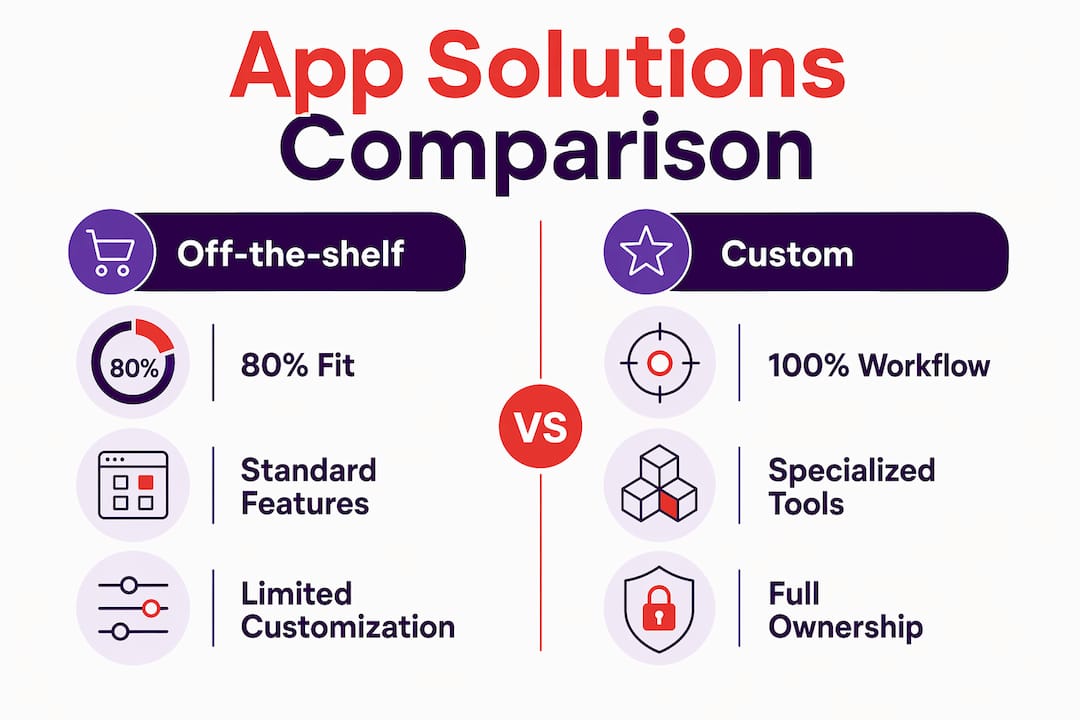
The honest answer is: it depends on which 20% of your workflow you are trying to solve. The 80/20 build vs. buy framework is the most practical decision model available. Buy a certified EHR system to cover the 80% of needs that are standard across healthcare organizations. Build custom apps for the specialized 20% that your EHR cannot handle.
That last 20% is where patient experience lives. It is where your specialty workflows, your unique referral patterns, and your population-specific care protocols sit. Generic platforms will never prioritize those features because they serve thousands of organizations, not yours.
Ownership is the other major factor. When you build a custom app, you own the source code. You control the feature roadmap. You are not waiting for a vendor’s quarterly release cycle to fix a workflow problem your staff identified six months ago. You are not paying per-seat licensing fees that scale against you as your organization grows.
| Decision factor | Off-the-shelf platform | Custom app |
|---|---|---|
| Workflow fit | Covers ~80% of standard needs | Built for your specific processes |
| Integration depth | Limited to vendor-supported APIs | FHIR, HL7, legacy systems, devices |
| Feature control | Vendor roadmap | Your roadmap |
| Long-term cost | Licensing scales with users | Fixed build cost, lower ongoing fees |
| Specialization | Generic | Purpose-built for your population |
Custom development targets specialized workflow layers integrated with existing EHRs via FHIR and HL7 rather than replacing full systems from scratch. That distinction matters for budget conversations. You are not rebuilding Epic. You are adding the layer Epic cannot provide.
Pro Tip: Before approving a custom build, list every workflow your team currently handles outside your EHR, in spreadsheets, email threads, or paper forms. That list is your custom app scope.
What makes custom healthcare app implementation succeed?
Most custom healthcare app projects fail not because of bad code but because of poor adoption. Failure to involve clinical staff leads directly to shadow IT, where staff build their own workarounds using unapproved tools. That creates compliance risk and data fragmentation.
The fix is user-centered design from day one. Clinicians and administrative staff need to be part of the requirements process, not just the testing phase. Their input shapes the interface logic, the alert thresholds, and the documentation shortcuts that determine whether the app gets used or ignored.
Four factors that drive successful implementation:
- Involve end users early. Run workflow observation sessions before writing requirements. Watch how nurses, physicians, and front desk staff actually move through their day.
- Use SMART on FHIR for integration. This standard enables apps to connect with EHR data securely and without custom middleware. It reduces integration time and compliance risk.
- Plan for ongoing maintenance. HIPAA requirements, security patches, and regulatory updates do not stop after launch. Budget for a support relationship, not just a build contract.
- Measure adoption, not just usage. Track whether staff complete workflows inside the app or revert to manual processes. Adoption gaps reveal design problems early.
Clinician adoption ties directly to user-centered design. Organizations that skip the co-design phase spend more fixing adoption problems post-launch than they would have spent getting it right the first time.
Pro Tip: Set a 90-day adoption benchmark before launch. Define what “successful use” looks like in measurable terms, such as percentage of scheduled appointments booked through the app, and track it weekly from go-live.
Key Takeaways
Custom healthcare apps deliver measurable gains in staff efficiency, patient engagement, and clinical outcomes when built around real workflows and deployed with clinician input from the start.
| Point | Details |
|---|---|
| Time recovery through automation | Custom apps recover 13–21% of nurse weekly hours by automating administrative tasks. |
| Patient engagement drives outcomes | Daily app engagement correlates with measurable HbA1c reduction in diabetes management. |
| Build for the 20% gap | Buy certified EHRs for standard needs; build custom apps for specialized workflows your EHR cannot handle. |
| Clinician involvement prevents failure | Excluding staff from design leads to shadow IT and poor adoption post-launch. |
| Integration requires open standards | FHIR and HL7 enable custom apps to connect with EHRs, devices, and legacy systems reliably. |
The part most decision-makers get wrong
Here is what I have seen repeatedly: healthcare organizations invest in custom app development and then treat the launch as the finish line. The app goes live, the vendor relationship ends, and six months later the clinical staff has drifted back to spreadsheets and sticky notes.
The technology is not the hard part. The hard part is maintaining clinician trust in the tool over time. That means responding to feedback quickly, shipping fixes before frustration builds, and treating the app as a living product rather than a completed project. The organizations that get the most from custom health technology are the ones that staff a product owner internally, someone who owns the relationship between the clinical team and the development team after launch.
I also think the industry undersells the burnout angle. Generic software that forces clinicians to work around its limitations is a daily friction tax. Custom apps that fit the actual workflow remove that tax. The analytics and patient engagement data backs this up, but the real proof is in retention. Clinicians stay longer at organizations where the tools work for them.
The future of custom health technology is not about replacing clinical judgment. It is about removing every obstacle between a clinician and the decision that matters. That is a narrow, specific, and very achievable goal. It just requires treating software as a strategic asset rather than a line-item expense.
— Josh
How Rule27design builds custom healthcare apps that work
Healthcare organizations need apps that fit their workflows, not the other way around. Rule27design builds custom healthcare solutions from the ground up, starting with your clinical processes and building outward to the technology. The focus is always on tools your staff will actually use.
Rule27design specializes in the infrastructure layer that makes custom apps reliable: admin panels, data integrations, and internal tools that connect your existing systems without replacing what already works. Whether you need a patient-facing engagement app, a clinical workflow tool, or a reporting system that pulls from your EHR, the approach is the same. Build for your team. Build for your patients. Build to last. If you are ready to move past generic platforms, start the conversation with Rule27design today.
FAQ
Why use custom healthcare apps instead of off-the-shelf software?
Off-the-shelf platforms cover roughly 80% of standard clinical needs. Custom apps handle the specialized workflows, integrations, and patient experiences that generic products cannot accommodate.
How do custom apps reduce clinician burnout?
Custom apps address root causes of inefficiency by fitting actual clinical workflows rather than forcing staff to work around software limitations. That daily friction reduction has a direct impact on staff wellbeing and retention.
What standards should custom healthcare apps support?
Custom apps should integrate using FHIR and HL7 standards to connect with EHRs, medical devices, and legacy systems. SMART on FHIR is the recommended approach for secure, standards-based EHR data access.
How long does it take to see ROI from a custom healthcare app?
Time-to-ROI varies by scope, but workflow automation gains such as the 13–21% nurse hour recovery are measurable within the first quarter of full adoption.
What is the biggest risk in custom healthcare app development?
Poor adoption caused by excluding clinical staff from the design process. Organizations that skip user-centered design consistently face shadow IT and low utilization after launch.

About the Author
Josh AndersonCo-Founder & CEO at Rule27 Design
Operations leader and full-stack developer with 15 years of experience disrupting traditional business models. I don't just strategize, I build. From architecting operational transformations to coding the platforms that enable them, I deliver end-to-end solutions that drive real impact. My rare combination of technical expertise and strategic vision allows me to identify inefficiencies, design streamlined processes, and personally develop the technology that brings innovation to life.
View Profile

