

Discover what is hybrid CMS and how it empowers content teams with a blend of traditional tools and headless capabilities for seamless delivery.
TL;DR:
- A hybrid CMS combines traditional editorial tools with API-driven content delivery, making it ideal for multi-channel teams. It offers independent content management, built-in SEO, localization, and workflow tools, reducing developer dependency. Poor governance can undermine its benefits, emphasizing the need for strict content structuring and component standards.
A hybrid CMS is defined as a content management system that combines traditional editorial tools with a headless, API-driven delivery layer in a single platform. Content managers get WYSIWYG editing and live preview. Developers get API access to push content to any channel. That combination is what makes a hybrid content management system the most practical choice for teams managing complex, multi-channel digital experiences. Neither pure headless nor traditional CMS alone delivers both. Hybrid does.
What is hybrid CMS and how does it work?
A hybrid CMS runs on a mixed architecture. The back end stores and manages content in a structured, channel-agnostic format. The front end can be served through a traditional coupled layer for websites or through APIs for mobile apps, digital signage, or any other channel. This decoupled architecture gives teams the flexibility of headless delivery with the ease of a familiar editorial interface.

The key difference from pure headless is what comes built in. A hybrid content management system ships with native SEO tools, content localization, workflow approvals, and content scheduling. In a pure headless setup, these features require custom development, which adds engineering time and cost. Hybrid removes that burden from the start.
Front-end integrations are flexible. A team might use a React-based single-page application for the website while the same content feeds a native iOS app through REST or GraphQL APIs. The editorial team never touches the code. They publish once and the content appears everywhere it needs to.
| Feature | Traditional CMS | Pure Headless CMS | Hybrid CMS |
|---|---|---|---|
| Editorial interface | Full WYSIWYG | Minimal or none | Full WYSIWYG |
| API content delivery | Limited | Full | Full |
| Built-in SEO tools | Yes | Rarely | Yes |
| Multi-channel output | No | Yes | Yes |
| Developer dependency | Low | High | Moderate |
| Governance controls | Basic | Custom-built | Built-in |
Pro Tip: If your team publishes to more than two channels, a hybrid CMS will save you from rebuilding editorial tooling that headless platforms leave out by default.
What are the benefits of hybrid CMS for content managers?
The biggest benefit is editorial independence. Content managers update landing pages, swap hero images, and adjust copy without filing a developer ticket. Visual SPA editors and campaign managers in hybrid CMS platforms reduce the time between a marketing decision and a live page. That speed matters when campaigns run on tight deadlines.
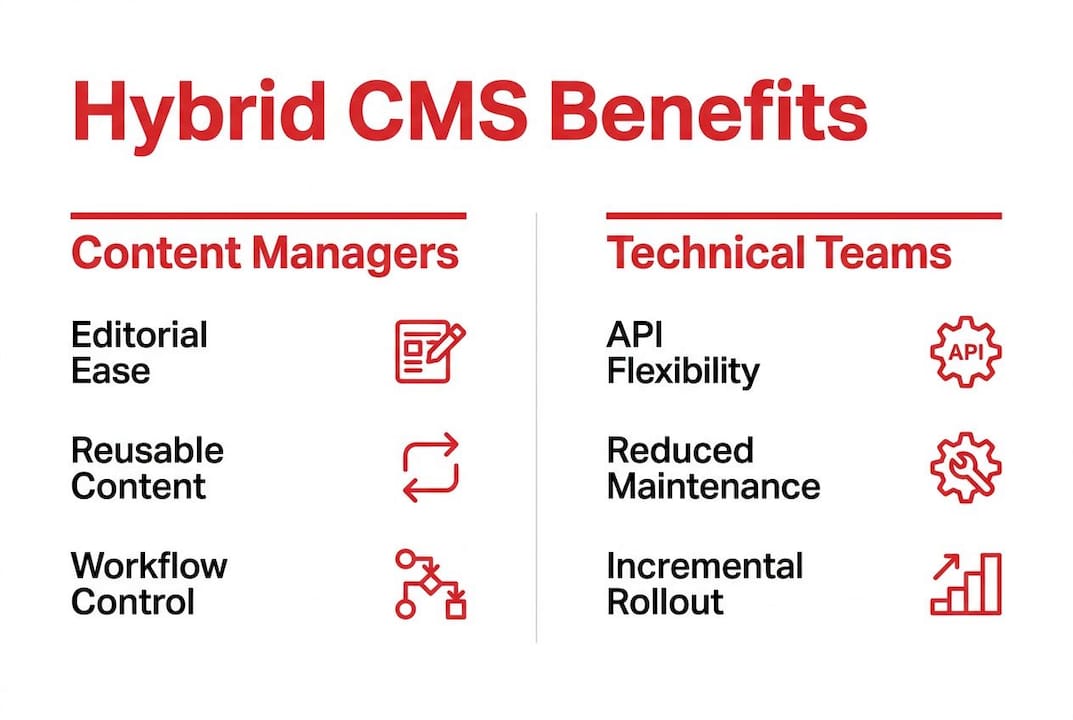
Hybrid CMS also makes content reusable. Teams store, tag, and syndicate content from a central repository, pulling from external sources like PIM and DAM systems. One piece of content can feed the website, email, social, and mobile without duplication. That consistency protects brand integrity across every touchpoint.
For SEO workflows, the built-in tooling is a real advantage. Teams manage metadata, canonical tags, and structured data inside the same interface they use to write content. No plugin juggling, no developer handoff. Platforms like those using HubSpot CMS SEO automation show how tightly integrated SEO tooling improves publishing speed and search performance together.
The top benefits content managers report from hybrid CMS adoption:
- Faster time to market for campaign pages and landing pages
- Reduced developer dependency for routine content updates
- Brand consistency across web, mobile, email, and social
- Built-in workflow approvals and content governance
- Native SEO, localization, and scheduling tools
- Easier content reuse through structured, channel-agnostic storage
- Improved collaboration between marketing and development teams
Pro Tip: Map your team’s weekly developer requests before evaluating platforms. If more than 30% are content updates, a hybrid CMS will directly cut that backlog.
For a deeper look at which CMS features support modern marketing workflows, the specifics matter more than the category label.
When do organizations choose a hybrid CMS?
Hybrid CMS architectures are the most common outcome for enterprise replatforming projects. The reason is practical. Organizations need omnichannel delivery but cannot afford to rebuild editorial tooling from scratch. Hybrid gives them both without forcing a choice.
The clearest signal that a team needs hybrid is a mismatch between technical and non-technical users. When developers want API flexibility and marketers want visual editing, a traditional CMS frustrates developers and a pure headless CMS frustrates marketers. Hybrid resolves that tension without compromise.
Common scenarios where organizations move to hybrid:
- The marketing team waits days for developer sprints to update landing pages.
- Content must reach web, mobile app, and email from a single source of truth.
- The company operates across multiple locales and needs localization built in.
- Engineering is spending time maintaining custom authoring UIs instead of building product.
- The organization is replatforming and needs a core web experience live within six months.
Hybrid CMS reduces engineering maintenance by providing built-in SEO, localization, and workflow governance. That means developers focus on product work, not content infrastructure. For teams managing content across five or fewer locales, hybrid CMS reduces operational friction compared to pure headless.
The incremental rollout model also matters. Hybrid CMS lets organizations launch a core web experience first, then expand to additional channels over time. That approach lowers risk and keeps projects on schedule. For multichannel content management at scale, that phased flexibility is often the deciding factor.
What challenges come with hybrid CMS, and how do you manage them?
Governance is the biggest human pitfall in hybrid CMS. Without strict component libraries and user roles, editors create unstructured, one-off pages that break design consistency and make content impossible to reuse. The platform gives editors power. Governance determines whether that power helps or hurts.
The risks compound over time. A team that starts with loose governance ends up with hundreds of pages that cannot be templated, migrated, or repurposed. That erodes the core advantage of hybrid CMS. Disciplined governance and component-based architectures preserve the benefits. Skipping them undoes them.
Best practices for managing hybrid CMS effectively:
- Define a component library before launch and enforce it through role-based permissions
- Assign content types and templates for every page category, not just the homepage
- Set up approval workflows so content goes through review before publishing
- Train editors on structured content principles, not just the interface
- Schedule quarterly audits to catch one-off pages before they multiply
- Keep developers involved in governance decisions, not just technical ones
Pro Tip: Treat your component library like a design system. Version it, document it, and require sign-off before adding new components. That discipline pays off every time you migrate or redesign.
Ongoing maintenance also requires planning. Hybrid CMS platforms update regularly. API contracts can shift. Front-end frameworks evolve. Teams that build with structured CMS capabilities from the start spend less time retrofitting when the platform changes.
Key Takeaways
A hybrid CMS delivers the editorial ease of traditional platforms and the API flexibility of headless in one system, making it the most practical choice for teams managing multi-channel content at scale.
| Point | Details |
|---|---|
| Core definition | Hybrid CMS combines WYSIWYG editing with API-driven content delivery in a single platform. |
| Primary benefit | Content managers publish independently without developer tickets for routine updates. |
| Best fit scenario | Teams with mixed technical and non-technical users managing content across multiple channels. |
| Biggest risk | Poor governance leads to unstructured pages that break consistency and reusability. |
| Key differentiator | Built-in SEO, localization, and workflow tools that pure headless requires custom development to match. |
The real reason hybrid CMS wins in practice
I’ve watched teams pick pure headless because it sounded modern, then spend six months building an authoring UI their marketers still hated. The technology was right. The experience was wrong. Hybrid CMS exists precisely because that pattern kept repeating.
The honest truth is that most marketing teams do not need the absolute maximum API flexibility that pure headless offers. They need enough flexibility to reach every channel, plus an interface that does not require a developer to babysit every content update. Hybrid hits that mark. Pure headless often overshoots it.
What I find underappreciated is the governance angle. Everyone talks about the editorial benefits and the API delivery. Fewer people talk about what happens when you give a 20-person content team unrestricted editing power without a component library. The platform becomes a liability instead of an asset. The teams that get the most from hybrid CMS are the ones that treat governance as a product decision, not an afterthought.
The CMS technology keeps evolving. Visual editing is getting better. AI-assisted content workflows are entering the picture. But the fundamental tension between developer flexibility and marketer usability is not going away. Hybrid CMS is the architecture that takes that tension seriously. That is why it keeps winning enterprise replatforming decisions.
— Josh
How Rule27design approaches hybrid CMS for growing teams
Rule27design builds custom content management systems and admin infrastructure for growth-stage companies that have outgrown basic tools. If your team is evaluating a hybrid content management system, the architecture decision is only part of the work. The editorial workflows, governance structure, and integration layer all determine whether the platform delivers on its promise.
Rule27design designs systems around how your team actually works, not how a vendor assumes you work. That means clean editorial interfaces, structured content governance, and API delivery built for your specific channels. Clients typically see a 40% improvement in operational efficiency after implementation. If you are ready to move past off-the-shelf limitations, see what’s possible with a system built for your team.
FAQ
What is a hybrid CMS in simple terms?
A hybrid CMS is a platform that combines a traditional editorial interface with API-driven content delivery. Marketers get visual editing tools and developers get APIs to push content to any channel.
How does hybrid CMS differ from headless CMS?
Pure headless CMS delivers content only through APIs and requires custom-built authoring tools. Hybrid CMS includes a built-in editorial interface alongside API delivery, reducing developer dependency for content teams.
What are the main benefits of hybrid CMS for marketers?
Hybrid CMS gives marketers WYSIWYG editing, live preview, built-in SEO tools, and workflow approvals without requiring developer support for routine updates. That independence speeds up campaign execution.
Is hybrid CMS right for small teams?
Hybrid CMS fits teams of any size that publish to more than one channel and include both technical and non-technical members. Smaller teams benefit most from the built-in tooling that replaces custom development.
What is the biggest risk of adopting a hybrid CMS?
Governance failure is the top risk. Without component libraries and defined user roles, editors create inconsistent pages that break design standards and make content difficult to reuse or migrate.

About the Author
Josh AndersonCo-Founder & CEO at Rule27 Design
Operations leader and full-stack developer with 15 years of experience disrupting traditional business models. I don't just strategize, I build. From architecting operational transformations to coding the platforms that enable them, I deliver end-to-end solutions that drive real impact. My rare combination of technical expertise and strategic vision allows me to identify inefficiencies, design streamlined processes, and personally develop the technology that brings innovation to life.
View Profile

