

Discover the benefits of the API-first approach in our comprehensive API-first approach guide. Learn how to implement it for faster growth.
TL;DR:
- An API-first approach designs the API contract before starting application development, enabling parallel work and reliable integration. It reduces development costs, accelerates time-to-market, and improves customer retention by fostering decoupled, secure, and high-quality APIs. Implementing it involves phases like contract design, mock publishing, and CI/CD testing, with emphasis on team alignment and gradual rollout.
An API-first approach is a software development strategy that designs the API contract before writing any application code, enabling parallel development, reliable integration, and maintainable products at scale. Unlike code-first development, where the API is an afterthought bolted onto existing logic, API-first treats the API as the product itself. This api-first approach guide covers the full picture: what it is, why it matters, how the workflow runs, and how growth-stage technical leads can implement it without losing momentum. Standards like OpenAPI and GraphQL are central to making this methodology work in practice.
What are the main benefits of an API-first approach?
API-first delivers measurable business advantages, not just architectural elegance. The core benefit is speed: frontend and backend teams work in parallel from day one because the API contract defines the interface before either side writes a line of production code. That parallelism cuts time to market significantly for growth-stage teams shipping under pressure.
The financial case is hard to ignore. Technical debt remediation costs 3x–5x more when teams wait to adopt API-first architecture rather than designing it upfront. That number means a $50,000 integration fix today could cost $250,000 if you defer the decision by two product cycles.
Retention also improves. API-first SaaS companies grow at roughly 2x the rate of traditional SaaS and command 25% higher valuation multiples. Infrastructure-layer companies that prioritize API-first architectures show a 1.8% monthly churn rate compared to the 3.5% annual average for general B2B SaaS. Lower churn at that scale compounds fast, and customer retention strategies become far easier to execute when your product integrates reliably.
Key benefits for growth-stage teams:
- Parallel development. Frontend teams consume live mock APIs while backend teams build the real implementation.
- Fewer integration bugs. Agreeing on the contract upfront catches mismatches before they reach production.
- System decoupling. Services communicate through defined contracts, so you can swap or scale individual components without cascading failures.
- Security and compliance by default. Authentication, rate limiting, and data validation live in the contract from day one.
- Better developer experience. APIs designed as products attract third-party developers and reduce onboarding friction.
Pro Tip: Start with one internal API and prove the model before rolling API-first across your entire product. A single successful example builds more buy-in than any architecture document.
How does the API-first development workflow operate?
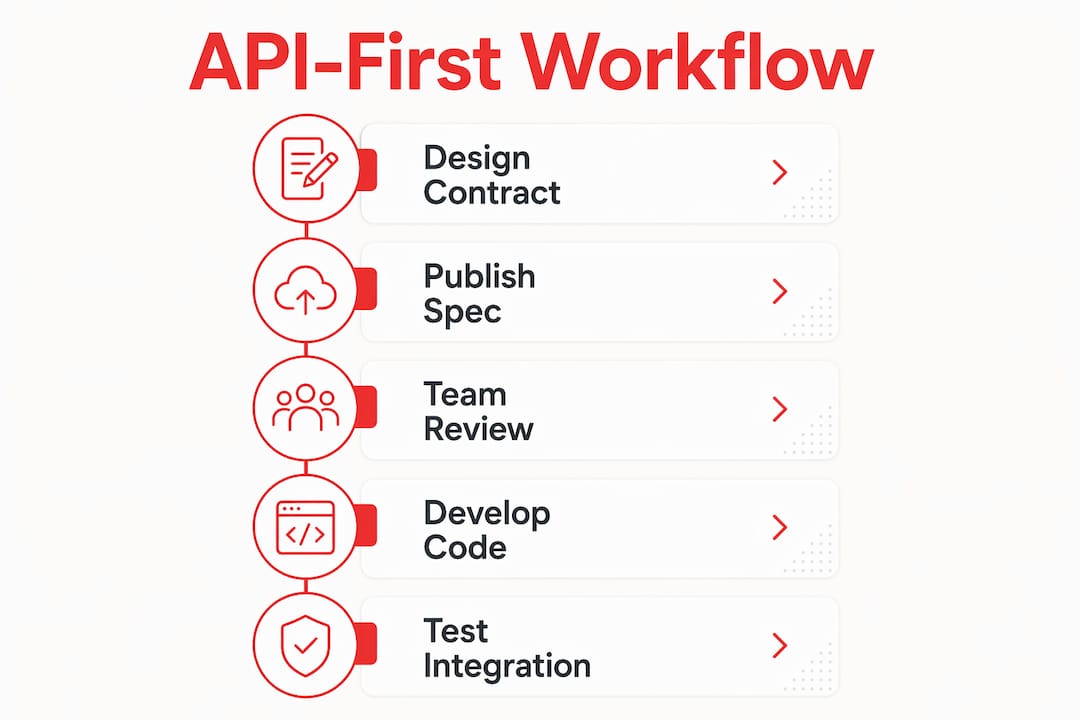
The API-first workflow runs through six distinct phases, each with a clear output that feeds the next stage.
-
Discovery and domain modeling. Product managers, UI/UX designers, and engineers map the business domain together. The goal is to identify the resources, relationships, and operations the API must support before anyone opens a code editor.
-
API contract design. The team drafts the API specification using OpenAPI for REST or a GraphQL schema for graph-based data needs. Treating the API contract as a collaborative document involving all three disciplines avoids expensive integration mismatches later. The contract gets reviewed, debated, and approved before any implementation begins.
-
Mock publishing. The approved spec generates a live mock server. Frontend teams hit real endpoints with realistic responses immediately. Skipping the live mock server causes frontend development blocking, which defeats the core efficiency gains of API-first. This step is non-negotiable.
-
Parallel backend implementation. Backend engineers build the real service against the agreed spec. Because the contract is fixed, they can work independently without coordinating every change with the frontend team.
-
Contract testing in CI/CD. Contract testing tools integrated into CI pipelines prevent spec drift, keeping the implementation aligned with the agreed API contract over time. Every pull request runs contract tests before merging.
-
Deployment, monitoring, and versioning. Planning for API versioning early prevents breaking changes and enables stable evolution across client applications. Version your API from v1, monitor usage patterns, and deprecate old versions on a published schedule.
Pro Tip: Publish your OpenAPI spec to a shared internal portal on day one. When every team can read the contract in one place, alignment happens automatically rather than through endless Slack threads.
What are the common pitfalls in API-first adoption?
Most API-first failures trace back to a small set of repeatable mistakes. Knowing them in advance saves weeks of rework.
-
Skipping mocks. Teams that skip live mock servers force frontend developers to wait for backend completion. The parallel development benefit disappears entirely, and the project timeline collapses back to a sequential waterfall.
-
Spec drift. The API contract and the actual implementation diverge over time when contract testing is absent from the CI pipeline. Spec drift is silent and cumulative. By the time teams notice it, the gap between spec and reality can span dozens of endpoints.
-
Over-designing the first version. Teams new to API-first sometimes design 40 endpoints when the product needs 8. Start with the minimum surface area that delivers value, then expand iteratively. An API you can extend is better than one you have to deprecate.
-
Tooling overload. Adopting five new tools simultaneously creates friction that kills adoption. Pick one spec format, one mock server, and one contract testing tool. Add more only when the team has mastered the basics.
-
Cultural misalignment. Successful API-first adoption requires cultural alignment across cross-functional teams, with emphasis on documentation quality and automated contract enforcement. Engineers who treat the spec as optional will drift. Make the contract the source of truth in code review, not just in planning.
Pro Tip: Add a contract linting step to your pull request checks using a tool like Spectral. It catches spec violations before they become production bugs, and it costs nothing to set up.
How does API-first compare to code-first development?

Code-first prioritizes implementation first and generates the API from existing code. API-first prioritizes the contract first and builds implementation to match. The distinction sounds subtle but produces very different outcomes at scale.
| Factor | Code-first | API-first |
|---|---|---|
| Starting point | Working code | API contract (OpenAPI or GraphQL) |
| Team parallelism | Sequential (backend first) | Parallel from day one |
| Integration risk | High (API reflects code structure) | Low (contract agreed upfront) |
| Scalability | Harder to decouple later | Decoupled by design |
| Best for | Prototypes, solo projects | Growth-stage products with multiple clients |
Code-first makes sense for solo developers building a proof of concept or a weekend project where speed of initial output matters more than long-term maintainability. API-first wins when you have multiple teams, multiple clients (web, mobile, third-party), or a product that needs to integrate with external systems. For growth-stage SaaS, the integration surface grows fast. API-first handles that growth without requiring a full architectural rewrite.
How can technical leads implement API-first methodology effectively?
Implementation succeeds or fails at the team level, not the architecture level. These steps give technical leads a concrete path forward.
-
Define your API strategy first. Decide which APIs are internal only, which are partner-facing, and which are public. Each category has different versioning, security, and documentation requirements. API-first is a strategic product decision that aligns engineering with business goals and UX design, not just a technical preference.
-
Choose your spec format based on team capability. REST with OpenAPI is simpler; GraphQL is more flexible for data-rich client views. If your team has never written a GraphQL schema, start with OpenAPI and migrate later when the team is ready.
-
Set up infrastructure before writing the first spec. You need a spec repository, a mock server, a contract testing framework, and an API gateway. Getting these in place before the first API design session removes friction from the workflow.
-
Run a collaborative design session for every new API. Bring product, design, and engineering into the same room. The collaborative API contract process catches mismatches at the design stage, where fixing them costs an hour instead of a sprint.
-
Measure adoption and quality. Track the percentage of endpoints covered by contract tests, the time between spec approval and mock availability, and the number of breaking changes per release. These metrics tell you whether the process is working.
Pro Tip: Assign one engineer as the API steward for each domain. That person owns the spec, reviews contract changes, and enforces standards. Shared ownership means no ownership.
For teams building scalable SaaS architecture, the API steward role pays dividends quickly. It creates a single point of accountability without creating a bottleneck.
Key Takeaways
API-first development is the highest-leverage architectural decision a growth-stage team can make, because the cost of retrofitting it later is 3x–5x higher than designing it from the start.
| Point | Details |
|---|---|
| Design contract first | Agree on the OpenAPI or GraphQL spec before writing any implementation code. |
| Publish mocks immediately | Live mock servers unblock frontend teams and prevent sequential development delays. |
| Enforce contracts in CI | Contract testing in CI/CD pipelines stops spec drift before it reaches production. |
| Start small and expand | Begin with one API domain, prove the model, then roll out across the product. |
| Align culture, not just tooling | Documentation quality and cross-team buy-in determine adoption success. |
Why I think most teams adopt API-first too late
Teams I’ve worked with almost always arrive at API-first after a painful integration failure, not before one. A mobile team ships a feature, the backend changes an endpoint without notice, and suddenly a production app is broken. That moment is avoidable. The spec would have caught it.
The misconception I hear most often is that API-first slows down early development. It does add a design step upfront. But that step replaces three rounds of integration debugging later. The math is obvious once you’ve lived through both paths.
The part most articles skip is the cultural component. You can adopt OpenAPI, set up a mock server, and run contract tests, and still fail if engineers treat the spec as documentation rather than law. The spec is the contract. Breaking it without a version bump is the same as breaking a client’s production app. Technical leads who enforce that standard consistently build teams that ship faster, not slower.
The future of this methodology is tighter integration with AI-generated clients and composable architectures. If your API contract is clean and versioned today, AI tooling can generate SDKs, test suites, and documentation automatically tomorrow. Teams that skip the contract now will pay to retrofit it when that tooling becomes standard.
— Josh
Rule27design builds the infrastructure behind API-first products
Growth-stage companies moving to API-first need more than a spec format. They need the admin panels, internal tools, and data systems that make the architecture actually usable by the teams running the product day to day.
Rule27design builds custom admin systems and digital infrastructure for companies at exactly this stage. The work covers API strategy, system design, and the internal tooling that keeps cross-functional teams aligned without adding process overhead. Clients typically see a 40% improvement in operational efficiency after implementing Rule27design systems. If your team is ready to move from code-first to API-first and wants an experienced partner for the architecture and tooling, Rule27design is worth a conversation.
FAQ
What is an API-first approach in simple terms?
An API-first approach designs the API contract before writing any application code. It treats the API as the product, enabling frontend and backend teams to work in parallel from day one.
How does API-first reduce development costs?
Fixing integration problems after the fact costs 3x–5x more than designing the API contract upfront. API-first catches mismatches at the design stage, where they cost hours to resolve rather than sprints.
What is the difference between OpenAPI and GraphQL?
OpenAPI describes REST APIs and is simpler to adopt for most teams. GraphQL is more flexible for data-rich client views but requires more upfront schema design. Choose based on your team’s current capability and product complexity.
When should a growth-stage company adopt API-first?
The right time is before your product has multiple clients (web, mobile, third-party integrations). Once you have more than one consumer of your backend, the coordination cost of code-first grows faster than the team can manage.
How do you prevent spec drift in API-first development?
Contract testing tools integrated into CI/CD pipelines automatically verify that the implementation matches the agreed spec on every pull request. This stops drift before it accumulates into a production gap.

About the Author
Josh AndersonCo-Founder & CEO at Rule27 Design
Operations leader and full-stack developer with 15 years of experience disrupting traditional business models. I don't just strategize, I build. From architecting operational transformations to coding the platforms that enable them, I deliver end-to-end solutions that drive real impact. My rare combination of technical expertise and strategic vision allows me to identify inefficiencies, design streamlined processes, and personally develop the technology that brings innovation to life.
View Profile

