

Discover what multichannel content management is and how to effectively engage your audience across platforms in 2026. Boost your strategy today!
TL;DR:
- Multichannel content management involves creating, adapting, and distributing content across multiple platforms to maximize audience engagement. Growth-stage companies should start with multichannel strategies, focusing on a pillar content model, clear governance, and suitable API-first CMS platforms before advancing to omnichannel integration. Effective management relies on structured workflows, automation, and tailored content formats that respect each platform’s native behavior.
Multichannel content management is the practice of creating, adapting, and distributing content across multiple independent platforms simultaneously to maximize audience reach and engagement. The industry term for this discipline is multichannel publishing, and it sits at the core of any serious content strategy in 2026. B2B buyers engage across 6 to 10 touchpoints before making a purchase decision. That stat means your blog post, LinkedIn article, email newsletter, and YouTube short are not optional extras. They are the purchase path. Growth-stage companies that treat content management as a single-channel operation are leaving real pipeline on the table.
What is multichannel content management and how does it work?
Multichannel content management covers five core processes: content creation, atomization, format adaptation, publishing, and performance tracking. Each step builds on the last, and skipping one creates the chaos most marketing teams know well.
- Content creation starts with a single authoritative asset, typically a long-form article, webinar, or research report.
- Atomization breaks that asset into smaller, channel-ready pieces. A 45-minute webinar becomes a blog post, a short video clip, an audiogram, and a quote card.
- Format adaptation goes beyond resizing. Cross-posting identical content is not multichannel management. A vertical video for TikTok and a carousel for LinkedIn carry the same core message but speak to completely different native behaviors.
- Publishing is where technology earns its keep. API-driven and composable CMS architectures let teams push content from a single source to every channel without rebuilding assets from scratch. Edits made once propagate automatically, which cuts redundant work and reduces errors.
- Tracking closes the loop. Without cross-channel analytics, you are publishing blind.
The difference between multichannel management and simple cross-posting is format intelligence. Platforms reward native content. Instagram’s algorithm favors Reels. LinkedIn surfaces long-form text posts. Email rewards plain, personal writing. Automation tools handle scheduling and simultaneous publishing, but the format decisions still require human judgment, at least for now.
Pro Tip: Build your content calendar around the atomization step, not the publishing step. If you plan distribution before you plan adaptation, you will default to cross-posting every time.

Multichannel vs. omnichannel: what is the real difference?
These two terms get swapped constantly. They are not the same thing.
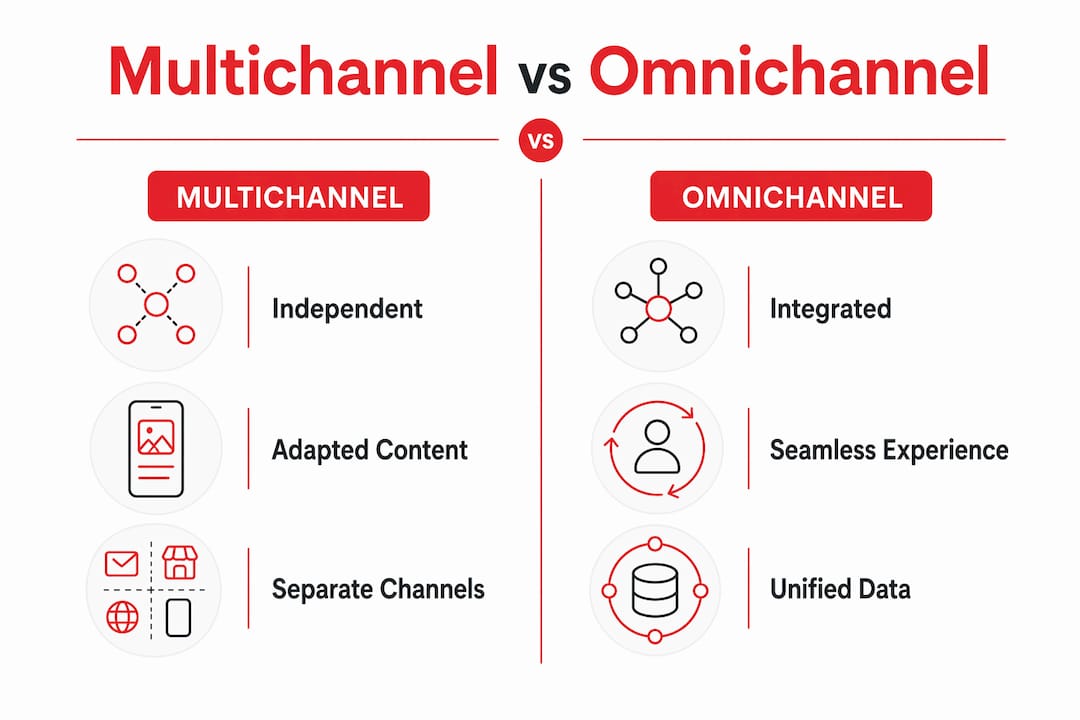
| Dimension | Multichannel | Omnichannel |
|---|---|---|
| Channel relationship | Independent platforms, each managed separately | Integrated channels sharing unified data and context |
| User experience goal | Maximum reach across platforms | Seamless, continuous experience across touchpoints |
| Technology requirement | API-driven CMS, scheduling tools | Centralized data layer, integrated workflows, unified governance |
| Complexity | Moderate | High |
| Best fit | Growth-stage companies scaling reach | Enterprise brands prioritizing customer journey continuity |
Multichannel manages independent channels; omnichannel integrates them into one seamless customer experience. The practical implication is significant. An omnichannel setup requires centralized content, unified customer data, integrated workflows, and brand governance across every touchpoint. A multichannel setup requires smart content adaptation and a reliable publishing infrastructure. For most growth-stage companies, multichannel is the right starting point. Omnichannel is the destination after you have the data infrastructure to support it.
Multichannel and omnichannel are frequently confused, and that confusion leads to misaligned technology investments. Teams buy enterprise omnichannel platforms before they have the content volume or data maturity to use them. Start with multichannel. Build the habits. Then layer in integration.
Pro Tip: If your team cannot consistently publish adapted content to three channels, you are not ready for omnichannel. Fix the production workflow first.
Best practices for multichannel content management at growth-stage companies
Scaling multichannel content without burning out your team requires a model, not just a tool. Here is what works.
-
Adopt the pillar content model. One authoritative asset can be systematically adapted into multiple channel-specific formats. A single research report becomes a webinar, a blog series, a LinkedIn newsletter, and a podcast episode. This approach saves resources and keeps messaging consistent. Growth-stage companies that skip this model end up creating net-new content for every channel, which is unsustainable.
-
Map channels to audience segments before you publish anything. Not every channel reaches the same buyer. A developer persona lives on GitHub and Hacker News. A CMO persona reads newsletters and attends LinkedIn Live events. Channel mapping prevents you from publishing everywhere and measuring nothing.
-
Sequence your publishing schedule. Coordinated publishing means your blog post goes live Monday, the LinkedIn summary drops Tuesday, and the email digest lands Thursday. This sequence extends the life of a single asset and creates multiple touchpoints without additional production work.
-
Use a central content repository as your single source of truth. When edits propagate automatically from one location, you eliminate version control problems and reduce the risk of outdated content living on secondary channels.
-
Select metrics that map to channel behavior. Email open rates, LinkedIn engagement rate, organic search impressions, and video watch time are all valid metrics. They measure different things. Tracking them together in a cross-channel dashboard gives you a real picture of content performance. Tools like Google Looker Studio or a custom analytics panel let you pull these into one view.
-
Prioritize content repurposing with AI to close the production gap. AI tools now generate SEO and GEO-optimized articles and automate asset creation from single content sources. This is not about replacing writers. It is about removing the bottleneck between strategy and execution.
Key challenges in multichannel content management
Most teams hit the same three walls. Knowing them in advance makes them easier to avoid.
-
Siloed channel management. When your social team, email team, and SEO team operate independently, messaging drifts. A product launch looks different on every channel, and customers notice. The fix is a shared content calendar and a single brief that travels with every asset through production.
-
Production volume. Production capacity is the biggest bottleneck in multichannel distribution. Teams that try to create original content for every channel hit a wall fast. Repurposing and automation are not shortcuts. They are the only way to maintain quality at scale.
-
Governance gaps. Centralized governance answers the operational questions that kill momentum: Who approves content before it publishes? Who owns version control? What happens when a channel-specific piece contradicts the brand guide? Without clear answers, you get inconsistent messaging and duplicated effort.
-
Format mistakes disguised as strategy. Publishing a 1,200-word blog post as a LinkedIn update is not multichannel management. It is cross-posting with extra steps. Every channel has native format expectations. Respecting those expectations is what separates a multichannel strategy from a multichannel mess.
Pro Tip: Assign a single content owner per campaign, not per channel. That person is responsible for the core asset and all its adaptations. This one structural change eliminates most governance problems.
How to choose the right CMS for multichannel content delivery
Technology is not the strategy. But the wrong technology makes good strategy impossible.
-
Prioritize API-first and composable CMS platforms over traditional page-based systems. A traditional CMS like an older version of WordPress ties content to presentation. A composable architecture separates content from display, so the same asset can render as a web page, a mobile push notification, or a voice response without rebuilding anything. Contentful, Sanity, and Storyblok are well-known examples in this category.
-
Require a centralized content repository. Your CMS should function as the single source of truth for every asset. When a product name changes, that edit should propagate to every channel automatically. If your team is manually updating content in five separate places, the CMS is not doing its job.
-
Check integration depth before you commit. A CMS that does not connect to your email platform, social scheduler, analytics stack, and automation tools creates manual handoffs. Manual handoffs create errors. Look for native integrations or a strong API layer that supports tools like HubSpot, Mailchimp, Buffer, or custom-built CMS features for SaaS teams.
-
Evaluate workflow and approval features. Governance lives inside your CMS. Role-based permissions, approval queues, and version history are not nice-to-haves. They are the infrastructure that keeps a multichannel operation from collapsing under its own volume.
| CMS capability | Why it matters |
|---|---|
| API-first architecture | Delivers content to any channel without rebuilding assets |
| Centralized content repository | Single source of truth eliminates version conflicts |
| Workflow and approval tools | Supports governance and brand consistency at scale |
| Native integrations | Reduces manual handoffs between publishing and analytics tools |
Understanding what a web CMS actually does at the infrastructure level helps you ask better questions before you sign a contract.
Key takeaways
Multichannel content management works when you combine a composable CMS, a pillar content model, and clear governance into one repeatable system.
| Point | Details |
|---|---|
| Start with atomization | Break one authoritative asset into channel-specific formats before planning your publishing schedule. |
| Multichannel is not omnichannel | Multichannel manages independent channels; omnichannel integrates them. Choose based on your data maturity. |
| Governance prevents chaos | Assign content ownership per campaign and define approval workflows before scaling distribution. |
| CMS architecture matters | API-first and composable platforms eliminate the manual work that kills multichannel consistency. |
| Production bottlenecks are solvable | Repurposing and AI automation close the gap between content strategy and execution capacity. |
Where most multichannel strategies actually break down
Here is what I see consistently with growth-stage teams: the strategy deck looks great, the channel list is ambitious, and then nothing ships on time. The problem is almost never the idea. It is the gap between the content model and the production reality.
Teams pick five channels before they have a reliable workflow for two. They invest in a CMS before they have defined what a “piece of content” actually means for their brand. And they measure success by volume, not by whether the content is actually adapted for the channel it lands on.
The teams that get this right do one thing differently. They treat their content hub as infrastructure, not a folder. Every asset that enters the system has a defined set of derivatives: the long form, the short form, the visual, the audio clip. That structure is decided before production starts, not after.
I also think the conversation around AI in multichannel is moving faster than most teams realize. AI-optimized content visibility in tools like ChatGPT, Perplexity, and Claude is now a real distribution channel. If your content is not structured for AI citation, you are missing a channel that is growing faster than social search. That is not a future problem. It is a 2026 problem.
— Josh
Build a multichannel content system that actually scales
Rule27design builds custom content management systems for growth-stage companies that have outgrown their basic tools. If your team is managing multichannel distribution through a patchwork of spreadsheets, disconnected platforms, and manual handoffs, there is a better way.

The Rule27design Innovation Lab is where we design and build the infrastructure behind scalable multichannel content operations. That includes composable CMS builds, cross-channel publishing workflows, AI-optimized content pipelines, and analytics dashboards that give you real visibility across every channel. Our clients typically see a 40% improvement in operational efficiency after implementation. If you are ready to replace the chaos with a system that works, let’s talk.
FAQ
What is multichannel content management in simple terms?
Multichannel content management is the practice of creating one core piece of content and adapting it for distribution across multiple platforms simultaneously. Each channel receives a version formatted for its native audience and behavior.
How is multichannel different from cross-posting?
Cross-posting pushes identical content to every platform. Multichannel management adapts the format, length, and presentation for each channel while preserving the core message.
What technology do you need for multichannel content management?
An API-first or composable CMS is the foundation. It acts as a central content repository and pushes adapted assets to each channel without requiring teams to rebuild content manually for every platform.
When should a growth-stage company move from multichannel to omnichannel?
Move to omnichannel when you have unified customer data, consistent publishing across at least three channels, and the integration infrastructure to connect those channels into a single customer journey. Most growth-stage companies are not there yet.
What is the biggest mistake teams make with multichannel content strategy?
The most common mistake is planning distribution before planning adaptation. Teams decide which channels to use before defining how content will be formatted for each one, which defaults to cross-posting and produces poor channel performance.
Topics

About the Author
Josh AndersonCo-Founder & CEO at Rule27 Design
Operations leader and full-stack developer with 15 years of experience disrupting traditional business models. I don't just strategize, I build. From architecting operational transformations to coding the platforms that enable them, I deliver end-to-end solutions that drive real impact. My rare combination of technical expertise and strategic vision allows me to identify inefficiencies, design streamlined processes, and personally develop the technology that brings innovation to life.
View Profile

