

Discover 5 content optimization tools SaaS for 2025. Compare features and benefits to enhance your content strategy.
Choosing the right tools for content creation, brand growth, and digital success can shape how fast ideas move from concept to results. Different teams need unique combinations of creativity, automation, planning, and technical support. Some focus on collaboration and workflow, while others want deep personalization or data-driven insights. The best solution depends on your goals and how you like to work. Curious what sets today’s top platforms apart and how they really help teams win? Let’s see what each brings to the table.
Rule27 Design
At a Glance
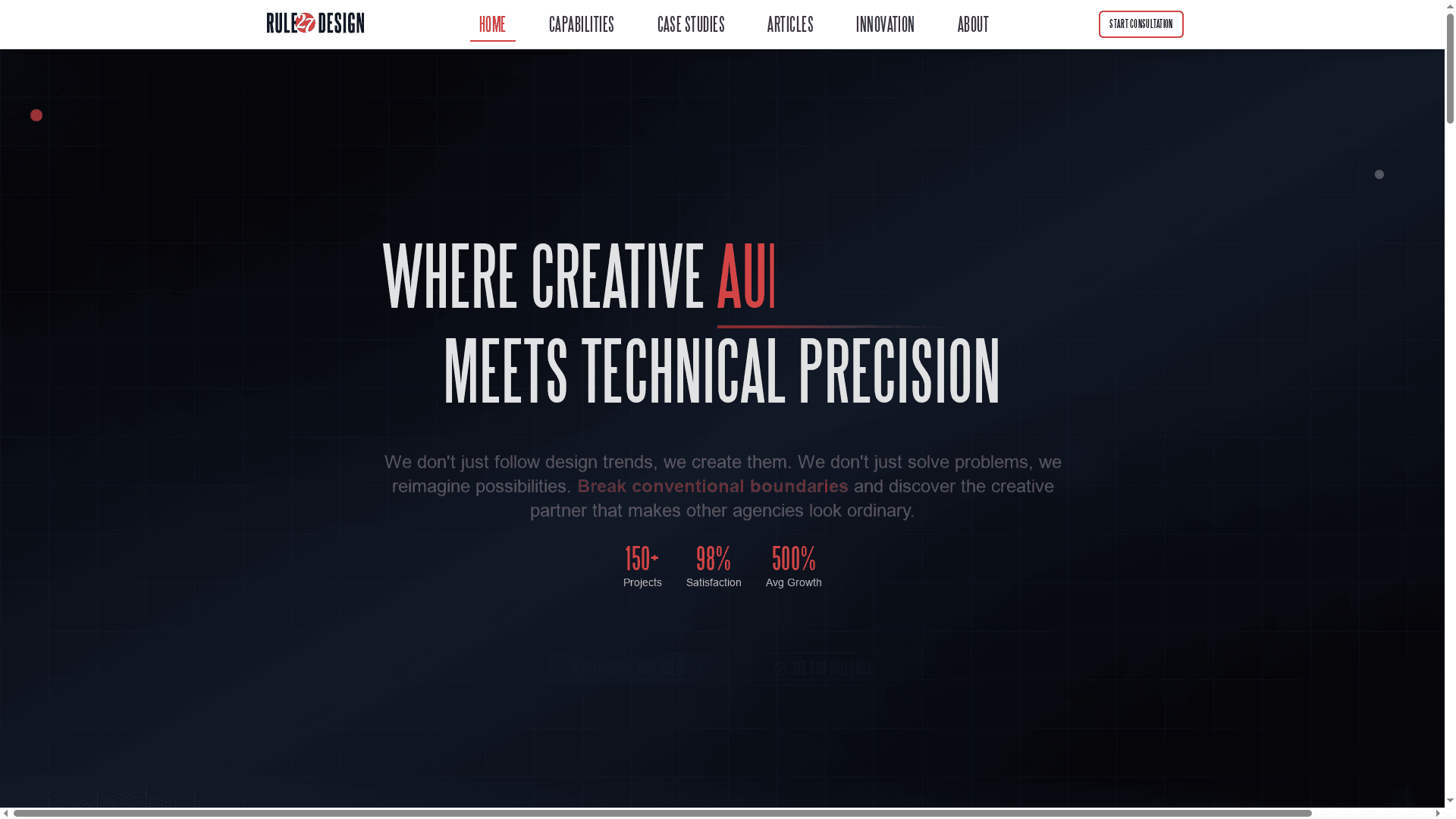
Rule27 Design is a full-service digital agency that blends creative ambition with technical execution to transform brands. Their work spans brand strategy, a creative studio, data-driven digital marketing, custom technical solutions, and executive advisory—positioning them as a strategic partner for ambitious organizations. If you need a team that pushes creative boundaries while delivering measurable results, Rule27 is built for that. Note: some website navigation quirks and a consult-first pricing model reflect a focus on bespoke engagements rather than off-the-shelf packages.
Core Features
Rule27’s capabilities combine creative and technical services into one offering: brand strategy and rebranding; a creative studio that covers graphic design, motion graphics, videography, and photography; data-driven digital marketing including SEO, SEM, social media, and email; custom technical solutions such as web development, mobile apps, CRM, and cloud solutions; plus executive advisory and fractional leadership. Those five universes let you move from strategy to execution without fragmenting ownership across multiple vendors.
Pros
- Highly awarded and recognized in the industry: Rule27’s awards validate their creative and strategic quality in competitive markets.
- Diverse capabilities across creative and technical domains: They cover everything from motion graphics to CRM development, which reduces the friction of coordinating separate vendors.
- Strong client satisfaction rate of 98%: A 98% satisfaction rate signals reliable delivery and consistent client experience.
- Impressive project and client growth statistics: Rapid growth indicates both market demand and an ability to scale outcomes for clients.
- Partnerships with major technology providers like Adobe and Google: These partnerships strengthen execution and give you access to proven toolchains.
Who It’s For
Rule27 is ideal for businesses and organizations seeking comprehensive branding, digital marketing, and technical solutions—especially those aiming for bold, boundary-pushing transformations. If you represent a growth-stage company, an enterprise content team, an e-commerce brand, or a digital agency needing strategic creative muscle plus development capability, Rule27 fits. It’s less tuned to buyers who want fixed, self-serve pricing and more suited to teams that prioritize tailored strategy and high-touch execution.
Unique Value Proposition
Rule27’s unique value is the seamless integration of high-caliber creative work with robust technical delivery and executive advisory. Many firms focus on either creative or development; Rule27 intentionally converges both, enabling cohesive brand transformations that are conceptually strong and technically sound. Their recognized creative excellence, paired with data-driven marketing and custom development, means you get brand identity, launch assets, performance marketing, and the underlying systems engineered to scale—managed by one partner. The consult-first pricing and occasional placeholder pages on the site are design choices that reflect a boutique, bespoke engagement model rather than a commodity product. In short: you get a unified team that reduces coordination overhead and preserves strategic continuity from brief to scale.
Real World Use Case
A client engaged Rule27 for a full rebrand that included a new logo, refreshed brand identity, and a data-driven digital marketing strategy. Rule27 executed creative assets, redesigned digital touchpoints, and implemented marketing campaigns that resulted in measurable growth and stronger industry recognition for the client.
Pricing
Pricing is not specified on the website; engagements require contacting Rule27 for consultation and custom quotes, which aligns with their tailored, project-based approach.
Website: https://rule27design.com
Contentful

At a Glance
Contentful is a digital experience platform that helps teams create, manage, and scale structured content across channels. It balances no-code tools for marketers with extensive developer APIs, enabling both rapid edits and deep integrations. Bottom line: it’s a strong choice for organizations that need flexible, scalable content infrastructure—but smaller teams should expect setup complexity and potential cost as they grow.
Core Features
Contentful provides scalable content management across websites, apps, kiosks, and digital signage, built on modular, reusable content components. It includes personalization and AI-driven content creation alongside no-code tools for marketers to create and tweak experiences. Automation and workflow features speed up deployment and updates, while extensive APIs enable deep developer extensibility and integration with e-commerce, customer data, and marketing systems.
Pros
- Supports multi-language content and global audiences: Contentful’s architecture is designed to handle multilingual content, making it suitable for global rollouts and regional variations.
- Integrates seamlessly with e-commerce, customer data, and marketing tools: The platform connects into broader stacks so you can orchestrate content with commerce and customer systems.
- Offers extensive APIs and extensibility for developers: Developers can extend functionality and build custom experiences using Contentful’s API-first approach.
- High uptime (99.99%) and professional support options: The platform emphasizes reliability and offers professional support channels for mission-critical deployments.
- Enables rapid content updates with real-time editing and updates: Teams can push content changes quickly and ensure consistency across channels with real-time updates.
Cons
- Complexity of initial setup for advanced integrations: Setting up advanced integrations requires technical resources and planning, which can slow initial time-to-value.
- Premium and enterprise plans might be costly for small businesses: Customizable enterprise pricing can become expensive for smaller teams that need advanced features.
- Learning curve for non-technical users for advanced features: While no-code tools exist, mastering advanced capabilities still requires training or developer support.
Who It’s For
Contentful fits organizations seeking a flexible, scalable digital content management and experience platform—marketing teams, content managers, developers, and digital strategists who need modular content, personalization, and global publishing capabilities. If your team manages multiple channels or anticipates rapid scale, Contentful is built for that complexity.
Unique Value Proposition
Contentful’s unique value lies in combining marketer-friendly no-code controls with an API-first architecture that developers can extend. That dual approach lets product and marketing teams iterate quickly while maintaining a robust, integrable backend that supports enterprise workflows and automation.
Real World Use Case
Large brands use Contentful to deliver personalized experiences across customer touchpoints quickly and consistently. For example, it powers fast updates and tailored content for complex, multi-channel campaigns used by global brands, enabling teams to automate translation, personalize content, and coordinate deployments across web, mobile, and in-store displays.
Pricing
Pricing is customizable based on business size and needs, with plans ranging from free starter options to enterprise solutions; specific costs are available upon request from the vendor’s sales team.
Website: https://contentful.com
Storyblok
At a Glance
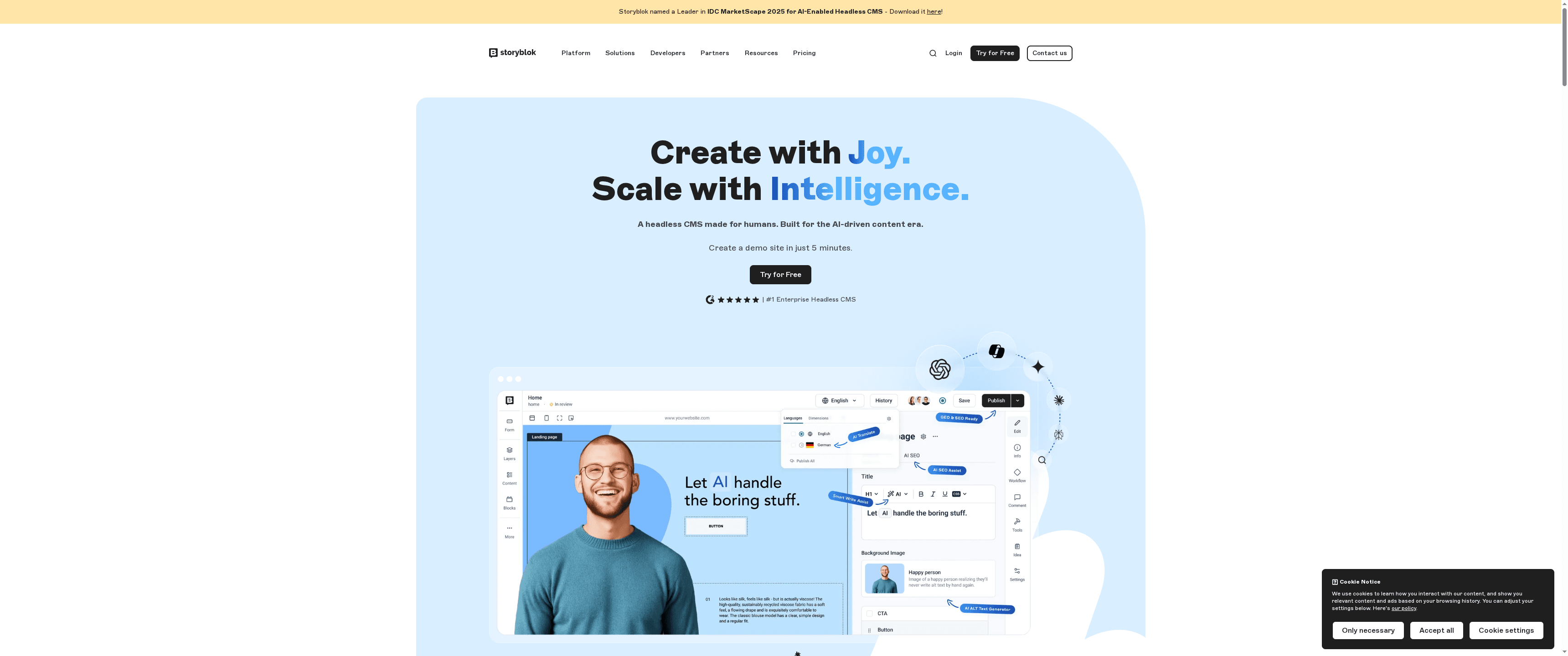
Storyblok is a modern headless CMS built around a visual editor and API-first architecture, designed for the AI-driven content era. It balances a developer-friendly, component-based approach with an intuitive drag-and-drop editor for marketers. The platform is enterprise-ready and strong on automation, AI-native search, and multilingual content, but pricing and advanced features can be complex for smaller teams.
Core Features
Storyblok combines a visual editor with headless CMS flexibility: editors use drag-and-drop components while developers consume content via customizable APIs. It supports major frameworks like Next.js, Vue, and React and includes automation tools (Flowmotion), a vector data layer (Strata) for AI-native search and personalization, content staging and environment spaces for collaboration, and integrations with build and commerce platforms. Security and compliance (including ISO 27001) and multilingual support with unlimited locales on premium tiers round out a platform built for scale.
Pros
- Highly scalable and customizable for enterprise needs: Storyblok’s API-first, component-based architecture lets development teams craft bespoke content models that scale with traffic and complexity.
- Intuitive visual editing interface: Non-technical editors can assemble pages with drag-and-drop components while previewing changes in context, reducing handoffs.
- Rich feature set for automation, AI, and workflows: Built-in automation and the vector data layer enable AI search, personalization, and automated content flows that speed time-to-value.
- Strong developer support with extensive API options: Developers get framework-agnostic APIs and component patterns that integrate with modern stacks like Next.js and React.
- Recognized leader in headless CMS: Industry recognition and awards indicate broad adoption and a mature product roadmap.
- Robust security and uptime guarantees: Enterprise controls and certifications support regulated industries and high-availability requirements.
Cons
- Pricing complexity with multiple plans and add-ons can confuse decision-makers: The mix of free starter tiers, feature-based paid plans from $99/month, and custom enterprise pricing requires careful cost evaluation.
- Potentially steep learning curve for beginners when customizing: Teams new to headless CMS patterns may need time to adapt development and editorial workflows.
- Advanced features and enterprise plans often require sales engagement: Accessing higher-tier capabilities typically involves direct contact with sales, which can slow procurement for fast-moving teams.
Who It’s For
Storyblok fits development teams, marketers, and enterprises that need a scalable, customizable, AI-enabled headless CMS. If you run multi-language sites, need personalized experiences, or want to separate content creation from presentation while keeping editors comfortable, Storyblok is a solid choice. Smaller teams should weigh the learning curve and plan choices against their immediate needs.
Unique Value Proposition
Storyblok’s unique value lies in pairing a joyful, visual editing experience with a powerful, API-first backend and AI-native capabilities (vector search and personalization). That blend reduces editorial friction while giving developers full control of delivery and scalability.
Real World Use Case
A global retail brand uses Storyblok to manage multi-language e-commerce sites: teams stage and localize content in separate environments, automate updates through Flowmotion, and deliver personalized product recommendations via the vector data layer across channels.
Pricing
Starter plan is free with limited features; paid plans start at $99/month and scale based on features and usage, with custom enterprise options available for large organizations.
Website: https://storyblok.com
Content Workflow by Bynder
At a Glance
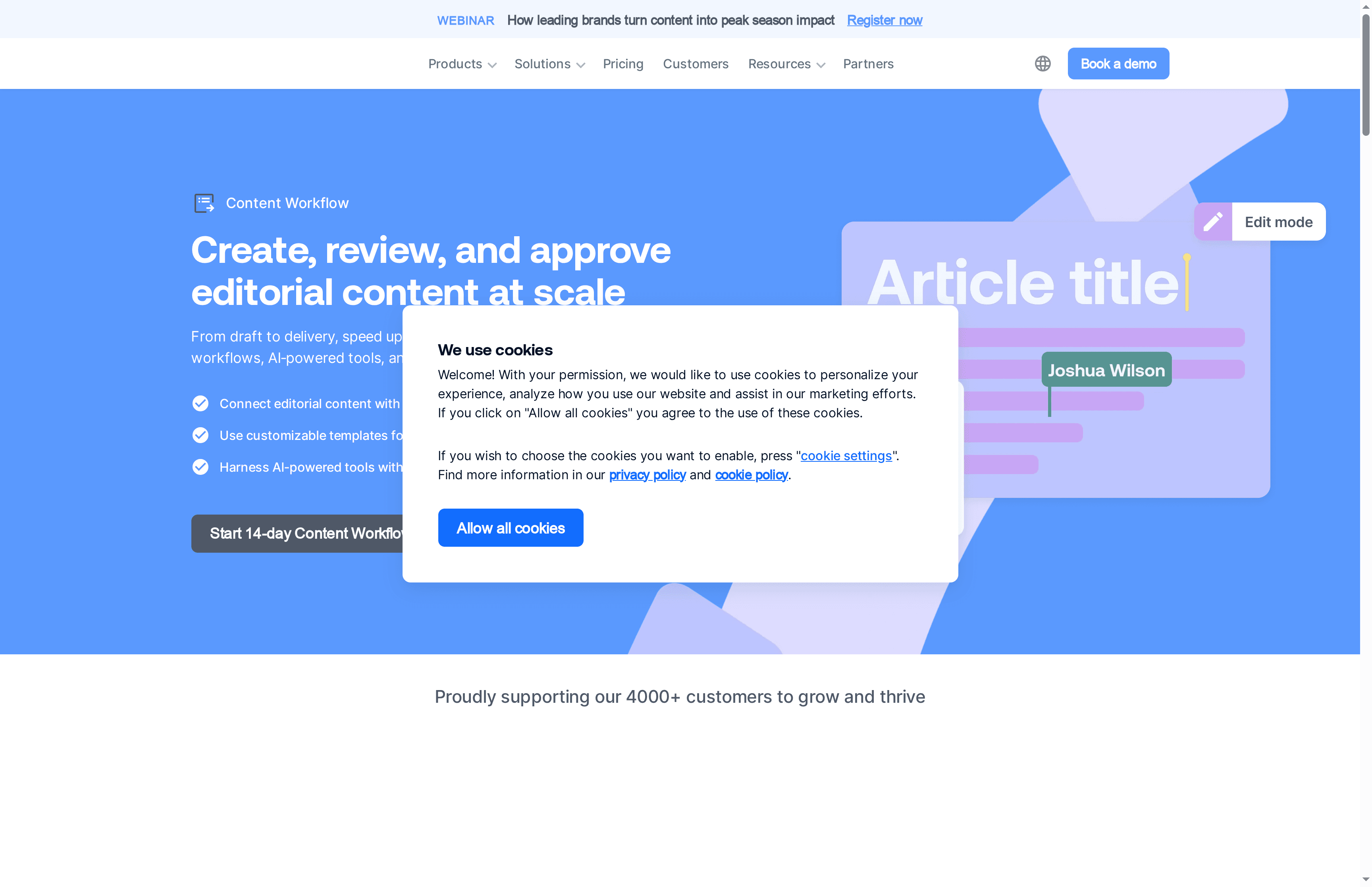
Content Workflow by Bynder is a collaborative content management platform built to speed up creation, review, and approval for editorial teams working at scale. It combines automated workflows, AI-assisted drafting and editing, and real-time collaboration into a single workspace. If you need consistent, repeatable content production across blogs, emails, social, and docs, this is a practical, production-focused option — but it isn’t without limits.
Core Features
The product provides end-to-end editorial capabilities: create, review, and approve content at scale using automated and customizable workflows. AI-powered tools help with drafting, editing, translating, and adapting tone, while templates enforce structure and speed. Real-time collaboration with inline comments and change visibility keeps stakeholders aligned, and integrations via API and plugins allow you to connect the platform to your CMS and digital asset management systems.
Pros
- Structured workflows reduce bottlenecks: Automated review processes and customizable flows let you model approvals and handoffs to match your team’s reality. This lowers miscommunication and keeps content moving.
- AI tools accelerate production: Built-in drafting and tone-adaptation features let teams iterate faster, cutting initial draft times and making consistent voice easier to maintain.
- Collaboration is visible and auditable: Inline comments, change visibility, and audit trails make it clear who changed what and why, which is critical for compliance and cross-functional signoffs.
- Flexible templates for consistency: Customizable templates enforce structure across formats, reducing rework on repeatable content like product docs or campaign assets.
- Multi-format support: It handles blogs, social posts, emails, and documentation in the same system, simplifying content operations across channels.
Cons
- UI limited to English, which may be restrictive for multilingual teams or global rollouts.
- Dependence on third-party AI engine updates (ChatGPT) introduces external variability in features and performance that Bynder cannot control.
- Requires integration setup for systems outside available options, which can add implementation time and engineering effort.
Who It’s For
Content Workflow by Bynder is aimed at content teams, marketing departments, and digital asset managers who need a centralized, repeatable way to produce editorial content with automation and AI support. Growth-stage SaaS companies, digital agencies, and enterprise marketing teams that publish frequently and require strict approval paths will benefit most. If your team needs immediate multilingual UI support, plan for additional tooling or processes.
Unique Value Proposition
Bynder’s strength is its combination of production-grade workflow automation and integrated AI editing inside a collaborative workspace. Instead of cobbling together separate drafting, review, and asset systems, you get a single platform that enforces consistency, records approvals, and plugs into your CMS or DAM.
Real World Use Case
A marketing organization used Content Workflow to formalize review and approval for campaign assets; the result was fewer errors in published materials and faster time-to-market because approvers could review inline and templates reduced rewrite cycles. The audit trail also simplified compliance checks.
Pricing
Starts with a 14-day trial; specific pricing details are not published on the site and require contacting the vendor for tailored quotes.
Website: https://gathercontent.com
MarketMuse
At a Glance
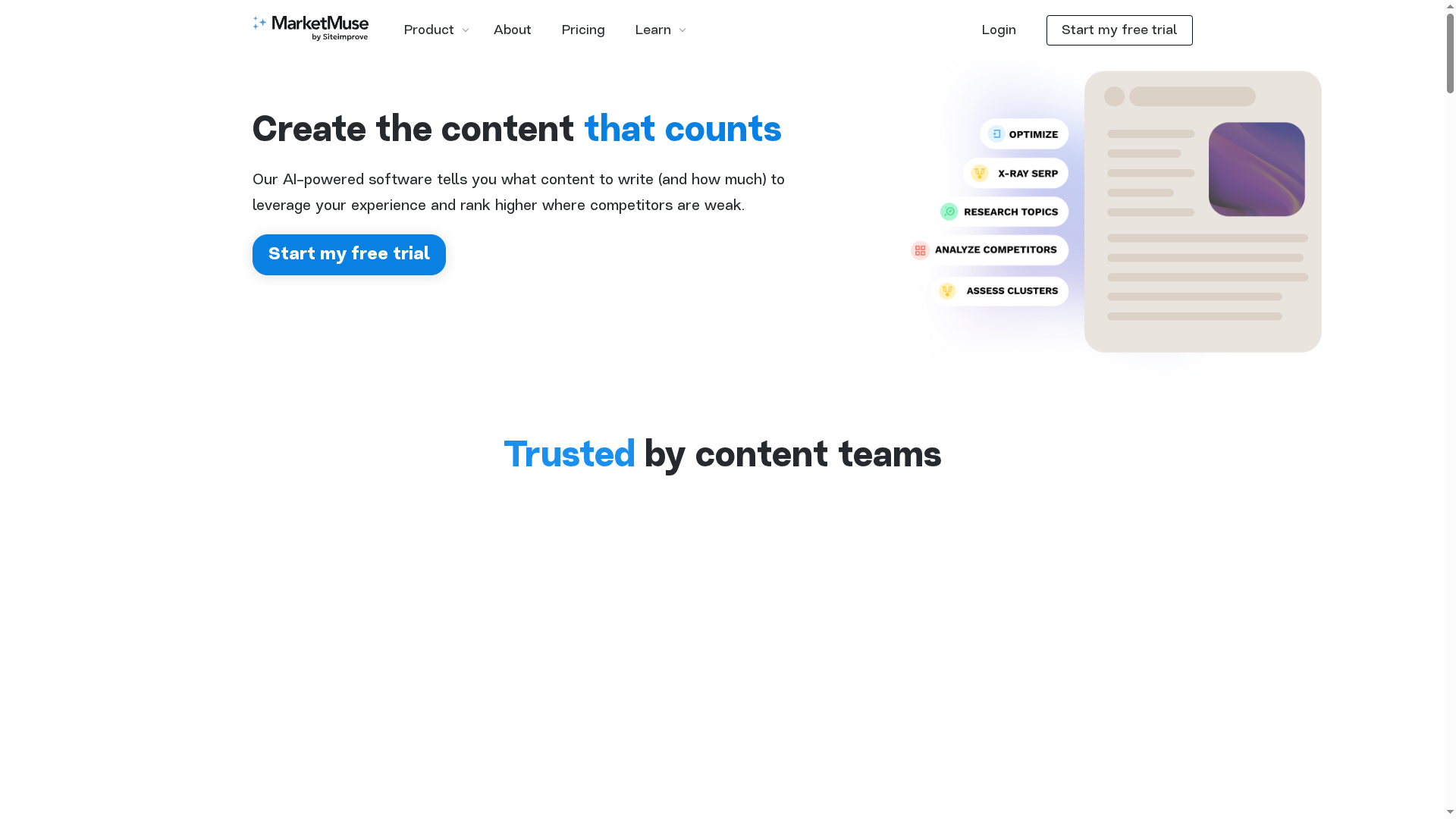
MarketMuse is an AI-driven content planning and optimization platform that helps teams find topic gaps, prioritize high-value content, and build data-backed editorial roadmaps. It analyzes your existing content and competitor landscapes to surface opportunities you can act on quickly. If you need actionable topic clusters and proprietary scoring to guide strategy, MarketMuse delivers—though it doesn’t replace a CMS or write finished articles for you.
Core Features
MarketMuse centers on AI analysis of your content inventory and competitive research to generate prioritized topic clusters and content roadmaps. Its core capabilities include AI-driven content inventory analysis, identification of high-value topic clusters, competitor gap analysis, personalized difficulty and content scoring metrics, and rapid generation of content planning roadmaps. In practice, the platform turns a messy site map into a prioritized list of pages to create or update, complete with suggested scopes and effort estimates.
Pros
- Automates content analysis and planning with AI: MarketMuse removes much of the manual research burden by scanning your content and surfacing clear opportunities.
- Helps identify content gaps and quick wins: The platform highlights where competitors rank and where you can capture low-hanging but valuable topics.
- Enhances topical authority and competitive positioning: By organizing content into topical clusters, it supports strategies that build subject authority over time.
- Supports team collaboration and workflows: The tool is designed for multi-user teams and agencies managing multiple client sites, helping keep plans and briefs centralized.
- Provides proprietary metrics like personalized difficulty and competitive advantage: These unique scores help you prioritize work based on effort vs. potential impact.
Cons
- Does not manage or host content like a CMS: MarketMuse focuses on strategy and planning rather than content publishing, so you’ll still need a CMS or integration layer.
- Does not generate or write content directly: The platform provides outlines and prioritization, but it doesn’t produce final content, so writing resources remain necessary.
- Pricing might be high for small teams or individual users: Tiers and feature limits mean smaller teams could find the cost-to-benefit ratio challenging.
Who It’s For
MarketMuse is best for mid-sized to large content teams, SEO professionals, and agencies that require deep, data-driven content planning and competitor analysis. If you run a content operation that needs prioritized roadmaps and evidence-based briefs rather than a hands-off content generator, this will fit well.
Unique Value Proposition
MarketMuse’s unique value lies in converting content inventory and competitive signals into prioritized, actionable roadmaps using proprietary scoring—so teams know where to invest time for the biggest authority gains. It’s strategy-first: less handholding, more signal.
Real World Use Case
A content team uses MarketMuse to audit existing pages, compare topical coverage to industry leaders, and generate a prioritized content plan. The result is a focused publishing calendar that targets high-value clusters and leads to measurable traffic and ranking improvements over time.
Pricing
MarketMuse offers multiple plans: Free (low volume), Optimize, Research, and Strategy tiers, with features and limits scaling by number of tracked topics, content briefs, and users. Exact pricing varies by tier and usage level.
Website: https://marketmuse.com
Digital Marketing and Content Management Tools Comparison
This table provides a comprehensive comparison of digital marketing and content management platforms based on features, target users, key pros and cons, and pricing models.
| Platform | Key Features | Pros | Cons | Pricing |
|---|---|---|---|---|
| Rule27 Design | Brand strategy, creative studio, digital marketing, technical solutions, executive advisory | Highly awarded, diverse capabilities, 98% satisfaction rate, strong growth, tech partnerships | Consult-first pricing model, lacks fixed self-serve pricing | Consult-based, bespoke quotes |
| Contentful | No-code tools, personalization, AI-driven content, extensive APIs | Multi-language support, seamless integrations, extensibility, 99.99% uptime | Complex setup, costly for small businesses, learning curve for advanced features | Customizable, contact vendor |
| Storyblok | Visual editor, API-first architecture, automation, AI-native search, multilingual support | Scalable and customizable, intuitive interface, rich features, strong developer support | Pricing complexity, learning curve for customization, sales engagement for enterprise | Starts at $99/month |
| Content Workflow by Bynder | Automated workflows, AI drafting, real-time collaboration | Structured workflows, AI tools, visible collaboration, flexible templates, multi-format support | UI in English only, dependent on third-party AI, requires integration setup | 14-day trial, contact vendor |
| MarketMuse | AI-driven content planning, competitor analysis, topic clustering, proprietary metrics | Automates analysis, identifies content gaps, supports collaboration, provides proprietary metrics | Does not manage content, doesn’t generate content, potentially pricey for small teams | Free and paid plans |
Frequently Asked Questions
What are the key features to look for in content optimization tools?
When evaluating content optimization tools, prioritize features like AI-driven analysis, content gap identification, and collaboration support. Aim to choose tools that help streamline your content strategy and enhance team collaboration, ensuring a more efficient content creation process.
How can I assess the effectiveness of a content optimization tool?
To assess the effectiveness, track metrics such as organic traffic increase and engagement over time. Aim to measure performance within 30–60 days of using the tool to see tangible results and make data-driven decisions.
Can content optimization tools help with SEO improvements?
Yes, content optimization tools significantly aid in improving SEO by identifying keyword gaps and suggesting high-value content topics. Use these insights to create a content calendar focused on strategically beneficial keywords to enhance your search engine rankings.
What should I consider regarding pricing when choosing a content optimization tool?
Consider the pricing tiers and any potential limitations on features, users, or content tracking. Evaluate your budget against the value provided by the tool to ensure it meets your content needs without exceeding your financial limits.
How can I integrate content optimization tools into my current workflow?
Start by evaluating the specific needs of your team and selecting a tool that fits seamlessly into your existing processes. Set up training for your team on the new tool to ensure they can use it effectively and efficiently, maximizing productivity from day one.
Topics

About the Author
Josh AndersonCo-Founder & CEO at Rule27 Design
Operations leader and full-stack developer with 15 years of experience disrupting traditional business models. I don't just strategize, I build. From architecting operational transformations to coding the platforms that enable them, I deliver end-to-end solutions that drive real impact. My rare combination of technical expertise and strategic vision allows me to identify inefficiencies, design streamlined processes, and personally develop the technology that brings innovation to life.
View Profile

