

Learn what SEO-friendly content really means in 2026, covering E-E-A-T, AI search visibility, and practical strategies for SaaS content teams to rank higher.
TL;DR:
- SEO-friendly content now balances human value with machine readability, emphasizing expertise and trust.
- Deep, authoritative content aligned with search intent and updated regularly outperforms keyword stuffing.
- Building content clusters, structuring for skimmability, and signaling authority are key for SaaS SEO success.
Most SaaS content teams think SEO-friendly means keyword-rich. Load up the right phrases, hit a word count, and you’re done. But that approach is quietly losing ground. SEO-friendly content now balances human value with machine readability, and the teams who get this right are pulling ahead fast. Search engines and AI tools like ChatGPT and Perplexity are getting better at recognizing genuine authority. This guide breaks down what SEO-friendly content actually looks like in 2026 and gives you a clear path to building it.
Key Takeaways
| Point | Details |
|---|---|
| Intent comes first | Successful SEO-friendly content aligns directly with user and search intent, not just keyword rankings. |
| E-E-A-T matters | Expertise, experience, authority, and trustworthiness are essential to compete in modern search, especially for SaaS. |
| Structure improves visibility | Clear headings, skimmable sections, and frequent updates boost both human engagement and algorithmic reach. |
| Optimize for humans and AI | Balance readability, Q&A, and supporting data to win visibility in both traditional and AI-powered searches. |
| Continuous improvement | Audit and refresh your core SaaS content regularly to adapt to market and algorithm changes. |
What does SEO-friendly content actually mean?
Let’s clear something up. SEO-friendly content is not a checklist of keywords sprinkled into paragraphs. It’s content that earns visibility because it genuinely helps people and signals trust to algorithms at the same time.
For SaaS brands, this matters more than ever. Your buyers are sophisticated. They’re comparing tools, reading reviews, and asking AI assistants for recommendations. If your content doesn’t speak to their actual intent, it won’t rank, and it won’t get cited.
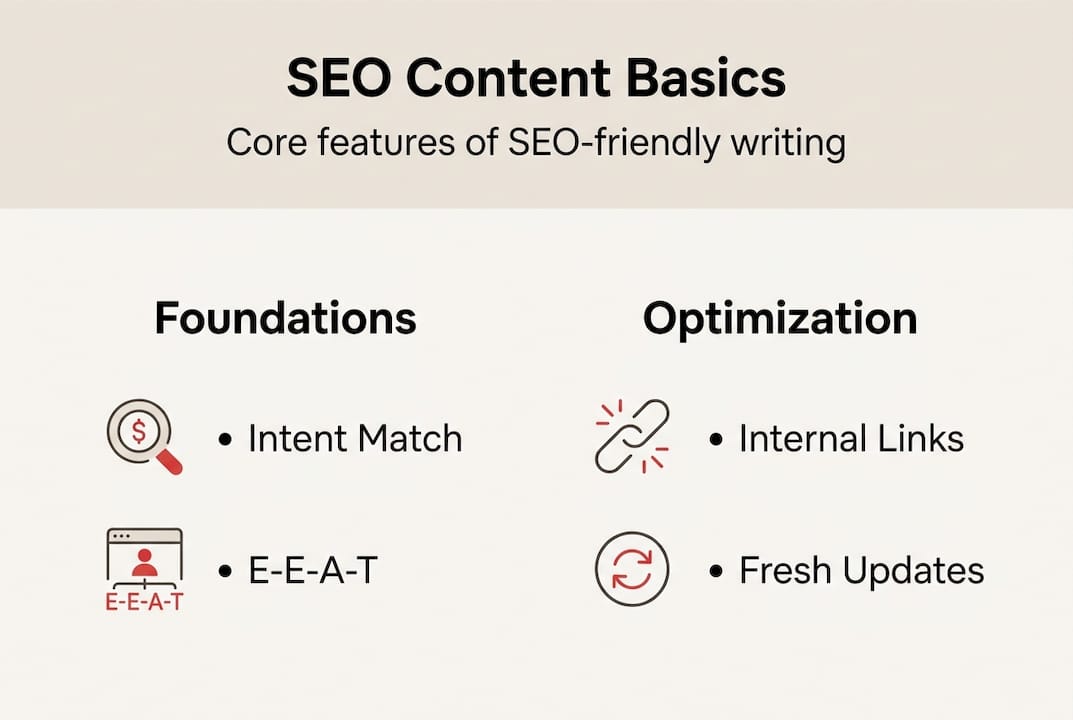
The modern definition centers on E-E-A-T, which stands for Expertise, Experience, Authoritativeness, and Trustworthiness. Google uses E-E-A-T as a quality framework, especially for YMYL (Your Money or Your Life) topics like finance, health, and, yes, software buying decisions. Optimizing for both search and AI means balancing E-E-A-T, intent, and readability all at once.
Here’s how old-school SEO thinking compares to the modern approach:
| Old approach | Modern approach |
|---|---|
| Keyword density focus | Search intent focus |
| Thin, high-volume content | Deep, topically authoritative content |
| One-time publish | Regular updates and freshness |
| Backlinks as primary signal | E-E-A-T plus entity optimization |
| Desktop-first structure | Skimmable, mobile-first formatting |
The shift is real. And it’s not just about Google. AI tools now pull answers from content they trust. That means your content needs to be clear, structured, and credible.
Key traits of genuinely SEO-friendly content:
- Matches the specific intent behind a search query
- Uses keywords naturally, not forcefully
- Demonstrates real expertise through examples and data
- Is structured so both humans and bots can navigate it easily
- Gets updated as information changes
“The brands winning in search right now aren’t gaming the algorithm. They’re building content so good that the algorithm has no choice but to reward it.”
For a deeper look at what signals actually move the needle, check out content ranking factors that are shaping results in 2026. And if you want a broader view of how content strategy fits the bigger picture, content marketing best practices are worth reviewing too.
Core components of SEO-friendly content
With a definition in hand, let’s break down the essential components every piece of SEO-friendly content should feature.
The foundation is keyword research tied directly to intent. Not just what people search, but why they search it. Informational, navigational, and transactional queries need different content approaches. Skipping this step means you’re guessing.
Content gap analysis is the next move. Look at what your competitors rank for that you don’t. These gaps are opportunities sitting in plain sight. Tools like Ahrefs or Semrush make this fast.

Structure matters more than most teams realize. Headings, short paragraphs, bullet lists, and tables all help readers skim and help bots parse. Readability directly drives conversions, and 43% of marketers now prioritize it as a core content metric.
The core components at a glance:
- Intent-matched keyword research
- Content gap analysis
- Skimmable structure with clear headings
- Short paragraphs with BLUF (Bottom Line Up Front) statements
- Active voice and plain language
- E-E-A-T signals like author bios, citations, and case studies
- Internal links to build topical authority
- Regular content updates for freshness
Regular updates deserve special attention. AI bots strongly favor content published or refreshed within the last three years. Stale content loses ground fast, especially in fast-moving SaaS categories.
Pro Tip: Add a “last updated” date to your top pages. It signals freshness to both readers and crawlers, and it takes about 30 seconds to implement.
Internal linking is another underrated lever. Linking related articles together tells search engines you have depth on a topic, not just one isolated post. Solid content management features make this easier to manage at scale. And if you want to speed up your quality checks, AI-powered content checklists can help your team stay consistent without slowing down.
| Component | Why it matters |
|---|---|
| Keyword intent match | Drives qualified traffic |
| Skimmable structure | Reduces bounce, aids bots |
| E-E-A-T signals | Builds trust with Google and AI |
| Regular updates | Maintains freshness and ranking |
| Internal links | Builds topical authority |
Key strategies for optimizing SaaS content
With the components clear, let’s translate them into practical strategies you can implement in your SaaS content program.
Start with intent-first research. Before writing anything, confirm what the searcher actually wants. Is this a comparison query? A how-to? A definition? Shape the entire piece around that intent, not around a keyword count.
Build content clusters. A cluster is a hub page on a broad topic supported by several detailed pages on subtopics. This structure signals topical authority to Google and makes it easier for AI tools to cite you as a reliable source. It’s one of the highest-leverage moves in SaaS SEO.
A practical optimization workflow:
- Run intent-first keyword research
- Map keywords to a cluster structure
- Write with skimmability in mind (short paragraphs, bold key points)
- Add Q&A sections and data tables for AI citation potential
- Include real case studies or client examples for E-E-A-T
- Audit and update top-performing pages every 6 to 12 months
- Track both organic rankings and AI citation rates
Clarity, summarization, and E-E-A-T strongly correlate with content cited in AI search experiences. That’s a big deal. If ChatGPT or Perplexity pulls your content into an answer, you’re getting visibility that doesn’t even show up in traditional rank tracking.
Hybrid workflows are the smart play. Use AI tools to speed up research, drafting, and formatting. Use human judgment for strategy, tone, and credibility. Neither alone is as strong as both together.
Pro Tip: Update your three best-performing pages before creating new content. Quick wins compound faster than starting from scratch every time.
Common pitfalls to avoid: over-optimization (stuffing keywords until the writing feels robotic), missing E-E-A-T signals (no author info, no sources, no proof), and forgetting to update content after publishing. Each one quietly drains performance over time. For teams managing this at scale, internal SEO tools and solid content analytics make the difference between guessing and knowing. Brushing up on content marketing fundamentals can also sharpen your strategic thinking.
Advanced nuances and edge cases: YMYL, AI, and contextual factors
It’s not one-size-fits-all. Here’s where advanced scenarios and exceptions matter most.
YMYL content requires a higher standard. If your SaaS touches finance, HR, legal, or healthcare workflows, Google scrutinizes your content more carefully. Real case studies, named expert authors, and transparent sourcing aren’t optional here. They’re the price of entry. YMYL and AI search both demand stronger E-E-A-T, Q&A formats, and authoritative citations.
AI-generated answers have their own logic. Tools like Perplexity and ChatGPT tend to pull from content that is clear, well-structured, and statistically grounded. If your article has a clean summary, a data table, and a Q&A section, you’re far more likely to get cited. That’s not a coincidence. It’s a format signal.
“AI tools don’t reward complexity. They reward clarity. The simpler and more structured your content, the more likely it gets surfaced in an AI response.”
SERP volatility is real. Google’s algorithm updates in 2025 and 2026 have hit SaaS, finance, and health content hard. Chasing every update is exhausting. The better move is building content so fundamentally strong that volatility has less impact on you.
Contextual factors that affect SEO outcomes:
- Site speed: Slow pages lose rankings and users simultaneously
- Security: HTTPS is a baseline requirement, not a bonus
- UX signals: Bounce rate and time on page still influence rankings
- Mobile formatting: Most SaaS buyers read on mobile first
- Schema markup: Helps AI and search engines understand your content structure
Scale doesn’t have to mean lower quality. Smart templates with built-in E-E-A-T prompts and regular content review cycles keep standards high even as output grows. Pair that with AI-powered SEO checklists and your team can move fast without cutting corners.
Why most SaaS teams misunderstand SEO-friendly content
Here’s the honest take. Most SaaS content programs are built around the wrong goal. Teams optimize for output, not authority. They publish frequently, chase trending keywords, and assume volume will eventually pay off. It rarely does.
The real drivers of SEO success are topical depth, genuine expertise, and consistent updates. These are slow, unglamorous, and hard to fake. That’s exactly why they work. Competitors who rely on short-term hacks eventually plateau. Teams who invest in modern ranking factors keep compounding.
The shift to AI search makes this even more urgent. If your content isn’t being cited by AI tools, you’re invisible to a growing segment of buyers who never scroll a traditional SERP. Competing on expertise and clarity is the only sustainable path. Track both AI citations and organic rankings. That’s the full picture now.
Frequently asked questions
What are the most important features of SEO-friendly content?
SEO-friendly content prioritizes search intent, uses keywords naturally, is structured for readability, and is regularly updated for freshness. Intent-driven research and skimmable structure are the core features that drive results.
How does E-E-A-T impact SaaS SEO content?
Strong E-E-A-T signals like expert authorship, case studies, and transparent sourcing are critical for SaaS content, especially on YMYL topics where Google applies extra scrutiny.
What common mistakes hurt SEO content performance?
Keyword stuffing, neglecting content updates, and ignoring search intent are the most costly errors. Over-optimization and stale content quietly drain rankings over time.
How often should SaaS teams update their content?
Top-performing pages should be audited every 6 to 12 months. Regular updates keep content competitive and visible to both search engines and AI bots.
Does optimizing for AI-driven search change content strategy?
Yes. Optimizing for AI search means leaning into clarity, Q&A formats, and current statistics. Clarity and Q&A formats directly boost the chances of your content being cited in AI-generated responses.
Topics

About the Author
Josh AndersonCo-Founder & CEO at Rule27 Design
Operations leader and full-stack developer with 15 years of experience disrupting traditional business models. I don't just strategize, I build. From architecting operational transformations to coding the platforms that enable them, I deliver end-to-end solutions that drive real impact. My rare combination of technical expertise and strategic vision allows me to identify inefficiencies, design streamlined processes, and personally develop the technology that brings innovation to life.
View Profile

