

Discover what is adaptive content and how it transforms marketing. Learn to personalize messaging for better engagement in 2026.
TL;DR:
- Adaptive content automatically changes messaging and visuals in real time based on user data to provide personalized experiences. It relies on modular content architecture and AI-driven systems to deliver relevant content promptly, enhancing engagement and conversions. Starting with a few key segments and building a centralized management system ensures scalable, privacy-compliant personalization.
Adaptive content is digital content that automatically changes its messaging, images, and calls to action based on real-time user data, context, and behavior. Also called contextual content adaptation, it goes far beyond static pages or visually responsive layouts. Where responsive design adjusts how content looks, adaptive content changes what content says and shows. Platforms like Thrive Agency, Personizely, and Wedia Group have built entire service lines around this shift. Understanding what is adaptive content and how to apply it is now a baseline skill for any content creator or digital marketer serious about personalization in 2026.
What is adaptive content and how does it work?
Adaptive content is a system, not a single tool. It modifies text, images, and CTAs in real time based on signals like device type, location, traffic source, scroll depth, time on site, and past engagement. Every user interaction feeds the system data, and the content shifts to match.

The mechanics fall into two categories: rule-based and AI-driven. Rule-based systems follow fixed logic. If a visitor comes from a paid ad, show version A. If they return for a third visit, show version B. These rules work, but someone has to write and update them manually. AI-driven systems improve automatically with every user session, using machine learning to find the best content combinations without human intervention.
The technical backbone of adaptive content delivery relies on APIs and dynamic content generation engines. These systems interpret live user interactions and trigger instant content changes, replacing static delivery with real-time personalized responses. Digital Asset Management platforms like those offered by Wedia Group sit at the center of this infrastructure, storing modular content assets and distributing the right variation to the right user at the right moment.
Content modularity is what makes real-time assembly possible. Breaking content into reusable atoms, such as individual headlines, body copy blocks, images, and CTAs, lets the delivery engine mix and match components on the fly. Without this modular architecture, no personalization engine can function at its full potential, regardless of how sophisticated the AI is.
Here are the four core signals adaptive content systems monitor:
- Device and environment — screen size, operating system, browser type
- Location and language — country, city, preferred language, local context
- Traffic source — organic search, paid ad, email campaign, social referral
- Behavioral history — scroll depth, pages visited, previous purchases, time on site
Pro Tip: Start by mapping your top three traffic sources and defining what a first-time visitor from each source actually needs. Build your first adaptive content rules around those three scenarios before touching AI-driven personalization.
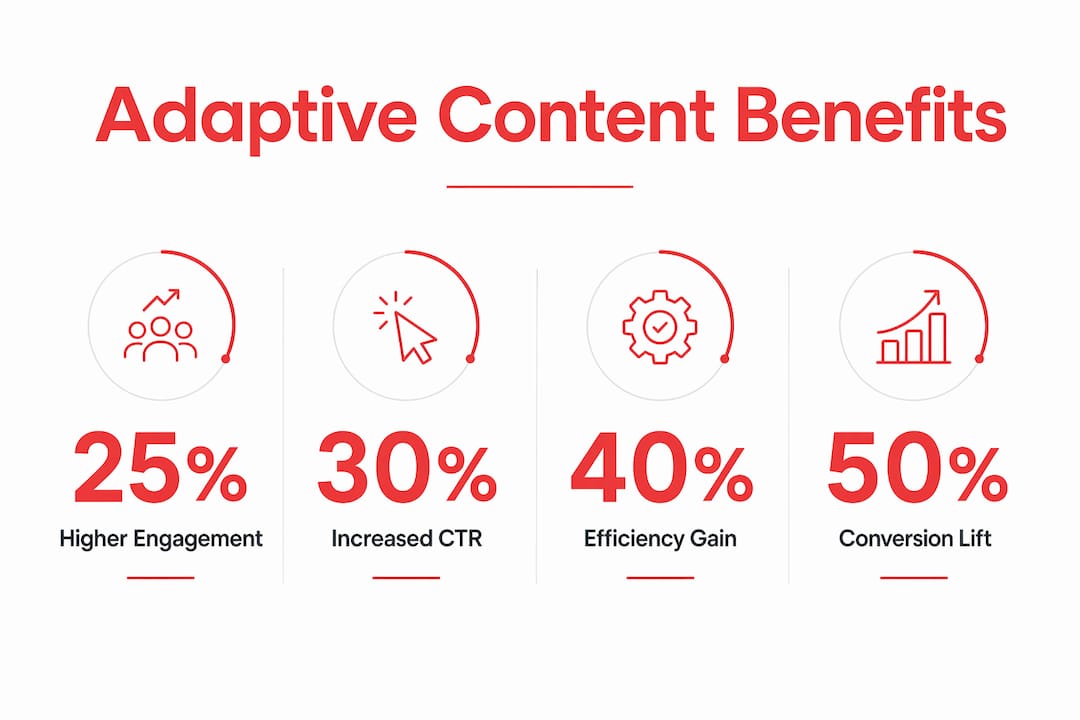
What are the key benefits of adaptive content for marketers?
The primary goal of adaptive content is to match user intent precisely, reducing cognitive overload and improving conversion readiness. When a user lands on a page and sees content that speaks directly to their situation, they spend less mental energy figuring out if they are in the right place. That clarity converts.
The benefits stack up across the full user journey:
- Higher relevance at every touchpoint. A returning customer sees loyalty offers. A first-time visitor sees an introduction. Neither sees the wrong message.
- Lower bounce rates. Content matched to intent keeps users engaged longer because the page answers their question immediately.
- Better conversion rates. Personalized content boosts engagement by making each interaction feel specific rather than generic.
- Reduced navigation friction. Users do not need to hunt for the right section. The right section finds them.
- Scalable personalization. AI integration means the system handles thousands of content variations without requiring a team to manage each one manually.
Adaptive content also improves the efficiency of content teams. Instead of building separate pages for every audience segment, teams build modular components once and let the delivery engine assemble them. That shift cuts production time and reduces the risk of inconsistent messaging across channels. For marketers managing multichannel content across email, web, and social, this is a significant operational gain.
The engagement uplift from personalization is not theoretical. AI’s role in marketing shows consistent gains in click-through rates and session duration when content adapts to user context. The underlying reason is simple: people respond to content that feels written for them.
How does adaptive content differ from responsive design?
Responsive design and adaptive content solve different problems. Responsive design adjusts layout, font size, and image dimensions so a page looks correct on any screen. Adaptive content focuses on substance and messaging relevance rather than visual layout. A responsive page looks right on mobile. An adaptive page says the right thing to the right person, regardless of device.
Basic personalization sits between the two. It uses fixed rules to swap out a name in an email subject line or show a returning visitor a different banner. It works, but it does not learn. Static content and simple rule-based personalization both require manual updates to stay relevant. Adaptive content with machine learning updates itself.
| Feature | Responsive design | Rule-based personalization | Adaptive content |
|---|---|---|---|
| What changes | Layout and visual format | Predefined content swaps | Messaging, images, and CTAs |
| Trigger | Screen size | Fixed rules | Real-time behavior and context |
| Learning ability | None | None | Continuous with AI |
| Manual updates needed | Minimal | Frequent | Minimal once trained |
| Personalization depth | None | Low to medium | High |
The table makes the distinction clear. Responsive design is a display solution. Rule-based personalization is a content shortcut. Adaptive content is a full personalization system that responds to the user as they move through their session.
Pro Tip: Do not replace your responsive design work with adaptive content. They operate at different layers. Build responsive layouts first, then layer adaptive content logic on top to control what each audience segment actually reads.
What are best practices for implementing adaptive content?
Winning adaptive content strategies make existing sites smart enough while building privacy compliance from the architectural level. That framing matters. The goal is not to rebuild everything. The goal is to add intelligence to what already works.
Follow these steps to implement adaptive content without creating chaos:
- Audit your existing content for modularity. Identify which content blocks, headlines, and CTAs can be separated from their templates and stored as reusable components.
- Define 2–3 high-impact user segments. New visitors, returning customers, and high-intent buyers are a solid starting trio. Build your first adaptive rules around these groups.
- Choose a centralized content repository. A Digital Asset Management platform or a custom CMS keeps all variations in one place. Centralized DAM platforms synchronize content updates across all adaptive variations instantly, preventing outdated or conflicting messaging.
- Set measurable goals before launch. Define what success looks like for each segment. Conversion rate, time on page, and bounce rate are the three most useful starting metrics.
- Introduce AI gradually. Start with rule-based logic, measure results, then layer in machine learning once you have baseline data to validate against.
The most common mistake is personalization bloat. Too many variations cause fragmented user journeys and technical debt that compounds fast. Starting with 2–3 segments keeps performance gains measurable and systems manageable.
A few pitfalls to avoid as you scale:
- Skipping privacy architecture. Build consent and data governance into the system from day one, not as an afterthought.
- Ignoring content maintenance cycles. Every adaptive variation needs to stay current. Without a centralized system, outdated content slips through.
- Over-automating without human review. AI optimizes for the metrics you give it. If those metrics are wrong, the content goes in the wrong direction. Schedule regular human audits.
- Building without analytics. Adaptive content without measurement is just complexity. Every variation needs a feedback loop.
Key Takeaways
Adaptive content is a real-time personalization system that changes messaging, images, and CTAs based on user behavior, requiring modular content architecture and centralized management to work at scale.
| Point | Details |
|---|---|
| Core definition | Adaptive content changes what content says based on real-time user signals, not just how it looks. |
| Modular architecture is required | Content must be broken into reusable components before any personalization engine can assemble them dynamically. |
| Start small, then scale | Begin with 2–3 user segments to avoid personalization bloat and unmanageable technical debt. |
| Centralized management prevents errors | A DAM or custom CMS keeps all content variations synchronized and current across every channel. |
| AI improves over time | Unlike rule-based systems, AI-driven adaptive content gets more accurate with every user session automatically. |
Why adaptive content is the next real shift in digital marketing
I have watched the personalization conversation cycle through the same arguments for years. Marketers get excited about dynamic content, build a dozen rules, and then quietly abandon the system six months later because it became too hard to maintain. The problem was never the idea. The problem was the architecture underneath it.
The shift to AI-driven adaptive content changes that equation. When the system learns on its own, the maintenance burden drops significantly. You are no longer writing rules for every scenario. You are defining goals and letting the model find the path. That is a fundamentally different relationship with your content infrastructure, and it is one that real AI-powered marketing ROI is starting to validate at scale.
What I find most interesting is the privacy angle. The best adaptive content systems I have seen in 2026 are not built around third-party cookies or aggressive tracking. They are built around first-party behavioral signals, contextual cues, and consent-first data models. That is not a compliance checkbox. That is a better signal. Users who consent to personalization are already more engaged, which means the data quality is higher from the start.
My honest advice: do not wait until you have a perfect content library to start. Pick one high-traffic page, define two audience segments, and build one adaptive rule. Measure it for 30 days. The results will tell you exactly where to go next. The teams that win with adaptive content are the ones who treat it as a continuous system, not a one-time project.
— Josh
How Rule27design builds adaptive content systems that actually scale
Rule27design works with growth-stage companies that have outgrown basic CMS tools but do not need enterprise software complexity. We build custom content management systems and admin panels designed around how your team actually works.
For adaptive content specifically, we design modular content architectures, connect behavioral data pipelines, and build the centralized management layer that keeps every variation current and consistent. Our recent work includes AI-optimized content systems that help clients perform better in ChatGPT, Claude, and Perplexity responses. If your team is ready to move beyond static pages and rule-based personalization, explore our content system solutions and see what a purpose-built adaptive content infrastructure looks like in practice.
FAQ
What is adaptive content in simple terms?
Adaptive content is digital content that automatically changes what it shows based on who is viewing it, using signals like location, device, and behavior to deliver the most relevant message in real time.
How is adaptive content different from personalization?
Basic personalization swaps predefined content based on fixed rules. Adaptive content uses AI and real-time behavioral data to continuously adjust messaging without manual rule updates.
What is adaptive content delivery?
Adaptive content delivery is the technical process of using APIs and dynamic content engines to serve the right content variation to each user instantly, based on live interaction data.
How do you create adaptive content?
Start by breaking existing content into modular components like headlines, body blocks, and CTAs. Define 2–3 user segments, set measurable goals, and use a centralized CMS or DAM platform to manage and distribute variations.
What are the biggest risks of adaptive content?
Personalization bloat is the top risk. Too many content variations create fragmented user experiences and technical debt. Starting with a small number of segments and scaling gradually keeps the system manageable and results measurable.

About the Author
Josh AndersonCo-Founder & CEO at Rule27 Design
Operations leader and full-stack developer with 15 years of experience disrupting traditional business models. I don't just strategize, I build. From architecting operational transformations to coding the platforms that enable them, I deliver end-to-end solutions that drive real impact. My rare combination of technical expertise and strategic vision allows me to identify inefficiencies, design streamlined processes, and personally develop the technology that brings innovation to life.
View Profile

