

Learn how web page optimization drives SaaS growth. A 0.1s speed lift boosts conversions 8-10%. Get the practical framework for content and performance wins.
TL;DR:
- Web page optimization combines content relevance, technical performance, and user experience for SaaS growth.
- Improving Core Web Vitals and matching content to user intent significantly boosts rankings and conversions.
- Cross-functional, ongoing collaboration between marketing and development teams is essential for effective optimization.
Most SaaS marketing teams assume great content is enough. It isn’t. A 0.1s speed improvement can lift conversions 8-10%, yet page speed is still treated as a dev problem rather than a growth lever. Web page optimization isn’t just an SEO checklist. It’s the intersection of content relevance, technical performance, and user experience working together. For growth-stage SaaS teams, getting this right means lower bounce rates, stronger search rankings, and users who actually stick around. This guide breaks down exactly what optimization means in your context and how to act on it.
Key Takeaways
| Point | Details |
|---|---|
| Optimization is holistic | Success requires a balance between content relevance and technical performance for best SaaS results. |
| Speed lifts conversions | Even a 0.1s improvement in page load time can increase SaaS conversions by up to 10%. |
| Metrics guide effort | Core Web Vitals and real-world business KPIs should drive your web page optimization priorities. |
| Structure for humans and AI | Well-structured, clear content boosts both organic search and AI-powered assistant visibility. |
| Team alignment matters | Optimizing web pages is most effective when marketing, content, and technical teams collaborate from the start. |
What is web page optimization and why it matters
Web page optimization is the ongoing process of improving a page so it ranks well, loads fast, and keeps users engaged. Simple idea. Harder to execute than most teams expect.
Web page optimization covers both on-page SEO practices to improve search visibility and technical performance work, focusing on content relevance, user experience, and Core Web Vitals. That’s a wide surface area. Most SaaS teams only work one side of it.
For SaaS specifically, the stakes are higher. You’re not selling a one-time product. You’re trying to acquire, activate, and retain users through a web experience that competes with well-funded alternatives. On-page SEO for engagement combined with performance optimization for retention means fast loads can reduce bounce rates by 40-60%. That’s not a marginal improvement. That’s pipeline.
Here’s what optimization actually touches:
- Content relevance: Does your page answer the exact intent behind the search query?
- Structure and clarity: Can users and crawlers navigate your content easily?
- Core Web Vitals: Is your page fast, stable, and responsive?
- E-E-A-T signals: Does your content demonstrate real expertise and credibility?
- Internal linking: Are you connecting related content to build topical authority?
“Optimization isn’t a one-time fix. It’s a continuous signal you send to both users and search engines that your page deserves attention.”
The biggest misconception? That keywords and design are enough. Keywords without speed lose rankings. Good design without SEO-friendly content loses organic traffic. And ignoring content ranking factors means you’re guessing instead of building on what actually works.
Now that you understand why optimization can’t be ignored, let’s break it down into its strategic components.
The two pillars: Content optimization vs. performance optimization
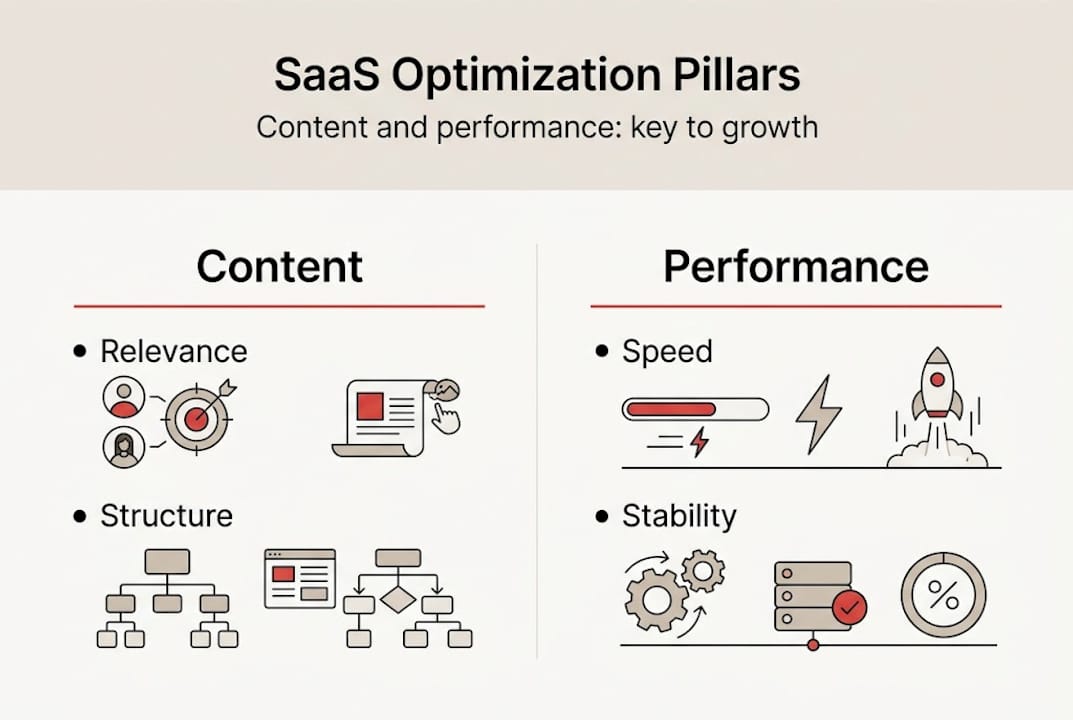
Think of web page optimization as two lanes running in parallel. Content optimization is about what your page says and how well it matches user intent. Performance optimization is about how fast and stable the experience feels. Both matter. Neither works well without the other.

| Factor | Content optimization | Performance optimization |
|---|---|---|
| Goal | Relevance and ranking | Speed and stability |
| Key actions | Intent matching, E-E-A-T, structure | Image compression, caching, CDNs |
| Primary metrics | Dwell time, CTR, rankings | LCP, CLS, INP, load time |
| Who owns it | Marketing and content teams | Dev and engineering teams |
| Quick win | Update meta titles and headers | Compress images and enable caching |
Content optimization means writing pages that match what your audience is actually searching for, building clear structure with proper heading hierarchy, and demonstrating SaaS CMS features that support topical depth and internal linking.
Performance optimization targets your Core Web Vitals: LCP at or under 2.5 seconds for loading speed, CLS at or under 0.1 for visual stability, and INP at or under 200ms for interactivity. These aren’t vanity metrics. Google uses them as ranking signals.
Key performance actions include:
- Compress and properly size all images
- Minify JavaScript and CSS files
- Enable browser caching and server-side caching
- Use a content delivery network (CDN) to reduce latency
- Defer non-critical scripts to speed up initial load
Pro Tip: Start with image compression. It’s the fastest path to a measurable performance lift with zero risk. Most SaaS pages carry oversized images that add seconds to load time. Fix that first before touching anything else.
Understanding both pillars gives you an optimization blueprint. Let’s now look at the data and outcomes you can expect.
Key benchmarks and business impact of optimization for SaaS
Numbers make the case better than theory. Here’s what the data actually shows for SaaS web performance.
| Optimization action | Benchmark | Business impact |
|---|---|---|
| Page speed improvement | 0.1s faster load | 8-10% conversion lift |
| CWV optimization | Full pass on all signals | Average position 42 to 14.5 |
| Load time reduction | 50% faster | 6-10% increase in sales |
| Bounce rate reduction | Fast loads | 40-60% fewer exits |
That position jump is worth pausing on. A SaaS company that passed all Core Web Vitals saw their average search position move from 42 to 14.5. That’s the difference between page 4 and page 2. Real traffic. Real pipeline.
So what should you prioritize? Based on the data, here’s the order that delivers the most value:
- Fix Core Web Vitals first. They directly affect rankings and user experience.
- Optimize for conversion intent. Match page content to the buyer stage, not just the keyword.
- Improve internal linking. It distributes authority and keeps users moving through your funnel.
- Audit and update existing content. Refreshing old pages often outperforms publishing new ones.
- Track content performance efficiency continuously. Optimization without measurement is guesswork.
The SaaS teams that win here aren’t doing anything exotic. They’re being systematic. They measure, fix, measure again, and keep going.
With the key metrics in mind, it’s essential to know how to put optimization to work in practical, day-to-day workflows.
How to implement web page optimization: Practical workflow for SaaS teams
Here’s a workflow that actually works for growth-stage SaaS teams where marketing and dev share responsibility.
- Run a full audit. Use tools like Google Search Console, PageSpeed Insights, and Screaming Frog. Identify your worst-performing pages by traffic loss, slow load times, and poor Core Web Vitals scores.
- Prioritize by impact. Not every page needs fixing at once. Focus on high-traffic, high-intent pages first. Product pages, pricing, and top landing pages move the needle fastest.
- Fix technical issues. Address Core Web Vitals failures, crawl errors, broken links, and mobile usability problems. This is where dev involvement is non-negotiable.
- Optimize content. Rewrite for intent clarity, add proper heading structure, include AI-powered content checklists to verify coverage, and strengthen E-E-A-T signals with author bios and citations.
- Review information architecture. Make sure your site structure supports both user navigation and crawlability.
- Measure and iterate. Set a 30-day review cadence. Track rankings, engagement, and conversions. Adjust based on what the data shows.
Watch out for these common mistakes:
- Keyword stuffing still tanks pages. Topical depth beats keyword density every time.
- Duplicate content and cloaking create crawl confusion and can trigger penalties.
- Single-page applications (SPAs) need server-side rendering (SSR) to be properly crawled.
Pro Tip: Write content in self-contained paragraphs with clear entities and direct answers. This structure helps both human readers and AI systems extract your content accurately, which matters more in 2026 than it ever did before.
“Topical coverage outperforms keyword density; answer-first content wins in AI-driven results. Structure your pages for extractability, not just readability.”
And don’t underestimate internal tool optimization. The systems your team uses to manage and publish content directly affect how fast you can execute on all of this.
All these steps lead to one crucial outcome: maximizing both user and algorithmic satisfaction. But what do most guides miss about this balance?
What most SaaS teams miss: The optimization balancing act
Here’s the uncomfortable truth. Most SaaS teams pick a lane and stay in it. Marketing owns content. Dev owns performance. Nobody owns the intersection. And that’s exactly where results get left behind.
Poor Core Web Vitals lose ranking tie-breakers even when content is strong. So you can write the best page in your category and still lose to a faster competitor with thinner content. That’s not a hypothetical. It happens constantly.
The teams that get this right treat optimization as a shared system, not a handoff. Content, design, and dev collaborate from the start of a page build, not after the fact. They run cross-functional sprints that tackle both content upgrades and speed fixes in the same cycle.
The shift from checklist thinking to continuous improvement is what separates good from great. Checklists get you to baseline. Iteration gets you to growth. Small, systemic changes compound over time in ways that one-time launches never do.
Pro Tip: Build a monthly cross-functional sprint with one content person and one dev. Pick three pages. Fix both content and performance issues together. Measure after 30 days. Repeat. That rhythm builds momentum faster than any quarterly project ever will.
If you want to see how SaaS growth strategies connect to this kind of operational discipline, the pattern is consistent: the teams winning on search are the ones treating optimization as a team sport.
Accelerate your SaaS growth with expert optimization
Web page optimization at this level isn’t a solo effort. It takes content expertise, technical depth, and systems that keep everything moving together. That’s exactly what Rule27 Design builds.
We work with growth-stage SaaS companies that have outgrown basic tools and need real infrastructure behind their content and performance strategy. Our digital optimization capabilities span custom CMS builds, AI-optimized content systems, and analytics that show you what’s actually working. If you’re ready to stop guessing and start compounding your results, explore our innovation services and see what a purpose-built system can do for your team.
Frequently asked questions
What are the most important web page optimization metrics for SaaS?
Core Web Vitals (LCP, CLS, INP) and conversion rate are the most critical metrics for SaaS web page optimization. Together they measure both technical health and business performance.
How quickly should a SaaS web page load for best results?
Aim for LCP under 2.5 seconds to pass Core Web Vitals and maximize conversions. Anything slower starts costing you rankings and users.
How does web page optimization help with AI and search engines in 2026?
Extractable, well-structured content alongside fast performance now improves visibility in both traditional search and AI-driven results like ChatGPT and Perplexity.
What’s the risk of only focusing on content or speed alone?
Poor CWV scores lose ranking tie-breakers even when content quality is high. Neglecting either side creates a ceiling on how far your pages can climb.
What is E-E-A-T and why does it matter?
E-E-A-T stands for Experience, Expertise, Authoritativeness, and Trust. Strong E-E-A-T signals via author bios and citations tell Google your content is credible and worth ranking.
Topics

About the Author
Josh AndersonCo-Founder & CEO at Rule27 Design
Operations leader and full-stack developer with 15 years of experience disrupting traditional business models. I don't just strategize, I build. From architecting operational transformations to coding the platforms that enable them, I deliver end-to-end solutions that drive real impact. My rare combination of technical expertise and strategic vision allows me to identify inefficiencies, design streamlined processes, and personally develop the technology that brings innovation to life.
View Profile

