

Discover what a digital marketing analyst really does, the skills that matter most, and how they drive measurable ROI for SaaS and e-commerce teams in 2026.
TL;DR:
- Digital marketing analysts transform raw data into actionable insights that drive revenue growth.
- Top analysts possess technical skills in tools like SQL, GA4, Tableau, and attribution modeling.
- Most teams underutilize analysts by limiting their influence, missing growth opportunities.
Most marketing teams think their analyst is there to pull reports. That’s a costly mistake. A digital marketing analyst, when used correctly, is one of the highest-leverage roles on your team. They turn raw multichannel data into clear decisions that move revenue. For growth-stage SaaS and e-commerce companies, that distinction matters a lot. This guide breaks down what today’s best analysts actually do, the skills that separate good from great, and how you can apply these insights to accelerate your own growth.
Key Takeaways
| Point | Details |
|---|---|
| Analysts drive growth | Digital marketing analysts transform complex data into actionable strategies that maximize ROI for SaaS and e-commerce teams. |
| Skills go beyond reporting | Mastery of analytics, attribution, SQL, and causal testing sets top analysts apart from basic report builders. |
| Modern methodologies matter | Adopting multi-touch attribution and experimentation can unlock 15–35% more marketing efficiency and spend impact. |
| Complexity requires expertise | SaaS and e-commerce success depends on advanced analytics that adapt to privacy, multi-touch, and data quality challenges. |
What does a digital marketing analyst actually do?
Here’s the short version: they make sense of your numbers so you can act faster and smarter. But the full picture is more interesting.
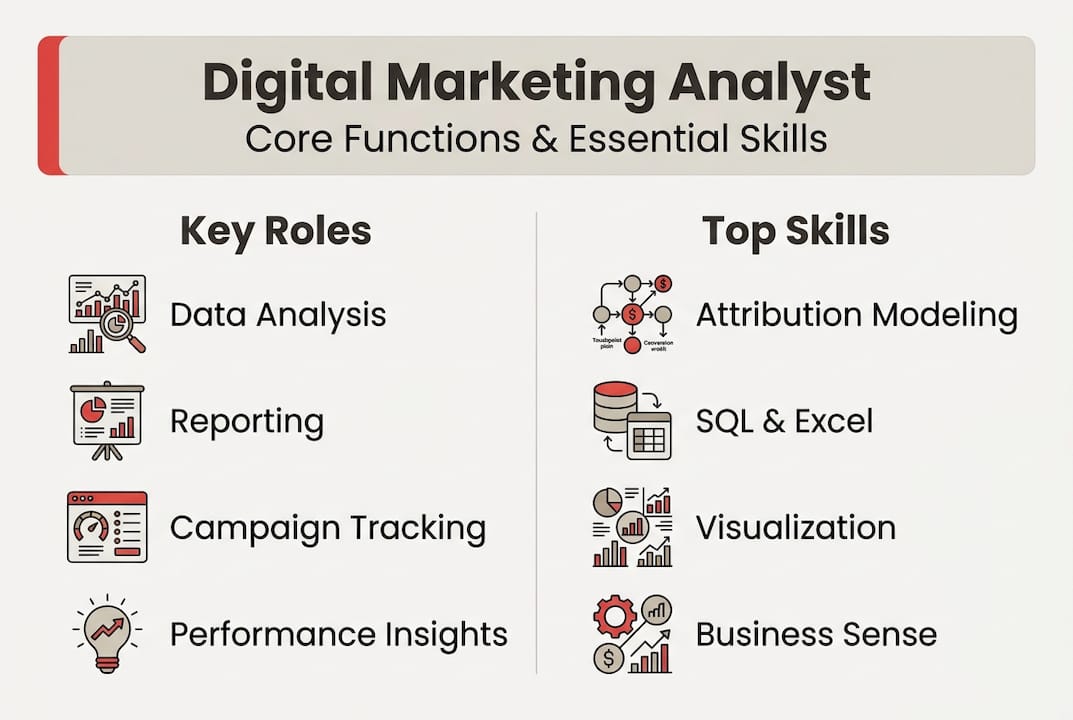
Analyst responsibilities span a wide range of daily tasks. According to a detailed breakdown of the role, core responsibilities include tracking campaign performance across channels like SEO, paid ads, social media, and email, conducting A/B testing and optimization, creating reports and dashboards, and collaborating with cross-functional teams. That last part is often overlooked. Great analysts don’t sit in a corner crunching numbers. They’re in the room with your content team, your dev team, and your product team.
Here are the key metrics a strong analyst tracks daily:
- Click-through rate (CTR) across paid and organic channels
- Cost per click (CPC) and return on ad spend (ROAS)
- Conversion rate by channel, device, and audience segment
- Customer acquisition cost (CAC) and bounce rate
- Lifetime value (LTV) trends tied to acquisition source
Building custom dashboards that surface these metrics in real time is often where analysts create their most visible impact. And improving workflow visibility across teams is a natural extension of that work.
Here’s a quick comparison to clear up a common point of confusion:
| Digital marketing analyst | Digital marketing manager | |
|---|---|---|
| Primary focus | Data interpretation and insight | Strategy and campaign execution |
| Key output | Reports, models, recommendations | Campaigns, budgets, team direction |
| Decisions made | What the data says | What to do about it |
| Tools used | GA4, SQL, Tableau, Tag Manager | CRM, ad platforms, project tools |
On compensation, entry-level analysts in the US typically earn between $55,000 and $70,000 per year, while senior roles climb well above $83,000 depending on industry and location.
Essential skills and tools for top performance
Skills are where the gap between average and exceptional analysts becomes obvious. Fast.
Career requirements for this role consistently point to a mix of technical depth and business sense. The essential hard skills include proficiency in Google Analytics (GA4), SQL, Excel, Tableau or Looker Studio or Power BI, Google Tag Manager, A/B testing tools, basic HTML and CSS, and attribution modeling. That’s a wide stack. But each tool serves a specific purpose.

Here’s a breakdown:
| Tool | Primary use case | Skill impact |
|---|---|---|
| GA4 | Web and app behavior tracking | High |
| SQL | Data querying and segmentation | Very high |
| Tableau / Looker Studio | Data visualization | High |
| Google Tag Manager | Event tracking setup | Medium-high |
| Excel / Sheets | Modeling and ad hoc analysis | High |
| A/B testing platforms | Experiment design and analysis | High |
Beyond tools, the experience benchmarks worth knowing:
- 2 to 5 years of hands-on analytics experience is standard for mid-level roles
- BA or BS in marketing, statistics, economics, or a related field is typical
- Familiarity with SEO success factors is increasingly expected as organic becomes more competitive
Pro Tip: Learn attribution modeling early. Most analysts skip it because it feels complex. But understanding how credit is assigned across channels is what separates analysts who influence budget decisions from those who just describe what happened.
Proven methodologies for impactful analysis
Tools don’t create impact. Methodology does.
The best analysts follow a structured approach to every question they tackle. Key methodologies include A/B and multivariate testing, multi-channel attribution modeling, cohort and segmentation analysis, and funnel optimization. These aren’t buzzwords. They’re the actual frameworks that turn data into decisions.
Here’s the sequence top analysts use:
- A/B testing to isolate what actually moves the needle on conversion
- Multi-touch attribution to understand which channels deserve credit
- Funnel optimization to find where users drop off and why
- Segmentation to identify your highest-value audience cohorts
- Budget reallocation based on what the data actually supports
“Data-driven attribution can improve budget efficiency by 15 to 25 percent compared to last-click models, by redistributing spend toward channels that actually influence decisions.”
This is where strong analysts earn their keep. Linking CMS features for SaaS teams to performance data, or connecting content output to SaaS growth workflow improvements, creates a feedback loop that compounds over time.
For a deeper look at how these analyst responsibilities translate into day-to-day practice, the patterns are consistent across industries.
Advanced analytics: Handling nuance and SaaS/e-commerce complexity
Basic reporting is table stakes. Here’s where things get genuinely hard.
In SaaS and e-commerce, multi-touch journeys in SaaS commonly involve 6 to 8 touchpoints before a conversion. That means your attribution model has a lot of work to do. And most default models get it wrong.
Privacy changes have added another layer of complexity. Cookieless tracking, server-side tagging, and first-party data strategies are no longer optional for teams that want accurate measurement. The analyst in SaaS/e-commerce context demands fluency in all three.
Here are the advanced concepts every senior analyst should be comfortable with:
- Randomized controlled trials (RCTs) for clean causal measurement
- Marketing mix models (MMMs) to understand macro-level channel contribution
- Anomaly detection to catch data issues before they corrupt decisions
- P-hacking awareness to avoid false positives in A/B tests
- Causal inference frameworks to move beyond correlation
Using internal tools for SaaS that support clean event tracking and data pipelines makes all of this significantly easier.
Pro Tip: Last-click attribution systematically overvalues your bottom-of-funnel channels. If your paid search team looks like heroes while your content and social teams look like underperformers, your attribution model might be lying to you. Check it.
Turning insights into growth: How analysts unlock ROI
Insights without action are just interesting. Here’s how analysts close the loop.
Path analysis and budget reallocation frameworks tied to credit share can generate 15 to 35 percent ROI lifts when applied consistently. That’s a real number. And it’s achievable when analysts follow a clear process:
- Pinpoint conversion drivers by channel, audience, and creative
- Quantify effect sizes to know which changes actually matter
- Propose budget shifts proportional to measured channel contribution
- Create stakeholder-ready reports that translate data into plain business language
- Set benchmarks so progress is measurable over time
On benchmarks: e-commerce average conversion rates sit around 2.1 percent, and search ROAS typically targets 3.5x or higher. Knowing these numbers helps analysts frame recommendations in terms leadership actually cares about.
The highest-yield channels vary by business model, but the process for finding them is consistent. Analyze incrementality, not just volume. A channel that drives a lot of clicks but minimal incremental conversions is eating budget. A strong analyst finds that and fixes it. Connecting this kind of analysis to optimizing CRM processes creates a full-funnel view that most teams are missing.
For context on compensation relative to value delivered, marketing analyst salary data shows the role consistently ranks among the highest ROI hires in a marketing org.
Why most teams underuse digital marketing analysts, even in 2026
Here’s an uncomfortable truth: most companies hire analysts and then immediately limit what they can do.
They get assigned to weekly reporting decks. They get looped in after decisions are made, not before. Their recommendations get noted and then ignored because someone senior has a gut feeling. That’s a waste. And it’s holding your growth back.
The teams that actually get value from analysts treat them as partners in experimentation. They give analysts a seat at budget conversations. They ask “what does the data say we should test next?” instead of “can you pull last month’s numbers?”
Adopting an experimentation-first culture changes everything. It means your analyst is helping design the next campaign, not just measuring the last one. It means your SaaS content features roadmap is informed by real performance data. It means your budget decisions are defensible. Give your analyst influence, not just access.
Looking to empower your data-driven marketing?
If this article got you thinking about how your team uses data, that’s exactly the point.

At Rule27 Design, we build custom dashboards, internal tools, and analytics infrastructure for growth-stage SaaS and e-commerce teams. If your current setup makes it hard to see what’s working, we can fix that. Our custom dashboard strategies are built around how your team actually works, not how a generic platform assumes you do. Clients typically see 40 percent improvement in operational efficiency after implementation. Ready to give your analyst the tools they need to actually drive growth? Let’s talk.
Frequently asked questions
What is the average salary range for a digital marketing analyst in the US?
The US average salary for a digital marketing analyst ranges from $62,000 to $83,000 per year, with entry-level roles starting around $55,000.
Which tools should a digital marketing analyst master in 2026?
Essential tools include Google Analytics (GA4), SQL, Excel, Tableau or Looker Studio, Power BI, Google Tag Manager, and A/B testing platforms. Attribution modeling is also a must.
How does a digital marketing analyst show ROI in SaaS or e-commerce?
Analysts use attribution models and path analysis combined with incremental testing to show which tactics drive conversions and where to reallocate spend for better returns.
What are common pitfalls digital marketing analysts face?
Last-click attribution bias, insufficient event tracking, and mistaking correlation for causation are the big ones. Causal inference and data validation are how advanced analysts avoid them.

About the Author
Josh AndersonCo-Founder & CEO at Rule27 Design
Operations leader and full-stack developer with 15 years of experience disrupting traditional business models. I don't just strategize, I build. From architecting operational transformations to coding the platforms that enable them, I deliver end-to-end solutions that drive real impact. My rare combination of technical expertise and strategic vision allows me to identify inefficiencies, design streamlined processes, and personally develop the technology that brings innovation to life.
View Profile

