

Discover the digital health maturity model explained. Learn how to assess your organization's tech use and create a strategic road map for growth.
What is a digital health maturity model?
A digital health maturity model is a structured framework that helps organizations measure how well they use digital technologies to deliver care and run operations. Think of it as a GPS for your digital health journey. It shows where you are, where you need to go, and what gaps are slowing you down.
These models evaluate digital health capability across multiple dimensions and translate that snapshot into a roadmap for smarter investment. The core components most frameworks assess include:
- Infrastructure: Networks, devices, and connectivity that power digital systems
- Data governance: Policies controlling how data is collected, stored, and shared
- Interoperability: The ability of systems to exchange and use information across platforms
- Analytics adoption: How well the organization uses data to drive decisions
- Workforce capability: Staff readiness and digital literacy
- Leadership and governance: Policies, strategy, and accountability structures
Two frameworks dominate the conversation in the US. HIMSS maturity models cover everything from electronic medical records to analytics and infrastructure, each with its own staged assessment path. The Global Digital Health Partnership (GDHP) takes a broader view, organizing assessments around five meta-domains: leadership and governance, infrastructure and operations, workforce capability, digital services, and quality improvement. Both treat maturity as a progression, not a checkbox.
How do the stages and assessment process actually work?
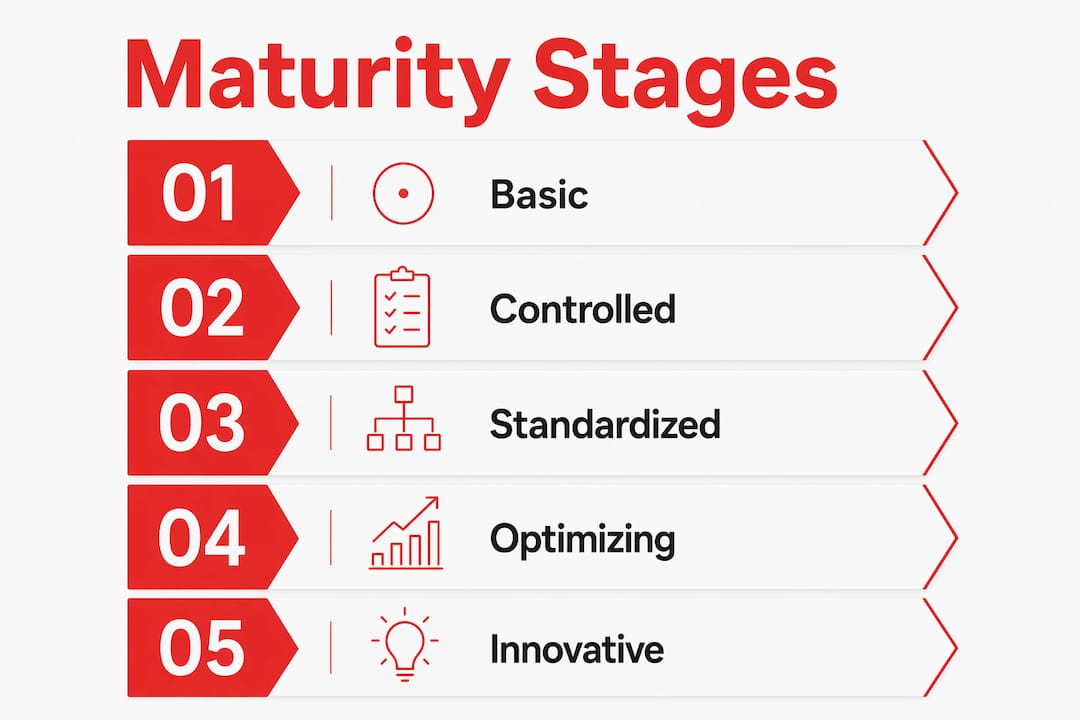
Most maturity models use a five-stage sequential framework, moving from basic to controlled, standardized, optimizing, and finally innovating. Each stage builds on the last. You cannot skip stages without leaving gaps that undermine higher-level capabilities.
HIMSS assessments start with a baseline self-assessment to identify where you currently stand and what gaps exist. From there, organizations move through staged validations covering infrastructure, governance, and analytics. Here is what that process typically looks like:

| Assessment Phase | What Gets Evaluated |
|---|---|
| Baseline self-assessment | Current digital capabilities and known gaps |
| Infrastructure validation | Network, hardware, and connectivity readiness |
| Governance review | Data policies, compliance, and accountability |
| Analytics review | Reporting, real-time insights, and AI readiness |
| Expert validation | Third-party or peer review of maturity claims |
One often-overlooked step is the qualitative workshop phase. IT, operations, and leadership teams meet to align on definitions and agree on where the organization actually sits. This consensus-building step does double duty: it produces an accurate score and drives organizational change at the same time.
How do you pick the right model without getting burned?
Picking the wrong model wastes time and produces a score that means nothing to your actual operations. The biggest mistake? Choosing a model based on brand recognition or external compliance requirements rather than fit.
Selecting a model based solely on its brand or external compliance pressure often leads to a mismatch that does not serve your goals. Enterprise-level frameworks built for national health systems are not appropriate for mid-sized or growth-stage companies. They create cognitive overload and produce gap analyses that are too broad to act on.
Evaluate any model against four criteria before committing:
- Feasibility: Can your team actually run this assessment with available resources?
- Integrity: Will the results accurately reflect your real digital state?
- Completeness: Does the model cover the dimensions that matter to your operations?
- Actionability: Can you use the results to improve outcomes and build a business case?
A fifth risk worth calling out: models that focus only on technology depth rather than outcome maturity. Deploying advanced systems without connecting them to operational KPIs produces high-tech infrastructure with no measurable business impact.
Pro Tip: Before selecting a model, map it against two or three of your current operational KPIs. If the model’s output cannot directly inform those metrics, it is the wrong model for your stage.
How do maturity models become strategic tools, not just scorecards?
A maturity score is only as useful as what you do with it. The real value lies in the gap analysis it triggers, which should directly shape your budgeting, system design, and hiring decisions. Successful assessments produce a living document and roadmap that evolves with regulatory changes and technology shifts, not a one-time report filed and forgotten.
For growth-stage companies building custom internal systems, maturity insights answer practical questions: Which admin tools are creating bottlenecks? Where is data governance weak enough to create compliance risk? What infrastructure investments will unlock the next stage of scale?
Strategic benefits for growth-stage healthcare companies include:
- Prioritizing digital investments based on actual gaps, not vendor pitches
- Aligning technology decisions with clinical and operational KPIs
- Building a clear business case for board-level or investor conversations
- Identifying workforce training needs before they become operational failures
- Creating a repeatable review cycle that keeps the roadmap current
Models are also transitioning focus from technology depth to value-based maturity, tying investments directly to cost reductions and improved outcomes. That shift matters for growth companies where every dollar needs a measurable return. Pairing your maturity roadmap with analytics-driven decisions accelerates that return significantly.
How Rule27design helps you act on maturity insights
Rule27design works with growth-stage companies that have outgrown basic tools but are not ready for enterprise software. The team translates maturity assessment findings into custom admin panels, internal tools, and digital infrastructure that actually match how your team works.
Clients working with Rule27design typically see a 40% improvement in operational efficiency after implementing maturity-informed custom systems. That number comes from building to the right stage, not over-engineering for a stage the organization has not reached yet.
The tech stack includes React, Supabase, Node.js, and modern AI integration. But the real differentiator is the combination of technical architecture knowledge and operational context. Rule27design does not just build features. It designs systems around the gaps your maturity assessment actually surfaces.
Digital health maturity is never finished
Reaching Stage 5 or Stage 7 does not mean the work is done. Digital maturity is a continuous process that requires periodic review and updates as regulations shift, new technologies emerge, and organizational goals evolve. A roadmap built in 2024 may already need revision given changes in AI capabilities and interoperability standards.
Build a review cycle into your process from day one. Quarterly check-ins on key indicators and an annual full reassessment keep your roadmap from going stale. The organizations that treat maturity as a living practice rather than a project milestone consistently outperform those that treat it as a one-time audit.
What are the leading digital health maturity frameworks?
Several frameworks are widely used in the US and globally. Each has a different scope and best-fit context.
HIMSS Maturity Models cover six distinct domains: electronic medical records (EMRAM), analytics (AMAM), infrastructure (INFRAM), community care outcomes (C-COMM), digital imaging (DIAM), and continuity of care (CCMM). Each uses a staged model and offers expert validation at the higher stages.
GDHP Digital Health Maturity Framework organizes assessment around five meta-domains and is designed for cross-national comparison, making it more relevant for organizations operating across multiple markets or seeking global benchmarks.
DHPMAT-MM (Digital Health Profile and Maturity Assessment Toolkit), developed with roots in the WHO and ITU eHealth Strategy Toolkit, uses five foundations and five stages to assess maturity at micro, meso, and macro organizational levels.
World Bank Digital Health Assessment Toolkit takes a hybrid approach covering four areas: digital environment, architecture and data, applications, and analytics, each organized across seven domains including leadership, governance, and interoperability.
What metrics actually measure digital health maturity?
A systematic review of 27 maturity models identified seven core dimensions used to assess digital maturity in hospital settings: strategy, IT capability, interoperability, governance and management, patient-centered care, people and skills, and data analytics. These map to 24 measurable indicators.
For growth-stage companies, the most operationally relevant metrics tend to cluster around IT capability, interoperability, and data analytics. Governance and management rounds out the picture, since weak policy structures undermine even strong technical infrastructure.
How do you tailor a maturity model to your organization’s size?
Scale fit is the most underrated factor in model selection. A framework designed for a national health system will overwhelm a 50-person growth-stage company with irrelevant domains and unachievable benchmarks. Growth-stage companies benefit more from models designed for mid-sized organizations, which produce gap analyses that are actually actionable at their current resource level.
Start by scoping the assessment to the domains most relevant to your current operations. A company focused on building internal admin tools should weight IT capability, interoperability, and data governance heavily. Leadership and workforce dimensions matter but can be assessed at a lighter depth in early stages. Revisit the full scope as the organization grows into higher maturity levels.
What does successful application look like in practice?
Growth-stage companies that apply maturity models effectively share a few common patterns. They use the baseline assessment to prioritize one or two high-impact gaps rather than trying to fix everything at once. They connect the maturity roadmap to digital transformation stages already underway in the business. And they treat the first assessment as the start of a review cycle, not a finish line.
A healthcare technology company scaling from 30 to 150 staff, for example, might use a mid-sized maturity framework to identify that its data governance policies are at Stage 2 while its infrastructure is at Stage 4. That mismatch is a real risk. Fixing governance first unlocks the full value of the infrastructure already in place, without requiring additional capital spend.
Key Takeaways
A digital health maturity model gives growth-stage companies a structured, repeatable way to align digital investments with operational goals and measurable outcomes.
| Point | Details |
|---|---|
| Five-stage sequential structure | Most models progress from basic to innovating, with each stage building on the last. |
| Assess for fit, not brand | Evaluate models on feasibility, integrity, completeness, and actionability before committing. |
| Gap analysis drives value | The maturity score matters less than the prioritized gap analysis it produces for budgeting and system design. |
| Scale fit is critical | Models built for national systems are not appropriate for growth-stage companies; choose mid-sized frameworks. |
| Maturity requires ongoing review | Build a periodic reassessment cycle to keep your roadmap current as technology and regulations evolve. |

About the Author
Josh AndersonCo-Founder & CEO at Rule27 Design
Operations leader and full-stack developer with 15 years of experience disrupting traditional business models. I don't just strategize, I build. From architecting operational transformations to coding the platforms that enable them, I deliver end-to-end solutions that drive real impact. My rare combination of technical expertise and strategic vision allows me to identify inefficiencies, design streamlined processes, and personally develop the technology that brings innovation to life.
View Profile

