

Discover the crucial role of analytics in patient engagement. Learn how data-driven strategies can enhance health outcomes and reduce costs.
TL;DR:
- Effective healthcare analytics convert patient data into timely actions that improve health outcomes.
- Organizations succeed by integrating real-time triggers, clinician training, and continuous behavioral loops into their systems.
Analytics in patient engagement is defined as the practice of collecting, measuring, and acting on patient behavioral data to improve adherence, satisfaction, and health outcomes. Healthcare organizations that treat this as a passive reporting function miss the point entirely. The real value comes from turning data into action at the right moment for the right patient. Recent evidence from Intermountain Health and Quad Medical shows that data-driven patient engagement programs can cut costs dramatically and convert preventive care gaps into completed clinical actions. HIPAA-compliant analytics platforms, EHR-integrated registries, and behavioral frameworks like ENGAGE are now the standard infrastructure for any serious patient engagement strategy.
How do healthcare organizations use analytics to measure patient engagement?
Patient engagement analytics goes well beyond counting portal logins. The real measure is meaningful patient behavior: task completion rates, response patterns across channels, medication refill adherence, and follow-up appointment rates. These signals tell you whether a patient is actually participating in their care or just technically enrolled.
Most organizations pull data from four core sources:
- Electronic Health Records (EHRs): Appointment history, lab completion, medication fills, and care gap registries
- Patient portals: Login frequency, message response rates, form completion, and self-reported symptom data
- Telehealth platforms: Visit attendance, no-show patterns, and post-visit engagement rates
- Remote monitoring devices: Biometric readings, alert responses, and device usage consistency
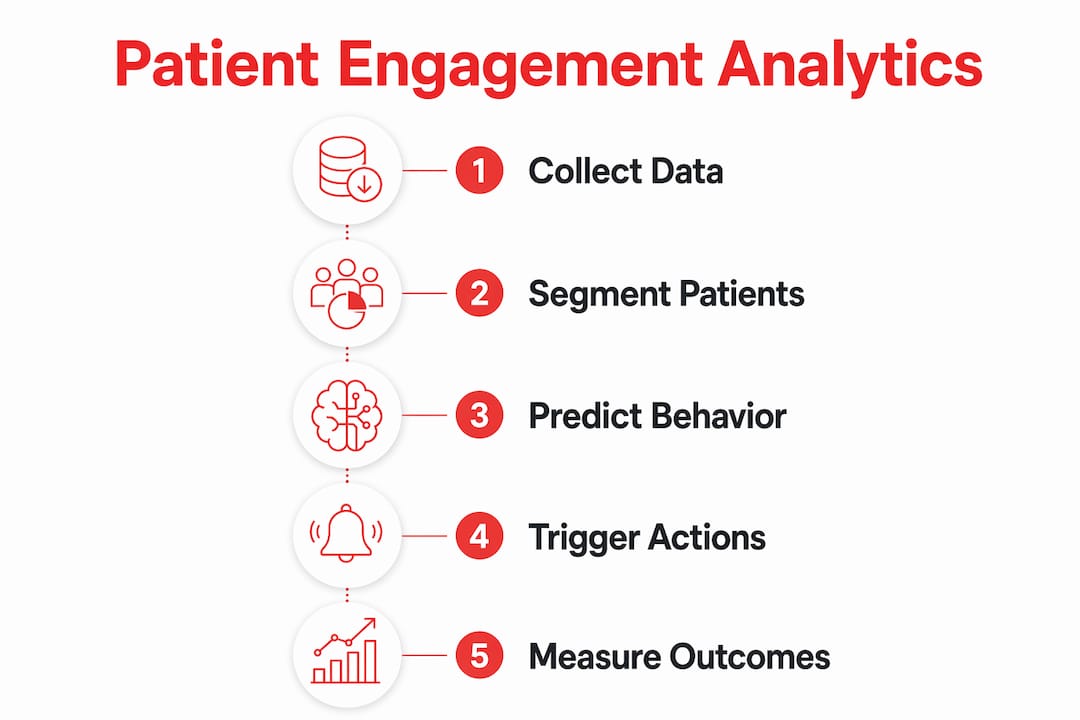
Once you have these data streams, segmentation is what separates useful analytics from noise. Predictive models can flag patients at risk of disengaging before they miss a critical appointment. Automated outreach then targets those patients with context-specific messages rather than generic reminders.
Pro Tip: Focus your analytics on high-salience patient moments like portal logins, appointment reminders, and post-visit follow-ups. Trying to track everything at once leads to data paralysis, not better care.
The goal is not more data. The goal is faster, smarter responses to the moments that actually move patient behavior.
What evidence supports the impact of analytics on patient outcomes?
The strongest case for data-driven patient engagement comes from Intermountain Health. Their AI-driven continuous monitoring program for chronic pulmonary patients produced results that are hard to ignore. Hospital admissions dropped 50.3% over two years, and per-patient costs fell from $36,837 to $15,899 annually. Navigator productivity scaled from 30 patients per navigator to 220. That is not a marginal improvement. That is a structural change in how care is delivered.
Quad Medical’s outreach program tells a similar story at the preventive care level. Using EHR quality registries to identify and contact patients with unmet preventive needs, they converted nearly 10% of leads into completed preventive actions within four months across six clinical categories. That conversion rate outperformed standard benchmarks. The key was precise segmentation, not volume outreach.
| Study | Intervention | Key Outcome |
|---|---|---|
| Intermountain Health | AI continuous monitoring, chronic pulmonary | 50.3% reduction in hospital admissions |
| Intermountain Health | Cost per patient per year | Fell from $36,837 to $15,899 |
| Quad Medical | EHR registry outreach | ~10% lead-to-action conversion in 4 months |
| RCT, passive AI display | Predictive analytics display at bedside | No significant improvement in primary outcomes |
The picture is not uniformly positive. A large randomized controlled trial testing passive AI predictive analytics displays found no significant improvement in primary patient outcomes or 21-day mortality compared to usual care. High-risk patients in that study actually had longer stays (6.8 days versus 3.4 days). The difference between Intermountain’s results and this RCT comes down to one word: operationalization. Displaying a prediction is not the same as acting on it.
Analytics benefit depends on broader context. Large immediate shifts in complex outcomes are unlikely without integrating behavioral and clinical factors into the workflow.
What challenges affect the effective use of analytics in patient engagement?
The biggest obstacle is the integration gap. Most healthcare organizations have dashboards. Far fewer have systems that convert those dashboards into real-time, context-aware interventions. Analytics must trigger action, not just report on what already happened. A missed lab result should automatically generate an outreach message. A failed medication refill should flag a care coordinator. Retrospective reports alone do not change patient behavior.
Clinician trust is the second major barrier. The RCT evidence is clear: clinician education correlates directly with whether AI predictions actually influence care decisions. When clinicians do not understand how a model works or do not trust its outputs, the predictions sit unused. Training is not optional. It is the difference between a model that changes outcomes and one that collects dust.
Behavioral science adds another layer that pure data analytics cannot cover alone. The ENGAGE framework addresses this directly. It combines AI segmentation with behavioral nudges across six steps: Enroll and Segment, Nudge and Hook, Anchor Habits, Generate Evidence, and Expand and Evolve. The ENGAGE framework treats patient engagement as a cyclical process, not a one-time campaign. That distinction matters enormously for long-term adherence.
Common pitfalls that undercut analytics programs:
- Treating analytics as a reporting tool rather than a trigger system
- Skipping clinician training on AI model interpretation
- Running one-off outreach campaigns instead of continuous engagement loops
- Collecting too many metrics without prioritizing the ones tied to clinical action
- Ignoring patient privacy preferences and HIPAA compliance requirements
Pro Tip: Build cyclical precision engagement loops rather than one-off campaigns. Each patient interaction should feed back into your segmentation model, refining the next outreach based on what actually worked.
How can healthcare professionals implement analytics-driven engagement strategies?
Moving from theory to practice requires a clear sequence. Here is how healthcare teams can operationalize analytics for real patient impact:
-
Audit your current data sources. Map every patient touchpoint: EHR, portal, telehealth, remote monitoring. Identify where data is siloed and where integration gaps exist before adding new tools.
-
Define your engagement metrics. Choose metrics tied to clinical outcomes: task completion rates, follow-up attendance, medication adherence, and care gap closure. Avoid vanity metrics like raw login counts.
-
Set up real-time triggers. Configure your systems so that specific patient events, such as a missed lab, an unanswered post-visit message, or a failed refill, automatically generate a response. Real-time event triggers consistently outperform retrospective reporting for engagement outcomes.
-
Segment before you reach out. Use EHR quality registries and predictive models to identify which patients need which type of outreach. Quad Medical’s success came from precise segmentation across six clinical categories, not mass messaging.
-
Run multi-channel outreach informed by data signals. Match the channel to the patient. Some patients respond to portal messages; others need SMS or phone calls. Your analytics should tell you which channel works for each segment. Understanding AI-powered personalization can sharpen this targeting significantly.
-
Measure, refine, and repeat. Track conversion rates at each step of the engagement funnel. Use that data to adjust your segmentation, messaging, and timing. Engagement analytics only compounds in value when you close the feedback loop. Optimizing digital patient workflows makes this iteration cycle faster and more consistent.
The organizations seeing the best results treat analytics as infrastructure, not a project. The system runs continuously, learns from each interaction, and gets more precise over time.
Key Takeaways

Analytics in patient engagement works when it triggers real-time, personalized interventions at high-salience moments, not when it sits in a dashboard waiting to be reviewed.
| Point | Details |
|---|---|
| Define meaningful metrics | Track task completion, adherence, and follow-up rates rather than raw login counts. |
| Operationalize in real time | Configure data triggers so missed labs and failed refills automatically generate outreach. |
| Segment before outreach | Use EHR registries and predictive models to target the right patients with the right message. |
| Train clinicians on AI outputs | Clinician education directly determines whether predictive models influence care decisions. |
| Use cyclical engagement loops | Apply frameworks like ENGAGE to build continuous, behavior-informed engagement rather than one-off campaigns. |
What I have learned about analytics and patient engagement
I have seen a lot of healthcare teams invest in analytics platforms and then wonder why nothing changed. The data was there. The dashboards looked great. But patients were still missing appointments and skipping refills at the same rate as before.
The problem is almost never the data. The problem is the gap between insight and action. A predictive model that flags a high-risk patient is only useful if someone or something responds to that flag within hours, not at the next weekly team meeting. The Intermountain results were not magic. They built a system where the data triggered specific, context-rich interventions automatically. That is precision escalation. Most organizations are still doing precision reporting.
The other thing I keep coming back to is clinician trust. You can build the most accurate model in the world, and if the care team does not understand it or believe in it, it will not change a single outcome. The RCT evidence on passive AI displays is a cautionary tale. Showing clinicians a risk score without teaching them how to interpret it is not an analytics program. It is a screen saver.
My honest recommendation: start smaller than you think you need to. Pick two or three high-salience patient moments, build real-time triggers around them, and measure the conversion rate obsessively. That feedback loop will teach you more than any vendor demo. Privacy and clinical appropriateness are non-negotiable guardrails throughout. Patients who trust you with their data engage more, not less.
— Josh
Analytics tools for healthcare: how Rule27design can help
Healthcare organizations often have the data but lack the infrastructure to act on it in real time. That gap between a dashboard and a triggered workflow is exactly where Rule27design works.
Rule27design builds custom admin panels, internal tools, and data systems that match how your clinical and operations teams actually work. Whether you need automated outreach workflows tied to EHR signals, a reporting system that surfaces the right metrics for care coordinators, or a process automation setup that closes care gaps faster, Rule27design designs the infrastructure around your specific workflow. Visit Rule27design to talk through what an analytics-driven engagement system could look like for your organization.
FAQ
What is the role of analytics in patient engagement?
Analytics in patient engagement is the practice of measuring patient behaviors, such as portal activity, appointment attendance, and medication adherence, and using those signals to trigger timely, personalized interventions that improve care outcomes.
How does data-driven patient engagement differ from standard outreach?
Standard outreach sends the same message to all patients. Data-driven engagement uses segmentation and behavioral signals to send the right message to the right patient at the right moment, which is why Quad Medical’s targeted approach converted nearly 10% of leads into completed preventive actions.
Why did passive AI analytics displays fail to improve outcomes in clinical trials?
A large RCT found that displaying AI risk scores without integrating them into clinical workflows produced no significant improvement in primary outcomes. Clinicians need education and clear protocols to act on predictions, not just access to them.
What is the ENGAGE framework?
ENGAGE is a behavioral science framework that combines AI segmentation with structured nudges across six steps to convert patient curiosity into sustained behavior change. It treats engagement as a continuous cycle rather than a one-time campaign.
How can healthcare administrators start using analytics for patient engagement?
Start by auditing your existing data sources, defining metrics tied to clinical outcomes, and configuring real-time triggers for high-salience patient events like missed labs or failed refills. Precision segmentation and clinician training are the two factors that most determine whether the program actually changes outcomes.

About the Author
Josh AndersonCo-Founder & CEO at Rule27 Design
Operations leader and full-stack developer with 15 years of experience disrupting traditional business models. I don't just strategize, I build. From architecting operational transformations to coding the platforms that enable them, I deliver end-to-end solutions that drive real impact. My rare combination of technical expertise and strategic vision allows me to identify inefficiencies, design streamlined processes, and personally develop the technology that brings innovation to life.
View Profile

