

Discover why real-time reporting is essential for business decisions. Learn how it drives growth and enables faster, smarter choices.
TL;DR:
- Real-time reporting delivers data instantly to decision-makers, enabling faster and more informed choices.
- Its advantages include increased operational speed, improved risk control, and empowered frontline staff.
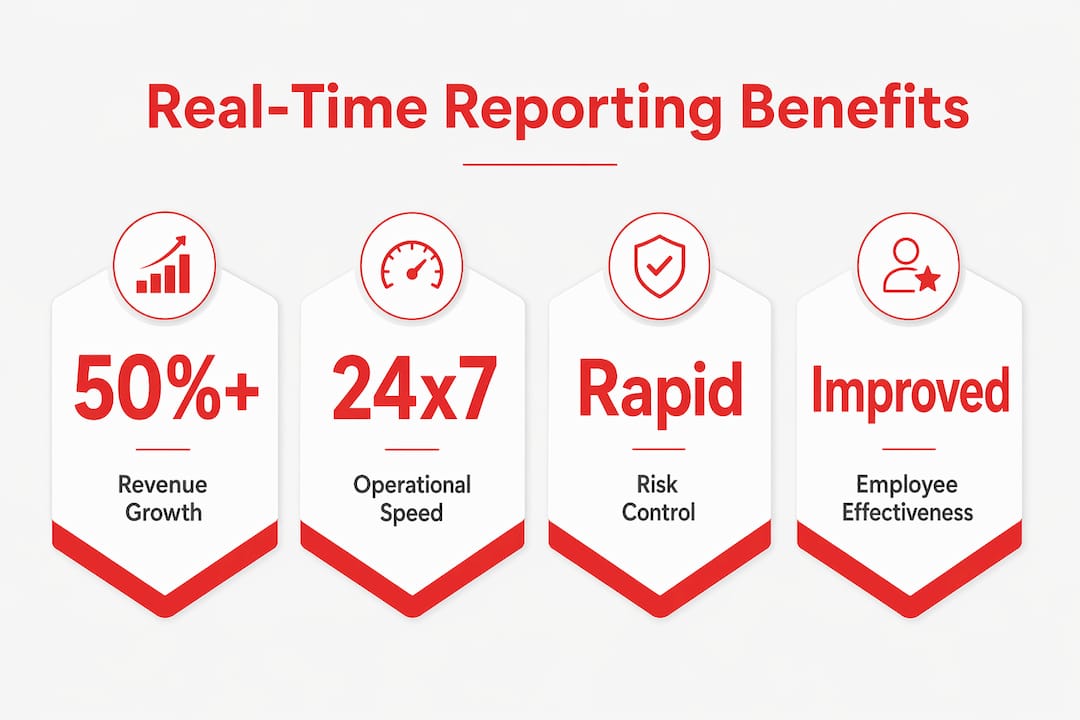
Real-time reporting is defined as the practice of delivering up-to-the-minute data to decision-makers the moment it is generated, with zero meaningful delay between event and insight. This is the core reason why real-time reporting has moved from a technical luxury to a business necessity. Top-quartile adopters achieve over 50% higher revenue growth and net margins than bottom-quartile peers. That gap does not come from better products alone. It comes from faster, better-informed decisions made at every level of the organization. The industry term for the underlying challenge is data latency, the delay between when data is created and when it reaches the person who needs it. Reducing that latency is the entire point.
What business advantages does real-time reporting provide?
Real-time reporting advantages are most visible in three areas: operational speed, risk control, and employee effectiveness.
Speed of decision-making is the most direct benefit. Standard reporting pipelines carry 24–48 hour delays, meaning the data you act on today describes yesterday’s reality. In fast-moving markets, that gap costs money. A pricing team that sees a competitor move at 9 a.m. and can respond by noon operates in a fundamentally different competitive position than one waiting for a morning report the next day.

Risk and fraud control is where real-time data impact is most measurable. Financial institutions using live fraud detection process transactions within 200 milliseconds to block losses before they occur. That response time is physically impossible with batch reporting. The value is not incremental. It is categorical.
The third advantage is less obvious but equally important: employee empowerment. Real-time capabilities let frontline staff act within governance frameworks without waiting for manager approval on every small call. A customer service rep who can see live order status, inventory, and account history resolves issues faster. That directly improves customer experience and reduces escalation costs.
Key real-time reporting advantages at a glance:
- Faster operational decisions without waiting for batch cycles
- Sub-second fraud and anomaly detection in financial and transactional systems
- Live inventory and supply chain visibility to prevent stockouts or overstock
- Immediate campaign performance feedback for marketing teams
- Empowered frontline staff who act on current data, not stale snapshots
The benefits of real-time reporting compound when the right roles get the right data. A warehouse manager with live throughput metrics makes better staffing calls. A sales director with live pipeline data makes better forecast calls. The pattern is consistent across industries.
When is real-time reporting essential vs. when is it overkill?
The most useful concept for evaluating real-time analytics benefits is the decision window. The decision window is the time between when a decision must be made and when the relevant event occurred. Data speed should match decision urgency. If the window is minutes, real-time is justified. If the window is days or weeks, batch reporting is almost always sufficient and far cheaper.
Here is a practical way to evaluate your own use cases:
- Identify the decision. What action will be taken based on this data? Who takes it?
- Define the window. How quickly must that action happen after the triggering event?
- Map the cost of delay. What is the measurable cost if the data arrives one hour late? One day late?
- Compare infrastructure cost. Does the cost of real-time architecture justify the cost of delay you are avoiding?
- Check process maturity. Is the underlying process fast enough to act on live data, or will the bottleneck sit elsewhere?
That last point is critical. Speeding a financial close from 15 days to 5 days often delivers more practical value than switching to live data feeds. Process latency and data latency are different problems. Fixing the wrong one wastes budget.
Common misapplications of real-time reporting include live dashboards for metrics that only change monthly, minute-by-minute sales tracking for products with weekly purchase cycles, and live inventory feeds for warehouses that reorder on a quarterly basis. These setups look impressive. They rarely change decisions.
Pro Tip: Before requesting a real-time feed, ask: “What would I do differently if I saw this data one hour sooner?” If the answer is nothing, batch reporting is the right call.
Strategic decisions, such as entering a new market or restructuring a product line, run on quarterly or annual data cycles. Real-time feeds add noise, not clarity, to those decisions. Reserve live data for tactical, time-sensitive operations where the cost of a delayed response is concrete and measurable.
What are the technical and operational challenges of real-time reporting?
Real-time reporting is not just faster batch reporting. It requires a fundamentally different architecture. Batch processing is stateless, meaning each job runs independently. Real-time streaming is stateful, meaning the system must continuously track context across millions of events simultaneously. That shift increases fragility, cost, and the expertise required to maintain the system.
The core challenges teams encounter:
- 24/7 availability requirements. Real-time pipelines cannot go down during business hours. They must run continuously, which means on-call engineering, redundancy planning, and failure recovery protocols that batch systems simply do not need.
- Data quality risks. Without automated validation and strong governance, real-time feeds produce noisy, inconsistent data. Speed without accuracy is worse than a slower, clean report.
- Alert fatigue. Excessive real-time alerts reduce focus and train teams to ignore notifications. When every metric triggers an alert, none of them feel urgent.
- Infrastructure cost. Real-time architectures require specialized tooling, more compute, and ongoing engineering attention. The complexity tax is real and often underestimated during initial planning.
The alert fatigue problem deserves special attention. Teams that receive hundreds of low-priority notifications daily stop responding to high-priority ones. This is not a behavior problem. It is a system design problem. Alerts should fire only when immediate human intervention is required and when a specific threshold has been crossed.
Pro Tip: Set alert thresholds based on the action they trigger, not on the metric itself. An alert for “revenue below $10,000 per hour” is useful only if someone can act on it within minutes. If not, it belongs in a daily summary report.
Custom dashboard solutions built around your actual decision cycles avoid most of these pitfalls by design. The architecture matches the use case rather than defaulting to live feeds for everything.
How to implement real-time reporting effectively
Effective implementation starts with a decision audit, not a technology selection. Map every reporting use case in your organization and assign each one a decision window. Then sort them into three categories: real-time, near real-time (15–60 minutes), and batch.
| Decision type | Data freshness needed | Example |
|---|---|---|
| Fraud and security alerts | Sub-second to seconds | Transaction monitoring |
| Operational throughput | Minutes | Warehouse pick rates, call center queues |
| Campaign performance | 15–60 minutes | Paid media spend and conversion tracking |
| Sales pipeline review | Daily | CRM opportunity updates |
| Financial reporting | Weekly or monthly | P&L, budget variance |
Most organizations find that only a small fraction of their reporting truly requires live data. The rest can run on near-real-time or batch schedules at a fraction of the cost and complexity.
Once you have that map, automate the slow processes first. If your month-end close takes three weeks, fixing that process delivers more value than adding a live revenue dashboard on top of a broken close cycle. Process improvement before speed investment is the correct sequence.
Define clear ownership for each live feed. Every real-time metric needs a named person or team responsible for acting on it. A dashboard nobody owns is a dashboard nobody uses. Most businesses over-engineer real-time capabilities, building live dashboards that are rarely consulted and waste engineering resources. Ownership accountability prevents that outcome.
For marketing teams specifically, near-real-time data on campaign spend and conversion rates hits the practical sweet spot. It is fast enough to catch a broken ad set before it burns budget, and slow enough to avoid reacting to normal statistical noise in early campaign data.
Key Takeaways
Real-time reporting delivers measurable business value only when data speed matches the actual decision window of the people using it.
| Point | Details |
|---|---|
| Decision window drives value | Match data freshness to how quickly a decision must be made, not to what is technically possible. |
| Revenue impact is real | Top-quartile real-time adopters achieve over 50% higher revenue growth than bottom-quartile peers. |
| Fix processes before adding speed | Automating slow processes like financial close often delivers more value than switching to live feeds. |
| Alert fatigue is a design flaw | Set thresholds based on the action required, not the metric, to keep alerts meaningful and acted upon. |
| Most use cases do not need live data | Audit your decisions first. Only a small share of reporting genuinely requires sub-minute data freshness. |
The uncomfortable truth about real-time data
Real-time reporting is one of the most over-requested and underutilized capabilities I see in business analytics. Teams ask for live dashboards because live feels better. It feels like control. But control and reactivity are not the same thing.
The organizations I have seen get the most value from live data are the ones that were already disciplined about their batch reporting. They had clean data, clear ownership, and defined processes before they added speed. The ones that struggled were the ones that thought real-time would fix a data quality or process problem. It never does. It amplifies whatever is already there.
The best real-time reporting I have encountered does not make teams more reactive. It makes them calmer. When a fraud alert fires, the team knows exactly what to do because the threshold was set deliberately and the response was rehearsed. That is the goal: validated data, delivered to the right person, at the right moment, with a clear next action.
If you are evaluating a real-time investment right now, start with one question: what decision changes if this data arrives faster? If you cannot name the decision and the person making it, the investment is premature. Build the process first. The technology will be more valuable when it has a clear job to do.
— Josh
Real-time reporting built around your actual decisions
Real-time data is only as useful as the system delivering it.
Rule27design builds custom business intelligence systems and admin panels designed around how your team actually makes decisions. We map your decision windows first, then build the data architecture to match. No over-engineered live feeds for metrics that only matter weekly. No generic dashboards that nobody checks. If you are ready to get live data working for your business, not just running in the background, talk to Rule27design about a reporting system built for your actual workflow.
FAQ
What is real-time reporting?
Real-time reporting is the delivery of data to decision-makers at the moment it is generated, with minimal or no delay. It reduces data latency so teams can act on current information rather than historical snapshots.
Why does real-time reporting improve business performance?
Companies in the top quartile of real-time capability achieve over 50% higher revenue growth than bottom-quartile peers. Faster data access reduces decision delays and enables faster responses to operational and market changes.
When is real-time reporting not worth the investment?
Real-time reporting adds little value when the decision window is days or weeks rather than minutes. Strategic decisions like budget planning or market entry run on longer cycles where batch reporting is sufficient and far less costly.
What is alert fatigue and how does it affect real-time systems?
Alert fatigue occurs when too many notifications train teams to ignore them. Setting thresholds based on required actions, not raw metric values, keeps alerts meaningful and prevents critical signals from being missed.
How do I know if my business needs real-time data?
Ask what decision changes if data arrives one hour sooner. If no specific decision or person comes to mind, near-real-time or batch reporting is the right fit and will cost significantly less to build and maintain.

About the Author
Josh AndersonCo-Founder & CEO at Rule27 Design
Operations leader and full-stack developer with 15 years of experience disrupting traditional business models. I don't just strategize, I build. From architecting operational transformations to coding the platforms that enable them, I deliver end-to-end solutions that drive real impact. My rare combination of technical expertise and strategic vision allows me to identify inefficiencies, design streamlined processes, and personally develop the technology that brings innovation to life.
View Profile

