

Discover the crucial role of digital asset security for growing companies. Protect your assets and build trust with effective security measures.
TL;DR:
- Digital asset security involves layered controls to prevent theft, loss, and unauthorized access, and it is a core business function for growth-stage companies. Effective strategies include using hardware wallets, cold storage, multisignature setups, and strict governance policies to protect private keys and assets. Operational disciplines like seed phrase management, multi-party approvals, and continual reviews are essential to prevent losses and adapt to future threats such as quantum computing.
Digital asset security is the comprehensive practice of safeguarding digital assets from theft, loss, and unauthorized access using multi-layered technical and operational controls. For growth-stage companies, this is not an IT checkbox. It is a core business function. Losses of $2.3 billion across 303 incidents in early 2026 show what happens when security matures too slowly. The role of digital asset security extends from protecting cryptographic keys and sensitive data to maintaining the operational continuity that investors, partners, and regulators expect. Get this right and you build trust. Get it wrong and the damage is often permanent.
What key components constitute effective digital asset security?
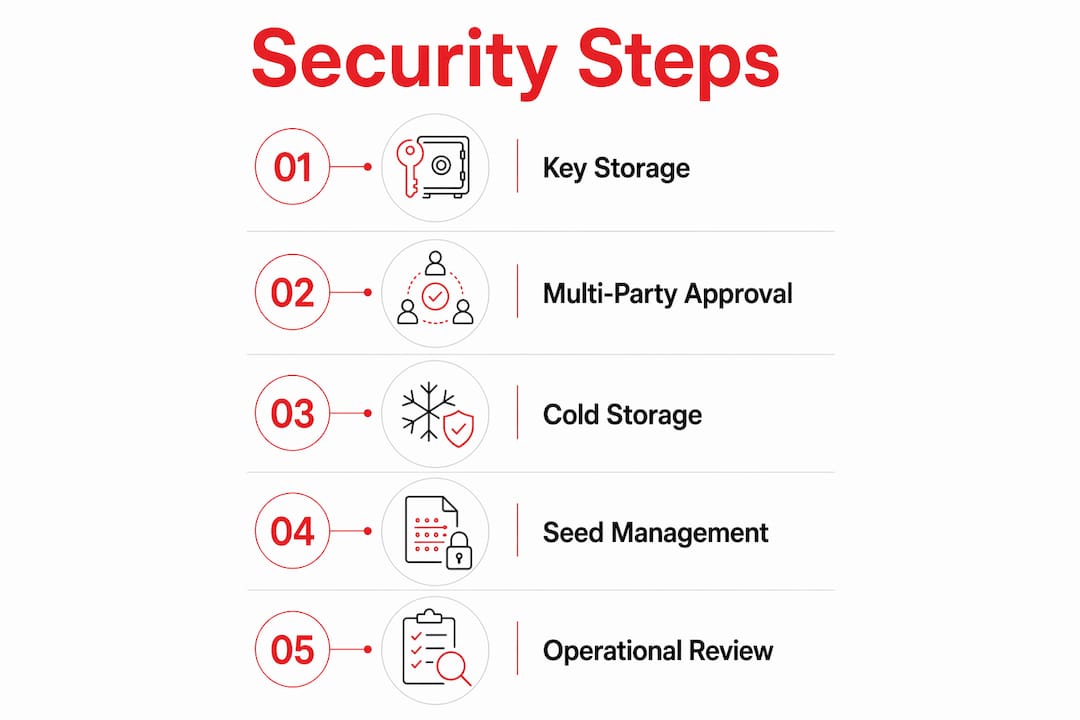
Effective digital asset security starts with controlling where and how private keys are stored. Every other control builds on that foundation.
Hardware wallets and secure storage
Hardware wallets with secure screens prevent blind signing attacks, where a user approves a transaction without seeing its real contents. Software wallets alone cannot provide this protection. A hardware wallet keeps the private key offline and forces all transaction signing to happen on the device itself. That physical separation is what makes it institutional grade.
Cold storage takes this further. Industry best practice allocates 90–95% of digital holdings to cold storage, reserving hot wallets only for operational liquidity needs. Cold storage means the wallet is never connected to the internet, which removes the attack surface for remote exploits entirely. That allocation discipline alone eliminates the most common vector for large-scale theft.
Multisignature wallets and governance policies
Multisignature (multisig) setups require multiple private key approvals before any transaction executes. Multisig adoption increased 147% by 2026, reflecting how quickly institutional operators recognized its value. A 3-of-5 multisig configuration, for example, means three out of five designated keyholders must sign. No single person can move funds unilaterally.
Governance policies sit on top of the technical controls. Nearly all high-impact thefts occur due to weak governance policies that permit “technically authorized” transactions rather than cryptographic failures. A transaction can be cryptographically valid and still be a theft if the policy layer did not catch it. Policy engines that enforce spending limits, counterparty whitelists, and time-delay rules close that gap.
- Hardware wallets: Use devices with secure screens to verify transaction details before signing.
- Cold storage allocation: Keep 90–95% of holdings offline. Hot wallets handle only active operational needs.
- Multisig configurations: Require multiple approvals for any outbound transaction above a defined threshold.
- Policy engines: Automate rule enforcement so no single approver can override business controls.
- Access tiering: Assign permissions by role. Not every team member needs signing authority.
Pro Tip: Review your digital asset lifecycle policies at least quarterly. Access rights and approval thresholds that made sense at 10 employees often create dangerous gaps at 50.
How do operational and strategic security practices complement technical controls?
Technical controls fail without operational discipline behind them. The uncomfortable reality is that most asset losses are operational, caused by lost seed phrases or compromised keys rather than sophisticated hacking. Over $40 billion in crypto assets may be permanently lost due to these kinds of failures. That number reframes the entire conversation. The threat is not always an outside attacker. It is often an internal process gap.

Seed phrase management and the 3-2-1 rule
The 3-2-1 seed phrase recovery rule is the standard for key backup: three copies, stored in two different physical formats, with one copy kept off-site. No digital storage. No cloud backup. No email. Physical copies in secure, geographically separate locations are the only reliable method. This practice prevents the most common cause of permanent asset loss.
Multi-party approvals and incident response
Here is a practical framework for operational security that growth-stage teams can implement without an enterprise budget:
- Distribute signing authority. Assign seed phrase custody and signing keys to different individuals. No single person holds complete control.
- Require multi-party approval for large transactions. Set a dollar threshold above which two or more approvers must sign off before execution.
- Document an incident response plan. Define who gets notified, what gets frozen, and who has authority to act within the first 60 minutes of a suspected breach.
- Run quarterly access audits. Remove signing authority from anyone who has changed roles or left the company.
- Monitor continuously. Use automated alerts for unusual transaction patterns, off-hours activity, or access from new devices.
Pro Tip: Legal succession planning is a real operational risk. The RUFADAA framework in the US authorizes fiduciaries to manage digital assets when a keyholder becomes unavailable. Without it, assets can be permanently inaccessible.
Strategic diversification also matters. Spreading holdings across multiple custody solutions, wallet types, and geographic locations reduces the blast radius of any single failure. Insurance products for digital assets now exist at the institutional level and are worth evaluating as your holdings grow.
What emerging technologies are shaping future digital asset security?
The threat environment does not stand still. Growth-stage companies that build security architecture today need to account for what will be required in five to ten years, not just what is required now.
Post-quantum cryptography
The US and EU plan to require quantum-resistant cryptographic algorithms by 2035 to protect digital assets against quantum computing threats. Quantum computers, once viable, can break the elliptic curve cryptography that most wallets rely on today. Adoption needs to start well before those machines arrive. Companies that wait for a regulatory deadline will be scrambling. Companies that start evaluating quantum-resistant algorithms now will have a clear path.
Multi-party computation and trusted execution environments
Enterprise operators use multi-party computation (MPC) and trusted execution environments (TEEs) to enforce policy logic and distribute key shares geographically. MPC splits a private key into shares held by separate parties. No single share is ever a complete key. A TEE is a secure enclave within a processor that executes code in an isolated environment, preventing even system administrators from tampering with it.
| Technology | What it does | Primary benefit |
|---|---|---|
| Multi-party computation (MPC) | Splits key into shares across multiple parties | Eliminates single point of failure |
| Trusted execution environments (TEE) | Enforces policy logic in isolated processor enclave | Prevents insider tampering |
| Post-quantum cryptography | Replaces elliptic curve algorithms with quantum-resistant ones | Future-proofs against quantum attacks |
| Hardware security modules (HSM) | Stores and manages keys in tamper-resistant hardware | Physical key protection at scale |
These technologies are no longer exclusive to large financial institutions. Growth-stage companies handling significant digital asset volumes can access MPC and TEE capabilities through infrastructure providers today.
How does security become a business function, not just an IT concern?
Institutional adoption requires embedding security controls deeply into business processes and workflows for market trust and scalability. Security is no longer just an IT concern. It is a core operational requirement that affects how partners evaluate you, how regulators assess you, and how investors price risk in your business.
The shift looks like this in practice. Early-stage companies treat security as a technical task owned by one person. Growth-stage companies need cross-functional ownership. Finance, legal, operations, and IT all have roles in a mature digital asset protection strategy. Approval workflows need to reflect actual business authority, not just technical access. Monitoring needs to feed into business reporting, not just a security dashboard that only the IT team reads.
Hardware wallets combined with software audits and multi-stakeholder governance provide the strongest protection against both physical and remote attacks. That combination only works when the governance layer has real organizational authority behind it. A policy engine that nobody enforces is just documentation.
The data security practices that support this shift are well-defined. The gap for most growth-stage companies is not knowledge. It is implementation. Building the internal systems and workflows that make security controls automatic and auditable is where most teams fall short.
Key Takeaways
Effective digital asset security requires layered technical controls, disciplined operational practices, and cross-functional governance working together as a single system.
| Point | Details |
|---|---|
| Cold storage allocation | Keep 90–95% of holdings offline to eliminate remote attack exposure. |
| Multisig and policy engines | Require multi-party approvals and automate rule enforcement to prevent unauthorized transfers. |
| Operational discipline | Use the 3-2-1 seed phrase rule and run quarterly access audits to close the most common loss vectors. |
| Emerging tech readiness | Evaluate MPC, TEEs, and quantum-resistant algorithms now, before regulatory deadlines force a rushed transition. |
| Security as a business function | Embed approval workflows and monitoring into cross-functional operations, not just IT processes. |
What I’ve learned from watching growth companies get this wrong
Most security failures I see in growth-stage companies share the same root cause. The technical setup is reasonable. The operational discipline is not there. One person holds the seed phrase. Nobody has tested the incident response plan. The multisig configuration exists but the policy thresholds were never updated after the company tripled in size.
The companies that get this right treat security as a living system. They schedule reviews. They assign ownership across teams. They test their recovery procedures before they need them. That is not a technology problem. It is a culture and process problem.
The emerging threat landscape makes this more urgent, not less. Quantum computing is not a distant science fiction scenario. Regulatory bodies in the US and EU are already setting 2035 timelines for quantum-resistant standards. Companies that start evaluating their cryptographic dependencies now will be in a far better position than those that wait for a compliance deadline.
My honest advice: stop treating digital asset security as a one-time setup task. Build it into your operational calendar. Review it when your team changes. Review it when your asset volumes change. The threat environment evolves continuously. Your defenses need to keep pace.
— Josh
How Rule27design builds security into your digital infrastructure
Growth-stage companies need systems that make security controls automatic, not manual. Rule27design builds custom admin panels, internal tools, and content management systems that embed approval workflows, access tiering, and audit trails directly into how your team works.
If your current setup relies on one person knowing where everything is, that is a process gap waiting to become a real problem. Rule27design designs digital systems for growth brands that scale with your team and keep controls intact as you grow. Ready to build infrastructure that actually holds up? Start here.
FAQ
What is the role of digital asset security?
Digital asset security protects digital holdings from theft, loss, and unauthorized access through layered technical and operational controls. It covers key management, governance policies, access controls, and incident response planning.
How much should be kept in cold storage?
Industry best practice allocates 90–95% of digital holdings to cold storage, with hot wallets reserved only for active operational liquidity needs.
What is a multisignature wallet?
A multisignature wallet requires multiple private key approvals before any transaction executes, preventing any single individual from moving funds unilaterally.
What is the 3-2-1 seed phrase rule?
The 3-2-1 rule means keeping three copies of your seed phrase in two different physical formats, with one copy stored off-site. No digital storage of any kind is recommended.
Why does post-quantum cryptography matter now?
The US and EU plan to require quantum-resistant algorithms by 2035. Companies need to start evaluating their cryptographic dependencies today because transitioning takes years, not months.

About the Author
Josh AndersonCo-Founder & CEO at Rule27 Design
Operations leader and full-stack developer with 15 years of experience disrupting traditional business models. I don't just strategize, I build. From architecting operational transformations to coding the platforms that enable them, I deliver end-to-end solutions that drive real impact. My rare combination of technical expertise and strategic vision allows me to identify inefficiencies, design streamlined processes, and personally develop the technology that brings innovation to life.
View Profile

