

Explore effective alanchandesign.com alternatives for growth-stage teams. Discover tailored solutions to boost your workflows and speed up project launches.
TL;DR:
- Most growth companies benefit from a custom build if their annual workflow costs exceed a certain threshold.
- Choosing between agency development, low-code platforms, open-source builders, or in-house projects depends on speed, control, and integration needs.
For most US growth-stage companies needing a custom admin panel, CMS, or internal tool, the right path is an agency-led custom build. Rule27design is the recommended partner for teams that need a tailored solution with ongoing support. If speed is the priority, a hosted low-code platform gets you moving fast. If content publishing is the core need, a headless CMS with an integrator is worth a look.
Three quick paths:
- Agency custom build (Rule27design): Best when your workflows are unique, integrations run deep, and you need a system that actually fits your team.
- Hosted low-code platform: Best when you need something live in days and can accept a customization ceiling.
- Headless CMS + integrator: Best when content publishing and multi-channel delivery are the primary job.
Three signals push you toward each path. If you need deep API integrations with existing systems, go custom. If time-to-launch is within a short timeframe, go low-code. If your team will own and maintain the tool long-term, make sure there is a named owner before you commit to any path.
Pro Tip: Before you evaluate any vendor, write down the one workflow your team works around every single day. That workaround is your MVP scope.
What are the best alanchandesign.com alternatives for your team?
| Category | Best for | Service type | Time to launch | Customization | Pricing model | Maintenance/ownership | Tech-stack compatibility | Scalability/security |
|---|---|---|---|---|---|---|---|---|
| Rule27design (agency custom build) | Unique workflows, deep integrations, long-term partnership | Agency | several weeks to a few months | High | Fixed project + retainer | Client-owned, agency-supported | React, Supabase, Node.js, GraphQL | High — built to your security requirements |
| Hosted low-code platform | Speed, simple CRUD tools, internal dashboards | SaaS platform | days to a couple of weeks | Low–medium | Subscription | Vendor-hosted | REST APIs, limited custom stack | Medium — vendor-dependent |
| Open-source builder | Developer teams, self-hosted control | Open-source | a few weeks to over a month | Medium–high | Free + infra costs | Self-hosted, team-owned | React, Node.js, PostgreSQL | Medium — requires internal ops |
| Headless CMS + integrator | Content-heavy products, multi-channel publishing | Platform + agency | several weeks | Medium | Subscription + project fees | Hybrid | GraphQL, REST, modern JS frameworks | Medium–high |
| In-house build | Full control, proprietary logic | Internal team | several months to about a year | Very high | Salary + infra | Fully team-owned | Any | High — if resourced correctly |
Recommended pick by outcome:
- Lowest total cost of ownership (TCO): Agency custom build when annual workflow tax exceeds a substantial annual workflow tax.
Comparing categories rather than named vendor products matters here. Vendor feature lists change quarterly. What stays stable is the decision axis: who owns the system, how deep can integrations go, and what happens when your needs outgrow the platform.
Which alternative actually fits your growth-stage company?
Open-source builders
Platforms like Appsmith and Budibase give you the source code. You self-host, you own the data, and a developer can extend the platform. The trade-off is ops burden. Someone on your team needs to manage deployments, updates, and security patches.
- Internal Tools vs. Off-the-Shelf Software: When Custom Builds Win — Jagatjeet
- The 60 problem: why internal tools become the most expensive thing nobody budgets for — Medium
- The Integration Debt Trap: Why In-House Integrations Break at Scale — Ampersand (WithAmpersand)
- Build vs Buy Software: CTO Decision Framework | ARDURA
In-house build
Full control, full responsibility. A focused custom tool built on Next.js and PostgreSQL can be completed in roughly 8 weeks at roughly tens of thousands of dollars in engineering cost, with monthly infrastructure low monthly infrastructure cost. That’s achievable when scope is tight. The risk is hidden costs: workarounds become permanent, and the tool gets embedded without a named owner for maintenance.
How do you choose the right path for your company?
Use a scored checklist across 10 dimensions. Score each 1–5. A total above 35 favors a custom build; below 25 favors buying a platform. The hybrid path — buy the platform layer, build the differentiation layer — is often the right call for growth-stage companies.
- Competitive differentiation: Does this tool give you an operational edge competitors can’t copy?
- Customization needs: Does your workflow diverge significantly from standard templates?
- Integration complexity: How many systems does this tool need to talk to, and how deep?
- Time-to-market: Do you need this live in days or weeks?
- Internal expertise: Does your team have the capacity to build and maintain this?
- Regulatory sensitivity: Are there data residency, HIPAA, SOC 2, or other compliance requirements?
- Scalability: Will this tool need to handle 10x the current load in 18 months?
- Data sensitivity: How sensitive is the data this tool touches?
- Vendor dependency: How comfortable are you with a vendor controlling your roadmap?
- Roadmap alignment: Does the vendor’s product direction match where your company is going?
Questions to ask vendors and internal stakeholders:
- What is the API depth — can we call any endpoint or only pre-built connectors?
- Who owns the system after launch, and what does the handoff look like?
- What are the SLA terms for uptime and incident response?
- What is the rollback or migration plan if we need to move off this platform?
- Where does our data live, and who can access it?
Red flags to watch for:
- No named internal owner for post-launch maintenance.
- Missing or undocumented API capabilities.
- Unclear data residency or no SLA terms in writing.
- Vendor can’t show a migration path off their platform.
Integration infrastructure with declarative manifests reduces long-term integration debt by removing per-customer sync code and handling auth, rate limits, and retries at the platform level. If your tool needs to sync with five or more external systems, ask every vendor how they handle that at scale.
What does a typical project timeline and cost look like?
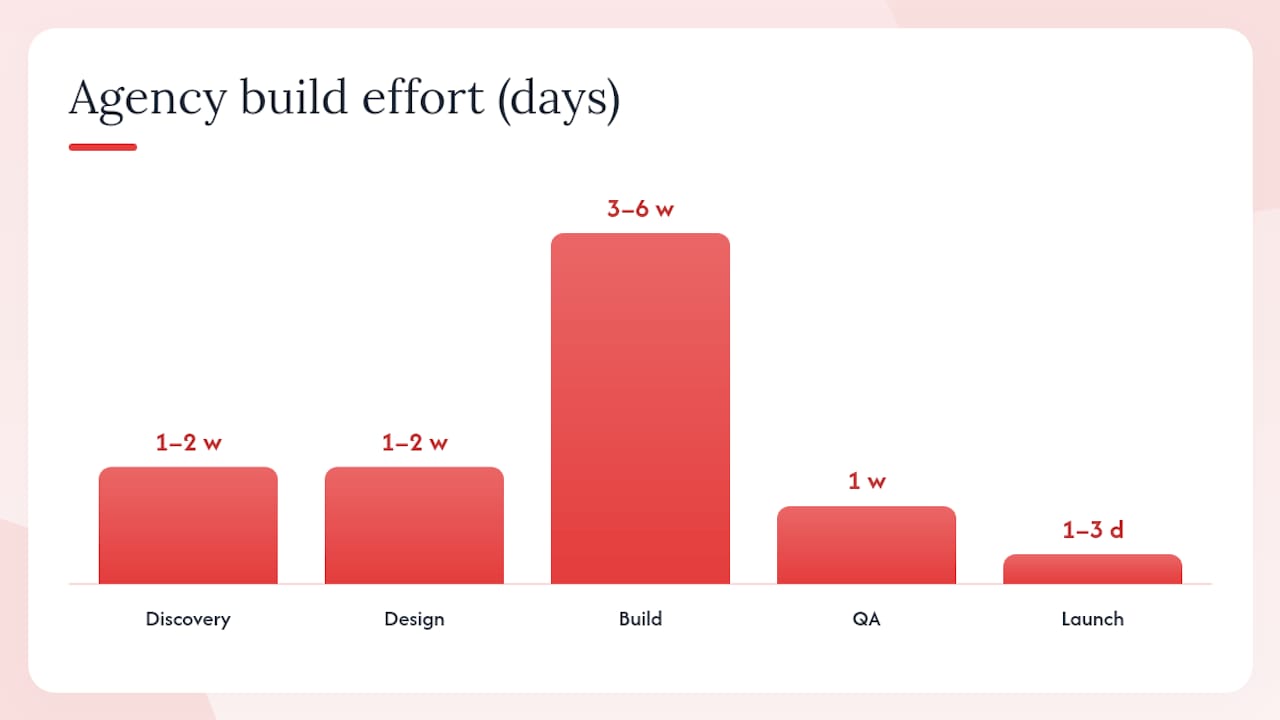
| Phase | Agency build | Low-code | Open-source | In-house |
|---|---|---|---|---|
| Discovery | 1–2 weeks | 1–3 days | 1 week | 2–4 weeks |
| Design | 1–2 weeks | 1–3 days | 1–2 weeks | 2–4 weeks |
| Build | 3–6 weeks | 1–2 weeks | 2–4 weeks | 8 weeks |
| QA | 1 week | 2–3 days | 1 week | 2–4 weeks |
| Launch | 1–3 days | 1 day | 2–3 days | 1 week |
| Maintenance | Ongoing, agency-supported | Vendor-managed | Team-managed | Team-managed |
Ballpark cost ranges:
- Agency custom build: tens of thousands to low hundreds of thousands of dollars project, thousands of dollars per year maintenance costs.
- Hosted low-code: a few hundred to a couple thousand dollars per month subscription.
- Open-source: thousands to tens of thousands of dollars setup, thousands to tens of thousands of dollars per year maintenance costs internal ops.
- In-house: tens of thousands to over a hundred thousand dollars depending on team size and scope.
The main cost drivers are integration complexity, custom reporting requirements, and security/compliance work. A tight MVP scope — one core workflow, three to five data sources, no custom reporting at launch — keeps agency builds in the $30k–$50k range.
Pro Tip: Scope your MVP to the one workflow that costs your team the most time. Add reporting and secondary integrations in phase two.
Scope checklist for MVP:
- One primary workflow end-to-end.
- Three to five data source integrations.
- Role-based access control.
- No custom analytics at launch.
- Clear handoff documentation included.
What do real project outcomes look like?
Rule27design’s work with AniltX delivered 30x organic growth through an AI-optimized content system built on React and Supabase. The system gave the editorial team direct control over content structure, metadata, and publishing workflows without engineering involvement for routine updates.
Rule27design clients typically see a 40% improvement in operational efficiency after implementing a custom system. That figure reflects reduced manual steps, fewer tool-switching interruptions, and faster data access for decision-making.
Common tech stacks in successful projects:
- React + Supabase + Node.js (most common for admin panels and CMSs).
- GraphQL for flexible data querying across multiple sources.
- PostgreSQL for structured data with complex relational needs.
- Modern AI integrations for content visibility in ChatGPT, Claude, and Perplexity.
Which path should you pick based on your company profile?
-
Speed-first: You need something live in within a short timeframe. Start with a hosted low-code platform. Validate the workflow. If you hit the customization ceiling within six months, that’s your signal to scope a custom build.
- Validate internally: Who owns this tool after launch?
- Ask the vendor: What’s the migration path if we outgrow this?
-
Control-first: Your workflow is unique, your data is sensitive, or you need the system to match your brand and logic exactly. Go with an agency custom build. Rule27design is the right call here.
- Validate internally: Do we have a named owner for post-launch maintenance?
- Ask Rule27design: What does the handoff and ongoing support look like?
-
Integration-first: You’re connecting five or more systems and need tenant-aware sync logic. A hybrid approach works best — buy the integration infrastructure layer, build the differentiation layer on top.
- Validate internally: Do we have the API documentation for every system we need to connect?
- Ask vendors: How do you handle auth, rate limits, and retries at scale?
One-line action: If you need a tailored custom solution with an ongoing partnership, contact Rule27design for a discovery call.
Key Takeaways
For most growth-stage US companies, a custom agency build becomes the right call once annual workflow inefficiency costs exceed workflow tax at a significant level — at that point, the TCO of off-the-shelf tools typically surpasses a purpose-built system.
| Point | Details |
|---|---|
| $60,000 annual workflow tax crossover | When annual workflow tax exceeds about $60,000, a custom build often costs less over three years. |
| Hidden costs multiply | Partial tools and workarounds can cost several times the visible tool price over a three-year horizon. |
| Name a maintenance owner | Every build path requires a named owner before launch — no owner means compounding risk. |
| Verify API depth first | Ask every vendor about API capabilities and migration paths before signing anything. |
| Rule27design for custom builds | Rule27design delivers agency-led custom admin panels and CMSs with a 40% operational efficiency improvement for clients. |
The case for building systems that actually fit
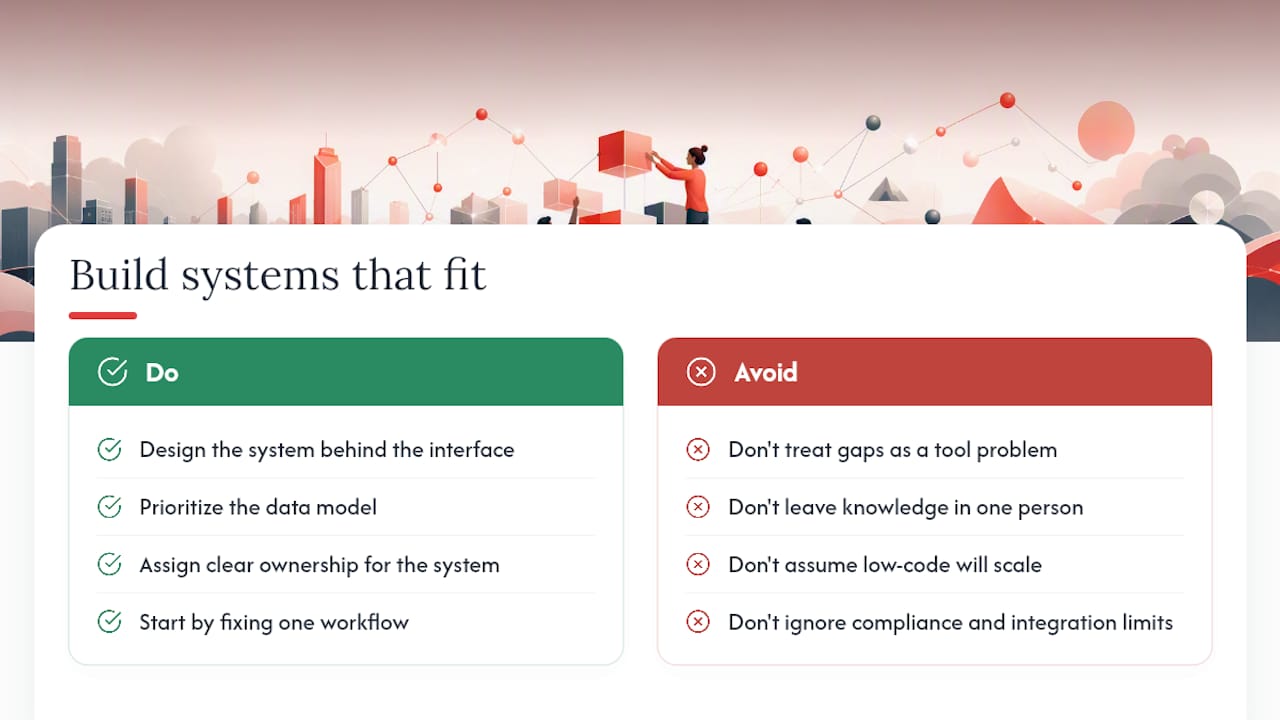
Most growth-stage teams reach a point where the tool they’re using covers about 60% of what they need. The other 40% gets handled by spreadsheets, Slack messages, and one person who knows where everything lives. That’s not a tool problem. It’s a system design problem.
The honest answer is that low-code platforms and open-source builders are genuinely good for a lot of use cases. They’re fast, they’re cheap to start, and they work fine until they don’t. The moment they stop working is usually not gradual — it’s a scaling event, a compliance requirement, or a new integration that the platform can’t handle cleanly.
What Rule27design focuses on is the system behind the interface. The data model, the ownership structure, the way the tool fits into how your team actually works. Clean UI matters, but a system nobody owns six months after launch is a liability, not an asset. The teams that get the most out of a custom build are the ones who come in with a clear picture of the one workflow they need to fix first.
Rule27design can scope your custom build fast
Growth-stage teams that have outgrown their basic tools but aren’t ready for enterprise software have a clear next step: a focused discovery with Rule27design.
A discovery engagement covers a requirements map, an integration assessment, and a fixed-scope estimate with a realistic timeline. You get stakeholder interviews, an API review of your existing systems, and sample UI sketches before any build commitment. Rule27design works on React, Supabase, and Node.js, but the stack follows the project — not the other way around.
For teams that want a digital experience that matches how they actually operate, this is the right starting point. Start your discovery at Rule27design and get a scoped estimate within two weeks.
Useful sources
- Internal Tools vs. Off-the-Shelf Software: When Custom Builds Win — Practical a substantial annual workflow tax crossover heuristic and build cost examples for growth-stage teams.
- The Integration Debt Trap: Why In-House Integrations Break at Scale — Covers declarative integration infrastructure and how to avoid per-customer sync debt.
- Build vs Buy Software: CTO Decision Framework — 10-criteria scoring matrix with hybrid path guidance for growth-stage CTOs.
- Rule27design articles and case studies — Proof points, tech stack context, and further reading on custom admin panels and CMSs.
- Agency alternatives roundup — KingSixteen — Independent perspective on evaluating creative and technical agency options.

About the Author
Josh AndersonCo-Founder & CEO at Rule27 Design
Operations leader and full-stack developer with 15 years of experience disrupting traditional business models. I don't just strategize, I build. From architecting operational transformations to coding the platforms that enable them, I deliver end-to-end solutions that drive real impact. My rare combination of technical expertise and strategic vision allows me to identify inefficiencies, design streamlined processes, and personally develop the technology that brings innovation to life.
View Profile

