

AI trends in content management 2025 for SaaS: adaptive automation, intelligent workflows, and optimizing for AI-driven search engines. Tailored for CTOs and managers.
Most American SaaS companies are already seeing the pace of AI-driven change outstrip traditional content management strategies. Companies that lean into these advancements report up to 50 percent faster content delivery and improved decision-making across teams. For CTOs and content managers, staying ahead of these AI trends is key to boosting efficiency and climbing ever more competitive AI search rankings. This guide spotlights emerging AI breakthroughs shaping content management for ambitious American organizations.
Key Takeaways
| Point | Details |
|---|---|
| AI Integration is Essential | For growth-stage SaaS companies, embracing AI trends in content management is crucial for efficiency and competitive advantage. |
| Key AI Capabilities | Intelligent content generation, predictive analytics, and dynamic personalization are transforming digital content workflows. |
| Ethical AI Practices | Establishing guidelines for AI use is vital to maintain transparency, accountability, and editorial integrity in content management. |
| Incremental Adoption Approach | Companies should implement AI features gradually, starting with low-risk areas to evaluate performance before expanding. |
Defining AI Trends in Content Management 2025
The landscape of content management is experiencing a seismic shift driven by artificial intelligence technologies. For growth-stage SaaS companies, understanding emerging AI trends represents more than technological curiosity—it’s a strategic imperative for operational efficiency and competitive positioning.
AI integration in content management systems is rapidly transforming how organizations create, optimize, and distribute digital content. Advanced machine learning algorithms now enable intelligent content tagging, automated metadata generation, and predictive analytics that can dramatically streamline workflow processes. These capabilities go beyond simple automation, offering nuanced insights that help content teams make data-driven decisions about strategy, audience targeting, and performance optimization.
Key developments in AI-powered content management include intelligent content recommendations, real-time SEO optimization, and adaptive content personalization. Natural language processing (NLP) technologies are enabling systems to understand contextual relationships, semantic meanings, and user intent with unprecedented accuracy. This means content management platforms can now automatically suggest content improvements, predict audience engagement, and dynamically adjust content presentation based on individual user behaviors and preferences.
The most advanced AI content management systems are integrating multiple intelligent capabilities: automated content generation, intelligent routing and workflow management, predictive performance analytics, and dynamic content optimization. These systems represent a fundamental reimagining of how digital content is conceptualized, created, and distributed across complex organizational ecosystems.
Pro Tip: Strategic AI Assessment: Conduct a comprehensive audit of your current content management workflows to identify specific AI integration opportunities that align with your organizational goals and technological infrastructure.
Types of AI Integration in Content Systems
AI integration in content management systems is revolutionizing digital workflows through sophisticated technological approaches. AI-powered content strategy implementations are transforming how organizations approach content creation, distribution, and optimization across multiple dimensions.
The primary types of AI integration can be categorized into four fundamental approaches: intelligent content generation, predictive analytics, automated workflow management, and dynamic content personalization. Each of these integration strategies addresses specific operational challenges while simultaneously enhancing overall content performance and efficiency.
Intelligent Content Generation involves using advanced natural language processing algorithms to draft initial content drafts, generate metadata, and suggest content improvements. These systems analyze existing content repositories, understand contextual nuances, and produce draft materials that align with organizational style guidelines and communication objectives. Embedded AI systems support content creation by providing real-time recommendations and structural guidance during the writing process.

Predictive analytics represent another critical AI integration approach, enabling content teams to forecast audience engagement, optimize content distribution strategies, and understand complex user behavior patterns. These systems leverage machine learning algorithms to analyze historical performance data, identify emerging trends, and provide actionable insights that drive strategic content decisions.
Here’s a summary of the main types of AI integration in content systems and their business impacts:
| Integration Type | How It Works | Business Impact |
|---|---|---|
| Intelligent Content Generation | AI drafts content and suggests improvements | Faster creation, consistent branding |
| Predictive Analytics | Analyzes data to forecast engagement and trends | Informed decisions, better targeting |
| Automated Workflow Management | Routes tasks and manages workloads automatically | Higher efficiency, resource savings |
| Dynamic Content Personalization | Adjusts content based on user data in real time | Stronger engagement, higher retention |
Pro Tip: Phased AI Adoption: Implement AI integrations incrementally, starting with low-risk workflows and gradually expanding capabilities based on measured performance improvements and team feedback.
Optimizing Content for AI Search Rankings
As AI technologies continue to reshape digital content strategies, understanding how to optimize content for advanced search algorithms has become crucial for growth-stage SaaS companies. AI tools are revolutionizing search engine optimization by providing unprecedented insights into keyword strategies, competitive analysis, and performance evaluation.
Semantic Search Optimization represents the cutting edge of AI-driven content ranking. Unlike traditional keyword-based approaches, semantic search focuses on understanding the contextual meaning and user intent behind search queries. This means content must go beyond simple keyword matching and demonstrate deep topical expertise, coherent information architecture, and comprehensive coverage of subject matter.
AI-first CMS architectures enable more sophisticated content optimization strategies by incorporating advanced natural language processing techniques. These systems can analyze content complexity, readability, semantic relationships, and alignment with user search intentions. Key optimization strategies include developing multilayered content that addresses related subtopics, using semantically connected terminology, and creating comprehensive resource-style content that anticipates and answers potential user questions.
Successful AI search ranking requires a holistic approach that combines technical optimization with high-quality, contextually rich content. This involves structured data implementation, intelligent metadata generation, dynamic content adaptation, and continuous performance analysis. Machine learning algorithms now assess content quality through complex metrics that evaluate engagement potential, information density, and alignment with user search behaviors.
This table contrasts traditional versus AI-driven search optimization strategies:
| Optimization Approach | Traditional SEO | AI-Driven SEO |
|---|---|---|
| Focus | Exact keywords matching | Semantic and intent-based analysis |
| Content Structure | Repetitive keywords, basic structure | Topic clusters, contextual relationships |
| Adaptability | Manual updates, slow to react | Real-time adjustments, continuous learning |
| Performance Measurement | Surface-level metrics | Deep user behavior and engagement insights |
Pro Tip: Semantic Content Mapping: Develop a comprehensive content map that explores topic clusters and interconnected themes, ensuring your content provides deep, contextual value across multiple related search queries.
Workflow Automation and Intelligent Collaboration
AI-powered workflow automation is fundamentally transforming content management strategies for growth-stage organizations. Intelligent collaboration tools are revolutionizing how teams create, review, and distribute content, enabling unprecedented levels of efficiency and strategic alignment.
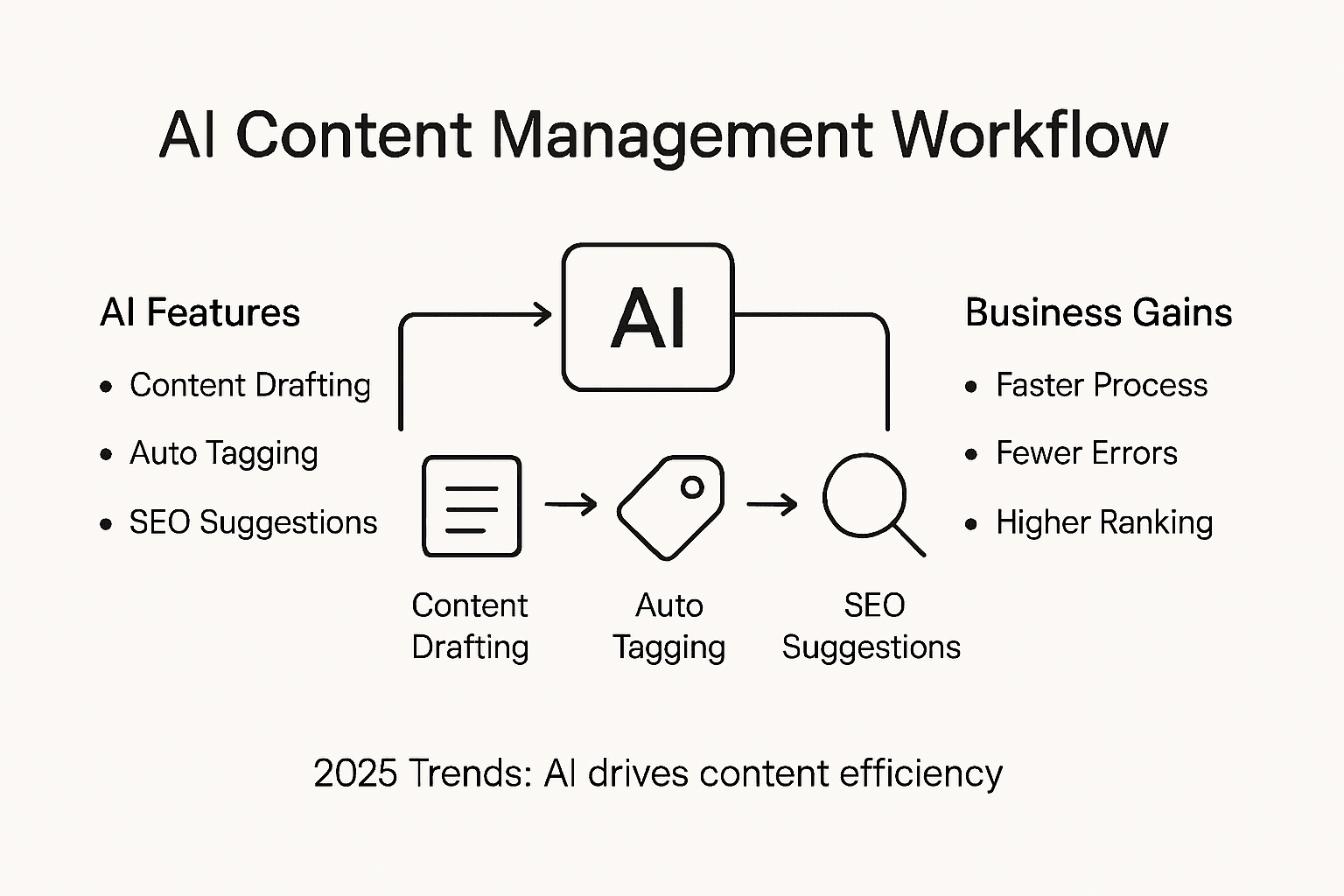
Intelligent Task Routing represents a critical advancement in workflow management. AI systems now analyze individual team member capabilities, workload, content complexity, and historical performance to dynamically assign tasks. These sophisticated algorithms can predict potential bottlenecks, recommend optimal collaboration paths, and automatically redistribute work to maintain consistent productivity and quality standards.
Modern content management platforms are evolving rapidly to incorporate advanced collaboration features. These systems leverage machine learning to create intelligent collaboration environments where team members receive context-aware recommendations, real-time editing suggestions, and personalized workflow optimizations. Key capabilities include automatic version control, semantic content matching, collaborative editing interfaces, and predictive project management tools that anticipate team resource requirements.
The future of workflow automation extends beyond simple task delegation. Emerging AI technologies are creating adaptive collaboration ecosystems that learn from team interactions, understand complex project dependencies, and proactively suggest optimization strategies. These systems can identify skill gaps, recommend cross-training opportunities, and help organizations develop more agile, responsive content production processes.
Pro Tip: Adaptive Workflow Mapping: Implement a quarterly review of your AI-driven workflow automation system, analyzing performance metrics and continuously refining task allocation algorithms to match evolving team dynamics.
Risks, Ethical Considerations, and Best Practices
As artificial intelligence becomes increasingly integrated into content management systems, organizations must navigate a complex landscape of technological potential and ethical responsibility. Establishing comprehensive ethical guidelines for AI development has become a critical priority for growth-stage companies seeking to implement advanced technological solutions.
Transparency and Accountability represent the foundational principles of responsible AI integration. This involves creating clear mechanisms for understanding how AI algorithms make decisions, ensuring that content generation and workflow management processes remain auditable and explicable. Organizations must develop robust frameworks that allow human oversight, prevent potential algorithmic biases, and maintain a balance between technological efficiency and human creative judgment.
Maintaining editorial integrity and audience trust requires a nuanced approach to AI implementation. Key ethical considerations include protecting data privacy, preventing algorithmic discrimination, and ensuring that AI tools enhance rather than replace human creativity. Companies must implement comprehensive governance structures that include regular algorithmic audits, transparent AI usage policies, and mechanisms for human intervention and correction.
The most advanced organizations are developing ethical AI frameworks that go beyond compliance, treating AI as a collaborative tool designed to augment human capabilities. This involves creating multidisciplinary teams that include ethicists, technologists, content specialists, and legal experts to continuously evaluate and refine AI integration strategies. Successful implementations recognize that AI is not just a technological solution but a complex sociotechnical system requiring ongoing management and thoughtful integration.
Pro Tip: Ethical AI Governance: Establish a cross-functional AI ethics committee with clear guidelines for reviewing, monitoring, and potentially limiting AI capabilities to ensure responsible technological deployment.
Unlock AI-Driven Efficiency and Search Success with Custom Solutions
The 2025 AI content management trends reveal a clear challenge: growth-stage companies need systems that intelligently handle content generation, workflow automation, and semantic search optimization to stay competitive. If you struggle with inefficient manual processes, lack of real-time AI-driven insights, or missed opportunities in AI-powered search rankings, you are not alone. These pain points directly impact content visibility, team collaboration, and operational efficiency.
At Rule27 Design, we build scalable custom admin panels and content management solutions tailored to your unique workflows and AI ambitions. Our expertise bridges the gap between generic software and complex enterprise products, delivering tools that enhance dynamic content personalization, intelligent workflow automation, and boost your presence in AI-driven search results like ChatGPT or Claude. Explore how our custom digital infrastructure integrates sophisticated AI capabilities to improve your content optimization and team collaboration.
Ready to transform your content systems for the AI-first future?

Discover the power of purpose-built AI-optimized content platforms made for growing companies. Visit Rule27 Design now to see how we can help you harness AI trends, increase operational efficiency by 40 percent, and elevate search visibility. Don’t wait—upgrade your content management strategy today for smarter, faster, and more engaging results.
Frequently Asked Questions
What are the key AI trends in content management for 2025?
The key AI trends in content management for 2025 include intelligent content recommendations, real-time SEO optimization, adaptive content personalization, and advanced predictive analytics, all aimed at enhancing operational efficiency and improving content strategies.
How does intelligent content generation work in AI content management systems?
Intelligent content generation utilizes advanced natural language processing algorithms to draft initial content, generate metadata, and suggest improvements by analyzing existing content and understanding context.
What role does predictive analytics play in content management?
Predictive analytics helps content teams forecast audience engagement and optimize distribution strategies by analyzing historical data and identifying emerging trends, enabling informed decision-making.
Why is semantic search optimization important for content visibility?
Semantic search optimization focuses on understanding user intent and contextual meaning, moving beyond traditional keyword matching to create content that demonstrates deep topical expertise and meets searchers’ needs effectively.

About the Author
Josh AndersonCo-Founder & CEO at Rule27 Design
Operations leader and full-stack developer with 15 years of experience disrupting traditional business models. I don't just strategize, I build. From architecting operational transformations to coding the platforms that enable them, I deliver end-to-end solutions that drive real impact. My rare combination of technical expertise and strategic vision allows me to identify inefficiencies, design streamlined processes, and personally develop the technology that brings innovation to life.
View Profile

