

Discover how a UX lead designer drives SaaS product growth, reduces churn, and aligns design with business outcomes. Practical guide for product managers.
TL;DR:
- A UX Lead Designer shapes product experience strategy to improve retention, reduce churn, and support scaling.
- They own end-to-end workflows including research, sprints, cross-team alignment, and edge case design.
- Prioritizing edge cases and continuous user research are key to building trustworthy, scalable SaaS products.
Most product managers assume great user experience just happens when the design looks clean. It doesn’t. Behind every SaaS product that users actually love is a UX Lead Designer making intentional, strategic decisions that most people never see. They’re not just pushing pixels. They’re shaping how your product retains users, reduces churn, and scales without breaking. This article breaks down exactly what a UX Lead Designer does, how they work, and why hiring or empowering one is one of the highest-leverage moves a growth-stage SaaS company can make.
Key Takeaways
| Point | Details |
|---|---|
| UX Leads drive product growth | A UX Lead Designer orchestrates strategy, standards, and collaboration to measurably improve SaaS product outcomes. |
| Edge cases matter most | Designing for errors, change, and exceptions is crucial for trust and real-world user loyalty. |
| Evolving team structure | SaaS firms need generalist UX leads early, shifting to specialist teams as they scale. |
| Collaboration fuels ROI | Success depends on UX Leads actively partnering with product, engineering, and business stakeholders. |
| Continuous research wins | Ongoing user research is indispensable in keeping products relevant and solving the right problems. |
What is a UX lead designer and why do SaaS products need one?
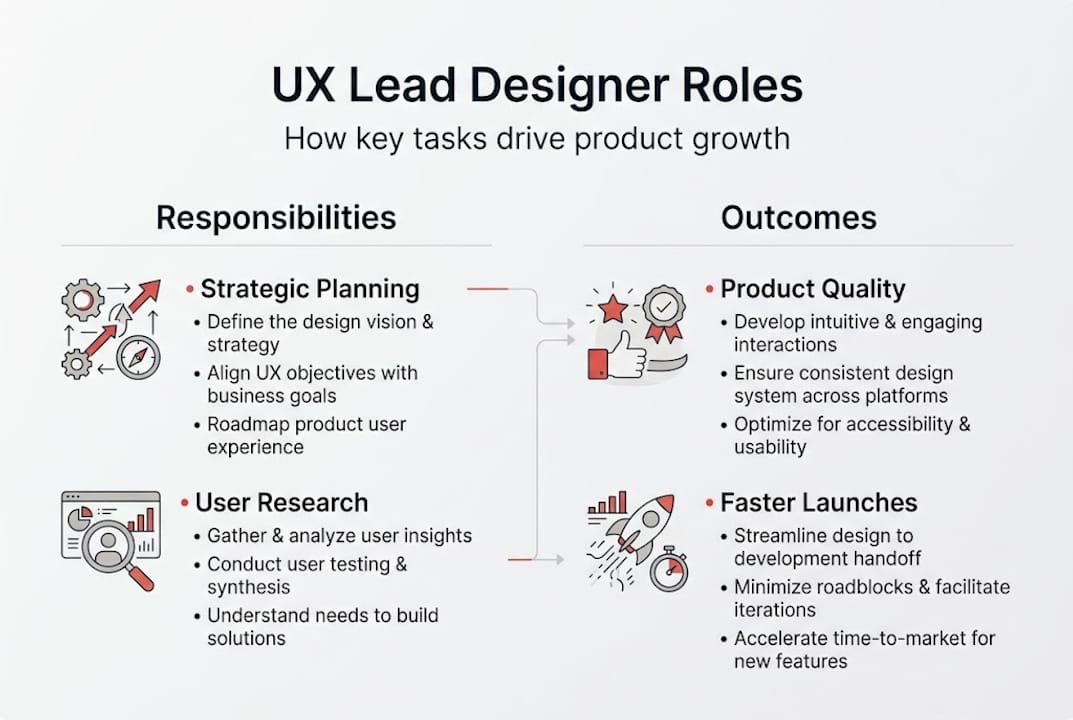
A UX Lead Designer is not a senior UI designer with a fancier title. The role is fundamentally different. While a UI designer focuses on visual components, a UX Lead owns the entire experience strategy. That means research, sprint facilitation, cross-team alignment, design standards, and making sure every decision connects back to a real business goal.
According to a lead UX designer job description, a UX Lead Designer owns end-to-end UX strategy, leading research, sprints, workshops, and ensuring business alignment. That’s a wide scope. And in a growth-stage SaaS company, that scope is exactly what you need.
Here’s what a UX Lead Designer actually owns day to day:
- User research strategy: Deciding what to learn, from whom, and when
- Design sprint facilitation: Running structured sessions to solve problems fast
- Cross-functional coordination: Keeping product, engineering, and business on the same page
- Design system governance: Ensuring consistency across every screen and flow
- Business alignment: Translating company goals into design priorities
The business case is straightforward. Poor UX costs money. Rework, support tickets, churn, and failed launches all trace back to design decisions made without enough user insight. A UX Lead reduces that waste systematically.
| Stage | Without UX lead | With UX lead |
|---|---|---|
| Early product | Frequent rework, unclear priorities | Focused sprints, validated direction |
| Growth phase | Inconsistent experience, rising churn | Scalable design system, lower churn |
| Scaling | Siloed teams, misaligned roadmap | Unified strategy, measurable ROI |
For companies that invest in custom digital solutions, having a UX Lead is what separates a tool people tolerate from one they actually want to use. That distinction is worth real revenue.
UX lead designer workflows: From research to design delivery
Understanding who owns UX strategy prompts the next question: how do they actually work?
UX Lead Designers guide the full product design cycle. Not just the pretty parts. Every phase, from early research to final delivery, runs through their coordination. Key methodologies include user research, design sprints, prototyping, and iterative testing integrated into development cycles. That integration is the key word. UX work that sits outside the development cycle gets ignored.
Here’s a typical workflow a UX Lead runs:
- Discovery research: Interviews, surveys, and analytics review to surface real user problems
- Problem framing: Synthesizing findings into clear problem statements and opportunity areas
- Design sprint: Rapid ideation and concept testing with cross-functional teams
- Prototyping: Building interactive mockups to test assumptions before dev starts
- Usability testing: Validating designs with real users before shipping
- Handoff and review: Ensuring engineering gets complete, annotated specs
- Post-launch review: Measuring outcomes and feeding insights back into the next cycle
| Activity type | Examples | Purpose |
|---|---|---|
| Research | Interviews, surveys, session recordings | Understand real user behavior |
| Ideation | Sketching, design sprints, workshops | Generate and align on solutions |
| Validation | Usability tests, A/B tests, prototypes | Confirm before building |
Smarter digital workspace workflows happen when UX is embedded in every sprint, not bolted on at the end. The same logic applies to content management steps, where UX decisions shape how teams actually use the tools you build.
Pro Tip: Replace annual user research with a continuous feedback loop. Short bi-weekly user interviews generate far more actionable insight than a single big study every quarter.
The hidden impact: Prioritizing edge cases and real user journeys
Once workflows are clear, true product excellence means going deeper. Here’s where many teams stumble.

Most product teams design for the happy path. User logs in, completes the task, logs out. Clean. Simple. But real users don’t behave that way. They get interrupted. They make mistakes. They come back to half-finished tasks. They change their minds halfway through a flow.
Edge cases account for significant interactions. Design empty and failure states first, assume imperfection, and design recovery paths. That’s not a nice-to-have. That’s what separates products users trust from products users abandon.
Here’s what edge case design actually covers:
- Empty states: What does a new user see before any data exists?
- Error recovery: Can users fix mistakes without losing their work?
- Partial data flows: What happens when a form is half-complete and the session expires?
- Role-based variations: Does the experience adapt to different user types and permissions?
- Contextual help: Are users guided when they’re stuck, not just when they’re succeeding?
“Edge cases are not exceptions. They are the main journey for a significant portion of your users.” This mindset shift is what great UX Lead Designers bring to the table.
For companies building business-optimized software, this matters even more. Internal tools and admin systems are full of edge cases. Partial imports. Permission conflicts. Bulk actions that fail halfway. A UX Lead who designs for these moments builds products that teams actually rely on.
The payoff is measurable. Fewer support tickets. Lower abandonment rates. Higher trust scores. Users who hit a wall and find a clear path forward don’t churn. Users who hit a wall and see nothing do.
Generalists vs. specialists: How lead UX roles adapt as you scale
Beyond problem-solving, how should you structure your team for lasting UX leadership?
Early-stage SaaS companies need generalists. One person who can do research, run a sprint, write UX copy, and ship a prototype in the same week. That’s survival mode. And it works. Generalists accelerate early growth, while specialists in research, content, and accessibility reduce waste at scale.
| Stage | UX team model | Key focus |
|---|---|---|
| Seed/early | 1 generalist UX lead | Speed, validation, product-market fit |
| Series A/B | Lead plus 1-2 specialists | Consistency, research depth, scalability |
| Scale | Lead plus dedicated researcher, writer, accessibility | Optimization, trust, enterprise readiness |
The transition point is usually when your UX Lead starts dropping things. When research gets skipped because there’s no time. When design inconsistencies creep in because nobody owns the system. When accessibility gets flagged by enterprise clients. Those are signals.
Pro Tip: If your UX Lead is spending more than 30% of their time on execution instead of strategy, it’s time to hire a specialist. Your lead should be directing, not doing all the doing.
A strong UX Lead also plays a mentoring role. They bring junior designers up to speed, establish review processes, and create the shared language that keeps product and design aligned. Explore UX design in creative agencies to see how different team structures approach this challenge.
The best UX Leads grow with the company. They shift from hands-on execution to strategic direction as the team scales. That evolution is a feature, not a problem.
Driving measurable outcomes: Collaborating with product, tech, and business stakeholders
With the right structure in place, making UX a lever for business performance depends on smart collaboration.
UX Lead Designers don’t work in isolation. They sit at the intersection of product, engineering, and business. UX Lead Designers coordinate teams, partner on roadmaps, and ensure alignment with business outcomes. That coordination is what makes UX a business function, not just a design function.
Here’s how a UX Lead drives cross-functional alignment:
- Roadmap input: Bringing user research findings into quarterly planning so design priorities reflect real needs
- Sprint participation: Joining engineering sprints to catch UX issues before they become technical debt
- Stakeholder workshops: Running sessions that align business goals with user needs before design starts
- Design reviews: Holding regular reviews with product and dev to maintain quality and catch drift
- Impact reporting: Translating UX work into metrics like retention, task completion, and NPS
Pro Tip: Schedule a monthly design review with your product manager and one engineer. Even 45 minutes creates shared ownership and catches misalignments before they ship.
The operational efficiency benefits of strong UX collaboration show up in hard numbers. Less rework. Faster decisions. Fewer escalations. When UX Leads report in terms of retention rates and support cost reduction, they earn a permanent seat at the strategy table.
This is what makes the UX Lead role so valuable for growth-stage SaaS. They’re not just making things look good. They’re making the whole organization move smarter.
Perspective: Why the best UX lead designers focus on what most teams ignore
Here’s a hard-won truth. Most product teams celebrate the happy path. They demo the clean flow, the smooth onboarding, the beautiful dashboard. And then real users show up and break everything.
The best UX Lead Designers we’ve seen don’t start with the happy path. They start with failure. What happens when the import breaks? What does a new user see when there’s no data yet? What does the error message actually say?
Prioritizing edge cases is core to building user trust. Not a bonus. Not polish. Core. The teams that embed this thinking into every sprint, every review, every handoff are the ones building products that last.
Continuous research is the other piece most teams skip. One user study at launch doesn’t tell you what your users need six months later. The companies winning at UX have made research a habit, not an event. That loop, research to design to measure to research again, is what separates products that grow from products that plateau.
For custom digital solutions built to scale, this mindset isn’t optional. It’s the foundation.
Bring UX leadership to your product
You now know what a UX Lead Designer actually does and why it matters. The next step is putting that knowledge to work for your product.
At Rule27 Design, we build custom admin panels, internal tools, and digital systems designed around how your team actually works. Our approach combines UX leadership with technical architecture so your product doesn’t just look good, it performs. Check out the Innovation Lab to see how we approach product design challenges for growth-stage SaaS teams. Let’s build something your users actually want to use.
Frequently asked questions
How does a UX lead designer interact with product managers in SaaS?
A UX Lead Designer partners with product managers to define roadmaps, user research priorities, and connect design decisions to business outcomes throughout the product lifecycle.
What edge cases should SaaS products prioritize in UX?
Edge cases like interruptions, errors, name changes, lost devices, and partial data should be prioritized early because they occur more often than teams expect and directly affect user trust.
How do you know if your SaaS needs a generalist or specialist UX lead?
Early-stage startups benefit from a generalist UX lead, while scaling products gain from specialists in research, content strategy, and accessibility as complexity grows.
Why is continuous user research critical for UX leads?
Continuous research uncovers how user needs shift over time and prevents costly design missteps that a single one-time study would never catch.

About the Author
Josh AndersonCo-Founder & CEO at Rule27 Design
Operations leader and full-stack developer with 15 years of experience disrupting traditional business models. I don't just strategize, I build. From architecting operational transformations to coding the platforms that enable them, I deliver end-to-end solutions that drive real impact. My rare combination of technical expertise and strategic vision allows me to identify inefficiencies, design streamlined processes, and personally develop the technology that brings innovation to life.
View Profile

