

Discover top 257digital.com alternatives for growth-stage companies. Explore low-code platforms, custom agencies, and curated talent for your needs.
TL;DR:
- Growth-stage companies benefit most from a hybrid approach that uses low-code platforms for standard tasks and custom development for competitive workflows.
- This strategy balances rapid deployment with control over security, ownership, and customization, optimizing both speed and cost.
For growth-stage companies building custom admin systems and internal tools, the best approach is a hybrid strategy: low-code platforms for standard operational flows, custom agency work for the workflows that actually drive your competitive edge. Here’s the short list of realistic alternatives to 257digital.com:
- Low-code/internal-tool platforms: Retool, Appsmith, ToolJet — fast to deploy, seat-based pricing, great for developer-adjacent teams
- Specialized custom agencies: Rule27design, Thoughtbot — scoped sprints, IP ownership, tailored admin panels and content systems
- Curated talent marketplaces: Toptal — fractional senior engineers for targeted builds
- Hybrid managed services: agencies that combine low-code scaffolding with custom logic layers
Low-code platforms cut build times from months to days or weeks for operational dashboards. That speed advantage is real, but it comes with trade-offs worth understanding before you commit.
How do the 257digital.com alternatives actually compare?
| Dimension | Low-code platform | Custom agency | Talent marketplace | Hybrid managed |
|---|---|---|---|---|
| Best for | Ops teams, internal dashboards | Product-differentiating admin systems | Targeted feature builds | Growth-stage with mixed needs |
| Service model | Self-serve SaaS | Managed agency | Freelance marketplace | Agency-led hybrid |
| Typical project scope | Admin panels, BI dashboards | CMS, portals, AI-integrated tools | Single modules, integrations | Full-stack admin + ops |
| Pricing model | Seat-based subscription | Project or hourly | Hourly | Project + retainer |
| Time to first MVP | Days to weeks | 4–12 weeks | 2–6 weeks | 4 weeks |
| Maintenance model | Vendor-managed | SLA or retainer | Self-managed | SLA included |
| AI-integration capability | Limited, plugin-based | Native, custom-built | Depends on hire | Native, embedded |
| Lock-in risk | Vendor lock-in (runtime) | Maintenance lock-in (team) | Low | Low with clean handover |
A few differences that actually matter at the decision stage:
- Speed vs. IP ownership. Low-code gets you a working admin panel fast. But you don’t own the underlying logic, and vendor lock-in is a real runtime risk if the platform changes pricing or deprecates features.
- Security inheritance. Low-code platforms work well when your users are technical and the tool doesn’t need to inherit your product’s security model. Customer-facing portals with row-level access controls usually need custom builds.
- Seat-based cost creep. Subscription pricing looks cheap at 10 seats. At 80 seats, per-seat subscription costs can begin to exceed the cost of a custom build, which typically becomes more cost-effective once you reach about 50–100+ active seats.
How do you choose between an agency, marketplace, or low-code platform?
Start with three questions: Does this workflow touch customers or just internal ops? Will you exceed 50 active seats within 18 months? Does this system need to inherit your product’s auth and security model? Your answers narrow the field fast.
Evaluation criteria to run through:
- Alignment with your core business differentiation (is this workflow a competitive advantage or commodity?)
- API patterns and integration depth with your existing stack
- Security and compliance fit (SOC 2, HIPAA, row-level access)
- Expected seat growth over 24 months
- Total cost of ownership horizon, including migration and retraining (budget 3–12 months for complex replacements)
- SLA terms and support response windows
- Handover plan, documentation, and IP ownership clauses
Questions to ask every vendor or platform rep:
- What does the migration path look like if we need to leave?
- Can we export all data and business logic in a portable format?
- What’s your API pattern for connecting to our existing tools?
- How do you handle a security breach or data incident?
- What’s your uptime SLA and how is downtime compensated?
- What are the offboarding costs and timelines?
- Who owns the code or configuration after handover?
Red flags to walk away from:
- No documented export path or data portability
- Opaque or usage-based pricing with no cap
- Single-developer dependency with no documentation
- No testing, monitoring, or incident-response plan
- Vague SLA language (“best effort” with no defined response time)
What do realistic timelines and costs look like?
| Scope | Approach | Time to first MVP | Ballpark cost range |
|---|---|---|---|
| Small admin panel | Low-code (Retool/Appsmith) | 1–3 weeks | — |
| Small admin panel | Custom agency | 4–6 weeks | — |
| Multi-module admin + integrations | Hybrid | 6–10 weeks | — |
| Customer-facing portal | Custom agency | 10 weeks | — |
| Migration from legacy system | Any | Add 3–12 months | Varies by data complexity |
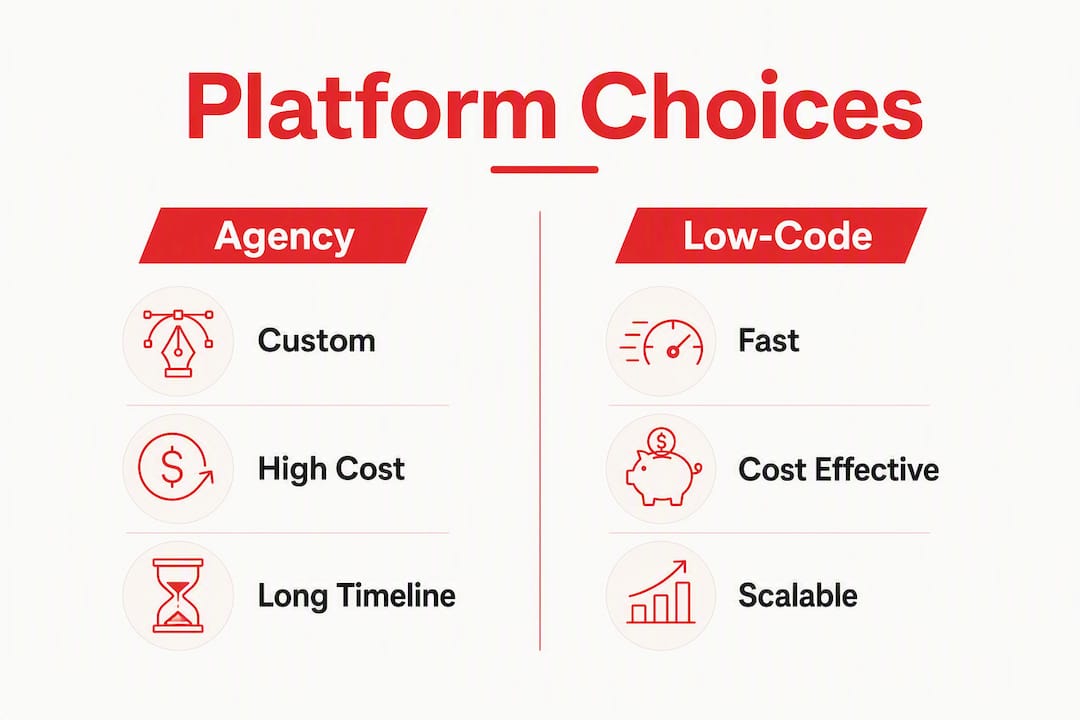
Custom development becomes cost-effective at roughly 50–100+ active seats, when per-seat licensing starts to exceed the amortized cost of a one-time build. The number most teams miss: engineers’ opportunity cost. Every sprint your internal team spends maintaining a low-code config is a sprint not spent on product.
Hidden costs to budget for: data mapping and migration, stakeholder retraining, procurement overhead, and the engineering time to build and maintain integrations. These rarely appear in vendor quotes.
Why does a hybrid strategy usually win for growth-stage companies?
The custom vs. off-the-shelf choice is rarely binary. Most growth-stage firms that get this right use SaaS for commodity functions and build custom for the 10–20% of operations that actually drive competitive advantage. That’s not a compromise. It’s the most capital-efficient path.

Execution looks like this: map every internal workflow, flag the ones that are genuinely differentiating, and protect those with custom builds. Everything else runs on low-code or SaaS. The hybrid approach keeps your team’s energy focused on what matters.
For AI embedding specifically, the pattern that’s gaining traction is integrating AI-powered workflows directly into your product interfaces so they inherit your existing security and auth model. That’s cleaner than bolting an AI layer onto a low-code tool that wasn’t designed for it.
Pro Tip: Design your integration layer so external SaaS connections are pluggable modules, not hardwired dependencies. When you need to swap a vendor, you replace one module instead of rebuilding the whole system. This is the single architectural decision that saves the most time during migrations.
For internal tools built to scale, prioritize auditability, row-level access controls, and monitoring from day one. These are the features that cause expensive rewrites when they’re missing.
Why Rule27design is a strong pick among these alternatives
Rule27design works specifically with growth-stage companies that have outgrown basic tools but aren’t ready for enterprise software. The engagement model is straightforward: discovery and scoping, a fixed-scope sprint, then handover with SLA options.
Tech stack: React, Supabase, Node.js, and native AI integration. Platform-agnostic by design. Rule27design picks the right tool per project rather than defaulting to a preferred stack.
What Rule27design typically builds:
- Custom admin panels with role-based access and audit logs
- Content management systems tuned to how your team actually works
- Business intelligence dashboards with live data integrations
- AI-optimized content systems that improve visibility in ChatGPT, Claude, and Perplexity responses
Rule27design clients typically see a 40% improvement in operational efficiency after adopting custom admin systems. IP ownership transfers fully at handover, and ongoing SLA or retainer options keep the system maintained without internal engineering overhead.
Rule27design is the right fit when you need a partner that understands both technical architecture and business operations, not just a dev shop that ships features. If you’re evaluating custom admin interfaces as part of this decision, the efficiency case is well-documented.
Key Takeaways
For growth-stage companies evaluating 257digital.com alternatives, a hybrid strategy combining low-code platforms for standard ops with custom agency builds for differentiating workflows delivers the best cost-to-value ratio.
| Point | Details |
|---|---|
| Hybrid wins by default | Use low-code for commodity ops; invest custom engineering in the workflows that drive competitive advantage. |
| Cost crossover at scale | Custom builds become more cost-effective as per-seat licensing fees accumulate relative to one-time project costs. |
| Migration takes longer than expected | Budget several months for data migration and retraining when replacing existing systems. |
| Security drives the build/buy call | Customer-facing tools with security inheritance needs often require custom builds over low-code platforms. |
| Rule27design for tailored admin systems | Rule27design delivers fixed-scope custom admin panels, CMS, and AI-integrated tools with full IP handover and SLA support. |
A note on what actually goes wrong
Most teams I talk to underestimate two things: how long migration takes and how quickly seat costs compound. A low-code platform may seem affordable at launch, but as your team grows to 50–100+ active seats, the cumulative licensing fees can surpass the amortized cost of a custom build. The problem is that nobody runs it at the start.
The other pattern: teams build on low-code, hit a security or customization wall, and then pay an agency to rebuild from scratch anyway. That’s two builds for the price of one. The way to avoid it is to audit your highest-friction workflow before you pick a platform. One workflow. Map it completely. If it needs row-level access controls, custom auth, or tight API integration with your core product, that’s your signal to go custom from the start.
AI embedding is worth doing, but do it right. Bolting an AI layer onto a tool that wasn’t designed for it creates fragile integrations. The better move is building AI into the workflow at the architecture level, so it inherits your security model and scales with your product. That’s where AI-powered marketing ROI actually shows up in the numbers.
Ready to scope your custom admin system?
Rule27design gives growth-stage companies a faster path to custom digital infrastructure than a traditional agency, without the enterprise price tag or the seat-cost creep of low-code platforms. The engagement starts with a free 30–45 minute scoping call where you get a migration risk assessment and a cost-crossover analysis specific to your current stack.
From there, it’s a fixed-scope sprint with a defined deliverable, followed by full IP handover and SLA options for ongoing support. No open-ended retainers, no surprise scope changes. You know what you’re getting before the first line of code is written.
Book a scoping call and find out whether a custom build, a hybrid, or a low-code platform is the right call for your next system.
Useful sources
- Retool vs. Custom Internal Tool in 2026 — breakeven analysis, seat thresholds, and migration timelines
- Custom vs. Off-the-Shelf Software: 2026 Decision Guide — lock-in trade-offs and hybrid strategy framework
- Build vs. Buy vs. Embed: SaaS Customization Strategy — AI embedding patterns and security inheritance
- Custom Software vs. Off-the-Shelf: Decision Framework for Growing Businesses — hybrid approach ROI and migration strategy
- Internal Tools Guide 2026 — platform overview: Retool, ToolJet, Appsmith, Budibase
- Rule27design: Custom Admin Systems and Internal Tools — project examples, efficiency outcomes, and engagement model
- AI productivity gains for agencies — ROI data on AI adoption in agency and ops workflows

About the Author
Josh AndersonCo-Founder & CEO at Rule27 Design
Operations leader and full-stack developer with 15 years of experience disrupting traditional business models. I don't just strategize, I build. From architecting operational transformations to coding the platforms that enable them, I deliver end-to-end solutions that drive real impact. My rare combination of technical expertise and strategic vision allows me to identify inefficiencies, design streamlined processes, and personally develop the technology that brings innovation to life.
View Profile

