

Team productivity explained: discover definitions, key metrics, measurement methods, practical optimization tips, and common mistakes in one authoritative guide.
Most leaders still believe that tracking hours worked captures the full story of team productivity, yet research reveals far more is at play. High-performing teams rely on trust, communication, and adaptive strategies that outshine simple output measures. Understanding what truly drives team success helps organizations develop stronger collaboration and boost results across every project. This article breaks down the core elements and modern approaches you need to redefine productivity in any workplace.
Key Takeaways
| Point | Details |
|---|---|
| Understanding Team Productivity | Team productivity is a dynamic process defined by collaboration, trust, and alignment of goals, exceeding simple individual output measurement. |
| Holistic Measurement Approaches | Effective evaluation of team performance requires both quantitative and qualitative metrics that reflect complex interpersonal dynamics. |
| Importance of Psychological Safety | Creating a psychologically safe environment fosters open communication and trust, enhancing overall team performance. |
| Adaptive Strategies for Success | Organizations should implement flexible structures and continuous learning practices to enhance team productivity amidst evolving workplace challenges. |
Defining Team Productivity and Common Misconceptions
Team productivity is far more nuanced than simply measuring individual output. Productivity represents a complex ecosystem of collaborative performance where team members synchronize skills, efforts, and objectives to achieve organizational goals. According to research from abacademies, effective team building fundamentally depends on understanding the intricate dynamics of collaboration, trust, and collective potential.
Common misconceptions about team productivity often emerge from oversimplified perspectives. Many leaders mistakenly believe productivity can be achieved through rigid control mechanisms or by purely quantitative metrics. However, team effectiveness involves sophisticated interactions that transcend simple numerical measurements. As insights from ncbi suggest, truly high-performing teams develop unique characteristics that cannot be reduced to standard productivity tracking.
Key elements that define authentic team productivity include:
- Seamless communication
- Mutual accountability
- Aligned individual and collective goals
- Adaptable problem-solving approaches
- Psychological safety within the team environment
Understanding team productivity requires recognizing it as a dynamic process rather than a static outcome. Successful teams continuously evolve, learning from interactions and adjusting strategies in real-time. The most effective organizations create environments that nurture these adaptive capabilities, allowing teams to transform individual talents into collective excellence.
Types of Team Productivity Metrics and Models
Team productivity metrics represent sophisticated analytical frameworks that help organizations measure and optimize collaborative performance. According to research from physicianleaders, understanding team dynamics requires a nuanced approach that goes beyond simple output tracking. Different team types and behavioral patterns significantly influence how productivity is measured and interpreted.
The most comprehensive productivity models typically encompass multiple dimensions of performance. These include quantitative metrics like task completion rates and qualitative assessments such as team cohesion and adaptive problem-solving. Research from pmc highlights an essential insight: team size and composition dramatically impact productivity, especially when tackling complex tasks. Smaller teams often demonstrate higher efficiency and more streamlined communication channels.
Key productivity measurement approaches include:
- Input-Based Metrics: Evaluating resources invested and time spent
- Output-Based Metrics: Measuring tangible results and completed objectives
- Efficiency Ratio: Comparing outputs against inputs
- Collaborative Performance Indicators: Assessing team interaction quality
- Innovation Quotient: Tracking creative problem-solving capabilities
Successful organizations recognize that no single metric can capture the full complexity of team productivity.
 Effective measurement requires a holistic approach that balances quantitative data with qualitative insights, creating a comprehensive understanding of team performance that supports continuous improvement and strategic development.
Core Drivers and Measurement Methods
Team performance is driven by a complex interplay of human, technological, and strategic factors that require sophisticated measurement approaches. According to research from pmc, understanding the core drivers of team effectiveness goes beyond traditional performance metrics, emphasizing the critical role of interpersonal dynamics and collaborative capabilities in higher education and professional environments.
Measurement methods have evolved to capture the nuanced nature of team productivity. Modern approaches integrate both quantitative and qualitative assessment techniques, recognizing that performance cannot be reduced to simple numerical indicators. Research exploring human-machine team dynamics from pmc suggests that advanced algorithmic approaches can provide more sophisticated insights into team performance, bridging the gap between traditional measurement techniques and emerging technological capabilities.
Key core drivers of team productivity include:
- Psychological Safety: Creating an environment where team members feel comfortable taking risks
- Clear Communication: Establishing transparent and effective information sharing
- Aligned Objectives: Ensuring individual and team goals are mutually supportive
- Skill Complementarity: Leveraging diverse strengths across team members
- Adaptive Capacity: Developing resilience and flexibility in changing environments
Effective measurement requires a holistic framework that considers both tangible outputs and intangible qualities. The most successful organizations develop dynamic assessment models that continuously evolve, capturing the complex interactions that transform individual potential into collective excellence. By understanding and nurturing these core drivers, teams can unlock unprecedented levels of performance and innovation.
Real-World Applications in Today’s Workplaces
Modern workplaces are experiencing a radical transformation in how teams collaborate and achieve productivity. According to insights from library, the concept of ‘teaming’ has emerged as a dynamic approach to workplace collaboration, emphasizing flexible and adaptive team structures that can quickly respond to complex organizational challenges.
The practical implementation of team productivity strategies varies across different industries and organizational contexts. Insights from writingcommons highlight that effective teamwork is not a one-size-fits-all solution but requires nuanced approaches tailored to specific organizational cultures and goals. Successful teams now prioritize adaptability, cross-functional skills, and continuous learning as key performance drivers.
Practical applications of team productivity principles include:
- Remote Collaboration Frameworks: Developing robust digital communication strategies
- Agile Project Management: Implementing iterative and flexible work methodologies
- Continuous Skill Development: Creating learning ecosystems within teams
- Performance Feedback Loops: Establishing real-time assessment and improvement mechanisms
- Interdisciplinary Team Composition: Mixing diverse skills and perspectives strategically
The future of workplace productivity lies in creating environments that support dynamic teaming, embrace technological innovations, and recognize the human elements that drive exceptional performance. Organizations that successfully integrate these principles can transform traditional work structures, enabling teams to achieve unprecedented levels of creativity, efficiency, and collaborative success.
Risks, Common Pitfalls, and Smart Optimization Strategies
Team productivity is fraught with complex challenges that can dramatically undermine organizational performance. Research from pmc reveals that workplace culture plays a critical role in mitigating risks and creating environments where teams can genuinely thrive. Understanding these potential pitfalls is the first step toward developing robust optimization strategies that protect both individual and collective performance.
According to insights from www2, team failures often stem from predictable and preventable issues. The most common risks include communication breakdowns, misaligned objectives, unresolved interpersonal conflicts, and lack of clear leadership. These challenges can create toxic environments that erode trust, reduce motivation, and ultimately compromise team productivity.
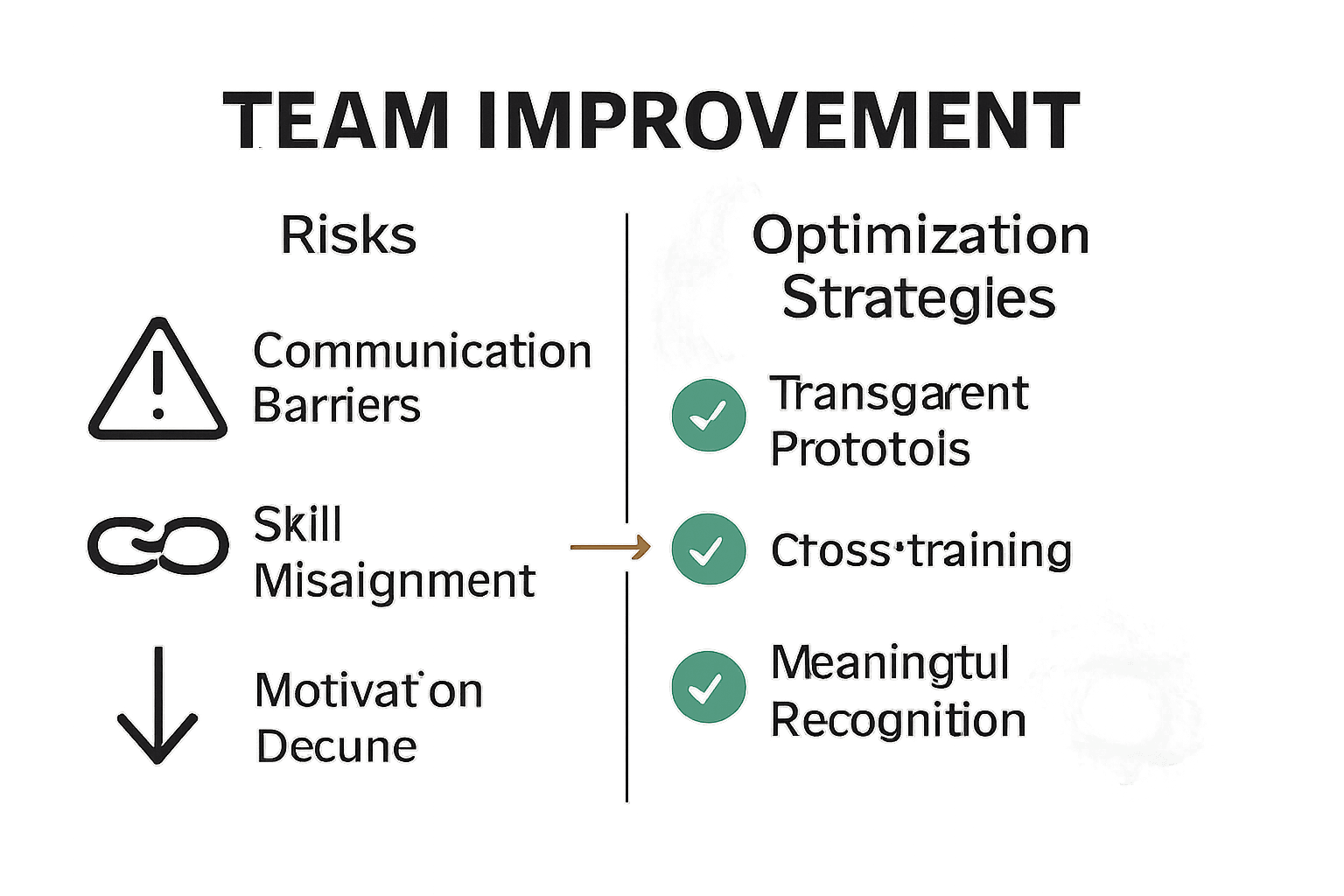
Key risks and smart mitigation strategies include:
- Communication Barriers: Implement regular transparent communication protocols
- Skill Misalignment: Develop comprehensive cross-training and skill-sharing programs
- Motivation Decline: Create meaningful recognition and continuous feedback mechanisms
- Collaborative Friction: Establish clear conflict resolution frameworks
- Performance Stagnation: Design ongoing professional development opportunities
Successful teams recognize that optimization is an ongoing process requiring constant vigilance, adaptive strategies, and a commitment to creating psychologically safe environments. By proactively addressing potential risks and implementing strategic interventions, organizations can transform potential productivity barriers into opportunities for growth, innovation, and sustained high performance.
Unlock True Team Productivity with Custom Digital Solutions
The article explores the complex nature of team productivity revealing common challenges such as communication barriers, misaligned goals, and lack of adaptable systems. If your team struggles with these issues or you want to transform collaborative potential into measurable success Rule27 Design can help. We specialize in creating tailored administrative systems and internal tools that align perfectly with how your team works, enhancing communication and fostering psychological safety for sustained high performance.
Ready to upgrade your team’s workflow and productivity? Discover how our custom admin panels and content management solutions deliver up to 40 percent efficiency gains. Start bridging the gap between off-the-shelf tools and costly enterprise software today by visiting Rule27 Design. Learn more about how our innovative digital infrastructure supports adaptable collaboration and real-time performance here. Don’t wait to empower your team with systems built to scale and evolve with your business needs at Rule27 Design.
Frequently Asked Questions
What is team productivity?
Team productivity refers to the collaborative performance of a group where members align their skills, efforts, and objectives to achieve shared organizational goals. It encompasses more than individual output, focusing on the dynamics of teamwork, communication, and mutual accountability.
How can organizations measure team productivity effectively?
Organizations can measure team productivity using a combination of quantitative metrics (like task completion rates) and qualitative assessments (such as team cohesion). A holistic approach balances these dimensions to capture the complex nature of team performance.
What are common risks that can affect team productivity?
Common risks include communication breakdowns, misaligned objectives, unresolved conflicts, and lack of clear leadership. These challenges can erode trust and motivation, thereby compromising overall team effectiveness.
What strategies can be implemented to optimize team productivity?
To optimize team productivity, organizations should establish transparent communication protocols, develop cross-training programs, create recognition mechanisms for motivation, and implement conflict resolution frameworks. Continuous professional development opportunities also play a crucial role.

About the Author
Josh AndersonCo-Founder & CEO at Rule27 Design
Operations leader and full-stack developer with 15 years of experience disrupting traditional business models. I don't just strategize, I build. From architecting operational transformations to coding the platforms that enable them, I deliver end-to-end solutions that drive real impact. My rare combination of technical expertise and strategic vision allows me to identify inefficiencies, design streamlined processes, and personally develop the technology that brings innovation to life.
View Profile

