

Discover what a UI/UX designer really does, the skills they need, salary benchmarks for 2026, and how their work drives growth for ambitious companies.
TL;DR:
- UI/UX designers integrate research, testing, and collaboration to ensure product success.
- They work through frameworks like User-Centered Design and Double Diamond to guide decisions.
- Hiring versatile designers with system thinking skills drives business scalability and growth.
Most people think UI/UX designers just make things look nice. Pick colors. Choose fonts. Maybe drop in a logo. That’s the misconception that quietly costs growth-stage companies real money. The truth is that UI/UX designers drive research, testing, and collaboration that directly shape whether your product succeeds or stalls. They sit at the intersection of business goals and user behavior. And if you’re building or scaling a digital product, an internal tool, or a customer-facing system, understanding what these designers actually do is one of the smartest moves you can make.
Key Takeaways
| Point | Details |
|---|---|
| UI vs UX clarified | UI relates to digital looks and interactivity, while UX covers end-to-end user experiences, and most roles mix both. |
| Core responsibilities | A UI/UX designer’s day involves user research, wireframes, prototypes, testing, and teamwork. |
| Frameworks matter | Effective design uses User-Centered Design or Double Diamond processes to deliver better products. |
| Salary benchmarks | In 2026, US UI/UX salaries range from $65k for juniors to $170k+ for seniors, with product designers gaining a premium. |
| Smart hiring | Versatile, process-driven UI/UX designers create scalable products and internal tools for real growth impact. |
What is a UI/UX designer? Unpacking the dual role
Let’s clear something up fast. UI and UX are two different things. But in practice, especially at growth-stage companies, one person often owns both.
UX stands for user experience. It’s about how a product feels to use. Is it intuitive? Does it solve the right problem? Does the flow make sense? UI stands for user interface. It’s about how the product looks and responds. Buttons, spacing, color contrast, micro-interactions. As UI focuses on visuals and interactivity while UX focuses on experience and usability, the same designer often handles both at smaller companies.
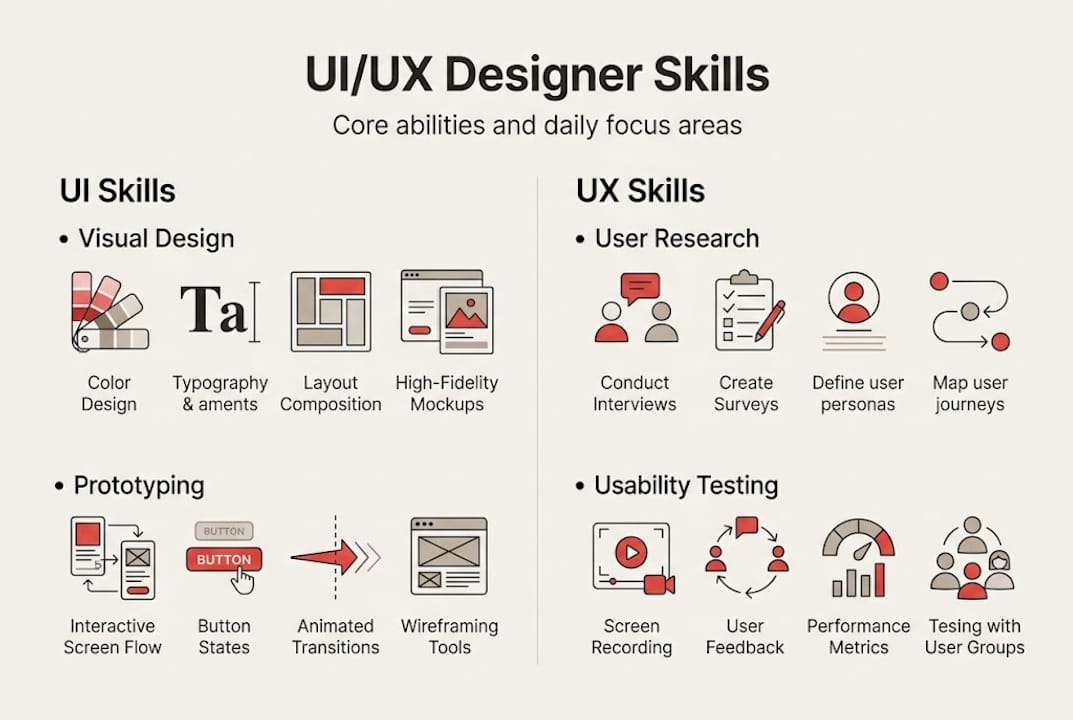
Then there’s the term product designer. It’s increasingly used to describe someone who does both UI and UX work, plus contributes to product strategy. Think of it as the evolved version of the combined role.
Here’s a quick breakdown:
| Role | Primary focus | Common deliverables |
|---|---|---|
| UX designer | User journeys, research, usability | Personas, wireframes, user flows |
| UI designer | Visual design, interactivity | Style guides, mockups, prototypes |
| Product designer | End-to-end product thinking | All of the above, plus strategy input |
Common deliverables you’ll see from these designers include:
- Wireframes: Low-fidelity layouts that map out structure before visuals
- Prototypes: Clickable mockups used for testing and stakeholder review
- User personas: Fictional profiles representing real user segments
- User flows: Step-by-step maps of how users move through a product
“Good UI/UX design isn’t decoration. It’s architecture for human behavior.”
Understanding the business impact of UI/UX goes well beyond aesthetics. These designers shape whether users stay, convert, or leave frustrated.
Core responsibilities: What UI/UX designers actually do
Now that the definitions are clear, let’s get into the actual work. What does a UI/UX designer do on a Tuesday afternoon? More than you’d expect.
UI/UX designers conduct user research, create wireframes and prototypes, perform usability testing, and collaborate across teams to keep products user-centered. Here’s how that breaks down in practice:
- User research: Interviews, surveys, and behavioral analysis to understand what users actually need, not what stakeholders assume they need.
- Wireframing and prototyping: Translating research into testable designs before a single line of code is written.
- Usability testing: Watching real users interact with designs to catch friction points early.
- Iteration: Refining based on test results. Good designers don’t fall in love with their first draft.
- Cross-functional collaboration: Working with developers, product managers, and marketing to align on goals and constraints.
- Presenting decisions: Communicating design choices with data, not just gut feel.
Each of these tasks connects to a real business outcome. Research prevents building the wrong thing. Testing catches problems before launch. Collaboration reduces rework. For companies supporting scalable SaaS products or enabling business scalability, these aren’t nice-to-haves. They’re load-bearing.

Pro Tip: Ask your designer to specifically map edge-case user scenarios during the research phase. Users who are confused, in a hurry, or using assistive technology reveal system weaknesses early. Solving those problems upfront cuts support tickets and churn down the road.
How UI/UX designers work: Key frameworks and processes
Great design isn’t random. It follows repeatable frameworks that keep teams focused and decisions grounded in evidence. Two of the most widely used are User-Centered Design (UCD) and the Double Diamond.
Key methodologies include User-Centered Design and the Double Diamond framework, emphasizing research through to delivery. Here’s what each means:
User-Centered Design (UCD) is a philosophy that keeps real users at the center of every decision. Every phase asks: does this serve the user? Is it validated?
The Double Diamond design process is a four-phase model that alternates between divergent thinking (exploring broadly) and convergent thinking (narrowing to solutions).
The four phases map out like this:
| Phase | What happens | Designer’s role |
|---|---|---|
| Discover | Research, interviews, observation | Gather raw user insights |
| Define | Synthesize findings, frame the problem | Create personas, journey maps |
| Develop | Ideate, prototype, test | Build and test multiple solutions |
| Deliver | Finalize, hand off, launch | Refine and document for dev |
Here’s why this matters for your business. Without a structured process, design decisions get made based on whoever talks loudest in the room. With a framework, every choice traces back to user evidence. That’s how you avoid expensive rebuilds.
The steps in practice:
- Start with real user interviews, not assumptions.
- Define the actual problem before jumping to solutions.
- Prototype multiple directions before committing.
- Test with users before handing off to developers.
Pro Tip: Insist on real user input at every phase, not just the research stage. Designers who validate during development catch misalignments early. That’s where you get the best ROI from design methodologies in action.
Skills, experience, and compensation: Who to hire in 2026
Knowing what designers do is one thing. Knowing what to pay them and what to look for is where hiring decisions get real.
US UX/UI salaries in 2026 range from $65,000 to $90,000 for juniors, $95,000 to $130,000 for mid-level, and $135,000 to $170,000+ for seniors, with a median around $105,000 to $112,000. Product designers typically command a 10 to 15% premium over standard UI/UX roles because of their broader scope.
Here’s a salary snapshot by tier:
| Experience level | Salary range (US) | Best suited for |
|---|---|---|
| Junior (0-2 yrs) | $65,000 to $90,000 | Execution support, fast-growth teams |
| Mid-level (3-5 yrs) | $95,000 to $130,000 | Owning features end-to-end |
| Senior (6+ yrs) | $135,000 to $170,000+ | Strategy, systems, team leadership |
| Product designer | 10-15% above equivalent | Full product lifecycle ownership |
Beyond salary, here’s what to look for in candidates:
- Hard skills: Figma, prototyping tools, basic HTML/CSS awareness, usability testing methods
- Soft skills: Empathy, curiosity, clear communication, comfort with ambiguity
- Process signals: Do they talk about user research first, or jump straight to visuals?
- Collaboration indicators: Have they worked closely with developers and product managers?
For optimizing internal tools, mid-level designers with systems thinking tend to outperform junior generalists. Remote hiring opens access to strong talent, but time zone overlap matters for collaboration. Check UX designer salary benchmarks if you’re comparing regional rates.
Stat to know: The median UI/UX salary sits around $105,000 to $112,000 in the US for 2026, making this a significant investment that pays back through reduced rework and higher product adoption.
Our take: What most business leaders miss about UI/UX hiring
Here’s what we see constantly. Companies hire designers based on portfolio aesthetics. Beautiful screens. Slick animations. Impressive case study layouts. And then six months later, the product still has usability problems and the support queue is full.
The portfolio matters. But what matters more is how a designer thinks. Do they lead with user research? Do they push back when a feature idea lacks validation? Do they obsess over edge cases, the confused user, the error state, the slow connection? Those instincts are what separate designers who look good from designers who build things that work.
For growth-stage companies, hire versatile UI/UX designers who deeply integrate user-centered frameworks and thorough edge-case thinking. A designer who asks “what happens when this fails?” is worth more than one who only asks “does this look good?”
Systems thinking and process mastery are what actually drive business scalability. Hire for that.
Connect with UI/UX design experts ready to drive your growth
You now have a clear picture of what UI/UX designers do, how they work, and what they cost. The next step is putting that knowledge to work.
At Rule27 Design, we build custom admin panels, internal tools, and digital systems that are designed from the ground up around how your team actually works. Our approach combines the kind of user-centered thinking this guide covers with robust technical architecture. The result? Systems your team wants to use. Check out our Innovation Lab to see what’s possible, or explore our full-stack design capabilities to find the right fit for your growth stage.
Frequently asked questions
What are the daily tasks of a UI/UX designer?
UI/UX designers conduct user research, design wireframes and prototypes, test usability, and collaborate with development teams to keep products aligned with real user needs.
How do UI and UX differ in practice?
UX focuses on overall experience and usability while UI focuses on visuals and interactivity. Both are essential, and collaboration between the two disciplines is what produces great products.
What frameworks do designers follow?
Key methodologies include User-Centered Design and the Double Diamond framework, which guide teams from research through ideation and into delivery.
What salary can I expect to pay a UI/UX designer in 2026?
US salaries range from $65,000 for juniors to $170,000+ for seniors, with product designers typically earning 10 to 15% more than standard UI/UX roles.
How do UI/UX designers impact business growth?
They increase usability, reduce support costs, and accelerate adoption. Prioritizing edge-case handling in complex systems reduces friction and boosts long-term scalability.

About the Author
Josh AndersonCo-Founder & CEO at Rule27 Design
Operations leader and full-stack developer with 15 years of experience disrupting traditional business models. I don't just strategize, I build. From architecting operational transformations to coding the platforms that enable them, I deliver end-to-end solutions that drive real impact. My rare combination of technical expertise and strategic vision allows me to identify inefficiencies, design streamlined processes, and personally develop the technology that brings innovation to life.
View Profile

