

Learn how SEO video drives 234% more organic traffic for SaaS. A complete guide to titles, schema, distribution, and ROI measurement for digital marketing managers.
Most SaaS marketers upload a product demo, share it on LinkedIn, and call it a day. That’s not SEO video. That’s just uploading. Real SEO video is a system, and when you build it right, the results are hard to ignore. Pages with video generate 5.2x longer dwell time and up to 234% more organic traffic for SaaS companies. This guide walks you through every layer of that system, from technical setup to distribution to ROI measurement, so you leave with a real playbook.
Key Takeaways
| Point | Details |
|---|---|
| Video SEO defined | Optimizing videos for search involves targeted metadata, transcripts, and strategic hosting. |
| Technical steps matter | Schema, transcripts, and on-page context directly impact video discoverability and ranking. |
| SaaS ROI is proven | Properly deployed SEO video can increase SaaS site traffic and user engagement by 2-5x. |
| Continuous improvement | Regularly measure video performance and remix metadata or visuals to maximize results. |
What is SEO video? Definition, goals, and SaaS context
SEO video is not a content format. It’s a strategy. It means creating and optimizing video assets so search engines can find, understand, and rank them for the right queries. The difference between a video that drives traffic and one that sits at zero views is almost always optimization, not production quality.
For growth-stage SaaS, the goals are specific. You want to attract users who are actively searching for solutions like yours. You want to educate them on features and use cases. And you want to convert them, whether that’s a trial signup, a demo request, or a deeper page visit. SEO video supports all three stages of that funnel.
The core mechanics include keyword-optimized titles between 60 and 70 characters, detailed descriptions with timestamps, semantic tags, closed captions, transcripts, custom thumbnails, and VideoObject schema markup. Each element signals relevance to search engines. Skip one and you leave ranking potential on the table.
Understanding how these elements interact with broader content ranking factors gives you a real edge. Video does not operate in isolation. It amplifies everything else on the page.
Pro Tip: Treat every video as a core content asset. Give it its own page, its own metadata, and its own keyword strategy, just like you would a blog post.
Here’s what a complete SEO video asset includes:
- Keyword-targeted title (60 to 70 characters)
- Description with timestamps and target keywords (300 to 500 words)
- Semantic tags covering topic, intent, and related terms
- Closed captions and full transcript
- Custom thumbnail with clear visual branding
- VideoObject schema markup
- Dedicated landing or watch page with supporting text
Core technical SEO elements: Titles, schema, transcripts, and more
Technical optimization is where most SaaS teams drop the ball. They focus on the video itself and ignore the metadata layer that tells search engines what the video is about. That metadata layer is everything.
Start with your title. It should be 60 to 70 characters, front-load the primary keyword, and describe exactly what the viewer will learn or gain. Vague titles like “Product Overview Q3” do nothing for search. Specific titles like “How [Product] automates SaaS onboarding in under 5 minutes” do a lot.
Descriptions deserve real effort. Aim for 300 to 500 words. Include your primary and secondary keywords naturally. Add timestamps so viewers and crawlers can navigate chapters. This also helps your video appear as a rich result with chapter links in Google.

Transcripts and captions are not optional extras. They make your content accessible and indexable. Search engines read transcripts the same way they read page copy. More text means more keyword surface area. The core mechanics of video SEO consistently point to captions as one of the highest-leverage technical moves.
Here’s a quick comparison of what well-optimized versus poorly-optimized video looks like in practice:
| Element | Well-optimized | Poorly-optimized |
|---|---|---|
| Title | Keyword-targeted, 60 to 70 chars | Generic, vague, or truncated |
| Description | 300 to 500 words with timestamps | One sentence or blank |
| Captions | Full, accurate, synced | Auto-generated only or missing |
| Schema markup | VideoObject implemented | None |
| Thumbnail | Custom, branded, high CTR | Auto-selected frame |
| Hosting page | Dedicated page with context text | Embedded on unrelated page |
For teams managing multiple videos, AI-powered content checklists can help standardize this process across every publish. Consistency at scale is where the real gains compound.
Here’s the step-by-step technical checklist to follow before every video goes live:
- Write a keyword-targeted title (60 to 70 characters)
- Draft a 300 to 500 word description with timestamps
- Add semantic tags covering topic, intent, and related queries
- Upload a full transcript or accurate captions file
- Design and upload a custom thumbnail
- Implement VideoObject schema on the hosting page
- Submit the page URL to Google Search Console
Pages with video see a 31% higher CTR in search results. That number alone justifies the extra hour it takes to do this right.
How to embed and distribute videos: YouTube, landing pages, and beyond
Optimization without distribution is a half-finished job. Where you host and embed your videos shapes how much traffic they actually drive.
YouTube is still the starting point. It dominates SERPs for video results and gives your content a second search engine to rank in. Upload there first. Optimize the YouTube listing fully. Then embed that video on a dedicated page on your own site.
That dedicated page matters. Pair the embedded video with 300 to 500 words of supporting text. This gives search engines context. A video floating on a sparse page with no surrounding copy is hard to rank. A video embedded in a well-written feature page or tutorial post is much easier to surface.
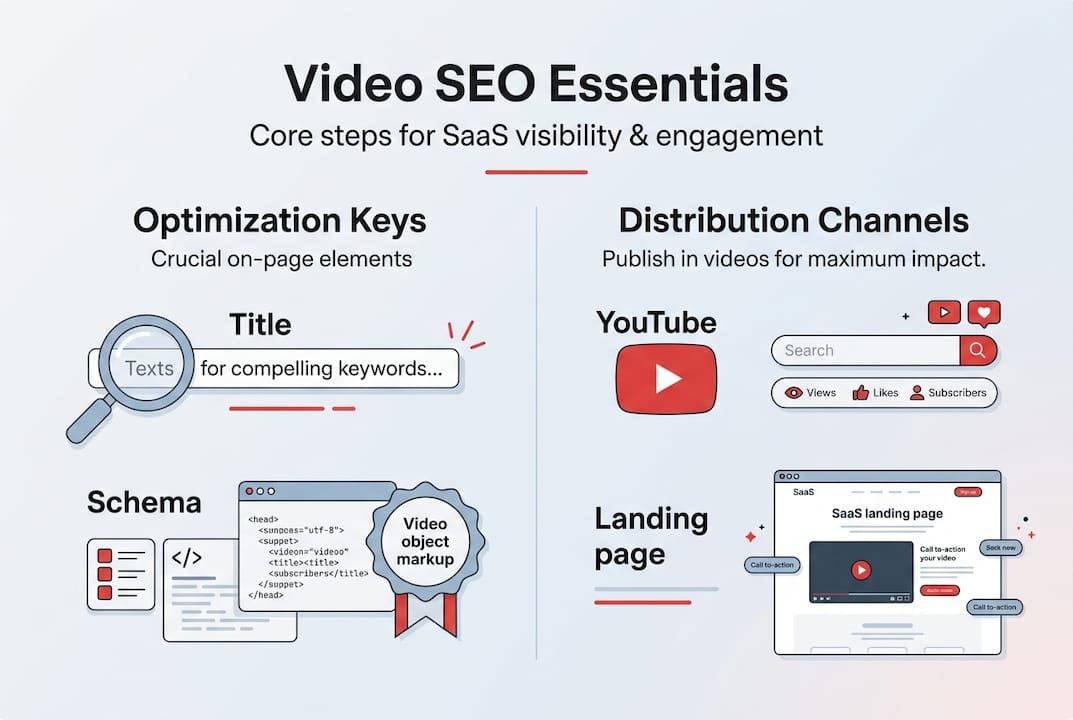
Video sitemaps are another underused tool. They tell search engines exactly where your video assets live and what they’re about. Submit your video sitemap through Google Search Console to speed up indexing.
Pro Tip: Pair product demo videos directly with the relevant feature or use case pages on your site. A demo for your reporting feature belongs on your reporting feature page, not just on YouTube. This creates compound SEO value, the page ranks for the feature, and the video ranks for the query.
Here’s a quick distribution checklist for every video you publish:
| Platform | Action | SEO benefit |
|---|---|---|
| YouTube | Full optimization, chapters, tags | SERP visibility, second search engine |
| Site landing page | Embed with 300 to 500 words context | Page authority, dwell time |
| Blog post | Embed in relevant article | Topical relevance, internal linking |
| Video sitemap | Submit to GSC | Faster indexing |
| Social channels | Share with transcript snippet | Reach and backlink potential |
For SaaS teams managing content at scale, having the right CMS features for SaaS makes this distribution workflow repeatable and fast.
Measuring and optimizing ROI: Tools, metrics, and SaaS case results
You’ve optimized. You’ve distributed. Now you need to know what’s working.
Start with Google Search Console. The video report shows which videos are indexed, what queries they appear for, and how many impressions and clicks they generate. This is your baseline. Check it weekly when you’re actively publishing video content.
The metrics that matter most for SaaS SEO video:
- Rankings for target keywords tied to each video
- Impressions and CTR from the GSC video report
- Dwell time on pages where video is embedded
- Bounce rate compared to pages without video
- Conversion rate on video-embedded landing pages
- AI citation rate as LLMs increasingly surface video content in answers
The results from SaaS companies that get this right are significant. One SaaS CRM saw a 234% organic traffic increase after implementing a structured video SEO program. That’s not a one-off. It reflects what happens when technical optimization, distribution, and measurement all work together.
“Expect 2-5x ROI via traffic and engagement when video SEO is tracked and iterated consistently.” Video SEO 2026
Iteration is the part most teams skip. A/B test your thumbnails. Try different title structures. Experiment with chapter placement in descriptions. Small changes compound over time.
Pro Tip: Start tracking AI citation rates now. Tools like Perplexity and ChatGPT are increasingly pulling video content into answers. Videos with strong transcripts and schema markup are more likely to get cited. This is a new traffic channel that most SaaS marketers are not measuring yet.
The 2-5x ROI benchmark is achievable, but only if you’re measuring the right things and making adjustments based on real data.
Take your SaaS content further with expert video SEO strategy
Video SEO is a system with a lot of moving parts. Titles, schema, transcripts, distribution, measurement. Each layer builds on the last. Getting it right consistently is where most growth-stage SaaS teams struggle, not because they lack effort, but because they lack the infrastructure to do it at scale.
The Rule27 Design team builds exactly that kind of infrastructure. Custom content systems, AI-optimized publishing workflows, and analytics setups that make video SEO repeatable and measurable. If your team is ready to move from ad hoc video uploads to a real content engine, that’s the conversation worth having. We work with growth-stage SaaS companies who’ve outgrown basic tools and need systems that actually scale with them.
Frequently asked questions
What is SEO video and how does it work?
SEO video is the process of optimizing video content so search engines can index and rank it for relevant queries. It relies on keyword-optimized titles, schema markup, and transcripts to signal relevance and improve discoverability.
Why should SaaS companies care about SEO video?
SaaS companies using SEO video can see 234% more organic traffic and pages with video hold visitors 5.2x longer, which directly improves conversion rates and reduces bounce.
What technical elements matter most for video SEO?
The highest-impact elements are keyword-targeted titles, detailed descriptions with timestamps, VideoObject schema markup, accurate captions, full transcripts, and custom thumbnails that improve click-through rates.
How do you measure success from SEO video?
Track rankings, impressions, CTR, and dwell time using the GSC video report for indexing data. Most well-executed video SEO programs deliver 2 to 5x ROI through combined traffic and engagement gains.

About the Author
Josh AndersonCo-Founder & CEO at Rule27 Design
Operations leader and full-stack developer with 15 years of experience disrupting traditional business models. I don't just strategize, I build. From architecting operational transformations to coding the platforms that enable them, I deliver end-to-end solutions that drive real impact. My rare combination of technical expertise and strategic vision allows me to identify inefficiencies, design streamlined processes, and personally develop the technology that brings innovation to life.
View Profile

