

Learn proven process improvement strategies for SaaS teams. Map workflows, pick the right framework, automate smart, and track results that actually move the needle.
TL;DR:
- Strategic process improvements are ongoing systems, not one-time fixes, to boost SaaS growth.
- Use value stream mapping and benchmarks to identify inefficiencies and prioritize quick wins.
- Small, continuous improvements like Lean and Kaizen outperform disruptive redesigns for most SaaS companies.
Your SaaS team is moving fast, but your processes aren’t keeping up. Manual handoffs slow down onboarding. Tools pile up with no clear owner. Nobody knows which workflow is the source of rising churn. Sound familiar? Growth-stage SaaS companies hit this wall constantly, and it costs real money. Strategic process improvement isn’t a one-time fix. It’s a system. This guide walks you through hands-on strategies, proven frameworks, and step-by-step actions so your team can stop fighting fires and start scaling with intention.
Key Takeaways
| Point | Details |
|---|---|
| Map before you change | Evaluating and benchmarking your SaaS processes first empowers targeted, measurable improvements. |
| Choose the right method | Different improvement strategies deliver unique value—start simple, layer complex frameworks as needed. |
| Automate for speed | Centralized automation and data visibility accelerate efficiency and can yield multi-million dollar savings. |
| Continuous monitoring matters | Track meaningful SaaS KPIs and compare to industry benchmarks quarterly for ongoing success. |
| Small wins fuel culture | Incremental changes build team buy-in and sustainable culture far better than one-off drastic overhauls. |
Assess the current state: Mapping and measuring your SaaS processes
Before you fix anything, you need to see it clearly. That’s where value stream mapping comes in. It’s a visual tool that traces every step in a workflow from start to finish, exposing waste, delays, and handoff failures that aren’t obvious from the inside. Think of it as turning the lights on in a room everyone’s been navigating in the dark.
Here’s the uncomfortable truth: SaaS app inventories are underestimated by 2x, and manual processes quietly pile up risk across your org. You probably have more tool overlap and shadow workflows than you realize.
Start by mapping your most critical processes. Then benchmark where you stand today. Key SaaS metrics to anchor your assessment include:
- Churn rate: Industry target is 5-7% annually
- Net Revenue Retention (NRR): Healthy SaaS orgs aim for over 100%
- CAC payback period: Benchmark is 12-18 months
- Gross margin: Top performers sit at 70-80%
Example SaaS processes and what to measure:
| Process | Key metric | Warning signal |
|---|---|---|
| Customer onboarding | Time to first value | Over 14 days |
| Customer support | First response time | Over 4 hours |
| Renewal management | Renewal rate | Under 85% |
| License management | Utilization rate | Under 60% |
| Sales handoff | Lead response time | Over 1 hour |
Once the map is in front of you, run a structured audit. Here’s a quick way to get started:
- List every workflow your team touches weekly
- Identify who owns each step and where handoffs happen
- Measure current cycle times against your benchmarks
- Flag redundant tools or duplicate efforts
- Rank inefficiencies by impact on revenue or customer experience
- Prioritize the top three to address first
Need more operational efficiency tips to frame your audit? Pairing your map with solid benchmarks from the 2025 SaaS Benchmarks Report gives you an objective baseline fast.
Pro Tip: Bring in team members from customer success, sales, and engineering to your audit session. Each group sees different parts of the workflow and will surface issues that no single department would catch alone.
Also explore workflow automation strategies early in your assessment. They often reveal automation opportunities you’ve been sitting on for months.
Select and apply the right process improvement methodology
Once you know your process gaps, it’s time to choose an effective approach. Not every framework fits every situation. Here’s a quick rundown.
Lean focuses on cutting waste. Six Sigma targets variation and defects using data. Kaizen drives continuous, small improvements through culture. Business Process Reengineering (BPR) redesigns workflows from scratch. Theory of Constraints (TOC) zeroes in on the single biggest bottleneck. Value Stream Mapping is a diagnostic tool that pairs well with all of them. Each of these methodologies has distinct ROI profiles and use cases depending on your team size, data maturity, and urgency.
Methodology comparison:
| Method | Complexity | Time to value | Best SaaS use case |
|---|---|---|---|
| Lean | Low | Weeks | Onboarding waste reduction |
| Kaizen | Low | Days to weeks | Cross-team collaboration |
| Six Sigma | High | Months | Churn and support quality |
| BPR | Very high | Quarters | Full workflow redesign |
| TOC | Medium | Weeks | Removing single blockers |
| Value Stream Mapping | Low | Days | Process visualization |
Matching the right method to your situation saves time and avoids overengineering:
- Slow onboarding: Lean or Value Stream Mapping to cut unnecessary steps
- Rising churn: Six Sigma to identify root causes with data
- Tool and cost sprawl: TOC to find and fix the main constraint first
- Broken core workflow: BPR with executive sponsorship to rebuild completely
- Team culture and adoption: Kaizen for sustained, people-first improvement
For optimizing SaaS marketing processes, Lean and Kaizen tend to generate visible wins quickly without overwhelming your team.

Pro Tip: Start with Kaizen or Lean. Get two or three quick wins under your belt before layering in Six Sigma. You’ll build confidence, prove ROI internally, and make your data-heavy work far more credible.
Save BPR for processes that are genuinely broken beyond repair. It requires executive sponsorship, serious change management, and time. Without all three, it often stalls out.
Execute changes: Action steps and technology enablers
Selecting a strategy is followed by practical execution. Here’s how to roll out improvements without derailing your team’s daily work.
- Pilot first: Pick one workflow, apply your chosen method, and run a 2-4 week test
- Measure early: Define your success metric before the pilot starts
- Iterate fast: Don’t wait for perfect data. Adjust based on early signals
- Expand gradually: Once validated, roll out to adjacent workflows
- Document everything: Capture what changed, who owns it, and what it improved
Automation is your biggest force multiplier. When you automate renewals, onboarding steps, or license management, you free your team to focus on high-value work instead of manual follow-ups. The compounding effect is real.
Key automation and enablement tools for SaaS teams:
- CRM automation for sales handoffs and pipeline tracking
- Customer success platforms for onboarding milestone triggers
- SaaS management platforms for license tracking and consolidation
- Data warehouses or BI tools for centralized reporting
- AI-powered monitoring for real-time process anomaly detection
“Centralizing workflows and automating processes can generate over $60M in savings. One consolidation initiative cut costs by up to 38% through smarter license management and workflow centralization.”
This kind of result doesn’t come from one big project. It comes from stacking many targeted improvements over time. Look at centralized workflow automation as the connective tissue between your tools and your team. And when you’re ready to evaluate your internal tooling, optimizing internal tools for SaaS efficiency is a smart next step.
One caution: AI-driven process monitoring adds speed and pattern recognition. But always pair it with human review. Governance and data validation aren’t optional. Bad inputs produce misleading outputs, and those mislead decisions.
Monitor success and avoid common pitfalls
With new processes in place, tracking results and avoiding missteps is crucial. If you don’t measure it, you can’t defend it. And in a growth-stage SaaS company, you’ll eventually have to defend it.
KPIs worth tracking from day one:
- NRR: Target over 100% monthly
- Churn: Keep it under 5-7% annually
- Activation rate: The percentage of new users hitting key milestones in week one
- CAC payback: Benchmark is 12-18 months
- Tool utilization: A low rate here signals waste
Hybrid AI and human operations lift conversion by 19.7%, but that only holds when ongoing measurement keeps the system honest. Quarterly benchmarking against peers is what separates teams that improve from teams that plateau.
Use the 2026 SaaS benchmark data to compare your benchmarking NRR and churn numbers against top performers in your category.
Common mistakes SaaS teams make during process improvement:
- Skipping measurement setup: If you don’t define success before you start, you can’t prove progress
- Ignoring governance: No owner means no accountability and drift back to old habits
- Moving too fast or too big: Radical changes without buy-in create resistance and stall momentum
- Treating it as a one-time project: Process improvement is ongoing, not a sprint
Signs your improvements are actually working:
- Activation rates climbing week over week
- Tool spend trending down without capability loss
- Fewer escalations from customer success
- Faster sales handoffs with less back-and-forth
- Team members proactively flagging inefficiencies instead of working around them
For tracking measuring key SaaS metrics effectively, build a simple dashboard your team checks weekly. Pair it with a data-driven SaaS strategy for deeper operational context.
A practical perspective: Why small wins beat big overhauls for SaaS teams
Here’s an opinion that might cut against what you’ve been reading elsewhere: radical process transformation is overrated for most growth-stage SaaS companies.
BPR sounds exciting. Redesign everything from scratch. Start fresh. But BPR without cultural and leadership support creates disruption that teams don’t recover from quickly. Timelines slip. Resistance grows. And the operational continuity you depend on to keep customers happy takes a hit.
Kaizen and Lean win more often. Not because they’re bolder, but because they build momentum. Every small improvement creates a proof point. Proof points create trust. Trust creates adoption. And adoption is what actually changes how an organization operates.
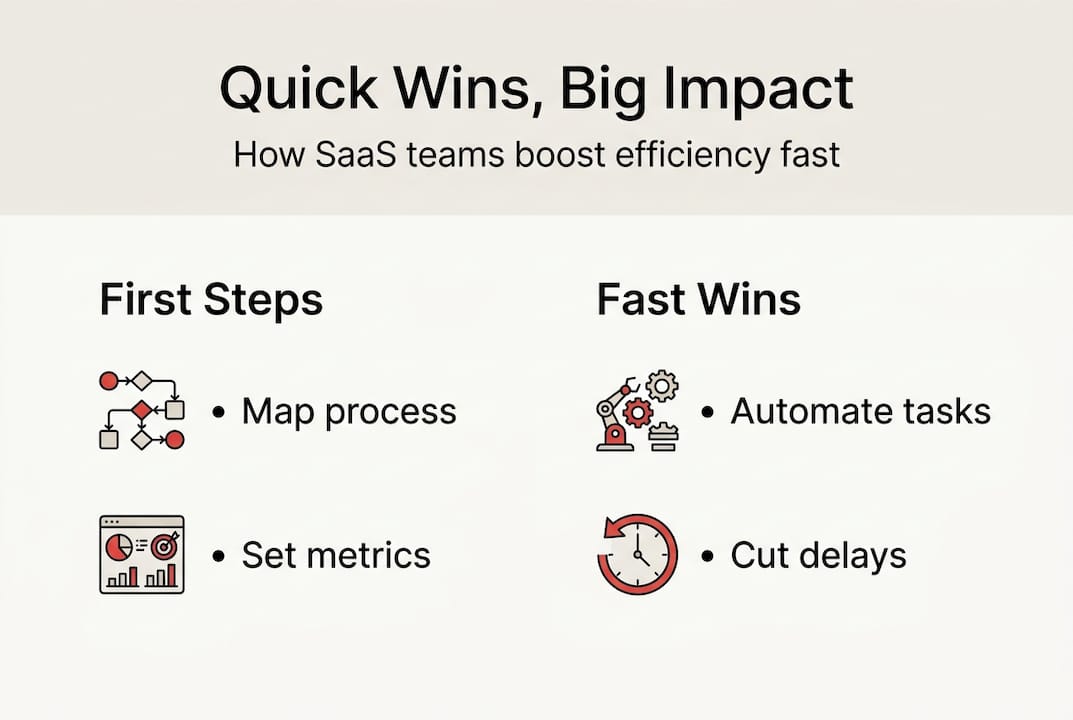
The $60M+ savings stories? They weren’t born from one giant transformation. They came from layered, compounding quick wins executed consistently over time.
Our advice: build a culture of practical efficiency first. Make incremental improvement part of how your team thinks, not just a project on the roadmap. Save BPR for the processes that are genuinely beyond repair. That’s a short list for most companies.
Apply innovation to accelerate your SaaS process improvement
Ready to put these strategies into action? You don’t have to figure it out alone.
At Rule27 Design, we build the systems that make process improvement stick. Custom admin panels, automated workflows, centralized dashboards. All designed around how your team actually operates. If you’re at the stage where your tools are slowing you down instead of speeding you up, that’s exactly where we come in. Our innovation lab is set up to help SaaS teams pilot, map, and scale the right improvements without the enterprise price tag. Let’s build something that fits.
Frequently asked questions
What is the fastest way to improve SaaS team efficiency?
Start with value stream mapping and workflow automation to quickly spot and fix process bottlenecks. Centralizing data and automating workflows cuts costs and risks while enabling fast efficiency wins.
Which SaaS process metrics should I track first?
Focus on churn, net revenue retention, customer activation rate, and CAC payback period. Churn at 5-7%, NRR over 100%, and CAC payback under 18 months are strong benchmarks to start from.
How do I avoid process improvement failure in a SaaS company?
Secure leadership buy-in for big changes, start small with quick wins, and review KPIs quarterly to adapt. BPR without executive support is risky. Kaizen and Lean are safer for building lasting gains.
When should we use radical redesign over small improvements?
Reserve radical approaches like BPR for processes that are genuinely broken and need executive sponsorship. Radical redesigns are disruptive and require senior leadership. Kaizen works better for ongoing culture change.

About the Author
Josh AndersonCo-Founder & CEO at Rule27 Design
Operations leader and full-stack developer with 15 years of experience disrupting traditional business models. I don't just strategize, I build. From architecting operational transformations to coding the platforms that enable them, I deliver end-to-end solutions that drive real impact. My rare combination of technical expertise and strategic vision allows me to identify inefficiencies, design streamlined processes, and personally develop the technology that brings innovation to life.
View Profile

