

Discover expert steps to optimize scalable digital infrastructure for SaaS growth. Learn alignment strategies, incremental investment, AI integration, and architecture choices that improve workflow efficiency.
Scaling digital infrastructure is one of the most complex challenges growth-stage SaaS CIOs face today. Without a clear roadmap, infrastructure decisions can drain resources, slow productivity, and hinder the very growth you’re trying to enable. The stakes are high: poorly optimized infrastructure impacts workflow efficiency, team collaboration, and your ability to respond to market demands. This guide delivers an expert-backed, stepwise approach tailored specifically for SaaS leaders ready to build infrastructure that scales efficiently while keeping costs under control and teams productive.
Key Takeaways
| Point | Details |
|---|---|
| Align IT with business goals | Before investing in infrastructure, ensure IT decisions map to quarterly business goals, customer targets, and operational efficiency. |
| Simplify and consolidate infrastructure | Consolidate platforms to reduce integration headaches, maintenance overhead, and security surface area. |
| Modular monolith for small teams | For teams under 20 developers, a modular monolith provides clear component boundaries with simpler deployment, debugging, and monitoring. |
| Incremental investments by revenue | Structure spending to handle twice the current load and monitor usage for 30 to 60 days before planning the next increment. |
| Quarterly alignment reviews | Schedule quarterly alignment reviews between IT leadership and business stakeholders to catch misalignment early. |
Preparing for scalable digital infrastructure: align and simplify
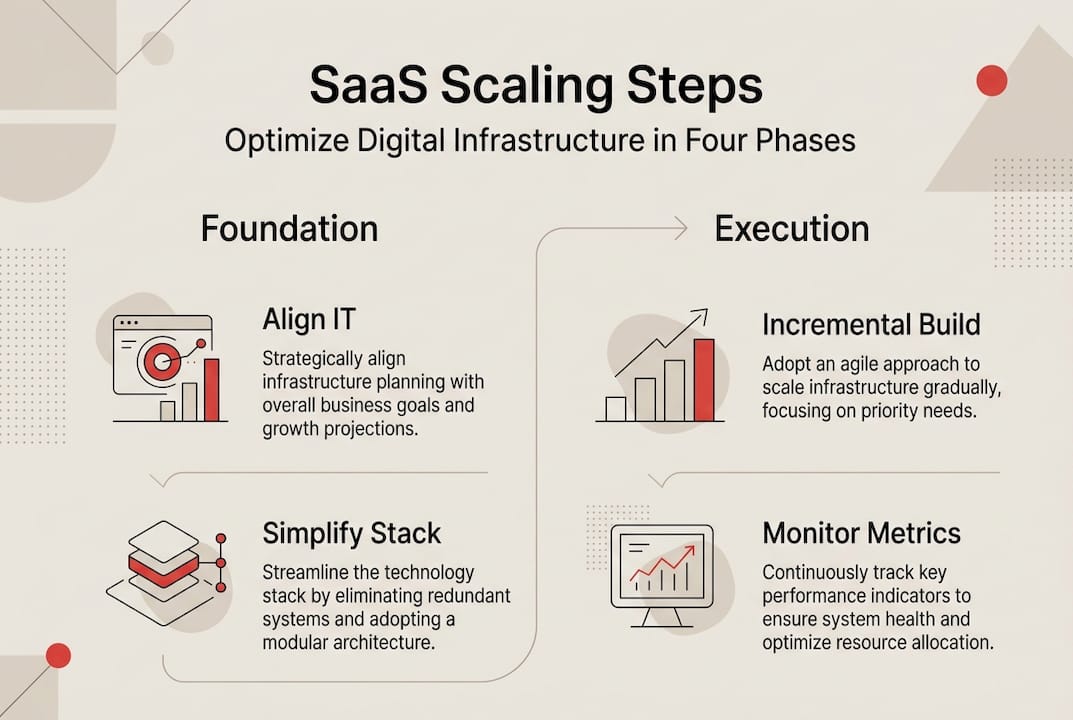
Before you invest a dollar in new infrastructure, you need two foundational elements in place: strategic alignment and architectural simplicity. These preparation steps determine whether your scaling efforts will drive growth or create expensive technical debt.
Start by aligning IT initiatives with business objectives to ensure every infrastructure decision supports measurable business outcomes. This alignment prevents the common trap of building impressive technical systems that don’t actually move revenue or productivity metrics. Your infrastructure roadmap should map directly to quarterly business goals, customer acquisition targets, and operational efficiency benchmarks.
Simplifying infrastructure is equally critical. Growth-stage SaaS companies often accumulate a patchwork of tools, platforms, and services that seemed necessary at the time but now create integration headaches and hidden costs. Consolidate platforms aggressively. Every additional system in your stack adds maintenance overhead, security surface area, and cognitive load for your team.
For teams under 20 developers, choosing a modular monolith architecture typically delivers better results than jumping to microservices. Microservices sound appealing in theory but introduce distributed system complexity that small teams struggle to manage effectively. A well-designed modular monolith gives you clear boundaries between system components while keeping deployment, debugging, and monitoring straightforward.
Simplified infrastructure directly reduces both expenses and operational complexity. You’ll spend less time fighting infrastructure fires and more time building features customers actually want. This preparation creates the stable foundation needed for the incremental investments and agile practices covered in the next section.
Pro Tip: Schedule quarterly alignment reviews between IT leadership and business stakeholders. As your company grows, business priorities shift faster than infrastructure can adapt. Regular check-ins help you catch misalignment early and adjust your roadmap before you’ve invested heavily in the wrong direction.
Executing incremental investment and agile implementation
Once your foundation is solid, execution becomes about smart investment timing and agile delivery practices that let you scale without betting the company on untested infrastructure decisions.
Invest incrementally based on your current revenue stage rather than projected future needs. This approach, supported by the CIO strategic roadmap, prevents the classic mistake of over-engineering for scale you haven’t reached yet. Companies that match infrastructure spend to revenue can cut costs by 60-70% compared to peers who overbuild prematurely.
Here’s how to structure incremental infrastructure investment:
- Assess current capacity limits and identify the next likely bottleneck based on growth trajectory
- Calculate the minimum viable investment needed to handle 2x your current load
- Implement the upgrade and establish monitoring to track actual usage against projections
- Measure outcomes for 30-60 days before planning the next increment
- Adjust future investments based on real usage patterns rather than theoretical models
Adopt agile implementation practices throughout your infrastructure work. Pilot new features or architectural changes with a subset of users or workloads first. Measure outcomes rigorously using metrics tied to business impact, not just technical performance. Iterate based on what you learn before rolling changes across your entire infrastructure.
This stepwise scaling approach reduces risk dramatically. Instead of making one large bet on an infrastructure direction, you make smaller, reversible decisions backed by real data. You can course-correct quickly when something doesn’t work as expected.
Monitor cost benchmarks carefully as you scale. Track metrics like cloud costs as a percentage of annual recurring revenue, infrastructure cost per customer, and cost per transaction. These ratios help you spot efficiency problems early. For example, if your cloud costs are growing faster than revenue, you likely have optimization opportunities in resource allocation or architectural design.

Understanding system scalability principles helps you make better incremental decisions by identifying which components need attention first.
Pro Tip: Use stage-appropriate infrastructure tiers matched to your revenue. Early stage companies under $1M ARR often do well with managed VPS solutions. Between $1M-$10M ARR, managed platform services like Heroku or Render offer good value. Above $10M ARR, direct cloud infrastructure with dedicated DevOps makes economic sense. Jumping tiers too early wastes money on complexity you don’t need yet.
Securing critical assets and leveraging AI to scale efficiently
As your infrastructure scales, two parallel concerns demand attention: protecting what you’ve built and leveraging new technologies to scale more efficiently than manual processes allow.
Implement zero-trust security frameworks to protect vital systems during growth phases. Traditional perimeter-based security fails when your team works remotely, partners access shared systems, and infrastructure spans multiple cloud providers. Zero-trust assumes no user or system is trustworthy by default, requiring verification at every access point.
Key zero-trust practices for scaling infrastructure include:
- Enforce multi-factor authentication universally across all administrative access points
- Implement least-privilege access controls that grant only the minimum permissions needed
- Monitor and log all system access with automated alerting for anomalous patterns
- Segment networks so compromised systems can’t easily pivot to other infrastructure
- Regularly audit access permissions and revoke unused credentials promptly
AI integration represents a powerful scaling enabler when approached systematically. However, only 5-20% of AI pilots successfully scale to enterprise-wide deployment. Success requires production-grade data infrastructure and careful integration planning from the start.
AI can automate infrastructure monitoring, optimize resource allocation dynamically, and improve team collaboration workflows when implemented thoughtfully. For example, AI-powered monitoring tools can predict capacity issues before they impact users, automatically suggest optimization opportunities, and even implement routine scaling decisions without human intervention.
Start with focused AI applications that solve specific infrastructure pain points. Monitoring and alerting systems make excellent first targets because they generate immediate value and provide clear success metrics. As you gain experience, expand to resource optimization, automated incident response, and eventually more complex applications.
“Scaling AI pilots effectively demands rigorous planning and production-grade data infrastructure. Most pilots fail not because the technology doesn’t work, but because organizations lack the foundational data quality and integration architecture needed for enterprise deployment.”
Integrate AI-powered infrastructure capabilities gradually, measuring impact at each step. Track metrics like mean time to detect issues, infrastructure cost per user, and team time spent on routine maintenance. These measurements help you understand whether AI investments deliver real efficiency gains or just add complexity.
Pro Tip: Deploy AI incrementally with clear success criteria and cost controls. Start with a single use case, prove value over 90 days, then expand. This approach prevents the common trap of investing heavily in AI infrastructure before you understand what actually works for your specific environment and team.
Designing for scale: architecture choices and workflow efficiency
Architectural decisions made early in your scaling journey have lasting impact on cost, team productivity, and your ability to adapt to changing business needs. Getting these choices right requires understanding both technical trade-offs and operational realities.
For most growth-stage SaaS companies with teams under 20 developers, modular monolith architecture delivers the best balance of scalability, cost, and team efficiency. This approach organizes your codebase into clear modules with defined boundaries, but deploys as a single unit. You get many benefits of microservices architecture without the operational overhead.
| Factor | Modular Monolith | Microservices |
|---|---|---|
| Infrastructure cost | Baseline | 3.75-6x higher |
| Operational complexity | Low to moderate | High |
| Team size requirement | Under 20 developers | 20+ developers |
| Deployment coordination | Simple, single unit | Complex, multiple services |
| Debugging difficulty | Straightforward | Distributed tracing required |
| Best for | Cohesive products, shared data | Distinct scaling needs, large teams |
Microservices make sense when you have genuinely independent services with different scaling characteristics. For example, if your video processing workload needs to scale separately from your API tier, microservices architecture provides clear benefits. But microservices cost 3.75-6x more in infrastructure and require significantly more DevOps expertise to operate reliably.
Beyond core architecture, workflow efficiency tools dramatically impact how effectively your team can manage scaled infrastructure. The right collaboration and automation tools reduce coordination overhead and prevent scaling from grinding productivity to a halt.
Top workflow tools that improve infrastructure team efficiency:
- Project management platforms like Asana or Linear that centralize work tracking and reduce status meeting overhead
- Infrastructure as code tools like Terraform that make environment changes reviewable and reversible
- Automated testing pipelines that catch issues before they reach production
- Collaborative documentation systems that keep runbooks and architecture decisions accessible
- Integrated monitoring dashboards that give the whole team visibility into system health
Companies that implement comprehensive workflow efficiency strategies report significant productivity gains. For instance, organizations using structured intake systems see up to 80% increases in request handling capacity without adding headcount.
Invest in team collaboration software that integrates with your infrastructure tools. When your project management system connects to your deployment pipeline, your monitoring alerts flow into team chat, and your documentation lives alongside your code, coordination friction drops dramatically. This integration becomes increasingly valuable as team size grows.
Design your architecture and tooling choices around your team’s actual working patterns, not theoretical best practices. The best architecture is the one your team can operate effectively, ship features quickly within, and debug confidently when issues arise. Technical elegance matters far less than operational reality.
Optimize your scalable infrastructure with Rule27 Design
Building cost-effective, scalable infrastructure that actually improves team productivity requires both technical expertise and deep understanding of how growth-stage SaaS companies operate. That’s exactly where Rule27 Design excels.

We partner with SaaS leaders to design and implement digital infrastructure that scales efficiently without the complexity or cost of over-engineered enterprise solutions. Our approach combines strategic IT alignment, agile implementation practices, and careful AI integration to deliver systems that enhance workflow efficiency and team collaboration from day one.
Our clients typically see 40% improvement in operational efficiency after implementing our custom admin panels, content management systems, and internal tools. We build infrastructure that matches how your team actually works, not how vendors think you should work. From proven workflow strategies to AI-powered content systems that improve visibility in AI search results, we deliver practical solutions that drive measurable business outcomes.
Ready to optimize your infrastructure for sustainable growth? Explore how Rule27 Design can help you build scalable systems that your team will actually want to use.
Frequently asked questions about scalable digital infrastructure
What are the first steps to prepare my infrastructure for scaling?
Start by aligning IT initiatives with business objectives and simplifying your existing infrastructure through platform consolidation. For teams under 20 developers, adopt a modular monolith architecture rather than jumping to microservices. These foundational steps create stability and reduce costs before you invest in scaling. Learn more about system scalability principles to guide your preparation.
How do I decide between modular monolith and microservices for my SaaS product?
Choose modular monolith if your team has fewer than 20 developers or your product components share significant data and business logic. Microservices make sense only when you have genuinely independent services with different scaling needs and the DevOps expertise to manage distributed systems. Microservices cost 3.75-6x more in infrastructure, so the scaling benefits must justify that investment.
What role does AI play in scaling digital infrastructure effectively?
AI automates infrastructure monitoring, optimizes resource allocation dynamically, and improves team collaboration workflows when implemented systematically. Start with focused applications like predictive monitoring that solve specific pain points and deliver clear ROI. Only 5-20% of AI pilots scale successfully, so deploy incrementally with production-grade data and measure impact carefully before expanding.
How can workflow tools improve team collaboration during scaling?
Integrated workflow tools reduce coordination overhead by centralizing work tracking, automating routine tasks, and providing shared visibility into system health. Companies using structured intake and collaboration systems see up to 80% increases in request handling capacity. Choose tools that integrate with your infrastructure pipeline so information flows automatically rather than requiring manual updates.
What common mistakes should I avoid when scaling infrastructure?
Avoid over-engineering for future scale you haven’t reached yet, which wastes 60-70% more than stage-appropriate infrastructure. Don’t jump to microservices before your team size and product complexity justify the operational overhead. Never skip incremental pilots when adopting new technologies like AI. Finally, resist adding tools without consolidating existing ones, as tool sprawl creates hidden costs and integration complexity that slow teams down.

About the Author
Josh AndersonCo-Founder & CEO at Rule27 Design
Operations leader and full-stack developer with 15 years of experience disrupting traditional business models. I don't just strategize, I build. From architecting operational transformations to coding the platforms that enable them, I deliver end-to-end solutions that drive real impact. My rare combination of technical expertise and strategic vision allows me to identify inefficiencies, design streamlined processes, and personally develop the technology that brings innovation to life.
View Profile

