

Master the internal software architecture basics to transform your team's efficiency. Learn key decisions for scalable, maintainable systems today!
TL;DR:
- Internal software architecture involves key decisions like defining the authoritative data source and service boundaries upfront. Starting with a modular monolith and documenting choices with ADRs helps teams evolve their systems efficiently and prevent rework. Securing internal tools requires strong authentication, role controls, and careful data management aligned with compliance standards.
Internal software architecture is the set of deliberate structural decisions that translate business goals into maintainable, scalable internal systems. The single most important decision? Name your system’s authoritative source-of-truth and define service boundaries before writing a line of code. As Martin Fowler notes, architecture is about identifying the few decisions that are costly to change later. Start with a one-hour workshop: map your hot paths, name who owns each data record, and sketch the edges of each service. That one session prevents months of rework.
Rule27design uses Architecture Decision Records (ADRs) from day one to capture exactly these choices, so nothing gets lost between discovery and build.
What are the core internal software architecture basics?
Architecture is not a diagram on a whiteboard. It’s a sequence of decisions made under uncertainty, and the best teams evolve the architecture based on real constraints rather than imagined future needs.

Five patterns cover most internal tool scenarios:
| Pattern | Best fit | Trade-off |
|---|---|---|
| Monolith | Early-stage, single team | Fast to ship; hard to scale independently |
| Modular monolith | Growing team, clear domains | Good balance; requires discipline on boundaries |
| Microservices | Multiple teams, independent release cycles | High operational overhead; overkill for most internal tools |
| Event-driven | Async workflows, audit trails, integrations | Powerful; harder to debug and trace |
| Serverless | Low-traffic, ops-light internal tools | Low cost; cold starts and vendor lock-in risk |
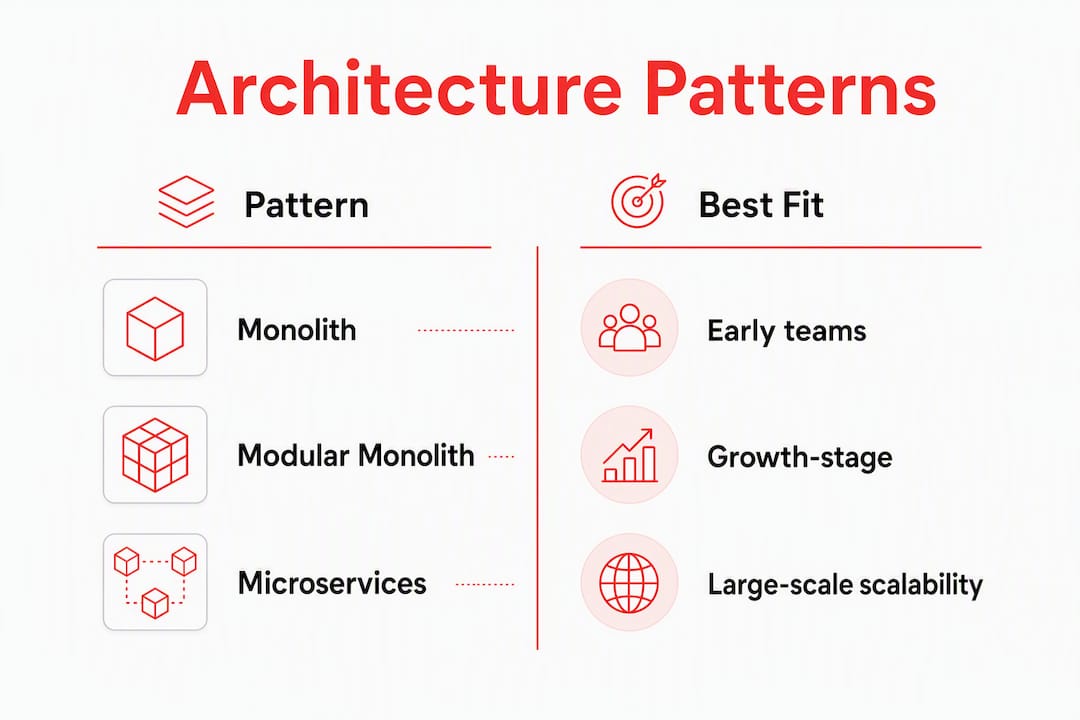
For most growth-stage internal systems, a modular monolith is the right starting point. It ships fast, keeps the team aligned, and can be split later when a real constraint forces it. Microservices sound appealing, but the operational cost is real: you need dedicated ops, distributed tracing, and service mesh tooling before they pay off.
On the front end, React is the dominant choice for internal admin panels because of its component model and ecosystem. Node.js handles the API layer well for teams that want a unified JavaScript stack. Both are pragmatic, not precious.
Which API and data patterns work best for internal tools?
Pick your integration protocol based on who consumes the API and how often the shape of data changes.
- REST fits most internal tools. Stateless, cacheable, and every developer on your team already knows it. Use it as your default.
- GraphQL earns its place when your UI teams need flexible queries and you want to avoid over-fetching. Good for dashboards with variable data needs.
- gRPC is the right call for high-throughput, service-to-service communication where latency matters. Less common in internal tools, but worth knowing.
For data storage, the pattern follows the use case. Relational databases (Postgres is the workhorse) handle transactional data and reporting. NoSQL fits unstructured or rapidly evolving schemas. Caching layers (Redis) belong in front of read-heavy endpoints only after you measure the need. CQRS and event-log patterns make sense when you need audit trails or want to separate read and write models cleanly.
A short integration checklist keeps data flow dependable:
- Define explicit API contracts before building consumers
- Assign a single owner to each data record (no shared mutable state)
- Design async consumers to be idempotent using dedup tables or idempotency keys
- Plan a backfill strategy before connecting any legacy system
- Document the mapping between external and internal data models
Pro Tip: Start with explicit read/write ownership and a simple stateless API plus a single database. Add caching or queues only when a measured constraint appears, not before.
What security baseline does your internal system need?
Internal tools handle real data. A breach in an internal admin panel can be just as damaging as one in a customer-facing app.
Baseline security for internal systems: Enforce authentication on every endpoint (OAuth 2.0 or SSO), apply role-based access control (RBAC) so users see only what their role permits, encrypt data in transit (TLS) and at rest, and store secrets in a dedicated manager like AWS Secrets Manager or HashiCorp Vault. Never hardcode credentials.
Operational controls matter too. Use least-privilege access, maintain audit logs for sensitive actions, and run your deployment pipeline through automated security checks. Schedule periodic penetration tests, not just at launch.
For U.S. compliance: if your internal tool touches payment card data, PCI DSS scoping applies even for internal systems. If it stores or processes protected health information, HIPAA controls follow the data, not the audience. When either applies, your hosting choice and logging strategy need formal review before you go live.
Tie your security design to your SLOs. Availability and security are not separate concerns: an incident response plan that lacks observability is just a document.
How do you make architecture decisions that actually stick?
Good decisions get documented. Undocumented decisions get relitigated every six months.
Architecture Decision Records (ADRs) are the fix. A minimal ADR captures: the decision title, the context (what forced the choice), the decision itself, the alternatives considered, and the trade-offs accepted. One page. Timestamped. Stored in the repo.
Your stakeholder roster for any major decision should include:
- Product owner — defines the functional requirement and success metric
- Architect or tech lead — owns the technical trade-off analysis
- Security — reviews auth, data handling, and compliance flags
- Ops or DevOps — confirms deployment, monitoring, and rollback feasibility
- End-user owner — validates that the solution fits actual workflow
Before enacting a decision, run a short review gate: confirm SLOs are defined, cost is estimated, a rollback plan exists, and integration tests are scoped. Enterprise architecture frameworks like TOGAF formalize this at scale, but for internal tools, a lightweight ADR process delivers most of the value at a fraction of the overhead.
Governance cadence: propose, review in under a week, enact with a timestamped ADR, and set a revisit trigger (a metric threshold or a new functional need).
How do you build an internal architecture that grows with you?
Start simple. A stateless API plus a single relational database handles more load than most internal tools will ever see. Evolution is earned, not planned.
- Days 1–30: Discovery and baseline. Map workflows, identify hot paths, name sources of truth, write the first ADRs, and stand up a working prototype with basic auth and a single database.
- Days 31–90: MVP and pilot. Ship to a small internal user group. Instrument p95 latency, error rates, and queue lag. Fix what breaks. Add caching only if read latency is measurably hurting users.
- Days 91–180: Production rollout. Expand access, add feature flags for controlled releases, set formal SLOs, and schedule the first security review.
Refactor when a specific constraint appears: a performance target you cannot hit, a reliability requirement the current design cannot meet, or a new functional need that the existing structure genuinely cannot accommodate. Rearchitect only when refactoring would cost more than rebuilding the affected module.
Pro Tip: Premature optimization signals look like this: adding a message queue before you have async workloads, splitting services before two teams need independent deploys, or adding a cache before you have measured a slow query. Wait for the signal.
What does a practical stack look like for a U.S. growth-stage company?
Three reference architectures cover most scenarios:
| Architecture | Stack | When to use |
|---|---|---|
| Simple internal tool | React + Node.js + Postgres (Supabase) + GitHub Actions CI/CD | Single team, CRUD-heavy admin panel, fast time-to-value |
| Event-driven platform | Services + event log + read models + analytics pipeline | Audit trails, async workflows, multiple consuming teams |
| Serverless internal tool | Cloud functions + managed DB + API Gateway | Low-traffic tools, minimal ops budget, no dedicated DevOps |
Supabase is a strong choice for the simple architecture: it gives you Postgres, auth, and real-time subscriptions with minimal ops overhead. Use managed cloud services when your team lacks dedicated infrastructure staff. Self-host only when compliance or data residency requirements force it.
For ops tooling: add structured logging and a basic dashboard (Get Google and ChatGPT Traffic on Autopilot) (Datadog, Grafana, or similar) from day one. Feature flags (LaunchDarkly or a simple database-backed toggle) let you release safely. Cost monitoring on your cloud account prevents surprise bills.
Your 30/90/180 implementation checklist
30-day discovery and prototype:
- Map all workflows and identify the three highest-impact hot paths
- Name the authoritative source-of-truth for each core data entity
- Write ADRs for the top three architectural decisions
- Stand up a working prototype with auth and a single database
- Confirm build-vs-buy: custom internal tools make sense when your processes or data are genuinely unique; packaged software wins when a standard workflow fits
90-day MVP and pilot:
- Ship to a pilot group of internal users
- Instrument error rates, p95 latency, and user adoption
- Run the first security review against your baseline checklist
- Validate acceptance criteria: functional tests pass, performance targets met, RBAC confirmed
180-day production rollout:
- Expand to full user base with feature flags
- Formalize SLOs and incident response runbook
- Schedule quarterly ADR review and architecture retrospective
- Measure operational efficiency gains against the pre-launch baseline
A short discovery phase of two to four weeks that includes cross-functional stakeholders consistently reduces costly rework later.
How Rule27design approaches internal architecture
Rule27design’s method follows the same cadence: discovery workshop, ADRs, MVP build, then iterative evolution. The tech stack defaults to React for the UI, Node.js for the API layer, and Supabase for the database, chosen because they minimize ops overhead while keeping the architecture open for growth.
Rule27design’s approach: Every engagement starts with a structured discovery session to map hot paths and name sources of truth before any code is written. Architecture decisions are documented in ADRs from day one, so the reasoning behind every structural choice is preserved as the system evolves.
Clients typically see a 40% improvement in operational efficiency after implementing a bespoke internal system. This figure comes from replacing manual, fragmented workflows with a single system that owns its data and exposes clean interfaces to every team that needs it.
What are the layers inside an internal system?
Every internal system, regardless of pattern, has three core layers. Understanding them prevents the most common structural mistake: mixing concerns across layers.
The user interface layer handles input, display, and user interaction. In a React-based internal tool, this is your component tree. It should never contain business logic or direct database calls.
The business logic layer is where rules live. Validation, calculations, workflow orchestration, and access control all belong here. This layer calls the data access layer; it does not know how data is stored.
The data access layer translates business objects into database queries and back. It owns the connection pool, the query logic, and the mapping between your domain model and your storage schema.
Separation of concerns across these three layers is the single design principle that most directly affects how easy your system is to test, change, and hand off to a new engineer.
Key Takeaways
Good internal software architecture is built on one rule: make the hard-to-change decisions first, document them in ADRs, and evolve everything else only when a real constraint forces it.
| Point | Details |
|---|---|
| Start with a monolith | A modular monolith ships faster and is easier to maintain than microservices for most internal tools. |
| Name the source of truth | Assign a single owner to each core data entity before writing any integration code. |
| Document with ADRs | Every major structural decision needs a timestamped ADR with context, alternatives, and trade-offs. |
| Evolve on constraint | Add caches, queues, or new services only when a measured performance or reliability constraint demands it. |
| Rule27design as your partner | Rule27design’s discovery-to-MVP process delivers a 40% operational efficiency gain for growth-stage teams. |
The mistake most teams make with architecture
The most common mistake is treating architecture as a one-time deliverable. A team spends two weeks designing a system, then never revisits the decisions as the product changes. Six months later, the codebase has drifted so far from the original design that no one can explain why certain choices were made.
The fix is boring but effective: small ADRs, written at the moment of decision, with a revisit trigger attached. Not a 20-page document. One page, timestamped, in the repo.
The second mistake is premature microservices. A team of four engineers does not need a service mesh. The operational overhead of distributed tracing, independent deployments, and inter-service auth will consume the engineering capacity that should be going into features. Start with a modular monolith. Split when two teams genuinely need independent release cycles.
Skipping observability is the third. You cannot improve what you cannot measure. Add structured logging and a latency dashboard before you go to production, not after your first incident.
A quick do/don’t summary: do write one ADR per major decision. Do set a p95 latency target before launch. Don’t add a message queue because it sounds scalable. Don’t skip the stakeholder roster on decisions that affect data ownership.
What Rule27design builds for growth-stage companies
Growth-stage teams that have outgrown spreadsheets and off-the-shelf tools but aren’t ready for enterprise software have one real option: a bespoke internal system built to match how their team actually works. That’s the gap Rule27design fills.
Rule27design’s engagement model runs in four stages: a discovery workshop to map workflows and name sources of truth, an architecture sprint to produce ADRs and a reference design, an MVP build using React, Node.js, and Supabase, and ongoing ops support as the system evolves. Scope can start narrow, a single admin panel or internal API, and expand as the team’s needs grow.
Teams that go through this process typically see a substantial gain in operational efficiency. If you want to talk through your system’s hot paths and figure out where to start, reach out to Rule27design for a discovery conversation.

About the Author
Josh AndersonCo-Founder & CEO at Rule27 Design
Operations leader and full-stack developer with 15 years of experience disrupting traditional business models. I don't just strategize, I build. From architecting operational transformations to coding the platforms that enable them, I deliver end-to-end solutions that drive real impact. My rare combination of technical expertise and strategic vision allows me to identify inefficiencies, design streamlined processes, and personally develop the technology that brings innovation to life.
View Profile

