

Unlock success with our guide on digital systems for growth brands explained. Learn to integrate tools for better automation and efficiency!
TL;DR:
- Most growth-stage companies struggle with system integration rather than tool selection, which hampers data and customer engagement. Building connected digital systems, including CRM, automation, analytics, and RPA, creates a full-funnel growth engine that compounds over time. Success requires aligning tools with measurable goals, managing complexity through rationalization, and developing a strategic roadmap focused on a single North Star metric.
You’ve got a project management tool, a CRM, a marketing platform, three analytics dashboards, and a Slack full of screenshots filling the gaps between them. Sound familiar? This is exactly where the conversation around digital systems for growth brands explained starts to matter. Most growth-stage companies don’t have a tools problem. They have an integration problem. The right digital systems don’t just automate tasks — they connect your data, your team, and your customer touchpoints into one engine that compounds over time. This guide breaks down what that actually looks like, and how to build it.
Key Takeaways
| Point | Details |
|---|---|
| Integrated growth systems | Connecting AI, automation, and CRM enables growth brands to boost ROI and operational efficiency significantly. |
| Align digital to goals | Digital transformation succeeds when technology adoption is tightly linked to specific business objectives like retention and revenue. |
| Manage tech complexity | Rationalizing marketing tools and deploying retention-first systems save costs and speed up execution. |
| Build a roadmap | A clear strategy with phased pilots and scaling ensures sustainable digital system adoption and impact. |
| Avoid common pitfalls | Focus on integration, retention, and orchestration layers rather than accumulating disconnected tools for scalable growth. |
Understanding digital systems for growth brands
So what exactly counts as a “digital system” when we’re talking about growth brands? It’s not a single tool. It’s the full stack of connected platforms that touch customer acquisition, activation, retention, and revenue. Think CRM, marketing automation, AI-driven analytics, and robotic process automation (RPA) working together, not in isolation.
The importance of digital systems for brands becomes clear fast when you look at the numbers. Digital growth solutions integrate data and AI to boost ROI by up to 40%, while RPA alone can cut operational costs by up to 40%. Those aren’t incremental gains. That’s a structural shift in how a business operates.
Here’s what a real digital system covers for a growth-stage brand:
- CRM — tracks every customer interaction and powers multichannel campaigns
- Marketing automation — sends the right message at the right time without a human triggering each one
- AI analytics — surfaces patterns in your data before they become obvious problems or missed opportunities
- RPA — removes repetitive manual tasks like data entry, invoice processing, and report generation
- AI marketing infrastructure — connects acquisition signals to spend decisions in real time
Together, these systems create a full-funnel growth engine. Acquisition feeds activation. Activation data improves retention. Retention metrics inform spend. Every layer compounds the one before it.
How digital transformation aligns with growth brand goals
Adding tools is easy. Aligning them to business goals is where most growth brands fall short. Digital transformation objectives need to be anchored to measurable outcomes like customer lifetime value (CLV), retention rates, and cost per acquisition — not just the tech itself.
Here’s a straightforward way to think about how to build that alignment:
- Define your primary growth metric. Is it CLV? Monthly recurring revenue? Retention rate? Pick the number that matters most right now.
- Map your current tools to that metric. Which systems touch the customer journey stages that drive that number?
- Identify the gaps. Where does data go silent? Where are your teams using spreadsheets to fill in what a system should handle?
- Connect CRM, automation, and analytics around those gaps, prioritizing integrations that directly impact your chosen metric.
- Run phased rollouts. Don’t replace everything at once. Test one integration, measure it, then expand.
- Review on a set cadence. Monthly reviews on system performance keep you from drifting back into tool sprawl.
Understanding digital transformation stages helps you know where you are in this process and what to tackle next. And CRM implementation is almost always the right place to start — it’s the foundation everything else plugs into.
Pro Tip: Before buying any new tool, ask one question: “Which business metric does this directly move?” If you can’t answer in one sentence, skip it.
Key digital systems powering growth-stage brands
Let’s get specific. These are the core systems growth brands are actually using right now to drive results.
CRM platforms do more than store contacts. They power multichannel campaign automation, track buying behavior, and feed data into every other system in your stack. Without a clean CRM, your marketing automation is flying blind.

Marketing automation handles personalized communications at scale. Instead of batch-and-blast emails, it sends behavior-triggered messages that feel relevant. Activation and retention numbers both improve because the timing and context are right.
AI revenue enablement tools are newer but moving fast. AI-driven revenue enablement improves revenue velocity by 21% and reduces cost of sales by 33% within 90 days. That’s the kind of lift that changes unit economics for a growth-stage company.
Order orchestration layers solve a specific but common problem: operational complexity across multiple sales channels and fulfillment systems. Instead of replatforming your entire tech stack, an orchestration layer sits on top and coordinates everything. Eddie Bauer’s implementation is a good real-world example — they went live in 80 days without replatforming, keeping operations running while adding capability.
| System | Primary function | Key impact | Typical implementation time |
|---|---|---|---|
| CRM | Customer data and campaign management | Higher CLV and retention | 4–8 weeks |
| Marketing automation | Personalized, triggered communications | Better activation and retention | 2–6 weeks |
| AI revenue enablement | Sales velocity and pricing optimization | 21% revenue velocity increase | 8–12 weeks |
| Order orchestration | Multichannel fulfillment coordination | Operational reliability at scale | 8–12 weeks |
Pro Tip: Don’t build a new data layer from scratch. Add AI on top of your existing workflow automation tools first to unify data streams before replacing anything.
Knowing which systems you need is one thing. Managing the complexity of running them together is another — and that’s where most growth brands start to struggle. You can also explore what a superior digital experience looks like when these systems are firing together.
Managing complexity: Optimizing your marketing tech stack and retention systems
Here’s a number worth sitting with. Growth-stage companies average 32 MarTech tools, with stack growth running at 3:1 compared to headcount. Rationalization — cutting redundant tools and consolidating platforms — saves an average of $1.3M annually and drops campaign launch time from 23 days down to 9.
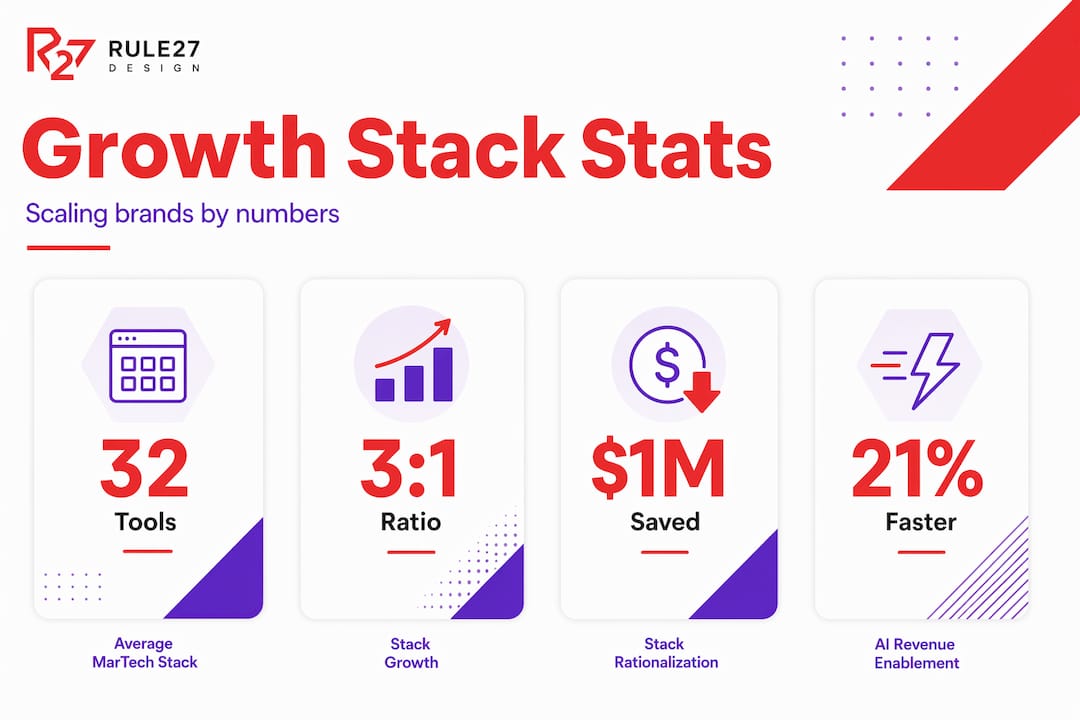
That’s the cost of complexity. And it’s very much a solvable problem.
Stack rationalization works by auditing what you have, identifying overlap, and consolidating toward platforms that do more with fewer integration points. The teams who do this well don’t just save money. They move faster.
Retention is the other side of this equation. Most growth brands spend heavily on acquisition and treat retention as a downstream problem. That’s backwards. Retention-first systems turn high churn rates into compounding profit engines, improving profits by 25–95% by shifting spend toward keeping customers rather than replacing them.
The retention flywheel looks like this:
- Capture — first-party data collected at every touchpoint
- Activation — onboarding sequences that get customers to value fast
- Value core — ongoing product or content experience that earns repeat behavior
- Loyalty — rewards and recognition that signal you notice them
- Reactivation — autonomous win-back sequences triggered by behavior signals, not calendar dates
| Metric | Before rationalization | After rationalization |
|---|---|---|
| MarTech tools | 32 average | 12–15 consolidated |
| Campaign launch time | 23 days | 9 days |
| Annual licensing cost | Baseline | $1.3M saved |
| Customer churn | 70%+ | Top-decile performance |
| Profit impact | Flat or declining | 25–95% improvement |
“Retention architecture is owned. The compounding starts the moment the first orbit activates.”
Pro Tip: Do a quarterly MarTech audit. For every tool in your stack, document its owner, its primary metric, and whether it integrates with your CRM. If it fails two of those three, it’s a candidate for removal.
The AI marketing ROI data from brands running retention-first architectures consistently shows that the lifetime value gains outpace any acquisition efficiency gains by a significant margin.
Building your digital growth roadmap: From strategy to scale
You need a roadmap, not just a wish list. Sustainable digital growth demands clear objectives, prioritized investments, gap analysis, and a plan for managing organizational change throughout the process.
Here’s how to build one that actually gets executed:
- Define your digital vision. What does winning look like in 18 months? Be specific about the customer experience and operational capabilities you’re building toward.
- Run a competitive and capability gap analysis. What are your top competitors doing that you aren’t? Which gaps in your current systems create the most friction?
- Prioritize your bets. Not every gap is equal. Rank initiatives by expected impact on your north star metric and implementation effort.
- Launch pilots. Small, fast MVPs beat big-bang rollouts every time. Test a new automation sequence, measure the result, then commit.
- Scale what works. Once a pilot proves its value, build the organizational support and integrations to take it fully live.
Key activities at each phase:
- Vision phase: stakeholder alignment, metric definition, competitive benchmarking
- Analysis phase: tech audit, data flow mapping, gap documentation
- Prioritization phase: ROI modeling, risk assessment, phased sequencing
- Pilot phase: small-scale deployment, feedback loops, rapid iteration
- Scale phase: full integration, team training, performance dashboards
Revisit your digital transformation stages regularly. The roadmap is a living document.
Pro Tip: Share roadmap milestones with the full team, not just leadership. Visible progress builds momentum and reduces the resistance that kills most transformation efforts before they finish.
Why many growth brands miss the mark with digital systems and how to do it better
Here’s what we see repeatedly: growth brands collect tools the way they collect customers. Fast, with enthusiasm, and without a clear plan for what happens next.
The result is a fragmented stack where data lives in silos, no one owns the integration layer, and the reporting tells you what happened last quarter but nothing about what to do tomorrow. That’s not a technology problem. It’s a strategy problem that technology made worse.
The second major mistake is treating retention as a feature rather than a system. Every brand we’ve worked with that was stuck in a growth plateau was over-indexed on acquisition. They had sophisticated paid media operations and almost no autonomous retention logic. Meanwhile, the digital experience data is clear — the brands compounding fastest are the ones treating their existing customer base as their primary growth asset.
The third mistake is underestimating operational complexity when scaling channels. You don’t need to replatform to add operational capacity. An orchestration layer buys you 12–24 months of runway to scale properly instead of in a fire drill.
And finally, manual segmentation is a ceiling. Static audience segments based on last month’s data can’t compete with AI-driven systems making decisions on real-time behavioral signals. The gap between brands using autonomous decision logic and those running manual campaigns is widening every quarter.
The growth strategies for digital brands that actually work share one thing in common: they connect every system to a single north star metric and measure every tool against its contribution to that number.
Explore Innovation Lab services to accelerate your digital growth
You’ve got the framework. Now the question is execution speed.
Rule27 Design’s Innovation Lab works specifically with growth-stage companies who’ve hit the ceiling of their current tools but aren’t ready to buy enterprise software. We design and build integrated digital systems aligned to your actual business goals — not a generic playbook. That includes AI-driven marketing architecture, CRM integration, marketing automation, and operational orchestration layers built on React, Supabase, and Node.js. Our clients average 40% gains in operational efficiency after implementation. If you want to see what AI-powered marketing ROI looks like when the systems are actually connected, or how to build a digital experience that compounds — let’s talk.
Frequently asked questions
What are digital systems for growth brands?
Digital systems are integrated tools like CRM, AI analytics, and marketing automation that connect customer data across channels to increase efficiency and accelerate growth. Digital growth solutions combining AI and data integration can boost ROI by up to 40%.
How do retention systems help scaling businesses?
Retention systems reduce churn by delivering timely, personalized interactions based on real behavior signals rather than static segments. Retention-first strategies can improve profits by 25–95% by shifting spend toward keeping existing customers.
What is the typical time to implement digital growth systems like order orchestration?
Implementation timelines vary, but adding an orchestration layer to existing infrastructure typically takes around 80 days, as demonstrated by Eddie Bauer’s deployment, balancing speed with operational continuity.
Why is MarTech stack rationalization important?
Bloated stacks slow teams down and inflate costs without improving results. MarTech rationalization saves an average of $1.3M annually and cuts campaign launch time from 23 days to 9.
How can growth brands avoid common digital system pitfalls?
Focus on connecting tools to a single core metric, start with CRM as your data foundation, build retention architecture before scaling acquisition, and audit your stack quarterly to remove tools that don’t integrate or contribute measurable results.

About the Author
Josh AndersonCo-Founder & CEO at Rule27 Design
Operations leader and full-stack developer with 15 years of experience disrupting traditional business models. I don't just strategize, I build. From architecting operational transformations to coding the platforms that enable them, I deliver end-to-end solutions that drive real impact. My rare combination of technical expertise and strategic vision allows me to identify inefficiencies, design streamlined processes, and personally develop the technology that brings innovation to life.
View Profile

