

Data analytics in business explained with types, practical applications, real-world impact, and common pitfalls to avoid. Boost efficiency and strategy.
More than 80 percent of American companies report struggling to turn overwhelming amounts of raw data into useful insights. For modern businesses, the avalanche of information can either create confusion or serve as a powerful edge. Clear data analytics unlocks smarter decision-making and growth by transforming numbers into strategies you can act on. This guide unpacks how American organizations use innovative analytics methods to stay ahead in an increasingly competitive market.
Key Takeaways
| Point | Details |
|---|---|
| Data Analytics Transforms Business | Data analytics converts raw data into actionable business intelligence, enhancing decision-making capabilities. |
| Types of Analytics Serve Different Purposes | Understanding Descriptive, Diagnostic, Predictive, and Prescriptive analytics helps organizations make informed strategic decisions. |
| Technological Tools are Essential | Leveraging advanced data analytics technologies enables companies to refine their analytical capabilities and operational efficiencies. |
| Avoid Common Implementation Pitfalls | Businesses must proactively address data collection mistakes, alignment issues, and organizational adoption problems to ensure successful analytics integration. |
Defining Data Analytics for Modern Business
Data analytics represents a strategic approach for transforming raw information into actionable business intelligence. At its core, business analytics involves systematic data analysis using statistical methods and predictive models to help organizations make smarter, more informed decisions.
Modern businesses leverage data analytics across multiple dimensions. This multifaceted discipline encompasses several critical methodologies:
- Statistical Modeling: Using mathematical techniques to identify trends and patterns
- Predictive Analysis: Forecasting potential future outcomes based on historical data
- Machine Learning: Developing algorithmic systems that improve decision-making capabilities
- Artificial Intelligence: Creating intelligent systems that can process complex datasets
Advanced business analytics integrates sophisticated tools and techniques to extract meaningful insights from complex datasets, enabling organizations to transform abstract numbers into strategic roadmaps. These approaches go beyond simple reporting, providing nuanced understanding of organizational performance, customer behavior, and potential market opportunities.

Understanding data analytics isn’t just about technical prowess—it’s about translating complex information into clear, actionable strategies. Successful implementation requires a blend of technological infrastructure, analytical skills, and strategic thinking. Modern businesses that master this approach can gain significant competitive advantages, making data-driven decisions that propel growth and innovation.
Key Types of Business Data Analytics
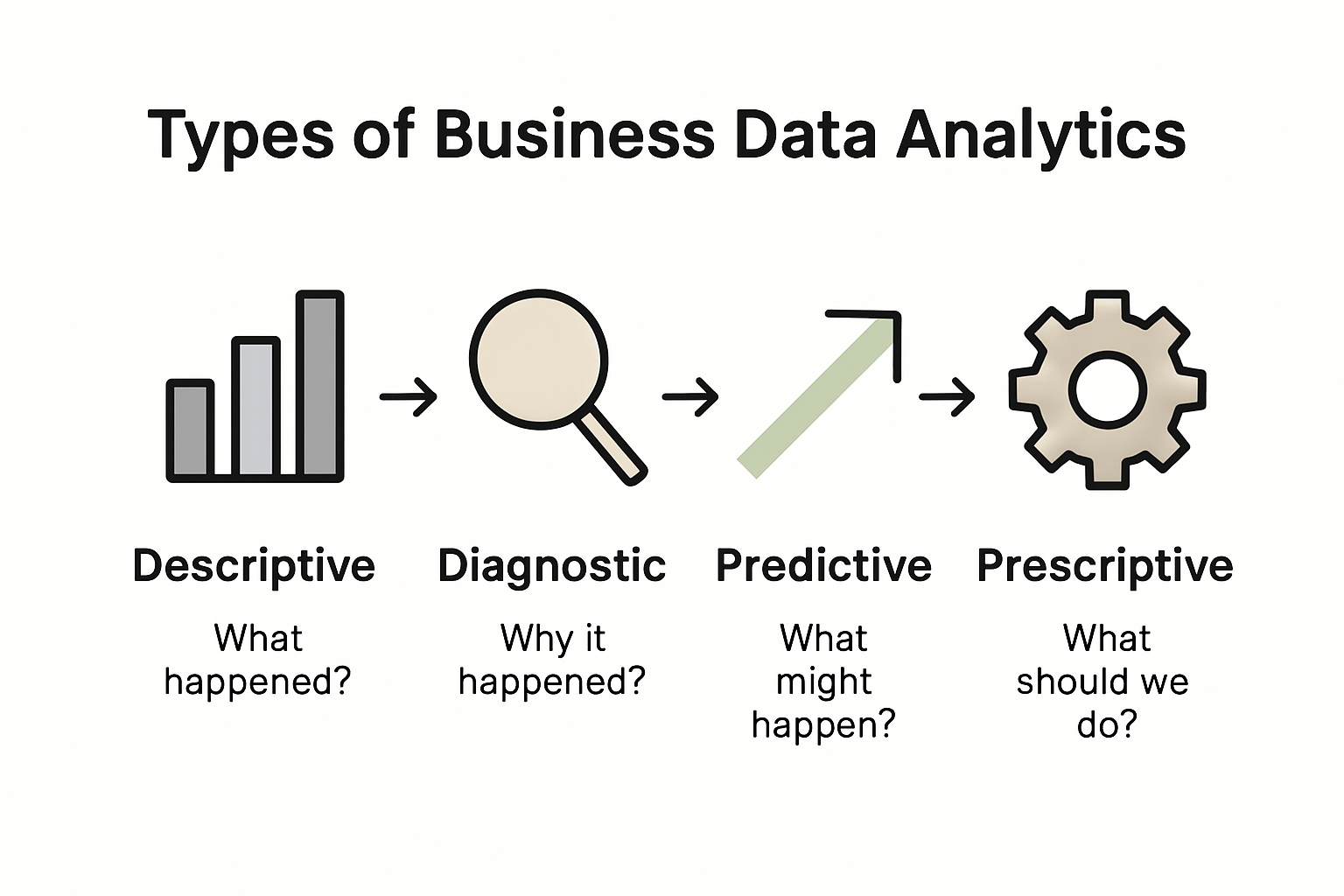
Business data analytics encompasses a spectrum of approaches designed to transform raw information into strategic insights. Data analytics is categorized into four distinct types, each serving a unique purpose in organizational decision-making: Descriptive, Diagnostic, Predictive, and Prescriptive Analytics.
Each type of analytics represents a progressively sophisticated level of organizational intelligence:
-
Descriptive Analytics:
- Summarizes historical data
- Answers “What happened?”
- Uses basic statistical techniques
- Provides foundational understanding of past performance
-
Diagnostic Analytics:
- Investigates why specific events occurred
- Employs deeper data exploration techniques
- Identifies root causes of trends and outcomes
- Helps understand complex organizational dynamics
-
Predictive Analytics:
- Utilizes advanced statistical techniques and machine learning to forecast future trends
- Develops probabilistic models
- Anticipates potential scenarios and outcomes
- Enables proactive strategic planning
-
Prescriptive Analytics:
- Recommends specific actions based on predictive insights
- Suggests optimal strategies
- Integrates artificial intelligence and complex algorithms
- Supports direct decision-making processes
Successful implementation of these analytics types requires a nuanced understanding of an organization’s specific goals, technological capabilities, and strategic objectives. While each type offers unique insights, the most effective approach often involves integrating multiple analytics methods to create a comprehensive, dynamic understanding of business performance and potential opportunities.
Essential Tools and Technologies Explained
Data analytics technologies form the backbone of modern business intelligence, providing sophisticated platforms for transforming raw information into actionable insights. Business analytics leverages a comprehensive array of tools and software designed to analyze, visualize, and interpret complex datasets, enabling organizations to make data-driven decisions with unprecedented precision.
The landscape of data analytics technologies can be categorized into several key segments:
Visualization Tools:
- Microsoft Excel
- Tableau
- Google Charts
- Power BI
- Zoho Analytics
Programming Languages:
- Python
- R
- SQL
- Julia
Business Intelligence Platforms:
- [Qlik Sense
- Tibco Spotfire
- Alteryx
- SAS Analytics](https://www.mdpi.com/2306-5729/6/8/86)
Advanced data analytics technologies go beyond simple reporting, integrating machine learning algorithms and artificial intelligence to provide predictive and prescriptive insights. These tools enable businesses to not just understand historical trends, but to anticipate future scenarios and recommend optimal strategies.
Successful implementation requires more than just acquiring sophisticated tools—it demands a strategic approach that aligns technological capabilities with specific organizational objectives. Businesses must invest in both cutting-edge technologies and the human expertise needed to leverage these powerful analytical platforms effectively.
Real-World Applications for Growth-Stage Companies
Growth-stage companies are uniquely positioned to leverage data analytics as a transformative strategic tool. Digital business transformation through advanced data operations provides organizations with an integrated approach to understanding their analytical information needs, enabling more intelligent decision-making across multiple business dimensions.
Key real-world applications for growth-stage companies include:
Customer Insights and Experience:
- Personalized marketing strategies
- Predictive customer behavior modeling
- Churn prediction and retention optimization
- Segmentation and targeted communication
Operational Efficiency:
- Process optimization
- Resource allocation analysis
- Performance benchmarking
- Workflow automation identification
Financial Strategy:
- Revenue forecasting
- Cost reduction opportunities
- Investment risk assessment
- Pricing strategy optimization
Competitive Intelligence:
- Market trend analysis
- Competitor performance tracking
- Emerging opportunity identification
- Strategic positioning insights
Business Intelligence and Analytics provides intelligence at different scales, helping companies develop new business models and improve operational performance. By transforming raw data into strategic insights, growth-stage companies can make more informed decisions, reduce operational risks, and create competitive advantages that accelerate their scaling potential.
Successful implementation requires a holistic approach that combines technological tools, data literacy, and a culture of continuous learning and adaptation. Companies that view data analytics not just as a technical solution but as a strategic mindset will be best positioned to thrive in an increasingly data-driven business landscape.
Common Pitfalls and How to Avoid Them
Data analytics implementation can be fraught with challenges that derail even the most well-intentioned business intelligence efforts. Determining which data items to prioritize is critical, as expanding Business Intelligence systems can lead to unsustainably high costs of data creation, making strategic selection paramount for organizational success.
Common pitfalls in data analytics include:
Data Collection Mistakes:
- Collecting irrelevant or redundant data
- Overlooking data quality and accuracy
- Insufficient data validation processes
- Ignoring potential bias in data sources
Analytical Strategy Errors:
- Misaligning analytics with business objectives
- Relying too heavily on historical data
- Lack of contextual understanding
- Overcomplicating analytical models
Technological Implementation Challenges:
- Insufficient technological infrastructure
- Poor data integration capabilities
- Inadequate security and privacy protocols
- Limited scalability of analytical systems
Organizational Adoption Issues:
- Weak data literacy across teams
- Resistance to data-driven decision making
- Lack of clear communication channels
- Insufficient training and support
Model-driven analytics requires a refined approach that connects raw data with deep domain understanding, transforming information into meaningful insights. Successful organizations recognize that effective data analytics is not just about technology, but about creating a holistic ecosystem of data intelligence.
To mitigate these risks, businesses must adopt a strategic, disciplined approach. This involves continuous learning, investing in team skills, maintaining rigorous data governance, and creating a culture that values data-driven insights as a core component of organizational strategy.
Unlock the Power of Data Analytics with Customized Business Systems
The article highlights key challenges growth-stage companies face when implementing data analytics. Complex tools, misaligned strategies, and lack of tailored solutions can hinder turning raw data into actionable insights that drive smarter decisions. If you are seeking to integrate descriptive, predictive, and prescriptive analytics seamlessly into your daily operations you need systems that fit your unique workflow—not generic software that falls short.
At Rule27 Design, we specialize in building custom administrative systems and internal tools that bridge this gap. Our solutions empower your team with intuitive dashboards and AI-optimized analytics designed to improve content visibility, streamline collaboration, and deliver meaningful business intelligence. We’ve helped clients gain up to 40% improvement in operational efficiency by transforming complex data into clear, strategic action plans.
Looking to leverage advanced data analytics without the frustration of overcomplicated platforms or off-the-shelf limits?
Explore how strategic design and powerful backend architecture come together at Rule27 Design to enhance your business intelligence. Take the next step today to turn your data into growth-driving decisions with systems tailored for your company’s needs.
Frequently Asked Questions
What is data analytics in the context of business?
Data analytics in business refers to the strategic process of examining raw data to derive meaningful insights, enabling organizations to make informed decisions using statistical methods and predictive models.
What are the main types of business data analytics?
The main types of business data analytics are Descriptive, Diagnostic, Predictive, and Prescriptive Analytics, each serving different purposes in understanding past performance, identifying causes of events, forecasting future trends, and recommending optimal actions.
How can businesses benefit from data analytics?
Businesses can benefit from data analytics by gaining insights into customer behavior, improving operational efficiency, enhancing financial strategies, and performing competitive intelligence, which collectively support data-driven decision-making and growth.
What common mistakes should organizations avoid in implementing data analytics?
Common mistakes include poor data collection, misalignment of analytics with business goals, insufficient technological infrastructure, and lack of organizational adoption, which can hinder the effectiveness of data analytics initiatives.

About the Author
Josh AndersonCo-Founder & CEO at Rule27 Design
Operations leader and full-stack developer with 15 years of experience disrupting traditional business models. I don't just strategize, I build. From architecting operational transformations to coding the platforms that enable them, I deliver end-to-end solutions that drive real impact. My rare combination of technical expertise and strategic vision allows me to identify inefficiencies, design streamlined processes, and personally develop the technology that brings innovation to life.
View Profile

