

Custom vs off-the-shelf solutions for SaaS optimize workflows, boost efficiency, and scale. Learn cost, flexibility, and integration factors for CTOs.
Choosing between custom and off-the-shelf software shapes how American SaaS businesses manage both rapid scaling and intricate workflow demands. Product leaders see firsthand how ready-made tools promise fast deployment, yet only tailored solutions can address nuanced operational challenges unique to their California teams. This guide breaks down core differences and highlights key factors so you can confidently align technology choices with your organization’s strategic ambitions and efficiency goals.
Key Takeaways
| Point | Details |
|---|---|
| Custom Solutions vs. Off-the-Shelf Software | Organizations must evaluate their unique needs and strategic goals when choosing between custom solutions and off-the-shelf software. |
| SaaS Tool Categories | Understanding the diverse categories of SaaS tools helps businesses select solutions that enhance specific operational efficiencies. |
| Integration Importance | Successful software integration is crucial for creating interconnected ecosystems that improve operational efficiency and user experience. |
| Avoiding Selection Mistakes | Companies should avoid common pitfalls in software selection by gathering comprehensive requirements and considering long-term adaptability. |
Defining custom and off-the-shelf solutions
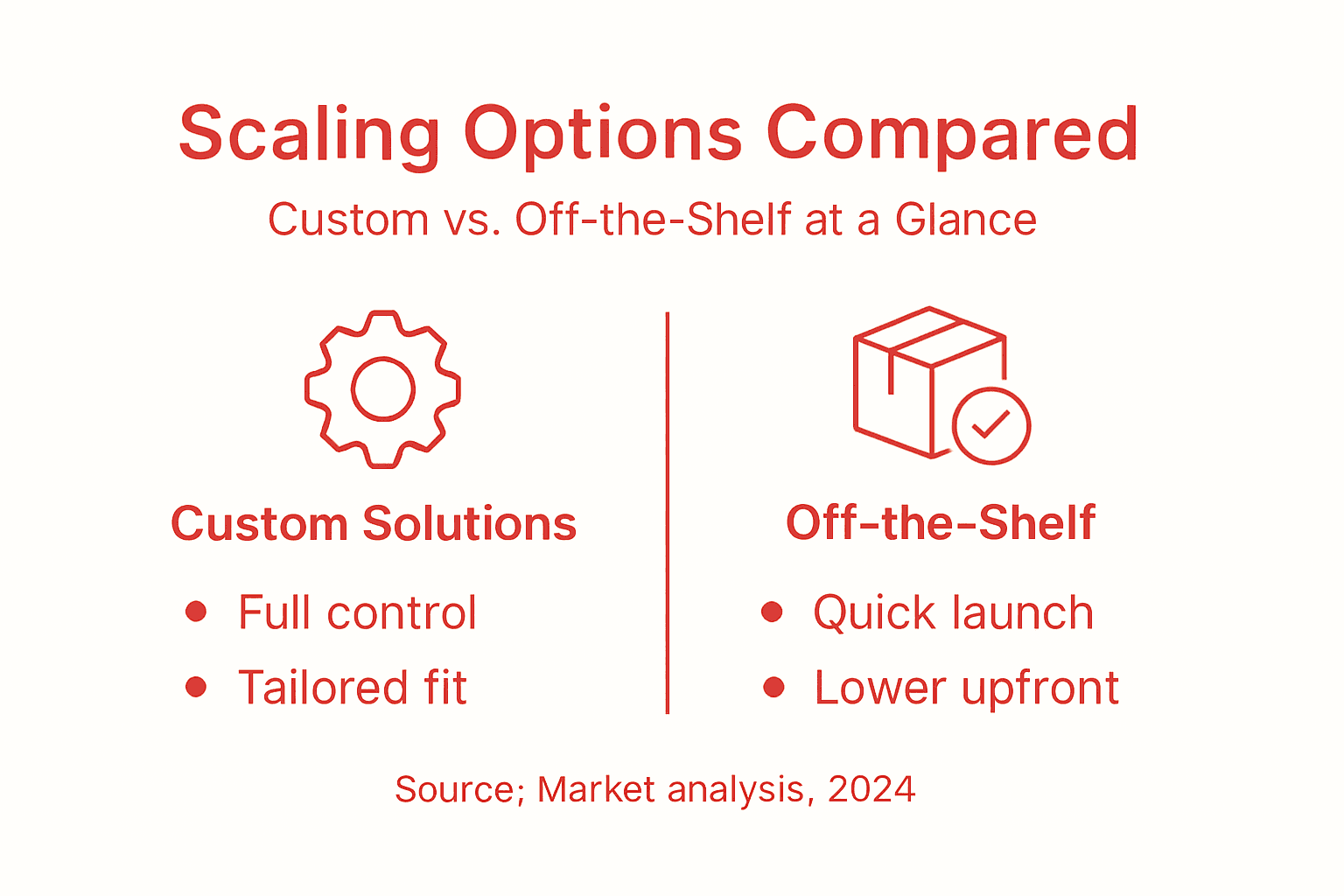
In the world of business technology, companies face a critical decision between custom solutions and off-the-shelf software. These two approaches represent fundamentally different strategies for meeting organizational technology needs. Commercial off-the-shelf (COTS) products are pre-built software packages designed to serve broad market requirements, while custom solutions are tailored specifically to an organization’s unique operational landscape.
Off-the-shelf solutions offer several compelling advantages for businesses seeking rapid deployment:
- Lower upfront development costs
- Faster implementation timelines
- Standardized features across industry segments
- Immediate availability
- Built-in best practices from vendor experience
Conversely, custom software provides organizations with precise technological alignment. Custom software development allows companies to design solutions that match their exact workflow complexities, accommodating nuanced operational requirements that generic products cannot address.
The selection between these approaches depends on multiple strategic considerations. Organizations must evaluate their specific needs, budget constraints, scalability requirements, and long-term technological vision. Factors like integration complexity, vendor lock-in potential, and future modification capabilities play crucial roles in determining the most appropriate solution.
Here’s how custom solutions and off-the-shelf software differ in strategic alignment and business impact:
| Consideration | Custom Solution | Off-the-Shelf Software |
|---|---|---|
| Workflow Fit | Tailored to unique processes | Standardized for common needs |
| Long-term Adaptability | Easily modified for growth | Limited by vendor updates |
| Risk Profile | Requires focused planning | May introduce vendor lock-in |
| Investment Horizon | Higher initial, lower long-term | Lower initial, can rise over time |
| Integration Complexity | Custom connectors possible | Dependent on built-in options |
| Business Differentiation | Enables distinct advantages | May lack competitive edge |
Custom solutions offer maximum flexibility, while off-the-shelf products provide immediate functionality at lower initial investment.
Pro tip: Conduct a comprehensive workflow audit before selecting between custom and off-the-shelf solutions to identify your organization’s most critical technological requirements.
Types of SaaS tools and workflow variations
The Software as a Service (SaaS) landscape represents a diverse ecosystem of technological solutions designed to streamline business operations. SaaS revenue in the United States is projected to reach an impressive $295 billion by 2025, reflecting the growing complexity and specialization of digital workflow tools.
SaaS tools can be categorized into several critical business function segments:
- Customer Relationship Management (CRM)
- Enterprise Resource Planning (ERP)
- Project Management
- Collaboration and Communication
- Financial and Accounting Systems
- Human Resources Management
- Marketing Automation
- Sales and Analytics Platforms
Each category offers unique workflow variations tailored to specific organizational needs. SaaS application integration has become increasingly sophisticated, enabling businesses to create seamless connections between different software platforms and optimize operational efficiency.

The following table summarizes SaaS tool categories and their primary value for organizations:
| SaaS Category | Main Value Provided | Typical Workflow Benefit |
|---|---|---|
| CRM | Client engagement management | Improved customer retention |
| ERP | Resource tracking and planning | Centralized data oversight |
| Project Management | Task allocation and progress | Enhanced team visibility |
| HR Management | Staff onboarding/payroll | Streamlined HR processes |
| Marketing Automation | Campaign execution | Targeted outreach efficiency |
The evolution of SaaS tools has transformed how companies approach technological infrastructure. Modern platforms prioritize flexibility, allowing organizations to customize workflows, scale resources dynamically, and adapt quickly to changing business requirements. This approach contrasts sharply with traditional monolithic software systems that required extensive manual configuration and limited adaptability.
SaaS tools are not just software solutions—they are strategic enablers of organizational agility and innovation.
Pro tip: Conduct a comprehensive audit of your existing workflow tools to identify potential integration opportunities and eliminate redundant software subscriptions.
Key features, flexibility, and integration
Software integration represents the critical backbone of modern technological infrastructure, enabling businesses to create seamless, interconnected digital ecosystems. Software integration strategies have evolved dramatically, transforming how organizations approach technological complexity and operational efficiency.
Key features that define advanced software solutions include:
- Robust API connectivity
- Real-time data synchronization
- Scalable architecture
- Comprehensive security protocols
- Cross-platform compatibility
- Customizable workflow configurations
- Advanced reporting and analytics
- Automated process management
Bespoke software development offers unparalleled flexibility, allowing organizations to precisely align technological capabilities with unique business requirements. This approach enables companies to build solutions that adapt dynamically to changing operational landscapes, unlike rigid off-the-shelf alternatives.
The integration landscape demands a strategic approach that balances technological sophistication with practical implementation. Successful integration requires a deep understanding of existing systems, potential workflow bottlenecks, and the ability to create seamless communication channels between diverse software platforms. Companies must prioritize solutions that offer granular customization without compromising overall system stability.
Effective software integration is less about technology and more about understanding complex business processes.
Pro tip: Conduct a comprehensive system audit to map existing software interactions and identify potential integration opportunities before implementing new technological solutions.
Operational costs, ROI, and scalability impacts
Technological investment decisions require nuanced analysis of long-term financial implications and strategic growth potential. Scalability approaches fundamentally transform how businesses evaluate software solutions, moving beyond traditional cost-per-license models to comprehensive return on investment frameworks.
Critical financial considerations for software solutions include:
- Initial development and implementation costs
- Ongoing maintenance expenses
- Training and adoption investment
- Potential productivity gains
- Technology upgrade pathways
- Resource allocation efficiency
- Performance optimization potential
- Risk mitigation expenses
Bespoke software development presents a compelling alternative to traditional off-the-shelf solutions, offering tailored scalability that directly aligns with organizational growth trajectories. While upfront costs might appear higher, custom solutions frequently deliver superior long-term value by eliminating unnecessary features and precisely matching operational requirements.
Operational cost management requires a holistic perspective that considers both immediate financial implications and future technological adaptability. Successful organizations recognize that scalability is not merely a technical consideration but a strategic imperative. They prioritize solutions that can dynamically adjust to changing business landscapes, supporting seamless expansion without requiring complete system redesigns.
True technological investment transcends immediate costs—it represents a strategic commitment to organizational agility and innovation.
Pro tip: Develop a comprehensive five-year total cost of ownership model that includes potential scaling scenarios before finalizing any software investment.
Mistakes to avoid when choosing your solution
Software selection represents a critical strategic decision that can dramatically impact organizational efficiency. Common project development mistakes can undermine even the most well-intentioned technological investments, creating long-lasting operational challenges.
Critical mistakes to avoid during software solution selection include:
- Neglecting comprehensive requirements gathering
- Underestimating total cost of ownership
- Ignoring scalability and future growth potential
- Failing to assess integration capabilities
- Overlooking security and compliance requirements
- Rushing implementation without thorough testing
- Disregarding user experience and adoption challenges
- Minimal stakeholder consultation
Bespoke software development challenges often stem from inadequate strategic planning and unrealistic expectations. Organizations frequently underestimate the complexity of creating custom solutions that precisely match their operational needs. This miscalculation can lead to extended development timelines, budget overruns, and solutions that fail to deliver expected outcomes.
Successful software selection demands a holistic approach that balances technical requirements with strategic business objectives. Companies must develop rigorous evaluation frameworks that go beyond surface-level feature comparisons, focusing instead on long-term adaptability, performance potential, and alignment with organizational growth strategies.
Effective software selection is less about finding the perfect solution and more about understanding your organization’s unique evolutionary path.
Pro tip: Create a cross-functional evaluation team that includes technical experts, end-users, and strategic leaders to ensure comprehensive software solution assessment.
Unlock Scalable Growth with Tailored Software Solutions
Choosing between custom and off-the-shelf software often leaves companies stuck with systems that either don’t fit their workflows or become costly to scale. This article highlights the risks of vendor lock-in, limited adaptability, and the challenge of aligning technology exactly to your business needs. If your organization needs a solution that grows with you while improving operational efficiency and content performance, a bespoke system could be your answer.
At Rule27 Design, we specialize in crafting custom admin panels, content management systems, and internal tools designed to match how your team works. Our expertise bridges the gap between generic off-the-shelf products and overly complex enterprise solutions. We create scalable software architectures that enhance workflow efficiency, empower team collaboration, and boost AI-optimized content visibility.
Don’t settle for software that limits your growth or drains your resources. Explore how our tailored digital infrastructure can transform your operations and help you scale confidently. Visit Rule27 Design today and take the first step toward a system built just for your business.
Frequently Asked Questions
What are the main differences between custom solutions and off-the-shelf software?
Custom solutions are tailored specifically to an organization’s unique needs, offering maximum flexibility and adaptability. In contrast, off-the-shelf software is pre-built to serve broad market requirements, making it more standardized and quicker to implement.
How does the scalability of custom solutions compare to off-the-shelf software?
Custom solutions are designed to easily adapt and grow with an organization, allowing for tailored scalability based on specific operational needs. Off-the-shelf software may have limitations regarding adaptability and often relies on vendor updates for scalability, which may not always align with unique business growth.
What are the cost implications of choosing custom solutions over off-the-shelf options?
While custom solutions typically have higher initial development costs, they can provide better long-term value by aligning with specific operational requirements and reducing unnecessary features. Off-the-shelf software usually has lower upfront costs but can accumulate higher expenses over time due to licensing and potential customization needs.
What kind of integration challenges should I expect with custom vs. off-the-shelf solutions?
Custom solutions can offer flexible integration options tailored to existing systems, potentially easing complex workflows. Off-the-shelf software may have limited built-in integration capabilities, which could complicate connections with other platforms or require additional middleware to function effectively.

About the Author
Josh AndersonCo-Founder & CEO at Rule27 Design
Operations leader and full-stack developer with 15 years of experience disrupting traditional business models. I don't just strategize, I build. From architecting operational transformations to coding the platforms that enable them, I deliver end-to-end solutions that drive real impact. My rare combination of technical expertise and strategic vision allows me to identify inefficiencies, design streamlined processes, and personally develop the technology that brings innovation to life.
View Profile

