

Discover a proven content audit workflow that empowers SaaS teams to boost efficiency and visibility. Follow each step for measurable improvements.
Most american SaaS teams waste up to 30 percent of their content budget on assets that never drive meaningful results. For growth-stage product managers in the Northeast, this inefficiency creates serious challenges to scaling and standing out. Streamlining your content audit workflow can turn scattered efforts into a powerful engine for operational agility and higher content visibility, giving you a clearer path to measurable success.
Step 1: Establish content audit objectives and criteria
Your content audit journey starts with defining clear objectives that will transform scattered content into a strategic asset. By establishing precise audit goals, you create a roadmap that guides your entire optimization process and ensures meaningful outcomes.
Begin by connecting your content audit objectives directly to your business goals. Evaluating content elements systematically requires understanding what you want to achieve. This might include improving website performance, aligning content with current brand messaging, identifying outdated materials, or enhancing audience engagement. Your specific objectives will depend on your organization’s unique needs, but they should always be measurable and actionable.
Consider developing objectives around key performance indicators like content relevance, accuracy, and audience alignment. Linking objectives to organizational priorities means creating criteria that can be objectively assessed. This could involve establishing benchmarks such as content age, search engine ranking, conversion rates, or user engagement metrics. Remember that your audit criteria should provide clear yes or no answers about content quality and effectiveness.
Here’s a summary of key audit objectives matched with recommended criteria for content measurement:
| Audit Objective | Recommended Criteria | Strategic Impact |
|---|---|---|
| Improve website performance | Search ranking, bounce rate | Increases organic traffic |
| Align with brand messaging | Messaging consistency, tone | Strengthens brand identity |
| Remove outdated materials | Content age, accuracy | Reduces risk of misinformation |
| Enhance audience engagement | User interactions, comments | Boosts retention and loyalty |
Pro tip: Create a simple scorecard with weighted criteria to make your content audit assessment more structured and repeatable.
Step 2: Inventory and categorize existing digital content
This step transforms your digital content from a scattered collection into a structured, manageable resource. Cataloging digital content assets requires a systematic approach that will give you complete visibility into your organization’s content landscape.
Start by gathering all digital content across platforms. This means collecting web pages, blog posts, images, documents, videos, and any other digital assets. Create a comprehensive spreadsheet that includes key details for each piece of content such as URL, title, content type, publication date, author, and current status. Documenting content with relevant metadata helps you understand each asset’s purpose and potential value. Consider using tools like content management systems or specialized content inventory software to streamline this process.

Next, develop a categorization strategy that makes sense for your organization. Group content by factors like topic, format, target audience, performance metrics, and strategic relevance. This might mean creating columns for categories such as evergreen content, time-sensitive materials, high-performing pieces, or content that needs immediate updating. The goal is to create a clear, actionable overview that helps you make informed decisions about each content asset.
Pro tip: Use color coding or tagging in your inventory spreadsheet to quickly visualize content status and priority levels.
Step 3: Evaluate content using performance and relevance metrics
In this critical phase, you will transform raw data into actionable insights about your content’s true effectiveness. Assessing content through precise evaluation measures) allows you to understand exactly how your digital assets are performing and where improvements are needed.
Begin by identifying key performance indicators that align with your organizational goals. These might include metrics like page views, average time on page, bounce rate, social shares, conversion rates, and organic search rankings. Look beyond surface level numbers to understand the deeper story behind each piece of content. Tracking comprehensive performance metrics means examining both quantitative data and qualitative feedback. Consider user engagement signals such as comments, scroll depth, and user interactions that indicate how deeply your content resonates with your audience.
Develop a scoring system that weights different metrics based on their strategic importance. For instance, a blog post might score higher for conversion potential than total page views, while an informational resource might be evaluated more on time spent reading and information comprehension. Create a standardized evaluation framework that allows you to compare content objectively and identify top performers as well as pieces that need significant improvement or retirement.
Use this table to quickly compare key content performance metrics and their primary business value:
| Metric | What It Measures | Business Value |
|---|---|---|
| Page Views | Traffic volume per content | Assesses popularity |
| Conversion Rate | Action completions from content | Links content to ROI |
| Time on Page | User attention span | Reflects engagement depth |
| Social Shares | Content distribution power | Expands reach and awareness |
Pro tip: Create a color-coded dashboard that visualizes your content performance metrics to quickly identify trends and opportunities.
Step 4: Prioritize and optimize content for target outcomes
This step transforms your content strategy from a scattered approach to a laser focused optimization process. Focusing efforts on high value content assets ensures you invest resources where they will generate maximum impact and drive meaningful business results.
Develop a prioritization matrix that considers multiple dimensions of content performance. Start by mapping each content piece against strategic goals such as lead generation, brand awareness, customer education, and conversion potential. Assign weighted scores based on factors like audience relevance, current performance metrics, alignment with business objectives, and potential for improvement. Some content might require minor updates while others need complete reconstruction or retirement.
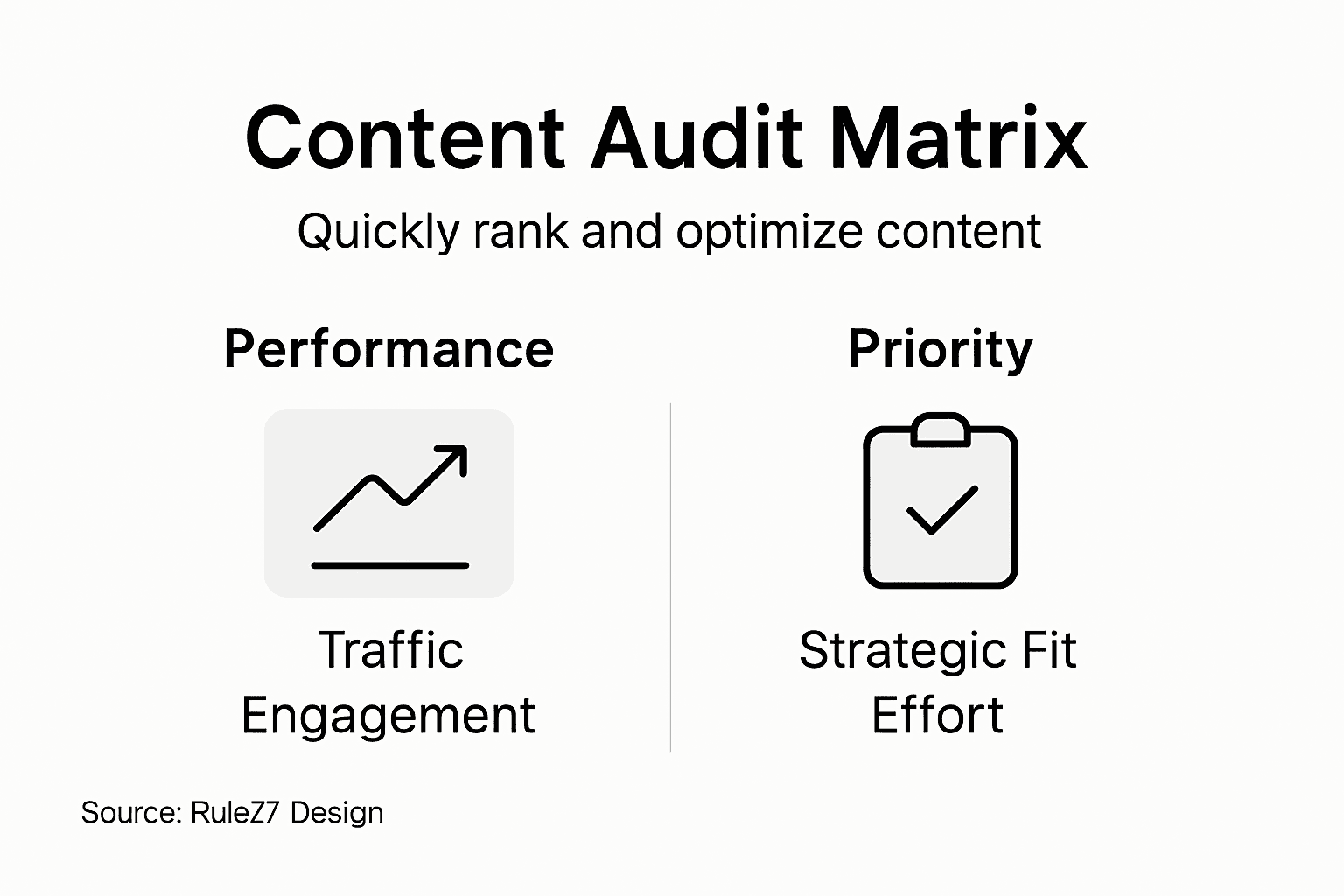
Strategic content marketing effectiveness demands a systematic approach to optimization. Concentrate on content that demonstrates strong potential or addresses critical audience needs. This might mean updating evergreen articles with current data, restructuring underperforming pieces to improve readability, or creating new content that fills identified gaps in your existing library. Prioritize updates that directly support your most important business goals and customer journey stages.
Pro tip: Create a simple scoring spreadsheet with columns for strategic value, current performance, and required effort to quickly rank content optimization priorities.
Step 5: Verify audit results and implement continuous improvements
This final stage transforms your content audit from a one-time assessment into an ongoing optimization strategy. Verifying comprehensive audit findings ensures that your insights translate into meaningful organizational improvements.
Begin by creating a detailed report that clearly communicates your audit findings, including performance metrics, recommended actions, and potential impact. Schedule a review meeting with key stakeholders to discuss the results, prioritize recommended changes, and establish clear ownership for implementation. Break down larger optimization initiatives into smaller, actionable tasks with specific timelines and responsible team members.
Tracking implementation of audit recommendations requires a systematic approach to monitoring progress. Develop a tracking mechanism that allows you to follow up on each recommended action, measure its effectiveness, and make iterative improvements. This might involve setting up regular check-ins, creating a shared dashboard, or using project management tools to ensure accountability and visibility into the optimization process.
Pro tip: Create a quarterly review cycle to reassess your content strategy and ensure continuous alignment with evolving business goals and audience needs.
Unlock the Full Potential of Your Content Audit with Custom Digital Solutions
Conducting a thorough content audit reveals critical insights, but turning those insights into efficient, scalable actions is often the real challenge. From establishing clear audit objectives to prioritizing and optimizing your content, managing all the moving parts can overwhelm teams relying on generic tools. The pain points are clear: fragmented content inventories, lack of actionable analytics, and limited visibility into performance metrics can slow down your optimization efforts and stall business growth.
At Rule27 Design, we specialize in building tailored content management systems and administrative tools that directly address these challenges. Our custom solutions are designed to enhance workflow efficiency, provide real-time performance dashboards, and integrate AI-driven features that boost content relevance and search rankings. Leveraging technologies like React, Supabase, and Node.js, we create systems that evolve with your needs — which means you spend less time managing data and more time using it to drive results.
Looking to elevate your content audit process into a streamlined, results-driven strategy?

Discover how our expert team can build a content optimization system uniquely aligned to your goals. Visit Rule27 Design now and take the first step toward transforming your content into your strongest business asset. Explore our solutions and learn how we help growth-stage companies boost efficiency by 40 percent and improve content performance dramatically.
Frequently Asked Questions
What are the key objectives for conducting a content audit?
Establish clear objectives such as improving website performance, enhancing audience engagement, and aligning content with brand messaging. Identify measurable goals like increasing conversion rates or reducing bounce rates within 30 days to track progress effectively.
How should I categorize my existing digital content during an audit?
Categorize your content by factors such as topic, format, and audience engagement. Creating a structured inventory, such as a spreadsheet detailing each asset’s purpose and current status, can help provide clarity and streamline decision-making.
What performance metrics should I evaluate during a content audit?
Focus on metrics like page views, average time on page, and conversion rates to assess content effectiveness. Evaluating these metrics regularly can reveal insights and highlight areas for improvement, helping you optimize underperforming pieces within a few weeks.
How can I prioritize which content to optimize first?
Develop a prioritization matrix that considers metrics like audience relevance, strategic alignment, and current performance. Assign weights to each factor to rank your content, allowing you to focus on high-value assets first, ideally within one month.
What steps should I take after completing the content audit report?
After finalizing your audit report, schedule a review meeting with stakeholders to discuss findings and prioritize recommended changes. Aim to establish clear ownership for implementation tasks, ensuring progress is tracked through regular check-ins over the next few months.
How can I ensure continuous improvement in my content strategy?
Implement a quarterly review cycle to reassess your content strategy in light of evolving business goals and audience needs. Tracking recommended actions and measuring their effectiveness will help maintain relevance and optimize your content continuously.

About the Author
Josh AndersonCo-Founder & CEO at Rule27 Design
Operations leader and full-stack developer with 15 years of experience disrupting traditional business models. I don't just strategize, I build. From architecting operational transformations to coding the platforms that enable them, I deliver end-to-end solutions that drive real impact. My rare combination of technical expertise and strategic vision allows me to identify inefficiencies, design streamlined processes, and personally develop the technology that brings innovation to life.
View Profile

