

Business scalability helps SaaS companies grow efficiently. Learn core concepts, types, key traits, risks, and practical applications for custom infrastructure.
Growth-stage SaaS companies often discover that scaling is not just about adding more servers or expanding teams. The gap between simple growth and true business scalability can determine who leads markets and who stalls out. This article gives CTO and operations managers clear insights into business scalability, covering hidden pitfalls and the smartest strategies for flexible, cost-effective expansion that keeps performance high no matter how quickly demands increase.
Key Takeaways
| Point | Details |
|---|---|
| Understanding Scalability | Business scalability involves creating adaptable systems for efficient growth without proportional resource increases. |
| Myths of Scalability | Common misconceptions include the belief that growth alone equates to scalability, which neglects the importance of strategy and systems. |
| Types of Scalability | In SaaS, crucial types include vertical and horizontal scalability, each with distinct operational strategies for growth. |
| Risks in Scaling | Companies must be aware of risks such as collaboration breakdowns and strategic misalignment to successfully navigate growth challenges. |
Defining Business Scalability and Common Myths
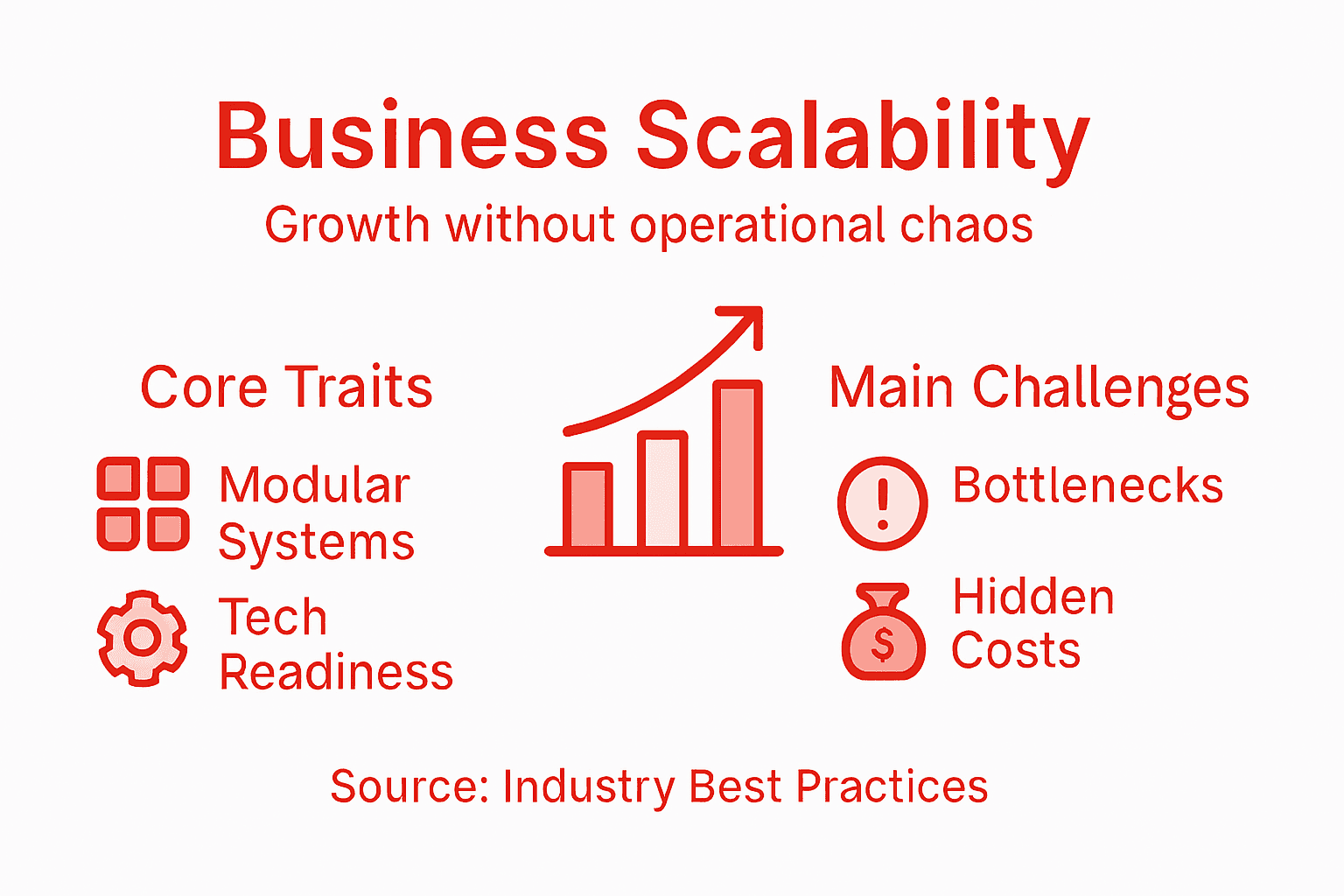
Business scalability represents a company’s strategic capability to expand operations efficiently without compromising performance or increasing costs proportionally. Research from leading business schools reveals that scalability goes far beyond simple growth—it’s about designing intelligent, flexible business models that can adapt and multiply revenue streams.
At its core, business scalability involves creating systems, processes, and organizational structures that enable rapid, sustainable expansion. This means developing capabilities that allow a company to handle increased workload, customer demand, and market complexity without requiring a linear increase in resources. Companies like Google and Apple demonstrate scalability by:
- Developing platform-based business models
- Outsourcing capital-intensive investments
- Establishing flexible distribution channels
- Leveraging strategic partnerships
- Creating modular, replicable operational frameworks
However, significant myths persist about what scalability actually means. Wharton research challenges traditional productivity assumptions, showing that successful scaling isn’t just about working harder, but working smarter. Many entrepreneurs mistakenly believe a compelling value proposition guarantees success, when in reality, scalable businesses require sophisticated, adaptable strategies.
Scalability isn’t about doing more—it’s about creating systems that automatically do more with less.
Common Scalability Myths include:
- Growth equals scaling
- More resources solve complexity
- Success is purely about productivity
- One-size-fits-all business models work everywhere
Truly scalable organizations understand that growth requires intentional design, technological infrastructure, and strategic partnerships that enable exponential rather than linear expansion.
Pro tip: Regularly audit your business processes to identify bottlenecks and design modular systems that can expand without requiring massive reinvestment.
Types of Scalability in SaaS Companies
Scalability in SaaS companies is a multifaceted concept that extends far beyond simple growth strategies. Multiple scalability approaches exist for technology organizations, each addressing different aspects of business and technological expansion.
The primary types of scalability in SaaS environments include:
- Vertical Scalability: Adding more resources to a single server or system
- Horizontal Scalability: Expanding by adding more servers or machines
- Cloud Computing Scalability: Dynamic resource allocation and management
- Architectural Scalability: Designing systems that can efficiently handle increased load
- Design Scalability: Creating flexible infrastructure that supports growth
Technology Scalability represents the technical backbone of SaaS growth. Choosing the right scaling approach depends on multiple factors including application architecture, expected traffic, and budgetary constraints. Vertical scaling involves enhancing a single server’s capabilities, while horizontal scaling distributes workload across multiple servers.
Effective scalability isn’t about adding more—it’s about designing smarter, more adaptable systems.
Companies must consider different scalability dimensions:
- Computational scalability
- Storage scalability
- Network scalability
- Operational scalability
- Financial scalability
Each dimension requires unique strategies and technological investments to ensure smooth, efficient growth without compromising performance or introducing unnecessary complexity.
Pro tip: Conduct regular infrastructure audits to identify potential scalability bottlenecks and design modular systems that can dynamically adapt to changing business requirements.
Key Traits of Scalable Digital Infrastructure
Effective digital infrastructure demands strategic design that transcends basic technological capabilities. Scalable systems require sophisticated architectural principles that enable organizations to adapt, grow, and respond to changing technological landscapes.
The fundamental characteristics of scalable digital infrastructure include:
- Modularity: Breaking complex systems into independent, manageable components
- Flexibility: Ability to quickly reconfigure and adjust resources
- Distributed Architecture: Spreading computational load across multiple systems
- Automated Resource Allocation: Dynamic scaling based on real-time demand
- High Availability: Minimizing downtime and ensuring continuous operation
System Design plays a critical role in infrastructure scalability. Digital public infrastructure must be accessible and trustworthy, supporting increasing user demands while maintaining robust security protocols. This requires a comprehensive approach that balances performance, cost-effectiveness, and adaptability.
Scalable infrastructure is not about building bigger systems, but about building smarter, more responsive networks.
Key performance indicators for scalable digital infrastructure include:
- Response time consistency
- Resource utilization efficiency
- Seamless horizontal and vertical scaling capabilities
- Fault tolerance and self-healing mechanisms
- Cost-effective expansion potential
Successful digital infrastructure anticipates growth, prevents bottlenecks, and provides a foundation for technological innovation without requiring constant massive reinvestments.

Pro tip: Implement continuous monitoring and automated testing frameworks to proactively identify and address potential scalability constraints before they impact system performance.
Real-World Examples and Use Cases
Scalability transforms theoretical concepts into practical business strategies. Software and business models demonstrate remarkable adaptability through innovative approaches that enable rapid, efficient growth across multiple industries.
Some compelling scalability use cases include:
- E-commerce Platforms: Dynamically adjusting server resources during peak shopping seasons
- Streaming Services: Handling millions of simultaneous user connections
- Social Media Networks: Supporting exponential user growth without performance degradation
- Financial Technology: Processing thousands of transactions per second
- Cloud Computing Services: Providing elastic infrastructure for diverse client needs
Cloud Architecture represents a prime example of scalability in action. Dynamic resource allocation enables unprecedented business flexibility, allowing organizations to optimize computing power, reduce costs, and respond rapidly to market changes.
Scalability isn’t just a technical feature—it’s a strategic business advantage that separates industry leaders from followers.
Successful scalability implementation requires understanding multiple dimensions:
- Technical infrastructure readiness
- Economic feasibility
- Performance predictability
- Security considerations
- Customer experience maintenance
Companies that master scalability can transform potential growth constraints into opportunities for innovation and market expansion.
Pro tip: Develop a comprehensive scalability roadmap that anticipates potential growth scenarios and creates flexible technological frameworks to support them.
Risks, Costs, and Common Pitfalls
Business scalability involves navigating complex challenges that can derail even the most promising growth strategies. Many innovations struggle to overcome organizational barriers, creating significant risks for companies attempting rapid expansion.
The most critical scalability risks include:
- Collaboration Breakdowns: Inability to coordinate across different organizational groups
- Strategic Misalignment: Lack of cohesive long-term growth vision
- Resource Constraints: Insufficient infrastructure to support rapid scaling
- Partnership Complexities: Challenges in managing interdependent relationships
- Cost Management: Unexpected expenses associated with scaling operations
Organizational Dynamics play a crucial role in scaling challenges. Companies often fail by adopting narrow business approaches, neglecting the systemic thinking required for sustainable growth.
The most expensive mistake in scaling is believing that what worked yesterday will work tomorrow.
Key financial and operational risks to monitor include:
- Overextending financial resources
- Losing core business focus
- Creating unsustainable complexity
- Compromising product or service quality
- Mismanaging organizational culture during growth
Successful scaling requires anticipating potential barriers and developing flexible strategies that can adapt to unexpected challenges.
The table below contrasts critical risks and solutions in scaling businesses:
| Risk Area | Typical Challenge | Proactive Solution |
|---|---|---|
| Collaboration | Coordination failures | Implement cross-team processes |
| Strategic Alignment | Lack of unified vision | Regular strategic reviews |
| Resource Constraints | Insufficient capacity | Plan phased infrastructure upgrades |
| Operational Costs | Rising expenses during scaling | Set strict cost controls |
| Organizational Culture | Dilution of core values | Maintain transparent communication |
Pro tip: Conduct quarterly scalability audits that assess your current infrastructure, identify potential bottlenecks, and create contingency plans for potential growth constraints.
Comparing Scalability Alternatives for Growth
Scalability strategies represent critical decision points for businesses seeking sustainable expansion. Different approaches offer unique advantages depending on organizational requirements, technological infrastructure, and growth objectives.
Key scalability alternatives include:
Here’s a summary comparing major scalability approaches:
| Scalability Approach | How It Works | Key Business Benefit |
|---|---|---|
| Vertical Scaling | Increase resources of a single server | Enhances performance quickly |
| Horizontal Scaling | Add more servers to distribute workload | Supports higher user volume |
| Serverless Architecture | Allocates resources based on usage events | Offers cost efficiency |
| Hybrid Cloud Solutions | Combines on-premise and cloud infrastructure | Increases deployment flexibility |
| Microservices Architecture | Breaks systems into independent modules | Improves reliability and scaling |
- Vertical Scaling: Adding resources to a single machine
- Horizontal Scaling: Distributing load across multiple servers
- Serverless Architecture: Dynamic, event-driven resource allocation
- Hybrid Cloud Solutions: Combining on-premise and cloud infrastructure
- Microservices Architecture: Breaking systems into independent, modular components
Cloud Platform Comparisons reveal nuanced differences in scalability models. Enterprise cloud providers offer distinct scalability approaches, each with specific strengths for different business needs. Considerations include cost structure, performance characteristics, integration capabilities, and long-term flexibility.
Scalability isn’t about choosing the most advanced technology, but selecting the right solution for your specific business context.
Selection criteria for scalability alternatives involve evaluating:
- Workload variability
- Budget constraints
- Performance requirements
- Security considerations
- Future growth projections
Successful scalability implementation demands a strategic approach that aligns technological capabilities with business objectives, ensuring flexibility and efficiency.
Pro tip: Conduct comprehensive benchmarking tests across multiple scalability models to determine the most cost-effective and performance-optimized solution for your specific organizational needs.
Unlock Scalable Growth With Custom Systems That Work
Growing your business without chaos requires strategic design of scalable digital infrastructure and intelligent administrative systems. If you struggle with bottlenecks caused by off-the-shelf tools or fear the complexity and cost of enterprise software, you are not alone. The article highlights key challenges such as coordination breakdown, resource constraints, and the need to build systems that can automatically do more with less. At Rule27 Design, we specialize in bridging that very gap by crafting custom admin panels, content management systems, and internal tools designed to scale in harmony with your business.
Discover how our deep expertise in technical architecture and business operations empowers you to improve workflow efficiency, enhance AI-optimized content visibility, and gain actionable insights through business intelligence solutions. Don’t let growing pains slow you down. Take the next step toward smarter, sustainable scalability by exploring Rule27 Design’s tailored solutions. See how custom systems can transform complexity into clear growth opportunities and visit our landing page today to get started.
Frequently Asked Questions
What is business scalability?
Business scalability is a company’s ability to expand its operations efficiently while maintaining performance and minimizing costs. It involves creating systems and processes that allow for rapid growth without having to increase resources linearly.
What are common myths about scalability?
Common myths include the belief that growth equals scaling, that adding more resources simplifies complexity, and that a strong value proposition guarantees success. True scalability requires strategic design and adaptable systems.
What types of scalability exist in SaaS companies?
In SaaS companies, major types of scalability include vertical scalability (adding resources to a single server), horizontal scalability (adding more servers), cloud computing scalability, architectural scalability, and design scalability to support efficient growth.
How can organizations mitigate risks associated with scaling?
Organizations can mitigate risks by ensuring strategic alignment, maintaining transparent communication, conducting regular scalability audits, and preparing for resource constraints and cost management challenges. These proactive measures help navigate the complexities of rapid expansion.
Topics

About the Author
Josh AndersonCo-Founder & CEO at Rule27 Design
Operations leader and full-stack developer with 15 years of experience disrupting traditional business models. I don't just strategize, I build. From architecting operational transformations to coding the platforms that enable them, I deliver end-to-end solutions that drive real impact. My rare combination of technical expertise and strategic vision allows me to identify inefficiencies, design streamlined processes, and personally develop the technology that brings innovation to life.
View Profile

