

Analytics matter for agencies by driving better decisions, improving operational efficiency, and enhancing content performance for SaaS companies.
Over 75 percent of American agencies now use advanced analytics to guide decisions and sharpen their competitive edge. For product managers and data analysts at growth-stage SaaS companies, understanding what drives this shift is no longer optional. The right analytics approach can reveal overlooked inefficiencies, empower teams to act fast, and set the stage for smarter content strategies that actually move the needle.
Key Takeaways
| Point | Details |
|---|---|
| Data Analytics Revolutionizes Agencies | Modern agencies harness data analytics to derive actionable insights that enhance decision-making and operational efficiency. |
| Investment in Analytics Tools is Crucial | Agencies should prioritize tools that integrate advanced analytics capabilities to improve resource allocation and strategic planning. |
| Continuous Data Literacy is Essential | Training teams on data interpretation fosters a culture of data-driven decision-making throughout the organization. |
| Ignoring Data Risks Competitive Position | Neglecting analytical insights can lead to inefficiencies and strategic missteps that jeopardize an agency’s market standing. |
Defining Analytics for Modern Agencies
Modern agencies are transforming their operational strategies through sophisticated data analytics, leveraging advanced technological capabilities to generate meaningful insights. Analytics has evolved from simple reporting mechanisms to comprehensive systems that decode complex organizational patterns and drive strategic decision-making.
At its core, analytics represents a systematic approach to examining diverse data types and transforming raw information into actionable intelligence. Data strategies from government agencies like the U.S. Office of Personnel Management demonstrate how analytics can revolutionize organizational performance by developing robust data-driven cultures. These approaches typically involve multiple critical components:
- Comprehensive Data Collection: Gathering information from multiple sources
- Advanced Processing Techniques: Using machine learning and statistical models
- Insight Generation: Translating complex data into strategic recommendations
- Continuous Performance Monitoring: Tracking metrics and adjusting strategies
Canada’s federal public service data strategy further illuminates how analytics serve as a foundational tool for modernizing organizational interactions, improving transparency, and enhancing service delivery. By systematically analyzing diverse data streams, agencies can develop nuanced understanding of their operational ecosystems, identify potential optimization opportunities, and make precise, data-backed decisions.
Pro tip: Invest in training your team on data literacy and analytics interpretation to maximize the value of your insights and foster a more adaptive organizational culture.
Key Types of Agency Analytics Tools
Agency analytics tools have become increasingly sophisticated, transforming raw data into strategic intelligence across multiple domains. These technological solutions enable organizations to extract meaningful insights, predict trends, and make data-driven decisions with unprecedented precision and efficiency.
The U.S. Office of Personnel Management’s data strategy highlights several critical categories of analytics tools that modern agencies utilize. These tools can be broadly categorized into distinct yet interconnected types:
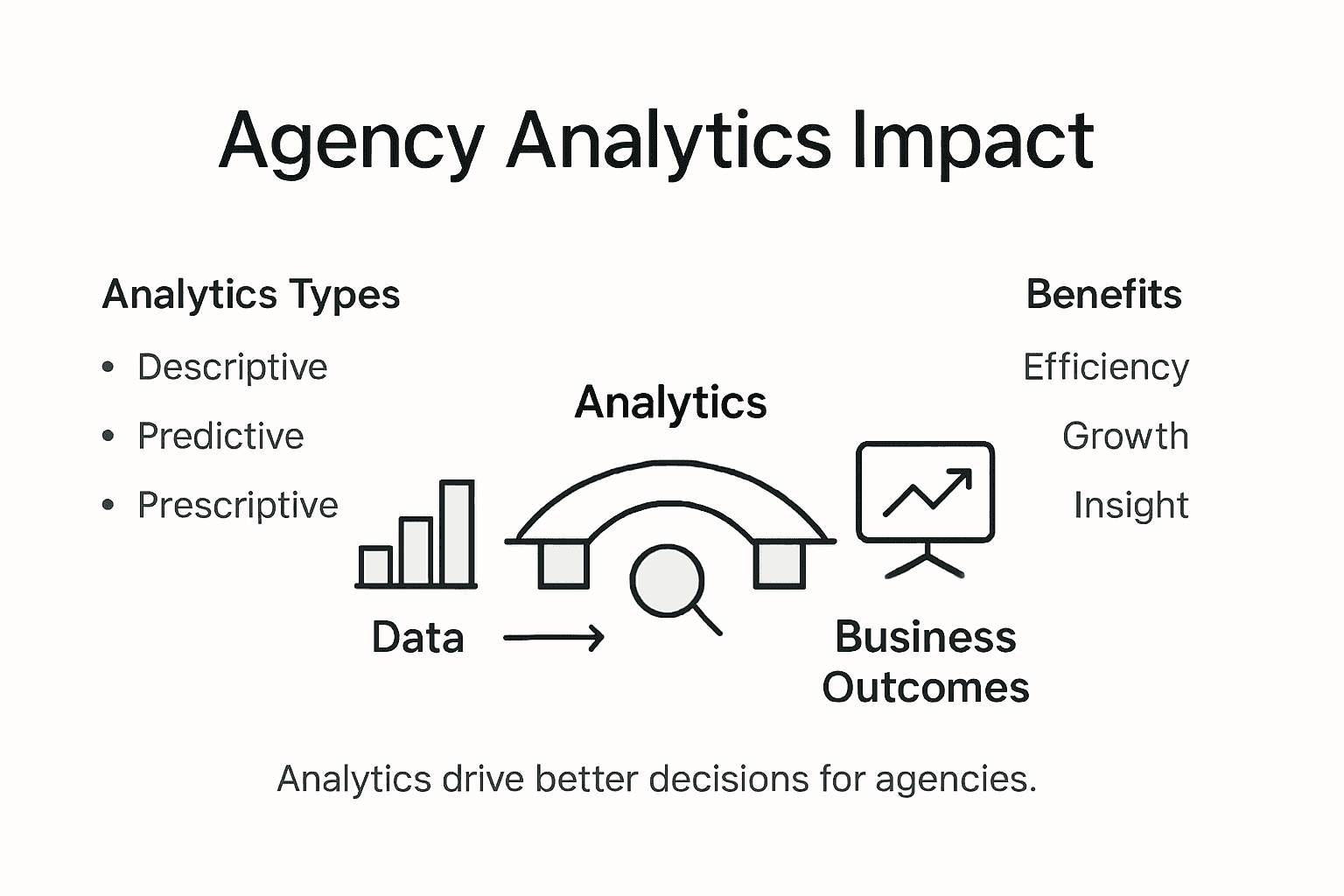
- Descriptive Analytics: Summarizing historical data and providing snapshot insights
- Diagnostic Analytics: Investigating why specific patterns or events occurred
- Predictive Analytics: Forecasting potential future trends and outcomes
- Prescriptive Analytics: Recommending specific actions based on complex data modeling
Canada’s comprehensive data strategy emphasizes the importance of integrated data systems that support advanced analytical capabilities. These platforms enable agencies to transcend traditional reporting mechanisms, transforming data into a strategic asset that drives organizational innovation and efficiency.

Modern analytics tools increasingly incorporate artificial intelligence and machine learning algorithms, allowing for more nuanced and adaptive data interpretation. By leveraging these advanced technologies, agencies can develop more responsive, intelligent systems that can quickly adapt to changing organizational landscapes and emerging challenges.
Here’s a comparison of the four main analytics tool types used by agencies:
| Analytics Type | Primary Focus | Example Business Use | Typical Outcome |
|---|---|---|---|
| Descriptive | Summarizes past data | Monthly performance reporting | Clear historical perspective |
| Diagnostic | Analyzes causes of events | Root cause analysis after issues | Identification of key drivers |
| Predictive | Forecasts future trends | Turnover or demand forecasting | Anticipation of future scenarios |
| Prescriptive | Recommends actions | Automated workflow optimization | Data-driven strategy selection |
Pro tip: Prioritize analytics tools that offer seamless integration, scalable architecture, and robust data visualization capabilities to maximize your agency’s analytical potential.
How Analytics Drive Efficiency and Growth
Analytics have transformed from passive reporting mechanisms into powerful strategic engines that propel organizational performance and unlock unprecedented growth potential. By converting raw data into actionable insights, agencies can systematically optimize their operations, allocate resources more intelligently, and create more responsive strategic frameworks.
The Canadian federal government’s strategic approach illustrates how analytics serve as a critical mechanism for driving organizational efficiency. This approach enables agencies to achieve multiple strategic objectives simultaneously:
- Resource Optimization: Identifying inefficiencies and reallocating assets strategically
- Performance Measurement: Establishing clear, quantifiable performance indicators
- Predictive Planning: Anticipating future challenges and opportunities
- Continuous Improvement: Creating adaptive systems that evolve with organizational needs
By integrating advanced analytical techniques, agencies can transform complex data streams into precise operational intelligence. These sophisticated approaches allow leadership to make data-driven decisions that minimize risks, maximize resource utilization, and create more agile organizational structures. The ability to rapidly interpret large datasets enables agencies to respond more dynamically to emerging challenges and changing environmental conditions.
Modern analytics platforms leverage artificial intelligence and machine learning to provide increasingly nuanced insights. These technologies can detect subtle patterns, predict potential outcomes, and recommend strategic interventions that would be impossible through traditional analytical methods. This represents a fundamental shift from reactive management to proactive strategic planning.
Pro tip: Develop a comprehensive data literacy program within your organization to ensure that team members at all levels can effectively interpret and leverage analytical insights.
Practical Use Cases for SaaS Agencies
Software-as-a-Service (SaaS) agencies are increasingly leveraging advanced analytics to transform their operational capabilities, delivering unprecedented value through data-driven insights and strategic technological implementations. These innovative approaches enable organizations to optimize performance, enhance customer experiences, and create more adaptive business models.
The U.S. Office of Personnel Management’s IT Strategic Plan highlights several compelling use cases that demonstrate the transformative power of analytics across different organizational domains:
- Workforce Optimization: Using predictive analytics to identify skill gaps and talent development opportunities
- Cloud Migration Strategies: Analyzing infrastructure performance and cost-efficiency metrics
- Customer Experience Enhancement: Tracking user interaction data to improve service design
- Operational Modernization: Implementing AI-driven decision-making frameworks
The Federal Data Strategy further emphasizes how SaaS agencies can create unified data platforms that integrate complex information streams. These platforms enable organizations to develop more intelligent, responsive systems that can quickly adapt to changing business requirements and technological landscapes.
Advanced analytics tools now allow SaaS agencies to move beyond traditional reporting, transforming raw data into strategic intelligence. By implementing machine learning algorithms and sophisticated data visualization techniques, organizations can uncover hidden patterns, predict future trends, and make more informed decisions that drive competitive advantage.
Pro tip: Implement a continuous learning framework that encourages cross-functional teams to share analytical insights and collaborate on data-driven innovation strategies.
Pitfalls of Neglecting Data Insights
Data blindness represents a critical strategic vulnerability for modern organizations, creating systemic risks that can undermine operational effectiveness and competitive positioning. When agencies fail to leverage comprehensive analytical insights, they essentially navigate complex business environments with severely limited visibility, making decisions based on intuition rather than empirical evidence.
The Canadian Data Strategy illuminates the profound consequences of neglecting data insights across multiple organizational dimensions:
- Resource Misallocation: Inefficient spending and missed optimization opportunities
- Reduced Operational Agility: Slower response to emerging market challenges
- Compromised Decision Quality: Increased risk of strategic missteps
- Diminished Competitive Advantage: Falling behind more data-informed competitors
The NCSC-NL Research Agenda further emphasizes that organizations without robust analytical frameworks are particularly vulnerable to unexpected disruptions. The absence of predictive capabilities means agencies remain reactive instead of proactively shaping their operational landscape.
Modern business environments demand sophisticated, data-driven approaches. Organizations that ignore comprehensive analytical strategies risk becoming obsolete, unable to anticipate market shifts, understand customer behaviors, or optimize internal processes. The cost of data neglect extends beyond immediate operational inefficiencies, potentially undermining long-term strategic positioning and organizational resilience.
Pro tip: Conduct a quarterly data maturity assessment to systematically identify and address analytical capability gaps within your organization.
Comparing Analytics Solutions for Agencies
Analytics solutions represent critical technological infrastructure that can dramatically transform organizational capabilities, enabling agencies to convert complex data streams into strategic insights. Selecting the right platform requires a sophisticated understanding of an organization’s unique operational requirements, technological ecosystem, and strategic objectives.
The U.S. Office of Personnel Management’s Data Strategy provides a comprehensive framework for evaluating analytics solutions across multiple critical dimensions:
- Scalability: Ability to grow with organizational needs
- Security Compliance: Robust data protection mechanisms
- Integration Capabilities: Seamless connectivity with existing systems
- User Accessibility: Intuitive interfaces for diverse skill levels
The Canadian federal Data Strategy further emphasizes the importance of comprehensive evaluation criteria, suggesting agencies consider additional nuanced factors beyond technical specifications. These include ethical data handling, alignment with organizational values, and potential for driving meaningful strategic transformation.
Modern analytics solutions can be categorized across a spectrum of complexity, ranging from basic reporting tools to advanced predictive platforms with artificial intelligence capabilities. Agencies must carefully assess their current technological maturity, budgetary constraints, and specific analytical requirements to identify the most appropriate solution. The optimal platform should not only address immediate data analysis needs but also provide flexibility for future technological evolution.
Here is a summary of essential criteria for evaluating analytics solutions for agencies:
| Evaluation Criteria | Why It Matters | Example Question to Ask |
|---|---|---|
| Scalability | Prepares for future growth | Will the solution handle higher data volume? |
| Security Compliance | Protects sensitive information | Does it meet government standards? |
| Integration | Ensures smooth system operation | Can it connect with our current tools? |
| Accessibility | Supports wide organizational use | Is the interface user-friendly? |
| Ethical Alignment | Upholds organizational values | Does it ensure responsible data use? |
Pro tip: Conduct a comprehensive pilot testing phase with multiple analytics solutions, involving stakeholders from different organizational levels to ensure holistic evaluation and user adoption.
Unlock Growth by Harnessing Custom Analytics Solutions
Many agencies struggle with transforming raw data into actionable insights that truly drive growth and operational efficiency. This article highlights how analytics tools—from descriptive to prescriptive—empower agencies to optimize resources, anticipate challenges, and foster continuous improvement. If you are facing challenges like resource misallocation, lack of predictive planning, or data overwhelm, you are not alone. Agencies need tailored analytics systems that reflect how their teams actually work and deliver real business intelligence.
At Rule27 Design, we specialize in building powerful, custom administrative systems and digital infrastructure designed to bridge the gap between generic off-the-shelf tools and expensive enterprise platforms. Our solutions incorporate advanced analytics and AI integration to help you unlock operational efficiency and achieve measurable growth. Whether you want to enhance your team collaboration, optimize your content visibility, or build scalable internal tools that evolve with your agency, we design systems that transform data into clear, actionable intelligence.
Explore how tailored analytics can align with your agency’s growth goals.
Stop settling for one-size-fits-all analytics that do not serve your unique needs. Partner with us at Rule27 Design to build a data-driven foundation that scales sustainably, improves workflow efficiency by up to 40 percent, and positions your agency for long-term success. Visit Rule27 Design now to start creating your custom analytics-driven system today.
Frequently Asked Questions
What is the role of analytics in agency growth?
Analytics plays a crucial role in agency growth by transforming raw data into actionable insights that help organizations optimize operations, allocate resources intelligently, and adapt to changing market conditions. This data-driven approach enables agencies to make informed decisions that enhance their performance and competitiveness.
How can agencies benefit from implementing predictive analytics?
Agencies can benefit from predictive analytics by forecasting future trends and outcomes based on historical data. This helps them anticipate challenges, identify opportunities, and create strategic plans that are responsive to emerging developments in their operational environment.
What are the key types of analytics tools used by agencies?
The key types of analytics tools used by agencies include descriptive analytics, which summarizes historical data; diagnostic analytics, which identifies causes of events; predictive analytics, which forecasts future trends; and prescriptive analytics, which recommends actions based on complex analysis.
Why is it important for agencies to address data blindness?
Addressing data blindness is important for agencies as failing to leverage analytical insights can lead to resource misallocation, reduced agility, compromised decision making, and diminished competitive advantage. By utilizing data effectively, agencies can enhance their operational effectiveness and maintain resilience in a dynamic environment.

About the Author
Josh AndersonCo-Founder & CEO at Rule27 Design
Operations leader and full-stack developer with 15 years of experience disrupting traditional business models. I don't just strategize, I build. From architecting operational transformations to coding the platforms that enable them, I deliver end-to-end solutions that drive real impact. My rare combination of technical expertise and strategic vision allows me to identify inefficiencies, design streamlined processes, and personally develop the technology that brings innovation to life.
View Profile

