

Discover ai-driven content management for growth-stage companies. Follow step-by-step actions to implement, refine, and optimize your content workflow efficiently.
Over 90 percent of organizations struggle to keep their content relevant and searchable in the age of artificial intelligence. As companies face growing digital demands, well-structured content management is more vital than ever. By following practical steps that address everything from data sourcing to automation and performance monitoring, you can transform your workflow and ensure your content stands out both for humans and machines.
Step 1: Assess Content Needs and Data Sources
In this crucial phase of AI driven content management, you will map out the precise landscape of your content requirements and identify the most strategic data sources available. Our goal is to create a comprehensive blueprint that will guide your entire content strategy, ensuring you leverage the right information with maximum efficiency.
According to research from arxiv.org, regaining “information autonomy” in the AI era demands a meticulous approach to assessing content needs. Start by conducting a thorough content audit of your existing materials. Catalog every piece of content you currently have tracking key metrics like topic, format, performance, and potential for repurposing. Create a spreadsheet that allows you to visualize gaps and opportunities in your current content ecosystem.
Next, evaluate your potential data sources with surgical precision. Look beyond traditional repositories and consider emerging channels like academic research databases, specialized industry reports, expert interviews, and niche community forums. As the study on arxiv.org highlights, integrating diverse data inputs is critical for building robust content management systems. Pay special attention to sources that offer unique insights not readily available through mainstream channels.

Pro Tip: When assessing data sources, prioritize quality over quantity. One deeply researched, authoritative source is worth ten superficial references.
Your next step will be to design a strategic framework for content sourcing and validation that ensures ongoing relevance and accuracy. By establishing clear criteria for data selection now, you will create a scalable process that adapts with your growing content needs.
Step 2: Integrate AI Tools With Your CMS
In this critical step, you will transform your content management system from a static repository into a dynamic intelligent platform that adapts and evolves with your organizational needs. The goal is to seamlessly embed AI capabilities that enhance productivity efficiency and content quality.
According to insights from CMS.gov, integrating AI tools requires a strategic approach focused on data-driven decision-making. Begin by conducting a comprehensive assessment of your current CMS capabilities and identifying specific areas where AI can provide meaningful improvements. Look for repetitive tasks content categorization metadata generation and predictive analytics as prime candidates for AI enhancement.
As recommended by CoreMedia, start with modular AI integrations that can be incrementally implemented. Select AI tools that offer robust API connections and demonstrate compatibility with your existing technology stack. Focus on solutions that provide clear performance metrics and can be easily scaled as your content requirements grow. Prioritize AI tools that offer natural language processing capabilities content recommendation engines and automated tagging systems to streamline your workflow.
Pro Tip: Always maintain a human oversight layer when implementing AI tools. Automated systems are powerful but still require human judgment and creative input.
Your next move involves setting up pilot programs to test these AI integrations systematically. By approaching AI implementation as an iterative process you will build a more intelligent responsive content management ecosystem that adapts to your evolving business landscape.
Step 3: Automate Content Workflows and Tagging
In this pivotal phase of AI-driven content management, you will transform your editorial processes by implementing intelligent automation that dramatically reduces manual effort and accelerates content production. Your mission is to create a seamless workflow where repetitive tasks are handled automatically while maintaining high quality and strategic oversight.
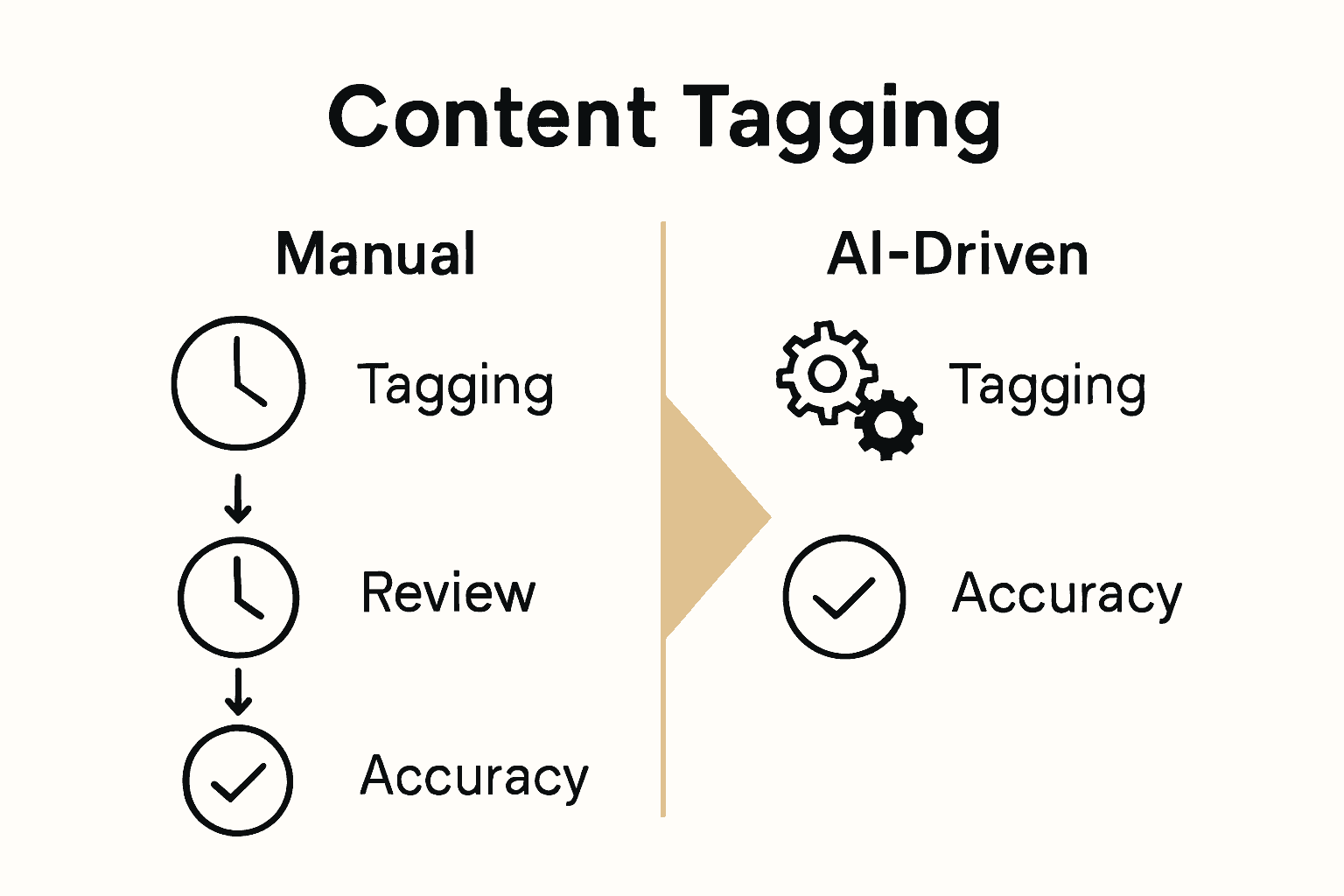
According to research from BigRock, automating content workflows can significantly reduce editorial friction and speed up time-to-publish. Begin by mapping out your current content creation process identifying every step from ideation to publication. Look for repetitive tasks such as metadata generation keyword tagging and initial content categorization that can be streamlined through AI-powered tools.
Implement an intelligent tagging system that uses natural language processing to automatically categorize and tag content based on its semantic meaning and context. Configure your AI tools to learn from your existing content taxonomy creating increasingly sophisticated and accurate tag recommendations over time. Set up rules that allow human editors to review and refine AI generated tags ensuring the final output meets your specific quality standards and editorial guidelines.
Pro Tip: Always maintain a human validation layer in your automated workflow. AI excels at pattern recognition but still requires human insight to capture nuanced context.
Your next strategic move involves continuously monitoring and fine-tuning these automated workflows. By treating automation as an iterative process you will progressively build a more intelligent content management ecosystem that adapts to your organizations unique needs.
Step 4: Optimize Content for AI Discovery
In this crucial phase of content management, you will transform your digital content into an AI-friendly format that maximizes discoverability and engagement. Your goal is to create intelligent content that not only resonates with human readers but also performs exceptionally well in AI-driven search and recommendation systems.
According to insights from Wikipedia Content Intelligence, optimizing content for AI discovery requires a strategic multilayered approach. Begin by structuring your content with clear semantic hierarchies using descriptive headings schema markup and precise metadata. Focus on creating rich contextual content that demonstrates deep topical expertise. This means developing comprehensive explanations that cover multiple facets of a subject while maintaining logical interconnections between different content elements.
As highlighted by Semantic Scholar, AI systems prioritize content that demonstrates clear semantic relationships and depth of knowledge. Implement advanced techniques such as entity recognition where you explicitly link your content to authoritative sources and provide clear contextual signals. Use natural language that is precise yet conversational ensuring your content can be easily parsed and understood by AI algorithms. Incorporate structured data formats like JSON LD to provide additional context and make your content more machine readable.
Pro Tip: Think of AI optimization as creating a detailed roadmap for machine comprehension. The more clearly you can articulate your content’s purpose and context the better it will perform in AI driven discovery platforms.
Your next strategic move involves continuously monitoring your content performance through AI analytics tools. By treating content optimization as an ongoing iterative process you will progressively enhance your digital presence and improve your visibility across emerging AI search and recommendation platforms.
Step 5: Monitor Performance and Fine-Tune Systems
In this critical final phase of AI-driven content management, you will establish a comprehensive performance monitoring and optimization strategy that transforms your content ecosystem into a continuously improving intelligent platform. Your objective is to create a dynamic system that learns adapts and evolves based on real-world performance data.
Begin by implementing a robust analytics framework that captures granular insights across multiple dimensions of content performance. Set up tracking mechanisms that monitor key metrics such as engagement rates semantic relevance AI discoverability content conversion rates and user interaction patterns. Develop a comprehensive dashboard that provides real-time visualization of your content performance allowing you to quickly identify strengths potential improvements and emerging trends.
Establish a systematic approach to system fine-tuning by creating iterative feedback loops. Configure your AI tools to continuously learn from performance data automatically adjusting tagging algorithms content recommendations and workflow processes. Regularly conduct manual reviews to validate AI generated insights and make strategic adjustments. Create a recurring optimization schedule where you comprehensively assess system performance conduct detailed analysis and implement targeted improvements.
Pro Tip: Treat your AI content management system like a living organism. Regular monitoring small incremental improvements and a commitment to continuous learning are the keys to long term success.
Your journey doesnt end here. Embrace a mindset of perpetual optimization where each iteration brings you closer to a perfectly tuned intelligent content management ecosystem that delivers exceptional value for your organization.
Unlock the Power of AI-Driven Content Management with Custom Solutions
Managing content at scale can feel overwhelming when off-the-shelf tools do not fit your team’s unique workflow. This article highlights the challenges of automating tagging, optimizing content for AI discovery, and fine-tuning systems that adapt over time. If you’re seeking a seamless way to transform your content management into an intelligent platform that improves efficiency and visibility across AI search tools you need a solution designed around your specific needs.

Explore how Rule27 Design creates tailored content management systems and internal tools that directly address these hurdles. With expertise in AI integrations, workflow automation, and content optimization, our solutions help you regain control over your content strategy while boosting performance in ChatGPT and other AI-driven platforms. Don’t settle for generic software when your business demands a scalable, smart system. Visit Rule27 Design now and start building the content infrastructure your growth calls for.
Frequently Asked Questions
How do I assess my content needs for AI-driven content management?
To assess your content needs, conduct a thorough content audit of your existing materials, tracking key metrics like topic, format, and performance. Create a spreadsheet to visualize gaps and opportunities, helping you prioritize what content to focus on first.
What are the best data sources to integrate for AI content management?
The best data sources include academic research databases, specialized industry reports, expert interviews, and niche community forums. Identify unique sources that offer insights not available through mainstream channels to enrich your content strategy.
How can I integrate AI tools into my content management system?
Start by evaluating your current content management system to identify repetitive tasks that could benefit from AI, such as metadata generation and predictive analytics. Choose modular AI tools with robust API connections that enhance your existing workflows without overwhelming your team.
What steps should I take to automate content workflows effectively?
Map out your current content creation process, focusing on repetitive tasks that can be automated, like keyword tagging. Implement an intelligent tagging system that uses natural language processing to ensure your editorial quality remains high while speeding up production.
How do I optimize my content for AI discovery?
To optimize your content, structure it using clear semantic hierarchies, descriptive headings, and precise metadata. Use techniques like entity recognition to create explicit links to authoritative sources, which helps improve AI discoverability and user engagement.
How can I monitor and fine-tune my AI-driven content management systems?
Establish a performance monitoring framework that captures key metrics, such as engagement rates and user interaction patterns. Regularly conduct manual reviews to validate AI-generated insights, and implement targeted improvements based on performance data to enhance your system continuously.

About the Author
Josh AndersonCo-Founder & CEO at Rule27 Design
Operations leader and full-stack developer with 15 years of experience disrupting traditional business models. I don't just strategize, I build. From architecting operational transformations to coding the platforms that enable them, I deliver end-to-end solutions that drive real impact. My rare combination of technical expertise and strategic vision allows me to identify inefficiencies, design streamlined processes, and personally develop the technology that brings innovation to life.
View Profile

