

Discover why scalable digital tools are essential for growth-stage success. Streamline operations and maximize efficiency to drive your business forward.
TL;DR:
- Most growth companies face a coordination problem rather than a tools issue, as adding systems leads to inefficiencies.
- Scalable digital tools ensure workflows and governance remain stable amid increasing complexity, reducing hidden costs and errors.
- Building integrated, governance-driven infrastructure early enables faster scaling, fewer rebuilds, and improved operational efficiency.
Most growth-stage companies don’t have a tools problem. They have a coordination problem. You add a new project management app, a reporting dashboard, a document tool, and suddenly your team is spending more time moving data between systems than actually using it. That’s why scalable digital tools matter. Not because they do more, but because they hold together as your operation gets more complex. The real cost of fragmented software isn’t the subscription fees. It’s the invisible tax your team pays every single day just to keep things in sync.
Key takeaways
| Point | Details |
|---|---|
| Scalability goes beyond user counts | Real scalability means your workflows, permissions, and reporting stay stable as complexity grows. |
| Tool sprawl creates hidden costs | Disconnected tools compound translation and reconciliation overhead, slowing cycles and increasing errors. |
| Governance enables faster scaling | Automated security, compliance, and cost controls reduce friction accumulation across all systems. |
| Consolidation delivers measurable ROI | Integrated platforms can cut process time significantly and pay back investment in under six months. |
| Start with bottlenecks, not features | Assess workflow friction points first, then select tools with upgrade paths and solid integration fundamentals. |
Why scalable digital tools are a different category
Most people think scalability means “works fine when you add more users.” That’s a start, but it misses the real challenge by a mile.
True digital scalability means your tools survive added complexity. More teams. More approval layers. More reporting requirements. More integrations. When a company doubles headcount, the number of coordination touchpoints doesn’t double. It grows geometrically. A 10-person team might have 45 coordination pairs. A 50-person team has over 1,200.
Fragmented point tools make this exponentially worse. Each tool defines data and workflows differently, which means every handoff between systems requires translation. Your team becomes the integration layer. That’s not a minor inconvenience. It’s a structural problem that compounds month over month.
Here’s what actually matters when evaluating digital scalability for your organization:
- Integration coherence. Can this tool talk to your other systems without custom workarounds that break every time there’s an update?
- Governance fundamentals. Does it support role-based permissions, audit trails, and approval routing that hold up under compliance requirements?
- Workflow stability. When you add a new process or team, does the tool accommodate it or require a rebuild?
- Reporting across contexts. Can you surface data from this tool in a unified dashboard, or are you exporting CSVs every Monday morning?
The importance of digital scalability comes down to one thing: avoiding the rebuild tax. Companies that choose tools without these fundamentals often find themselves migrating everything 18 months later, at significant cost and disruption. Governance is the main scalability problem for most growing organizations, not raw tool performance.
The real benefits of scalable tools in practice
The advantages of scalable technology show up in places most leaders don’t look until something breaks. Let’s be direct about what the data actually shows.
| Metric | Before consolidation | After consolidation |
|---|---|---|
| Contract cycle time | Baseline | 72% reduction |
| Signature errors | Baseline | 85% fewer errors |
| Payback period | N/A | 5.4 months |
| Annual net savings | $0 | $128,400 |
Those numbers come from a real consolidation of scanning and e-signature tools. And they’re not unusual. The pattern repeats across industries: when you replace fragmented point solutions with integrated platforms, cycle times drop and error rates fall.
The operational efficiency story gets even clearer with manufacturing. AGCO saw a 35% reduction in process execution time after deploying an AI-powered connected worker platform through API integration. Operator learning curves dropped by 50%. Those gains came not from new features but from coherence. Workers stopped switching contexts. Data flowed where it needed to go.
“A scalable digital workforce can’t be built from disconnected tools. Strategic governance layers that coordinate staff and automation are essential to avoid siloed processes.” — Artera
Here’s what benefits of scalable tools look like day to day. Onboarding a new team member takes two hours instead of two days because your permissions model is already structured. Generating a compliance report takes minutes because your audit trail is automatic. Launching a new workflow doesn’t require IT tickets because your platform was designed to accommodate growth.
These aren’t hypothetical gains. They’re the consistent result of treating your digital infrastructure as a system rather than a collection of individual subscriptions.

Challenges when selecting scalable digital tools
Picking the wrong tool at this stage is expensive. Not because of the purchase price, but because of the migration costs and opportunity costs you’ll pay later. Here’s what to watch for.
Enterprise tools aren’t automatically better. A tool built for a 5,000-person company comes with admin overhead that can slow a 50-person team to a crawl. You’re paying for features you won’t use while fighting configuration complexity that requires dedicated specialists.
Smaller tools aren’t safer. A lightweight point solution that works perfectly today often fails under increased complexity. The thing that made it easy to adopt, its simplicity, becomes the thing that limits you.
The right evaluation criteria for scalable IT tools focuses on fundamentals:
- Identity and permissions. Can you define granular roles and adjust them without a developer?
- API maturity. Does the tool offer stable, documented APIs or fragile one-off connections that break on updates?
- Upgrade path. Is there a clear route from your current tier to where you’ll be in two years, without a full migration?
- Reporting depth. Can you build cross-functional reports without exporting data manually?
Reusable governed API building blocks are what separate mature integration patterns from the fragile one-off connections that create sprawl. Deloitte’s guidance on API lifecycle management is clear: standardization at the integration layer is what keeps automation reliable as you add complexity.
Pro Tip: Before signing any contract, run your three most complex real workflows through a tool pilot. Not demo workflows. Your actual workflows with your actual edge cases. Most tools look great on a product tour and reveal their limits in week two of real use.
How governance and integration accelerate scaling
Governance sounds like a compliance checkbox. It’s actually the engine that makes scaling feel effortless rather than painful.
Here’s how to think about it practically. When you add a new automation, a new team, or a new workflow, there are two ways that can go. Either each addition requires manual configuration, monitoring, and approval, or your governance layer handles it automatically according to policies you’ve already set. The first approach creates linear scaling at best. The second creates compounding returns.
MuleSoft Omni Gateway demonstrates what a mature governance platform looks like: unified control over APIs, autonomous agents, and workflows, with automatic enforcement of security, cost, and compliance policies. That means you can add automation faster because the guardrails are already in place.
A practical governance layer for a growth-stage company looks like this:
- Role-based access control that updates automatically when someone joins, changes roles, or leaves.
- Audit trails that log every action across your digital workflows without manual effort.
- Policy enforcement that flags or blocks actions outside approved parameters before they cause problems.
- Unified reporting that shows activity across all integrated tools in one place.
Workflow state and identity governance are the real units of scalability. Not user counts. When your control layer for permissions, approval routing, and auditability stays stable as you grow, you can add tools and teams without rebuilding your entire operational model.
Pro Tip: Implement governance infrastructure before you feel like you need it. By the time tool sprawl and permission chaos are obvious problems, you’re already paying the price in errors, compliance risk, and team frustration.
Applying scalable tools strategies in your organization
Getting this right is a process, not a single decision. Here’s a practical framework.
Start by auditing your current coordination overhead. Where does data get copied manually? Where do approvals stall? Where does your team switch between four tools to complete one task? Those friction points are your roadmap. Centralized knowledge and automated processes deliver cost savings and speed gains even before you add AI capabilities, so getting the infrastructure right first is the move.
When evaluating new tools, weight governance fundamentals and integration maturity over feature lists. A tool with 80% of the features but a stable API and solid permissions model will serve you better than the feature-rich option that requires manual workarounds to connect to your stack.
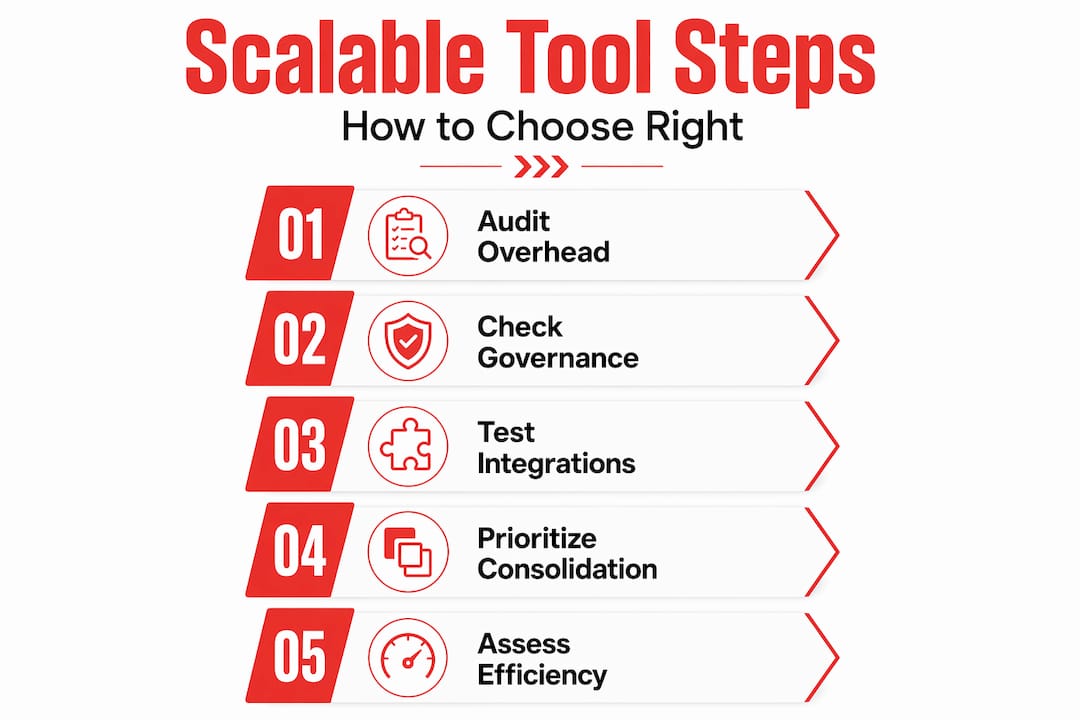
Consolidate where you can. Tool sprawl kills scaling by compounding the translation and reconciliation overhead your team carries invisibly. Fewer, better-integrated tools consistently outperform larger collections of specialized ones. You can explore workflow automation tips built specifically for this transition.
Think about how scalable tools improve efficiency at the infrastructure level, not just the task level. When your digital systems are designed for growth, each new workflow you add builds on a stable foundation instead of creating new coordination problems.
My take on the tool sprawl trap
I’ve worked with enough growth-stage companies to recognize the pattern immediately. The team is smart, the tools are reasonable, and somehow everything still feels harder than it should.
What I’ve found is that most leaders focus on what tools do and miss what tools cost in coordination overhead. You buy a project management tool, a reporting tool, a document tool, and an automation platform. Each one is genuinely useful. But now you have four data models, four permission systems, and four sets of notifications. Your team becomes the integration layer by default.
The shift I’ve seen work is moving from a tools mindset to an infrastructure mindset. You’re not picking software. You’re designing a system. And systems have to be coherent. The companies I’ve watched scale without losing operational control all share one thing: they built governance into their infrastructure early, before they needed it.
The ones who struggle usually say some version of “we’ll deal with permissions and integrations later.” Later always comes at the worst possible moment, usually right when you’re trying to close a big deal or onboard a new client.
What actually works: fewer tools, deeper integration, and governance that runs automatically. The compounding value of consistent workflows shows up every single week in faster cycles, fewer errors, and a team that actually knows where things are.
— Josh
Ready to build infrastructure that actually scales?
If you’ve been adding tools without seeing the efficiency gains you expected, the issue probably isn’t the tools themselves. It’s the architecture underneath them. Rule27design works with growth-stage companies who’ve outgrown basic software but aren’t ready for bloated enterprise solutions. We design and build custom admin systems, internal tools, and digital infrastructure that fits how your team actually works, with governance and integration built in from day one.
Our clients typically see 40% improvement in operational efficiency after implementation. Not because we picked better tools. Because we built coherent systems. If you’re ready to move from tool collection to operational infrastructure, the Rule27design Innovation Lab is where that work starts. You can also read more about custom workflow benefits for companies at your stage to get a clearer picture of what that looks like in practice. For additional context on scalable AI-driven growth, there are solid frameworks worth exploring before you commit to a direction.
FAQ
Why do scalable digital tools matter for growth-stage companies?
Scalable digital tools matter because growth adds coordination complexity faster than it adds headcount. Without tools that handle permissions, integrations, and reporting at scale, teams absorb that complexity manually, which slows cycles and increases errors.
What’s the difference between a scalable tool and a regular tool?
A scalable tool maintains stable governance, integrations, and workflows as your team and processes grow. A regular tool might handle more users but breaks down when you add complexity like new approval layers, cross-team reporting, or automation.
How do scalable tools improve efficiency in practice?
Efficiency gains come from reducing context-switching and coordination overhead. AGCO’s connected worker platform cut process execution time by 35% and reduced operator learning curves by 50% through better integration and workflow coherence.
When should a growth-stage company prioritize governance in their digital stack?
Governance should be built in before you feel the pain of not having it. Once permission chaos and tool sprawl are obvious problems, you’re already paying for them in errors, compliance risk, and team friction.
What’s the biggest mistake companies make when choosing scalable digital solutions?
The biggest mistake is evaluating tools on features rather than integration maturity and governance fundamentals. A tool with a stable API and solid permissions model outperforms a feature-heavy option that requires manual workarounds to connect to your existing stack.

About the Author
Josh AndersonCo-Founder & CEO at Rule27 Design
Operations leader and full-stack developer with 15 years of experience disrupting traditional business models. I don't just strategize, I build. From architecting operational transformations to coding the platforms that enable them, I deliver end-to-end solutions that drive real impact. My rare combination of technical expertise and strategic vision allows me to identify inefficiencies, design streamlined processes, and personally develop the technology that brings innovation to life.
View Profile

