

Why leverage business analytics? Learn key benefits, SaaS-specific use cases, data-driven decisions, cost risks, and common mistakes for U.S. operations managers.
Over 60 percent of American SaaS companies admit they struggle to turn raw data into timely business decisions. This challenge hits close to home for operations managers tasked with building more efficient, insight-driven teams without the complexity of large-scale enterprise tools. Unpacking the principles of business analytics reveals practical, scalable methods that help you transform everyday data into powerful strategies for growth and operational clarity.
Key Takeaways
| Point | Details |
|---|---|
| Business Analytics Framework | Effective business analytics combines descriptive, diagnostic, predictive, and prescriptive analytics to turn data into strategic insights. |
| Data Integration Essentials | Successful analytics relies on rigorous data collection and integration from multiple sources, ensuring high data quality and compliance with governance protocols. |
| Cross-Functional Teams | Building a cross-functional analytics team enhances the value of analytics initiatives by integrating diverse expertise and perspectives. |
| Risks Management | Organizations must proactively address risks such as data privacy and model inaccuracies through robust governance and validation strategies. |
Defining Business Analytics and Its Core Principles
Business analytics represents a sophisticated approach to transforming raw data into meaningful strategic insights for organizational decision making. At its core, this discipline leverages advanced statistical techniques and computational methods to extract valuable intelligence from complex datasets.
Traditionally, business analytics encompasses three primary analytical approaches: descriptive, predictive, and prescriptive analytics. Descriptive analytics summarize historical performance data, helping organizations understand what has already occurred. Predictive analytics uses statistical modeling to forecast potential future trends and outcomes. Prescriptive analytics goes a step further by recommending specific actions based on computational analysis.
Key principles of effective business analytics include:
- Rigorous data collection from multiple organizational sources
- Maintaining high data quality and integrity
- Utilizing advanced statistical modeling techniques
- Translating complex analytical findings into actionable business strategies
- Continuous refinement of analytical models
The goal of business analytics extends beyond mere number crunching. It involves developing comprehensive insights that drive strategic planning and operational improvements across multiple business domains, including marketing, finance, supply chain management, and customer experience.
Pro tip: Invest in building a cross-functional analytics team that combines technical expertise with strong business acumen to maximize the value of your data analytics initiatives.
Major Types of Business Analytics for SaaS
In the competitive SaaS ecosystem, understanding the nuanced landscape of business analytics is crucial for driving strategic growth and operational excellence. Business analytics for SaaS companies is typically structured around four primary analytical approaches that progressively transform raw data into actionable business intelligence.
Descriptive Analytics serves as the foundational layer, focusing on summarizing historical performance data. For SaaS organizations, this means generating comprehensive reports about past customer behaviors, subscription trends, and revenue metrics. These insights provide a clear snapshot of current business performance, helping leadership understand existing patterns and baseline achievements.

Diagnostic Analytics delves deeper by investigating the underlying reasons behind observed trends. In a SaaS context, this involves exploring why certain customer segments churn, understanding which product features drive engagement, or identifying the root causes of revenue fluctuations. By employing advanced statistical techniques and machine learning algorithms, diagnostic analytics helps uncover complex correlations that might not be immediately apparent.
The more advanced analytical approaches include Predictive Analytics, which uses statistical modeling to forecast potential future scenarios, and Prescriptive Analytics, which recommends specific actions to optimize outcomes. These techniques enable SaaS companies to anticipate customer needs, predict potential churn, and proactively design strategies that enhance user retention and revenue growth.
Key Applications of Business Analytics in SaaS:
- Customer segmentation and personalization
- Churn prediction and prevention
- Pricing strategy optimization
- Product feature development
- Revenue forecasting
- User experience enhancement
Pro tip: Implement a robust data governance framework that ensures data quality, accessibility, and security across all your analytical processes to maximize the effectiveness of your business analytics initiatives.
Here’s a comparison of the four major types of business analytics used in SaaS environments:
| Analytics Type | Core Function | Strategic Value | Typical SaaS Example |
|---|---|---|---|
| Descriptive | Summarizes past data | Reveals business trends | Monthly user activity reports |
| Diagnostic | Explains root causes | Identifies key improvement areas | Analysis of churned users |
| Predictive | Forecasts future outcomes | Enables proactive planning | Churn risk predictions |
| Prescriptive | Recommends actions | Optimizes decision making | Automated pricing suggestions |
Business Analytics in Team Operations and Growth
Business analytics has transformed from a technical function to a strategic cornerstone for team operations and organizational growth. Interdisciplinary approaches combining operations management, statistics, and information systems now enable teams to leverage data-driven insights that optimize workflows and drive strategic decision making.
At the core of effective team operations, business analytics provides a comprehensive framework for understanding and improving organizational performance. By bridging data science with business strategy, analytics initiatives empower teams to translate complex data into actionable intelligence. This approach allows leaders to make informed decisions about resource allocation, process optimization, and strategic planning.
Key Benefits of Business Analytics in Team Operations:
- Enhanced operational efficiency
- More accurate performance forecasting
- Improved resource allocation
- Deeper understanding of team dynamics
- Proactive problem identification
- Data-supported strategic planning
Modern business analytics goes beyond traditional reporting by creating a holistic view of team performance. Advanced analytical techniques enable organizations to predict potential bottlenecks, identify skill gaps, and design targeted interventions that support continuous improvement and sustainable growth.
Pro tip: Develop a cross-functional analytics team that includes members from operations, finance, and technology to ensure comprehensive and balanced insights across your organization.
Essential Data Requirements and Integration Steps
Data integration forms the critical backbone of successful business analytics, transforming raw information into strategic insights. Effective analytics depends on obtaining relevant, high-quality data from multiple disparate sources, requiring a systematic approach to collection, cleaning, and consolidation.
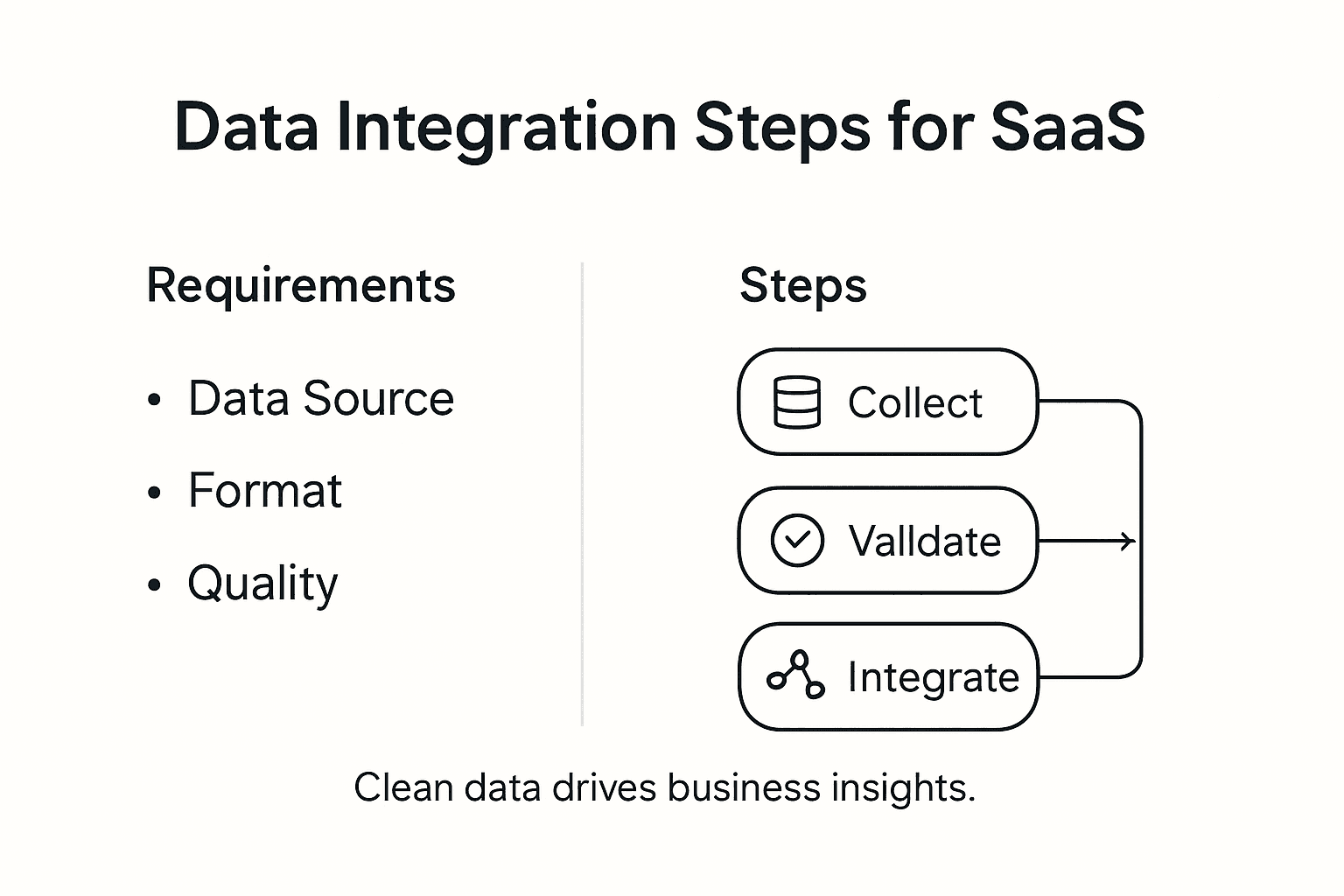
The data integration process involves several strategic steps that ensure comprehensive and reliable analytical foundations. Organizations must focus on collecting data from diverse sources such as databases, ERP systems, CRM platforms, and external datasets, carefully validating and harmonizing information to create a cohesive dataset.
Key Data Integration Requirements:
- Comprehensive data collection across multiple platforms
- Rigorous data cleaning and error correction
- Consistent data formatting and standardization
- Establishing clear data governance protocols
- Ensuring data privacy and security compliance
- Creating scalable data infrastructure
Successful data integration requires more than technical prowess. It demands a strategic approach that aligns data collection with specific business objectives, enabling organizations to transform complex information into actionable insights that drive meaningful decision making and sustainable growth.
Pro tip: Implement automated data validation tools and establish a centralized data governance committee to maintain consistent data quality and integrity across your organization.
Risks, Costs, and Mistakes to Avoid
Business analytics presents complex challenges that can derail organizational efforts if not carefully managed. Developing analytics capabilities without clear alignment to specific business decisions represents a critical strategic pitfall, potentially resulting in substantial wasted resources and misguided strategic planning.
Primary Risks in Business Analytics:
- Data privacy and security vulnerabilities
- Inaccurate predictive modeling
- High implementation costs
- Complex technological integration challenges
- Talent acquisition and retention difficulties
- Potential misinterpretation of analytical insights
Organizations must implement robust risk analytics frameworks that integrate predictive assessments, continuous monitoring, and comprehensive compliance strategies. This approach helps mitigate potential technological and operational risks while ensuring that analytics initiatives deliver meaningful, actionable insights.
Successful risk management in business analytics requires transparent communication between technical teams and business leadership. By fostering collaborative environments that prioritize clear understanding and ethical data practices, organizations can develop analytics strategies that are both powerful and responsible.
Pro tip: Establish a cross-functional analytics governance committee that includes representatives from technology, legal, and business strategy to proactively identify and mitigate potential risks in your analytics initiatives.
The following table highlights common risks in business analytics and recommended mitigation strategies:
| Risk Area | Potential Impact | Mitigation Strategy |
|---|---|---|
| Data privacy issues | Legal and reputational damage | Implement encryption and strict access |
| Model inaccuracies | Poor business decisions | Regular model validation and updates |
| High implementation costs | Budget overruns | Phase implementation, measure ROI |
| Talent retention challenges | Analytics project delays | Offer ongoing training and incentives |
Unlock SaaS Growth with Tailored Business Analytics Solutions
Many SaaS companies struggle with turning complex data into actionable insights due to fragmented tools or overly complex enterprise software. This article highlights key challenges such as data integration, predictive analytics, and operational efficiency that can stall growth and obscure decision making. If your team faces hurdles in harnessing descriptive, diagnostic, or prescriptive analytics to optimize customer retention and revenue forecasting, you are not alone.
At Rule27 Design, we specialize in bridging those gaps by building custom administrative systems and internal tools designed around your unique business operations. Our expert approach leverages advanced digital infrastructure that scales with your SaaS growth goals. From improving content visibility in AI search to creating actionable business intelligence dashboards, we enable you to translate raw data into strategic decisions.
Experience how tailored systems empower your team to increase operational efficiency by up to 40 percent.
Explore our solutions and discover how clean interfaces combined with robust backend architecture bring your business analytics initiatives to life.
Imagine a system that matches how your team works and drives predictive insights directly into your workflow. Don’t wait to evolve your SaaS analytics capabilities into a competitive advantage.
Ready to turn your SaaS data into growth? Contact Rule27 Design today to build the custom tools that make business analytics work for your team.
Frequently Asked Questions
What are the primary types of business analytics for SaaS growth?
The primary types of business analytics for SaaS growth include descriptive, diagnostic, predictive, and prescriptive analytics. Each type serves a distinct purpose, from summarizing past performance to forecasting future trends and recommending specific actions.
How does business analytics improve operational efficiency in SaaS companies?
Business analytics enhances operational efficiency by providing data-driven insights that streamline processes, optimize resource allocation, and identify areas for improvement, ultimately leading to better strategic decision-making.
What are the key benefits of leveraging business analytics in SaaS?
Key benefits include increased revenue forecasting accuracy, improved customer segmentation and personalization, proactive churn prediction, and optimized pricing strategies, all of which contribute to overall business growth.
What are common risks involved with implementing business analytics in SaaS?
Common risks include data privacy vulnerabilities, inaccurate predictive models, high implementation costs, and challenges in talent acquisition and retention. It’s important for organizations to establish strong governance frameworks to mitigate these risks.

About the Author
Josh AndersonCo-Founder & CEO at Rule27 Design
Operations leader and full-stack developer with 15 years of experience disrupting traditional business models. I don't just strategize, I build. From architecting operational transformations to coding the platforms that enable them, I deliver end-to-end solutions that drive real impact. My rare combination of technical expertise and strategic vision allows me to identify inefficiencies, design streamlined processes, and personally develop the technology that brings innovation to life.
View Profile

