

Learn how to measure sales content performance beyond views and downloads. Use a tiered framework to connect content to revenue, win rates, and pipeline impact.
TL;DR:
- Most SaaS teams focus on activity metrics like views and downloads, which don’t indicate actual revenue impact.
- High-performing teams track content usage in deals and link content to pipeline outcomes using a tiered measurement framework.
- Effective measurement begins with proper taxonomy, CRM integration, and focused KPIs aligned to buyer stages and business results.
Your sales content is getting views. Downloads are up. The team is busy creating. But deals aren’t closing faster, and pipeline feels stuck. Here’s the uncomfortable truth: most SaaS teams measure content by activity, not by revenue impact. Views and downloads are easy to track, but they tell you almost nothing about whether your content is actually moving buyers. The teams consistently hitting quota have figured out a smarter way to measure. This guide walks you through the exact framework, real SaaS examples, and practical steps to connect your content directly to business outcomes.
Key Takeaways
| Point | Details |
|---|---|
| Move beyond activity metrics | Relying on views and downloads alone leads to missed revenue opportunities—tiered measurement is essential. |
| Segment by sales stage | Tracking performance by funnel placement gives actionable insight and drives content relevance. |
| Prioritize revenue attribution | Tie content measurement directly to influenced pipeline and business outcomes for true impact. |
| Integrate CRM and analytics | Combining CRM data with advanced analytics ensures consistent, full-funnel tracking and optimization. |
| Foundation before AI | Establish taxonomy and content governance before layering in AI for scalable content measurement. |
Why activity metrics alone miss the mark
Activity metrics feel satisfying. You can see them in real time, share them in Slack, and put them in a report. Views, downloads, completions, email open rates. They’re everywhere because they’re easy to pull. But they’re leading indicators at best. They tell you content exists and people touched it. They don’t tell you whether it helped a deal move forward.
Here’s what goes wrong. A whitepaper gets 2,000 downloads. The team celebrates. But nobody checks whether those downloaders were in any active deals, or whether any of them became customers. The content looks like a win, but the data is decorative.
“Most teams stop at Level 1 metrics because they’re easy to collect. The real signal lives at Levels 2 and 3, where content connects to behavior and business outcomes.”
Advanced SaaS teams have moved beyond this. They use a tiered measurement framework that organizes content metrics into three levels:
- Level 1 (Adoption/Reaction): Views, completions, downloads. Useful as a baseline, but not sufficient on their own.
- Level 2 (Behavior): How reps actually use content in calls, whether they share it at the right stage, and whether buyers engage with it post-send.
- Level 3 (Business Impact): Win rates, deal velocity, influenced revenue, and quota attainment tied to specific content assets.
Most SaaS content teams spend 90% of their energy on Level 1. The teams outperforming them are tracking Level 2 and Level 3. The shift isn’t just about better analytics. It’s about asking different questions. Not “how many people saw this?” but “did this help us win?”
Understanding SEO ranking metrics matters too, but organic traffic is still a Level 1 signal unless you can tie it to pipeline. The goal is connecting every content touch to a buyer outcome.
The tiered framework for sales content performance
Now that we’ve recognized the limits of activity metrics, let’s walk through the exact measurement framework that helps connect content to real business results.
Here’s how the three levels map to specific metrics:
| Level | Category | What to track |
|---|---|---|
| Level 1 | Adoption | Views, downloads, email opens, completion rate |
| Level 2 | Behavior | Rep usage by stage, buyer engagement time, content shared in deals |
| Level 3 | Business Impact | Win rates, influenced revenue, deal velocity, pipeline coverage |
Attribution is where most teams get stuck. Multi-touch attribution models like U-shaped or linear attribution let you credit multiple content touches across a deal cycle. A buyer might read a blog post, then engage with a case study, then watch a demo video. Each touch contributed. Linear attribution splits credit evenly. U-shaped weights first and last touch more heavily. Neither is perfect, but both beat zero attribution.
To implement tiered tracking, follow these steps:
- Define your content taxonomy. Every asset needs consistent tags: funnel stage, persona, product area, content type. Without this, segmentation is impossible.
- Segment by funnel stage. Top-of-funnel content should be evaluated differently than late-stage battle cards or ROI calculators.
- Integrate CRM workflows with your content platform. You need to know which assets appear in deals that close, not just which assets get views.
- Set baseline benchmarks. Before optimizing, know your current win rate by content type. That’s your starting point.
- Review by cohort. Compare deals where specific content was used versus deals where it wasn’t. That delta is your content’s actual impact.
Pro Tip: Always segment your metrics by sales stage. A piece that performs well at awareness might drag down close rates if reps share it too late. Stage-level segmentation reveals these misfires fast.
For content visibility for SaaS to translate into revenue, the measurement layer has to be connected to your CRM from day one, not retrofitted later.

What leading SaaS teams do differently
With the framework in place, let’s spotlight how high-performing SaaS companies achieve real results by measuring and optimizing their sales content.
The numbers here are hard to ignore. Zapier achieved a 454% ROI with targeted content, Quali saw 121% engagement growth, and B2B SaaS firms using intent-based content quadrupled their MQLs. Atlassian used content scoring to prioritize assets and boost overall content impact across their sales motion.
| Company | Strategy | Result |
|---|---|---|
| Atlassian | Content scoring and asset prioritization | Measurable boost in content impact |
| Zapier | Targeted, audience-specific content | 454% ROI |
| Quali | Engagement-focused content refresh | 121% engagement growth |
| B2B SaaS (intent-based) | Buyer intent signals driving content | 4x MQL increase |
What did these teams actually prioritize? A few clear patterns show up:
- They connected content to pipeline, not just traffic. Every major asset had a corresponding CRM tag so attribution was automatic.
- They scored content assets based on engagement quality, not volume. A case study read for 7 minutes in an active deal is more valuable than 500 passive downloads.
- They refreshed content based on data, not gut feel. Old assets dragging down close rates got updated or retired.
- Analytics drove decisions, not intuition. Content calendars were built around what moved deals, not what was easiest to produce.
The creative execution impact matters, but the real edge comes from knowing which creative is working and why. These teams weren’t just producing more. They were producing smarter, guided by metrics that actually predicted revenue.
For optimizing web pages and content hubs, the same logic applies. Measure what moves buyers, not just what drives traffic.
Advanced analytics, CRM integration, and AI: Turning insight into action
To move from measurement to optimization, let’s examine how analytics, CRM, and AI can supercharge your strategy and what to watch out for.
Full-funnel tracking requires your CRM and analytics platforms to speak the same language. When they don’t, you end up with data silos. Marketing sees traffic. Sales sees pipeline. Nobody sees the connection. Fixing this is less about buying new tools and more about setting up consistent data flows between the systems you already have.
Here’s what high-performing teams get right on integrations:
- CRM tagging at content touchpoints. Every time a piece of content appears in a deal, it gets logged. No exceptions.
- Analytics platforms like Gong or Highspot track content usage on calls and in buyer portals, feeding behavioral data back into your reporting.
- Common mistakes: Launching advanced dashboards before taxonomy is clean, measuring everything instead of the metrics tied to revenue decisions, and treating analytics as a reporting tool instead of a decision-making system.
According to Forrester’s research on revenue enablement, teams should prioritize revenue-tied metrics, integrate CRM and analytics for attribution, refresh content governance continuously, and segment by funnel stage. The research also highlights that AI should come after fundamentals are solid, not before.
Pro Tip: Don’t layer AI tools onto a broken foundation. If your taxonomy is inconsistent and your CRM data is messy, AI will just surface bad insights faster. Get the basics right first, then explore AI marketing ROI tools.
For teams ready to move forward, AI content checklists can accelerate governance reviews and content audits once your baseline metrics are in place. A strong digital marketing analyst role is also critical here. Someone needs to own the connection between content data and revenue decisions. The right CMS features for SaaS and solid CRM efficiency practices round out the infrastructure.
A smarter approach: Why measurement starts with taxonomy and relevance
Here’s the take you won’t hear in most analytics webinars: the biggest measurement problem in SaaS content isn’t the tools. It’s the taxonomy.
Teams chase dashboards, AI insights, and attribution models before they’ve answered a simpler question: does every content asset have a consistent label that maps to a buyer stage, persona, and use case? Without that foundation, even the most sophisticated analytics platform returns noise.
The tiered framework research is clear on this. Leading metrics like adoption rates predict lagging outcomes like revenue, but only when measurement happens at the initiative and function level with clean taxonomy underneath. Leading indicators only lead somewhere useful if they’re organized correctly.
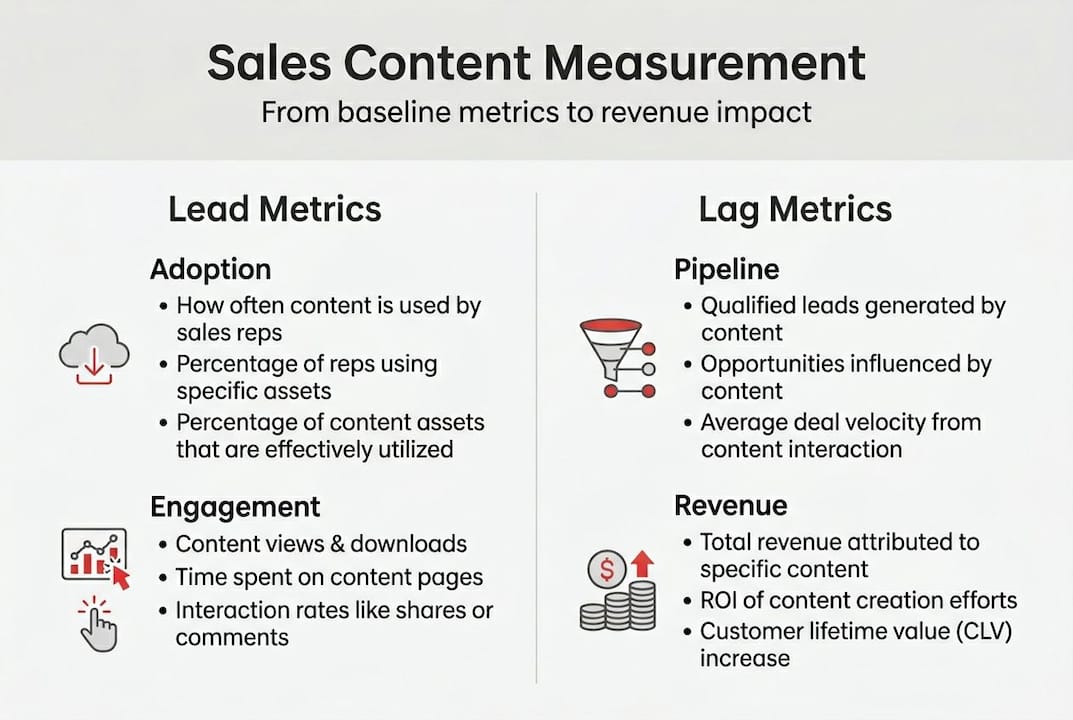
Most teams obsess over advanced analytics before mastering content health. Simple, relevant metrics consistently outperform complex ones when governance is weak. A well-tagged content library with basic CRM integration beats a sophisticated AI dashboard built on messy data every time. Strong SEO ranking factors and content relevance are also foundational, not afterthoughts.
Start with taxonomy. Segment by relevance. Then measure. In that order.
How Rule27 can help you drive sales content impact
Ready to put these strategies into action? Here’s how Rule27 can help you accelerate results.
Rule27 Design builds the kind of systems that make measurement actually work. Custom content management platforms, CRM-integrated analytics, and content operations infrastructure designed around how your sales team works, not around what came with the software.

If your team is ready to move beyond activity metrics and start connecting content to revenue, the Innovation Lab is a great place to start. You’ll see how we approach content performance infrastructure for growth-stage SaaS companies. For a full picture of what we build, the Capabilities overview breaks down exactly how we help teams like yours scale content impact without enterprise-level complexity.
Frequently asked questions
What are the best metrics for measuring sales content performance?
The best metrics include adoption rates, behavioral usage data, and business impact indicators like influenced revenue and win rates. These three tiers together give you a complete picture of content effectiveness.
How do CRM systems help measure sales content effectiveness?
CRM platforms track content engagement across deals and link it to pipeline and revenue, enabling full-funnel attribution. Integrating CRM for attribution is one of the highest-leverage moves a SaaS content team can make.
Can AI improve sales content measurement?
AI can surface content patterns and enrich analytics, but only after taxonomy and governance are solid. AI works post-fundamentals, not as a substitute for clean data and consistent content tagging.
What examples show the ROI of optimized sales content?
Zapier’s 454% ROI, Quali’s 121% engagement growth, and a 4x MQL increase from intent-driven content in B2B SaaS are three of the clearest data points showing what strategic content measurement can unlock.

About the Author
Josh AndersonCo-Founder & CEO at Rule27 Design
Operations leader and full-stack developer with 15 years of experience disrupting traditional business models. I don't just strategize, I build. From architecting operational transformations to coding the platforms that enable them, I deliver end-to-end solutions that drive real impact. My rare combination of technical expertise and strategic vision allows me to identify inefficiencies, design streamlined processes, and personally develop the technology that brings innovation to life.
View Profile

