

Learn creating actionable analytics reports to drive team collaboration and boost content performance with a proven, step-by-step strategy tailored for SaaS companies.
More than 60 percent of American SaaS product teams struggle to translate analytics into clear action for growth. Complex data spreads across tools and teams, blocking collaboration at critical moments. By honing in on the right metrics and crafting reports that turn raw numbers into shared insights, American product managers can foster smarter teamwork and drive measurable gains in content performance.
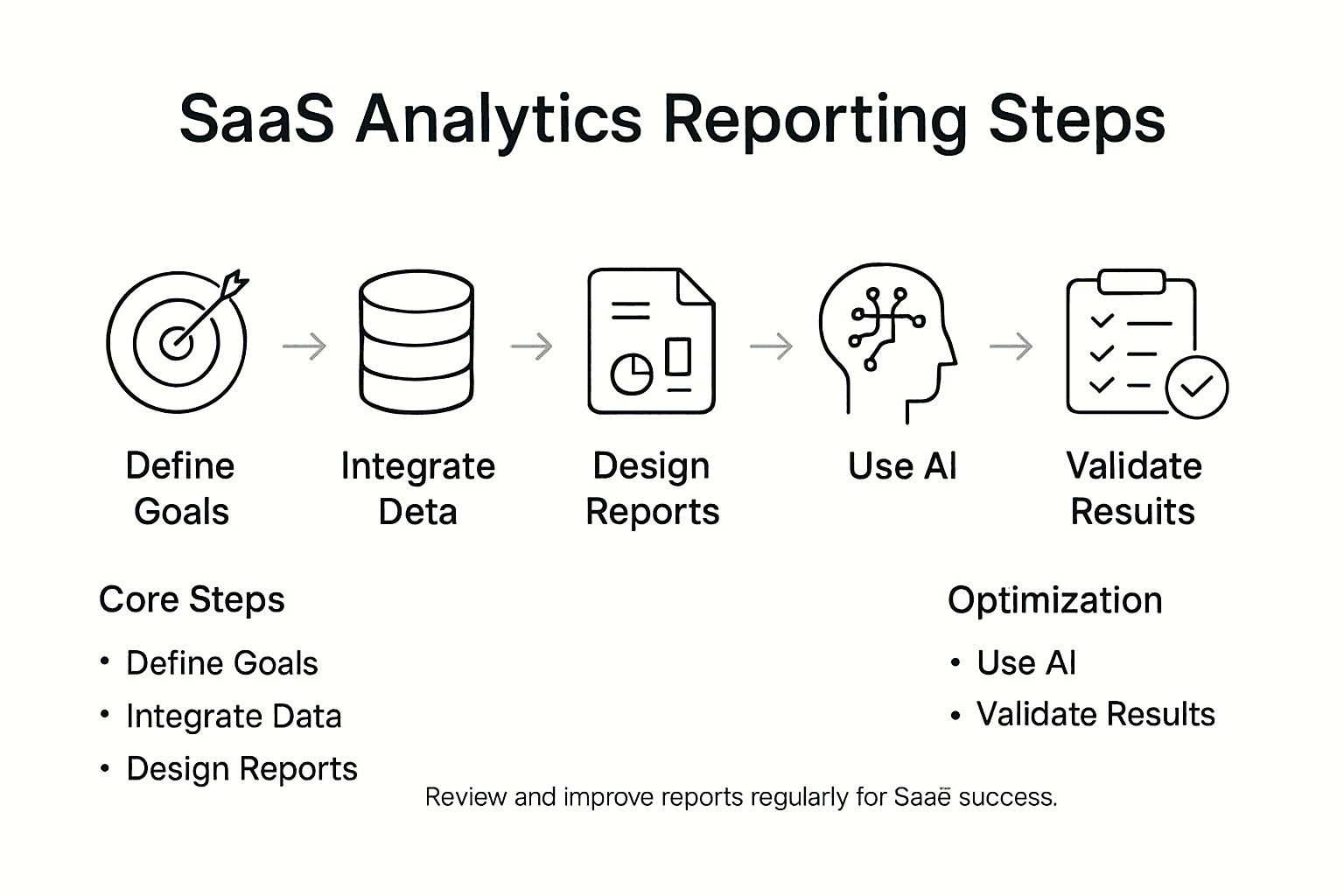
Step 1: Define critical metrics and business goals
Understanding your SaaS company’s metrics is like plotting a roadmap for success. In this step, you’ll learn how to identify the key performance indicators that truly matter for your business growth and strategic objectives.
To begin, focus on metrics that directly connect to your core business goals. The 4D Model provides an excellent framework for identifying and tracking critical metrics across customer satisfaction, profit, return on investment, and overall performance. Start by breaking down your primary business objectives into measurable components. Are you aiming to increase user acquisition? Reduce churn? Improve customer lifetime value? Each goal requires specific metrics for tracking progress.
Consider creating a metric hierarchy that aligns with your strategic vision. Research shows that effective KPI selection should directly correlate with organizational strategy which means moving beyond surface level numbers and diving deep into indicators that provide meaningful insights. For a SaaS product, this might include metrics like monthly recurring revenue, customer acquisition cost, user engagement rates, and feature adoption percentages.
Pro tip: Create a living dashboard that updates in real time, allowing your team to track progress and make rapid strategic adjustments based on your defined metrics.
Here’s a summary of essential SaaS business metrics and why they’re important:
| Metric | Measures | Business Impact |
|---|---|---|
| Monthly Recurring Revenue | Ongoing subscription income | Tracks growth and stability |
| Customer Acquisition Cost | Cost to gain each user | Guides budget efficiency |
| Churn Rate | Users lost over time | Assesses retention health |
| Feature Adoption | Usage of new product features | Informs product development |
Step 2: Integrate relevant data sources securely
Connecting your data sources securely is a critical step in building a robust analytics infrastructure for your SaaS product. In this phase, you will learn how to safely aggregate and protect your organization’s valuable information across multiple platforms.
Government and enterprise security frameworks offer crucial guidance for securely integrating SaaS data sources, emphasizing the importance of creating comprehensive security maps and defining clear stakeholder responsibilities. Start by identifying all potential data sources including internal databases, third party analytics tools, customer relationship management systems, and user engagement platforms. For each source, assess the security protocols and ensure they meet your organization’s compliance standards.
Implement strong authentication mechanisms like single sign on (SSO) and multi factor authentication to control data access. Develop a detailed access map that defines who can view specific datasets and under what conditions. This approach not only protects sensitive information but also creates a transparent framework for data management. Regularly audit these integrations to ensure ongoing security and compliance with evolving regulatory requirements.
Pro tip: Create a centralized access log that tracks all data source interactions to quickly identify and respond to potential security anomalies.
Review this comparison of common SaaS data sources and their typical security risks:
| Data Source | Example Data | Main Security Risk |
|---|---|---|
| Internal Database | Customer profiles | Unauthorized access |
| Third-Party Analytics | Usage statistics | Data leaks via integration |
| CRM System | Sales history | Mismanaged permissions |
| Engagement Platforms | Clickstream data | Privacy regulation breaches |
Step 3: Design intuitive report layouts for teams
Creating a report layout that speaks directly to your team’s needs is more art than science. In this crucial step, you will transform raw data into a visual story that drives decision making and clarity across your organization.

Modern SaaS dashboard design prioritizes user centered approaches that map precisely to professional team requirements. Begin by understanding each team member’s specific role and information needs. A sales manager will want different visual representations compared to a product development lead. Focus on creating a modular design that allows customization while maintaining a consistent overall structure. Use familiar chart types that communicate information quickly visual cues like color coding, clear typography, and logical information hierarchy.
Responsive design and progressive data disclosure are key principles for making reports accessible and comprehensible across different devices and user expertise levels. Implement interactive elements that let users drill down into specific metrics without overwhelming them with unnecessary complexity. Consider using tabs, collapsible sections, and hover states to provide additional context while keeping the primary view clean and focused. Remember that the goal is not just to display data but to tell a compelling story that helps your team make informed decisions rapidly.
Pro tip: Conduct periodic user testing with team members to continuously refine your report layouts and ensure they remain intuitive and valuable.
Step 4: Incorporate AI-driven insights for optimization
Transforming your analytics strategy with artificial intelligence means moving beyond traditional reporting into predictive and prescriptive intelligence. In this step, you will learn how to leverage AI technologies to unlock deeper understanding of your product’s performance and user behavior.
AI integration into SaaS product analytics enables advanced techniques for predicting user engagement and personalizing experiences, helping teams make more strategic decisions. Start by implementing machine learning models that can predict potential customer churn, analyze user sentiment, and segment your audience with unprecedented precision. Focus on identifying patterns that human analysts might miss like subtle changes in user interaction, emerging feature preferences, and potential friction points in your product workflow.
Machine learning frameworks offer powerful optimization strategies for improving service reliability and customer retention. Configure your AI systems to perform continuous anomaly detection, demand forecasting, and predictive maintenance. This approach allows you to proactively address potential issues before they impact user experience. Train your models using historical data, continuously refine their accuracy, and create adaptive feedback loops that help your AI insights become more sophisticated over time.
Pro tip: Implement a periodic review process where human experts validate and fine tune AI generated insights to maintain a balance between machine intelligence and strategic human judgment.
Step 5: Validate results and refine report actions
Validating your analytics reports is the critical final stage that transforms raw data into meaningful strategic guidance. In this step, you will learn how to systematically review your insights, ensuring they drive genuine business improvement and not just generate impressive looking charts.
Begin by establishing a rigorous validation framework that cross checks your analytics findings against multiple perspectives. Compare your generated insights with qualitative feedback from team members, customer interviews, and direct user experience data. Look for consistent patterns or potential discrepancies that might indicate blind spots in your current reporting methodology. Set up statistical significance thresholds that determine when an insight is actionable versus when it might be statistical noise or a temporary anomaly.
Create a continuous improvement loop for your reporting process. Develop a structured approach to periodically audit your analytics methodology, questioning assumptions and challenging existing reporting paradigms. This means not just accepting data at face value but critically examining the context, collection methods, and potential biases that might influence your insights. Implement a quarterly review process where you deconstruct your reporting approach, invite external perspectives, and be willing to completely redesign your analytics framework if the current model is not delivering meaningful, actionable intelligence.
Pro tip: Designate a rotating team of critical thinkers from different departments to review your analytics reports, ensuring diverse perspectives challenge potential analytical blind spots.
Unlock True Growth with Actionable SaaS Analytics Reports
The challenge highlighted in “Creating Actionable Analytics Reports for SaaS Growth” is clear: transforming raw data into meaningful, strategic insights that steer your SaaS business forward. You want analytics that go beyond standard charts identifying key metrics like churn rate and monthly recurring revenue with ease. You need intuitive, customizable report layouts combined with AI-driven insights that predict trends and optimize customer retention. Most importantly, these tools must seamlessly integrate within your existing workflows while ensuring security and ongoing validation.
At Rule27 Design, we understand these unique pain points. We specialize in building custom administrative systems and internal tools tailored to how your teams work best. Our expertise bridges the gap between generic off-the-shelf solutions and complex enterprise software that often overserves or underdelivers. Whether you want to craft detailed dashboards aligned with your strategic KPI framework or embed AI-powered analytics that offer predictive insights, we develop powerful digital infrastructure that scales with your growth.
Experience how custom-designed reporting systems can drive operational efficiency and improve decision-making across departments by visiting our homepage. Discover our approach to building content management systems and developing sophisticated internal tools that enable actionable analytics.
Elevate your SaaS analytics reporting today and make data your strongest asset.
Frequently Asked Questions
What are the essential metrics to include in a SaaS analytics report?
To create actionable analytics reports for SaaS growth, include metrics like Monthly Recurring Revenue, Customer Acquisition Cost, Churn Rate, and Feature Adoption. Focus on metrics that align directly with your business goals to ensure relevance and effectiveness.
How can I securely integrate multiple data sources for analytics reporting?
Securely integrate data sources by assessing each source’s security protocols and implementing strong authentication measures such as Single Sign-On and Multi-Factor Authentication. Start by creating a detailed access map that outlines who can view specific datasets and restrict access as necessary.
What are the best practices for designing user-friendly analytics reports?
Design user-friendly analytics reports by creating a modular layout that accommodates different team roles, using familiar chart types, and incorporating interactive elements. Conduct user testing to gather feedback and make iterative improvements, ensuring clarity and accessibility across all levels of expertise.
How can AI enhance the insights gained from SaaS analytics reports?
AI enhances SaaS analytics by providing predictive and prescriptive insights that identify patterns in user behavior and engagement. Implement machine learning models to analyze historical data, allowing for proactive decision-making and optimized customer experiences.
What steps should I take to validate the insights in my analytics reports?
To validate analytics insights, establish a rigorous framework that compares quantitative findings with qualitative feedback from team members and users. Regularly audit your reporting methodology and set thresholds for statistical significance, ensuring that your insights lead to meaningful business actions.
How often should I review and update my analytics reporting methods?
You should conduct a thorough review of your analytics reporting methods at least quarterly. This regular assessment helps you challenge existing assumptions, incorporate diverse perspectives, and adjust strategies based on evolving business needs and metrics.

About the Author
Josh AndersonCo-Founder & CEO at Rule27 Design
Operations leader and full-stack developer with 15 years of experience disrupting traditional business models. I don't just strategize, I build. From architecting operational transformations to coding the platforms that enable them, I deliver end-to-end solutions that drive real impact. My rare combination of technical expertise and strategic vision allows me to identify inefficiencies, design streamlined processes, and personally develop the technology that brings innovation to life.
View Profile

