

Discover how prescriptive analytics, AI, and segmentation power effective collections strategy design for growth-stage SaaS teams improving cash flow and DSO.
TL;DR:
- Most SaaS teams focus on reports instead of actionable analytics for collections.
- Prescriptive analytics automates tailored collection strategies, increasing recovery rates and efficiency.
- AI and segmentation improve prioritization, reduce costs, and lower days sales outstanding.
Most SaaS teams assume they have an analytics problem when they actually have an analytics type problem. Pulling monthly reports on overdue accounts is not a collections strategy. It is a history lesson. Real collections strategy design sits at the intersection of data, automation, and action-oriented thinking, and the gap between teams who get this right and those who don’t shows up directly in cash flow. This guide breaks down which analytics types actually drive collections outcomes, how AI and segmentation scale recovery efforts, and what a practical blueprint looks like for growth-stage SaaS companies ready to stop guessing and start recovering.
Key Takeaways
| Point | Details |
|---|---|
| Prescriptive analytics is key | Collections strategy success depends on prescriptive, action-oriented analytics. |
| AI and segmentation boost results | Scalable SaaS teams use AI and segmentation for real-time prioritization and better recovery rates. |
| Integrated automation lowers costs | Automating collections workflows can cut operating costs by up to 60 percent. |
| Blueprints enable rapid scaling | A step-by-step analytics-driven strategy improves cash flow and adapts as your SaaS grows. |
Why analytics matter in collections strategy design
Data is everywhere. But having data and using it strategically are two very different things. For SaaS teams managing recurring revenue, collections is not just a finance function. It directly shapes workflow efficiency for SaaS operations, cash runway, and how the business scales.
Most teams start with descriptive analytics. They look at aging reports, overdue balances, and days sales outstanding (DSO). Useful? Yes. Enough? Not even close. Descriptive analytics tells you what already happened. Predictive analytics gives you a probability of what might happen next. But prescriptive analytics is where the real leverage lives. It recommends optimal actions such as specific treatments, contact strategies, and prioritization for delinquent accounts.
Here is the thing most teams miss. They invest in dashboards and reporting tools, then wonder why recovery rates stay flat. The answer is almost always that they stopped at descriptive or predictive and never moved into prescriptive territory.
“Collections strategy design primarily involves prescriptive analytics, which recommends optimal actions such as specific treatments, contact strategies, and prioritization for delinquent accounts.”
Pro Tip: Teams that underinvest in prescriptive analytics typically leave 10 to 15% in recoveries on the table every quarter. That adds up fast at scale.
Here is what analytics-driven collections actually delivers when done right:
- Faster cash flow through automated, prioritized outreach
- Operational visibility across your entire AR portfolio in real time
- Smarter account prioritization based on risk scores, not gut instinct
- Reduced manual workload for finance and ops teams
- Better streamline team workflows alignment between billing, finance, and customer success
The teams winning at collections in 2026 are not just tracking more data. They are acting on it faster and more precisely than their competitors.
Types of business analytics: Which drive collections outcomes?
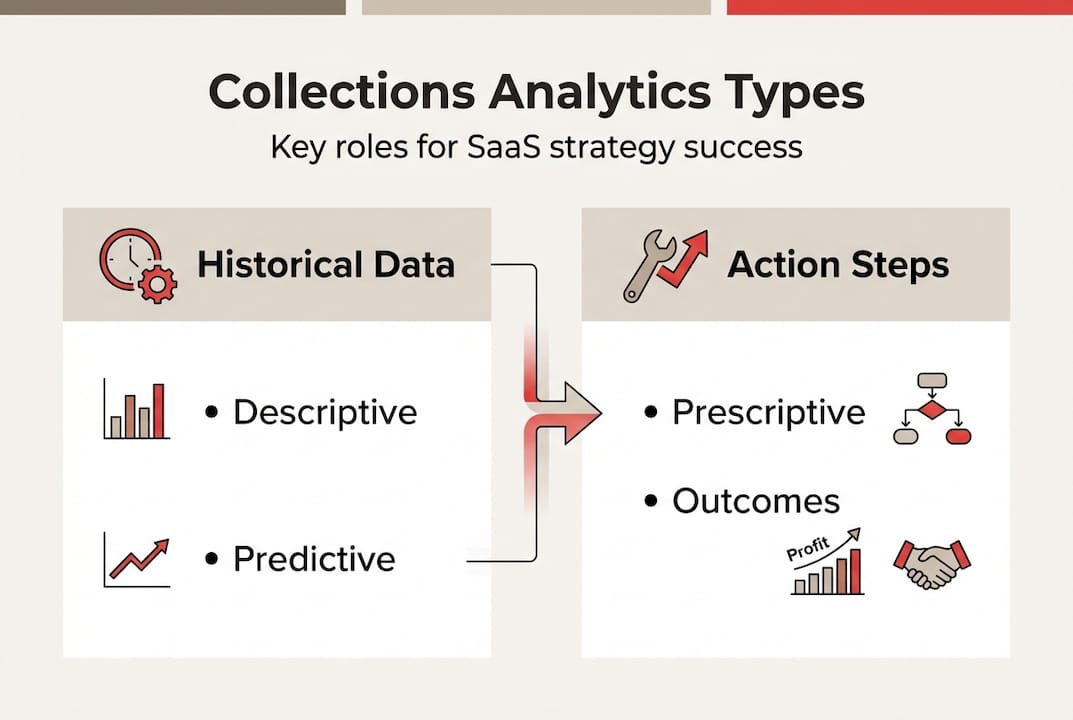
Let’s get specific. There are three major analytics types and each one plays a distinct role in collections. Understanding where each fits will change how you build your strategy.
Descriptive analytics answers: what happened? It surfaces historical trends, overdue account summaries, and aging buckets. Good for reporting. Not good for strategy.

Predictive analytics answers: what is likely to happen? Using ML models, it forecasts which accounts are most likely to go delinquent or churn without intervention. A step forward, but still not an action engine.
Prescriptive analytics answers: what should we do? This is the role of analytics experts who design collections systems that actually recommend specific treatments, timing, and contact channels for each account segment.
| Analytics type | What it tells you | Impact on collections |
|---|---|---|
| Descriptive | What happened | Low: good for review only |
| Predictive | What might happen | Medium: identifies risk early |
| Prescriptive | What action to take | High: drives recovery and efficiency |
For growth-stage SaaS, prescriptive analytics is where strategy becomes real. It powers tailored dunning schedules, account prioritization queues, and outreach timing that actually matches customer behavior patterns.
“Prescriptive analytics is where data becomes actionable strategy.”
Here is the typical progression for maturing SaaS collections teams:
- Start with descriptive to understand the current state of AR and overdue accounts
- Add predictive to flag accounts before they hit critical delinquency thresholds
- Mature into prescriptive to automate and optimize every touchpoint in the collections workflow
Skipping to prescriptive without the data foundation does not work. But staying stuck at descriptive is leaving real money behind. The path is sequential, and teams that accelerate through it see compounding returns on every dollar of overdue AR.
AI, automation, and segmentation in modern collections strategy
Knowing the analytics types is the foundation. Operationalizing them at scale is where AI and segmentation come in.
AI and machine learning scoring models evaluate each account in real time. They weigh payment history, product usage signals, contract value, and tenure to generate a risk score. That score drives prioritization automatically. No manual queue sorting. No guesswork about who to call first.
AI-powered segmentation takes this further by grouping accounts into cohorts with shared risk and value profiles. A high-value enterprise account that is 10 days late gets a different treatment than a small, high-churn-risk account at the same stage. Tailored outreach means higher response rates and faster resolution.
| Metric | Before AI integration | After AI integration |
|---|---|---|
| Recovery rate | Baseline | +10 to 15% improvement |
| Cost per collected dollar | Baseline | 30 to 50% reduction |
| DSO (days sales outstanding) | Baseline | 20 to 35% reduction |
| Manual effort in AR | High | Significantly reduced |
Real-world example: a growth-stage SaaS team with 5,000 active accounts segmented customers by risk tier, tenure, and MRR value. They layered prescriptive analytics on top, automating dunning sequences per segment. The result was a 12% boost in cash recovery within two quarters.
Pro Tip: Integrating your analytics stack with billing platforms like Zuora enables continuous optimization without manual intervention. Scalable AI platforms that integrate predictive scoring with prescriptive workflows handle high-volume AR efficiently and keep automating SaaS workflows running in the background.
The payoff is not just recovery. It is operational leverage. Your finance team stops spending time on triage and starts focusing on strategy. That is a different kind of business.
Blueprint: Designing an analytics-first collections strategy
Ready to build this out? Here is a practical five-step framework for designing a collections strategy powered by prescriptive analytics and automation.
-
Define your data foundation. Pull together billing data, CRM records, payment history, and product usage signals. Garbage in means garbage out. Clean, connected data is non-negotiable before layering analytics on top.
-
Select the right analytics layer. Start with descriptive to baseline your current AR health. Add predictive scoring to identify at-risk accounts early. Then build out prescriptive workflows that recommend treatments per account segment.
-
Segment your customer base. Use risk score, contract value, tenure, and product tier to create meaningful cohorts. Each segment needs its own outreach strategy, timing cadence, and escalation path.
-
Enable automation. Connect your analytics outputs to your dunning engine, billing system, and CRM. Automate the routine touchpoints. Scalable SaaS tools make this integration manageable even for lean ops teams.
-
Monitor and iterate. Track recovery rate, DSO, and cost per collection weekly. Update your models as account behaviors shift. Static strategies decay fast in a dynamic SaaS environment.
AI and automation combined cut collection costs by 40 to 60% while improving DSO across SaaS portfolios. That is not marginal improvement. That is a structural shift in how finance operates.
Pro Tip: Embed analytics checkpoints into every workflow stage, not just at monthly reviews. Real-time feedback loops catch deteriorating accounts earlier and keep your models current. Pairing this with strong CRM processes for collections amplifies the impact at every touchpoint.
The teams that build this right treat collections as a living system, not a quarterly fire drill.
What most SaaS teams get wrong about collections analytics
Here is the uncomfortable truth. Most SaaS teams build dashboards, call it analytics, and wonder why nothing changes. The dashboard is not the strategy. It is just a better history book.
The biggest mistake we see is over-reliance on historical data without any action orientation. Teams know exactly what went wrong last quarter. They have zero plan for what to do differently tomorrow. That is descriptive analytics masquerading as strategy.
The second mistake is treating all accounts the same. Uniform dunning emails sent to every overdue account regardless of risk, value, or tenure is not a collections strategy. It is noise. Accounts that receive generic outreach recover at lower rates because the message does not match their situation.
Real efficiency is not just about the tech stack. It is about aligning people, process, and analytics so that every team member knows what to act on and when. Reducing workflow bottlenecks in your collections process requires that alignment, not just a better tool.
SaaS leaders who push beyond dashboards and into systemic operational transformation are the ones who see compounding gains. Iterate on your models. Iterate on your workflows. That is what separates the leaders from everyone else.
Frequently asked questions
Which type of business analytics is most effective for collections strategy design?
Prescriptive analytics is most effective for collections strategy because it recommends specific actions based on data rather than just reporting or predicting outcomes.
What results do SaaS companies see from analytics-driven collections?
Growth-stage SaaS firms typically see 10 to 15% improvement in recoveries and 40 to 60% lower costs when they combine analytics, AI, and automation.
How do AI and segmentation enhance collections strategies?
AI and segmentation automate account prioritization and tailor outreach by risk and value, leading to faster recovery and meaningfully higher efficiency across the AR portfolio.
Can analytics integration reduce DSO and improve cash flow?
Yes. Integrating prescriptive analytics with billing systems like Zuora reduces DSO and directly improves cash flow by automating treatment decisions at scale.

About the Author
Josh AndersonCo-Founder & CEO at Rule27 Design
Operations leader and full-stack developer with 15 years of experience disrupting traditional business models. I don't just strategize, I build. From architecting operational transformations to coding the platforms that enable them, I deliver end-to-end solutions that drive real impact. My rare combination of technical expertise and strategic vision allows me to identify inefficiencies, design streamlined processes, and personally develop the technology that brings innovation to life.
View Profile

