

Business intelligence basics for SaaS founders: core concepts, BI types, practical workflows, AI trends, risks, and cost considerations in 2026.
Most American SaaS companies discover that over 60 percent of their critical business decisions rely directly on how well data is interpreted and shared. Operational efficiency hinges on more than just collecting numbers or building reports. Understanding Business Intelligence and its core concepts helps founders and product managers move beyond guesswork, bringing clarity to complex workflows and enabling confident, data-driven choices at every level.
Key Takeaways
| Point | Details |
|---|---|
| Business Intelligence is a Dynamic Framework | BI integrates human capabilities with technology, adapting to complex information needs for effective decision-making. |
| Key Components of BI Systems | Effective BI systems focus on data collection, integration, analysis, reporting, and visualization to derive actionable insights. |
| Emerging AI Trends Enhance BI | AI integration in BI systems allows for predictive analytics, natural language processing, and automated insights, driving more informed decisions. |
| Critical Implementation Considerations | Founders must assess total costs and maintain data governance to avoid common pitfalls during BI implementation. |
Business intelligence defined and key concepts
Business Intelligence (BI) represents a strategic approach that transforms raw data into meaningful insights for driving organizational decision making. At its core, BI is not just a technological solution but a comprehensive system that integrates human capabilities with technological infrastructure to address complex information needs.
According to comprehensive academic research on BI systems, Business Intelligence is fundamentally a process powered by both human expertise and technological capabilities. It goes beyond simple data collection, focusing on creating actionable intelligence that enables organizations to make informed strategic choices. The multidimensional nature of BI means it encompasses data integration, analysis, reporting, and visualization techniques that help leaders understand complex business dynamics.
Key components of a robust Business Intelligence framework include:
- Data Collection: Gathering information from multiple sources
- Data Integration: Consolidating data from various systems
- Data Analysis: Extracting meaningful patterns and trends
- Reporting: Presenting insights in clear, actionable formats
- Visualization: Transforming complex data into understandable graphics
BI systems are not static technologies but dynamic frameworks that evolve with organizational needs. They require continuous refinement of data strategies, technological infrastructures, and analytical approaches. Successful implementation demands not just technological investment but also cultural adaptation, ensuring that data-driven decision making becomes an integral part of organizational DNA.
Pro tip: When implementing a BI strategy, prioritize building a data-literate culture where employees at all levels understand and value data-driven insights.
Major types of business intelligence systems
Business Intelligence (BI) systems are diverse, serving different organizational needs and strategic objectives. Comprehensive academic research categorizes these systems across three critical perspectives: management, technological, and product-focused approaches.
From a management perspective, BI systems can be classified into several primary types:
- Operational BI Systems: Focus on real-time data processing and immediate decision support
- Strategic BI Systems: Designed for long-term planning and high-level organizational strategy
- Analytical BI Systems: Emphasize deep data exploration and complex pattern recognition
- Performance Management Systems: Track key performance indicators (KPIs) and organizational metrics
Decision support systems represent another critical classification, offering three distinct analytical modes: descriptive (what happened), predictive (what might happen), and prescriptive (what should happen). Each mode provides progressively more sophisticated insights, enabling organizations to move from reactive to proactive decision-making strategies.
Technologically, BI systems are further differentiated by their underlying infrastructure and data processing capabilities. These include data warehousing platforms, online analytical processing (OLAP) tools, and advanced data mining solutions. The most sophisticated systems integrate multiple technologies to provide comprehensive, dynamic intelligence that adapts to changing business environments.

Here’s a summary comparing major Business Intelligence system types and their strategic focus:
| BI System Type | Decision Speed | Analysis Depth | Strategic Impact |
|---|---|---|---|
| Operational BI | Real-time | Basic | Immediate response |
| Strategic BI | Scheduled reviews | Moderate | Long-term planning |
| Analytical BI | Moderate | High | In-depth business insight |
| Performance Management | Ongoing | KPI-focused | Goal attainment |
Pro tip: Select a BI system that matches your organization’s specific analytical maturity and can scale with your evolving data complexity.
How BI tools enhance SaaS workflows
Business Intelligence (BI) tools have revolutionized how SaaS companies approach data-driven decision making, transforming raw information into actionable insights that directly impact operational efficiency. Embedded BI technologies represent a breakthrough in integrating analytics directly into existing software workflows, enabling real-time data exploration without switching between multiple platforms.
The primary ways BI tools enhance SaaS workflows include:
- Instant Performance Tracking: Providing real-time metrics and KPI dashboards
- Predictive Analytics: Forecasting trends and potential business outcomes
- User Behavior Insights: Understanding customer interaction patterns
- Resource Optimization: Identifying bottlenecks and efficiency opportunities
- Personalized Reporting: Generating customized insights for different organizational roles
BI tools create a seamless analytical environment where data becomes an active participant in workflow management. By embedding intelligence directly into existing software interfaces, these tools eliminate the traditional barriers between data collection and strategic action. Teams can now make informed decisions faster, with visualization tools that transform complex datasets into intuitive, actionable graphics.
For growth-stage SaaS companies, the integration of BI tools means more than just data analysis. It represents a fundamental shift towards a more responsive, agile operational model where every team member can leverage data-driven insights to drive performance and innovation.
Pro tip: Select BI tools that offer native integration with your existing SaaS infrastructure to minimize implementation complexity and maximize user adoption.
Emerging AI and automation in business intelligence
Artificial Intelligence is rapidly transforming Business Intelligence, creating unprecedented opportunities for data-driven decision making. Augmented analytics research reveals how AI is revolutionizing traditional BI approaches by automating complex data processing tasks and generating intelligent insights with remarkable precision.
Key emerging AI trends in Business Intelligence include:
- Predictive Analytics: Using machine learning to forecast complex business scenarios
- Natural Language Processing: Enabling conversational interactions with data systems
- Automated Insight Generation: Creating human-readable reports without manual intervention
- Robotic Process Automation: Streamlining repetitive data management tasks
- Real-time Decision Support: Providing instantaneous strategic recommendations
The integration of AI into Business Intelligence systems represents more than technological advancement. Generative AI research suggests a fundamental shift towards more intuitive, accessible data environments where complex information becomes immediately actionable. Advanced AI algorithms can now interpret intricate datasets, identifying patterns and generating insights that would take human analysts weeks or months to uncover.
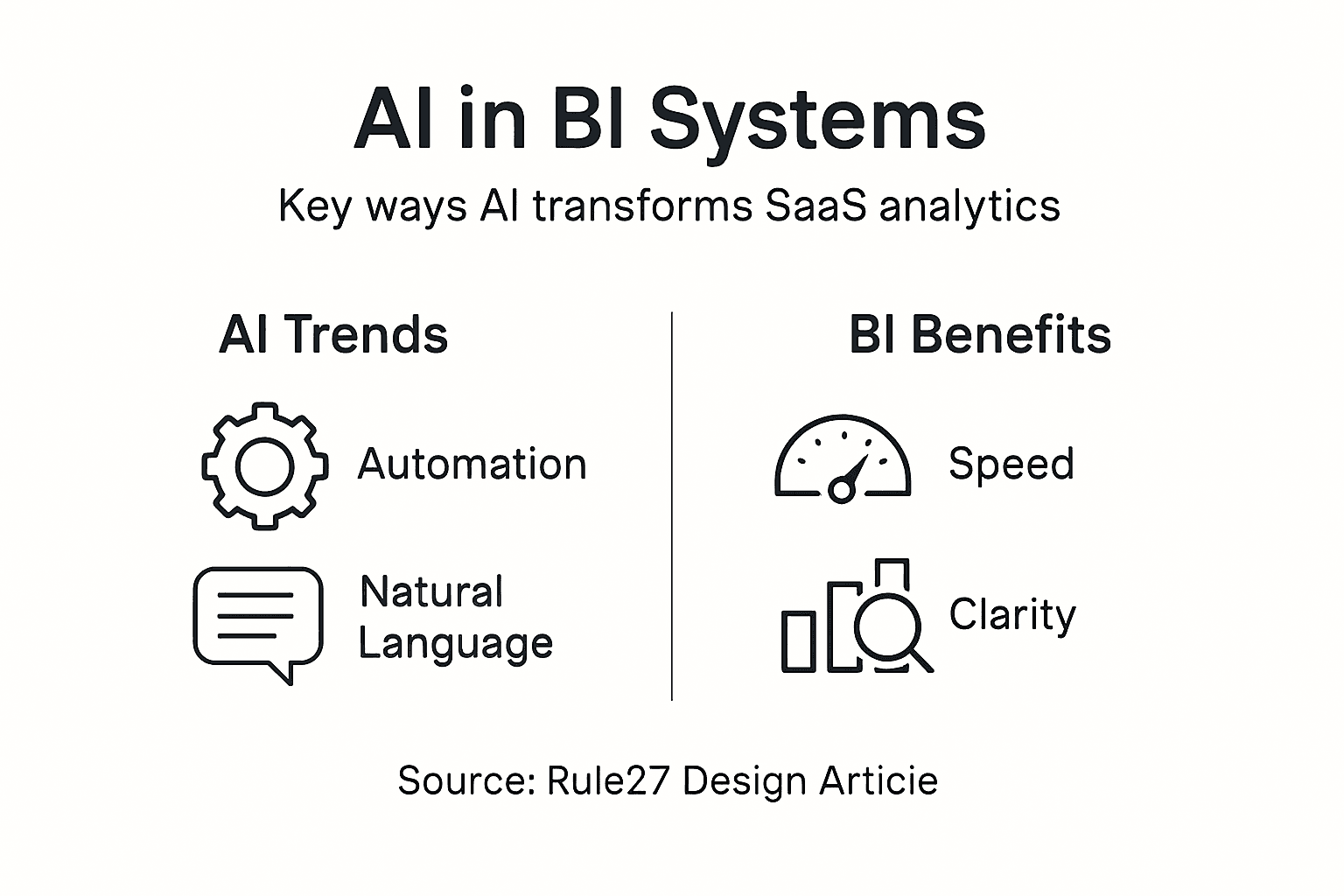
Below is a table highlighting how AI trends are reshaping business intelligence capabilities:
| AI Trend | Enhanced BI Capability | Real-World Benefit |
|---|---|---|
| Predictive Analytics | Automated forecasting | Anticipate market changes |
| Natural Language Processing | Conversational analytics | Simplified data exploration |
| Automated Insight Generation | Instant reports | Faster strategic decisions |
| Robotic Process Automation | Streamlined workflows | Reduced manual data labor |
| Real-time Support | Instant recommendations | Rapid response to business events |
For organizations, this means a dramatic reimagining of data strategy. AI-powered BI tools are not just analytical platforms but intelligent partners that can predict market trends, optimize resource allocation, and provide nuanced strategic guidance across different business functions.
Pro tip: Invest in AI-powered BI tools that offer transparent algorithmic processes and allow human oversight to maintain ethical decision-making standards.
Risks, costs, and common BI mistakes for founders
Business Intelligence implementation represents a significant strategic investment with complex financial and operational considerations. Academic cost research reveals that founders often underestimate the true expenses associated with comprehensive BI systems, extending far beyond initial software licensing.
Common BI implementation risks and mistakes include:
- Budget Miscalculation: Underestimating total cost of ownership
- Inadequate Infrastructure: Selecting systems incompatible with existing technology
- Poor Data Governance: Failing to establish clear data management protocols
- Scalability Limitations: Choosing inflexible solutions that cannot grow with the business
- Security Vulnerabilities: Neglecting robust data protection mechanisms
Cloud-based BI solutions analysis highlights critical considerations for founders, emphasizing that cost reduction must be balanced against potential risks like data security and compliance challenges. Successful BI implementation requires a holistic approach that considers technological capabilities, organizational readiness, and long-term strategic alignment.
Founders must recognize that BI is not a one-time purchase but a continuous investment requiring ongoing maintenance, training, and technological adaptation. The most sophisticated BI systems demand substantial human capital, including specialized personnel who can interpret complex data landscapes and translate insights into actionable strategies.
Pro tip: Conduct a comprehensive total cost of ownership assessment and build a flexible implementation roadmap that allows incremental investment and continuous evaluation.
Frequently Asked Questions
What is Business Intelligence (BI)?
Business Intelligence (BI) is a strategic approach that transforms raw data into actionable insights, enabling organizations to make informed decisions. It integrates human expertise and technology to create a comprehensive system for data analysis, reporting, and visualization.
How do BI tools enhance SaaS workflows?
BI tools enhance SaaS workflows by providing real-time metrics, predictive analytics, and user behavior insights. They allow for seamless integration into existing software, enabling teams to make faster, data-driven decisions and improve operational efficiency.
What are the major types of Business Intelligence systems?
The major types of Business Intelligence systems include Operational BI, Strategic BI, Analytical BI, and Performance Management Systems. Each type serves different organizational needs, focusing on various aspects of decision-making and analysis.
What risks and costs are associated with implementing BI systems?
Implementing BI systems entails various risks and costs, such as budget miscalculation, inadequate infrastructure, poor data governance, scalability limitations, and security vulnerabilities. Founders need to conduct thorough assessments to mitigate these risks and plan for ongoing investment.

About the Author
Josh AndersonCo-Founder & CEO at Rule27 Design
Operations leader and full-stack developer with 15 years of experience disrupting traditional business models. I don't just strategize, I build. From architecting operational transformations to coding the platforms that enable them, I deliver end-to-end solutions that drive real impact. My rare combination of technical expertise and strategic vision allows me to identify inefficiencies, design streamlined processes, and personally develop the technology that brings innovation to life.
View Profile

