

Content scalability boosts SaaS growth—covering core concepts, architecture types, workflow impacts, costs, and common hurdles for U.S. SaaS leaders.
Over 60 percent of American SaaS teams report struggling to increase content production without sacrificing quality. As your company grows, scaling content efficiently becomes a major challenge for founders and content directors across the United States. Understanding core concepts like modular workflows and flexible infrastructure can help American teams meet rising demand, improve performance, and avoid burnout as they expand their content operations.
Key Takeaways
| Point | Details |
|---|---|
| Content Scalability | Involves systematic expansion of content production without compromising quality, requiring adaptive frameworks and planning. |
| Scalable Architectures | Utilize modular, distributed, and event-driven systems to manage content demands and enhance operational efficiency. |
| Efficiency Improvements | Intelligent scalability frameworks lead to reduced manual intervention, faster production cycles, and improved team collaboration. |
| Common Mistakes in Scaling | Teams often overlook security implications and integration complexity, leading to potential operational pitfalls and increased costs. |
Content scalability explained and key concepts
Content scalability represents a strategic approach for SaaS teams to systematically expand their content production capabilities without compromising quality or performance. At its core, scalability means designing systems that can smoothly handle increasing workloads while maintaining efficiency and output standards.
In the context of digital technology, scalability involves complex organizational dynamics that extend beyond simple technical implementations. The process requires thoughtful planning across multiple dimensions: technological infrastructure, team workflows, content creation processes, and adaptive research methodologies. Teams must anticipate growth patterns and build flexible frameworks that can absorb increased demands without breaking down.
Key scalability strategies for content teams include:
- Developing standardized content templates
- Creating robust content management systems
- Implementing modular production workflows
- Establishing clear editorial guidelines
- Investing in collaborative tools that support distributed work
Computer science principles of scalability reveal two primary approaches: vertical and horizontal scaling. Vertical scaling focuses on enhancing a single system’s capacity, while horizontal scaling distributes workloads across multiple systems. For content teams, this translates into building adaptable processes that can expand team capabilities efficiently.
Below is a summary that contrasts vertical and horizontal scaling approaches for content teams:
| Scaling Approach | Implementation Focus | Team Impact | Resource Strategy |
|---|---|---|---|
| Vertical Scaling | Upgrade a single system | Centralized management | Increase capacity per node |
| Horizontal Scaling | Add multiple systems | Distributed workload | Expand nodes across network |
Pro tip: Design your content infrastructure with modularity and flexibility as core principles, allowing for seamless expansion without complete system redesigns.
Types of scalable content architectures
Scalable content architectures are critical frameworks that enable SaaS teams to expand their content production capabilities strategically and efficiently. These architectures provide structured approaches to managing increasing content demands while maintaining quality and performance.
Architectural design principles emphasize several key approaches for building robust content systems. Modular architectures stand out as particularly effective, allowing teams to decompose complex content workflows into manageable, interconnected subsystems. This approach enables independent scaling of specific components without disrupting the entire content production pipeline.
Primary types of scalable content architectures include:
- Distributed Content Systems
- Decentralized content creation workflows
- Parallel processing capabilities
- Geographic and role-based content distribution
- Microservice-Based Architectures
- Independent, specialized content services
- Flexible deployment and scaling
- Enhanced fault isolation
- Event-Driven Architectures
- Asynchronous content processing
- Real-time adaptation to workload changes
- Efficient resource allocation
Large language model architectures provide additional insights into advanced scalability techniques. These models demonstrate sophisticated approaches like sparse sequence modeling and hybrid processing frameworks that can be adapted to content production environments. The key is designing systems that can dynamically adjust to varying content complexity and production requirements.
The table below highlights business impacts of major scalable content architectures:
| Architecture Type | Business Benefit | Scalability Feature |
|---|---|---|
| Distributed Content System | Faster global reach | Decentralized workflows |
| Microservice-Based | Improved fault isolation | Independent content services |
| Event-Driven | Real-time adaptation | Asynchronous processing |
Pro tip: Implement a modular architecture with clear service boundaries, allowing individual components to scale independently without creating system-wide bottlenecks.
How content scalability drives workflow efficiency
Content scalability is more than a technical concept - it’s a strategic approach that transforms how SaaS teams create, manage, and distribute content. By implementing intelligent scalability frameworks, organizations can dramatically improve operational efficiency, reduce bottlenecks, and accelerate production timelines.

Dynamic resource allocation strategies reveal critical insights into workflow optimization. Adaptive workflow systems enable teams to dynamically redistribute workloads, ensuring that content production remains fluid and responsive to changing demands. This approach prevents resource congestion and allows for more intelligent task management across different team members and projects.
Key efficiency improvements driven by content scalability include:
- Reduced manual intervention
- Faster content production cycles
- More consistent quality control
- Enhanced team collaboration
- Predictable resource utilization
Performance optimization techniques underscore the intricate relationship between scalability and workflow smoothness. By designing systems that can seamlessly adjust to varying content complexity, teams can maintain high-quality output without sacrificing speed or increasing operational stress. The goal is creating a content production environment that grows organically with your team’s evolving needs.
Pro tip: Implement flexible workflow tools that allow real-time task redistribution and automatic workload balancing to maximize team productivity.
Operational requirements and real-world use cases
Content scalability demands sophisticated operational requirements that go beyond simple technological implementations. SaaS teams must develop comprehensive strategies that address technical infrastructure, team dynamics, and adaptive resource management to successfully scale their content production capabilities.
Database scalability principles reveal critical operational considerations for building robust content systems. Data partitioning strategies emerge as fundamental techniques, allowing organizations to distribute workloads efficiently across multiple resources. This approach enables teams to manage increasing content complexity without sacrificing performance or introducing significant system overhead.
Key operational requirements for content scalability include:
- Flexible infrastructure design
- Automated resource allocation
- Comprehensive monitoring systems
- Dynamic load balancing capabilities
- Fault-tolerant architecture
- Seamless integration between tools
- Predictive capacity planning
Workforce management frameworks demonstrate real-world applications of scalable systems. Successful implementations typically involve creating notification mechanisms that help teams understand resource availability, compatibility checks to ensure smooth transitions, and adaptive systems capable of redistributing tasks dynamically. These approaches transform content production from a static process to a fluid, responsive ecosystem.
Real-world use cases span multiple industries, from tech startups to global media organizations. Content teams leveraging scalable architectures can rapidly adjust to market demands, reduce operational bottlenecks, and maintain consistent quality across expanding content portfolios.
Pro tip: Develop a comprehensive scalability roadmap that includes regular system audits, performance benchmarking, and incremental infrastructure upgrades to maintain operational flexibility.
Risks, costs, and common scalability mistakes
Scaling content production is far from a straightforward process. SaaS teams must navigate a complex landscape of technical challenges, financial investments, and potential operational pitfalls that can significantly impact their growth strategies.
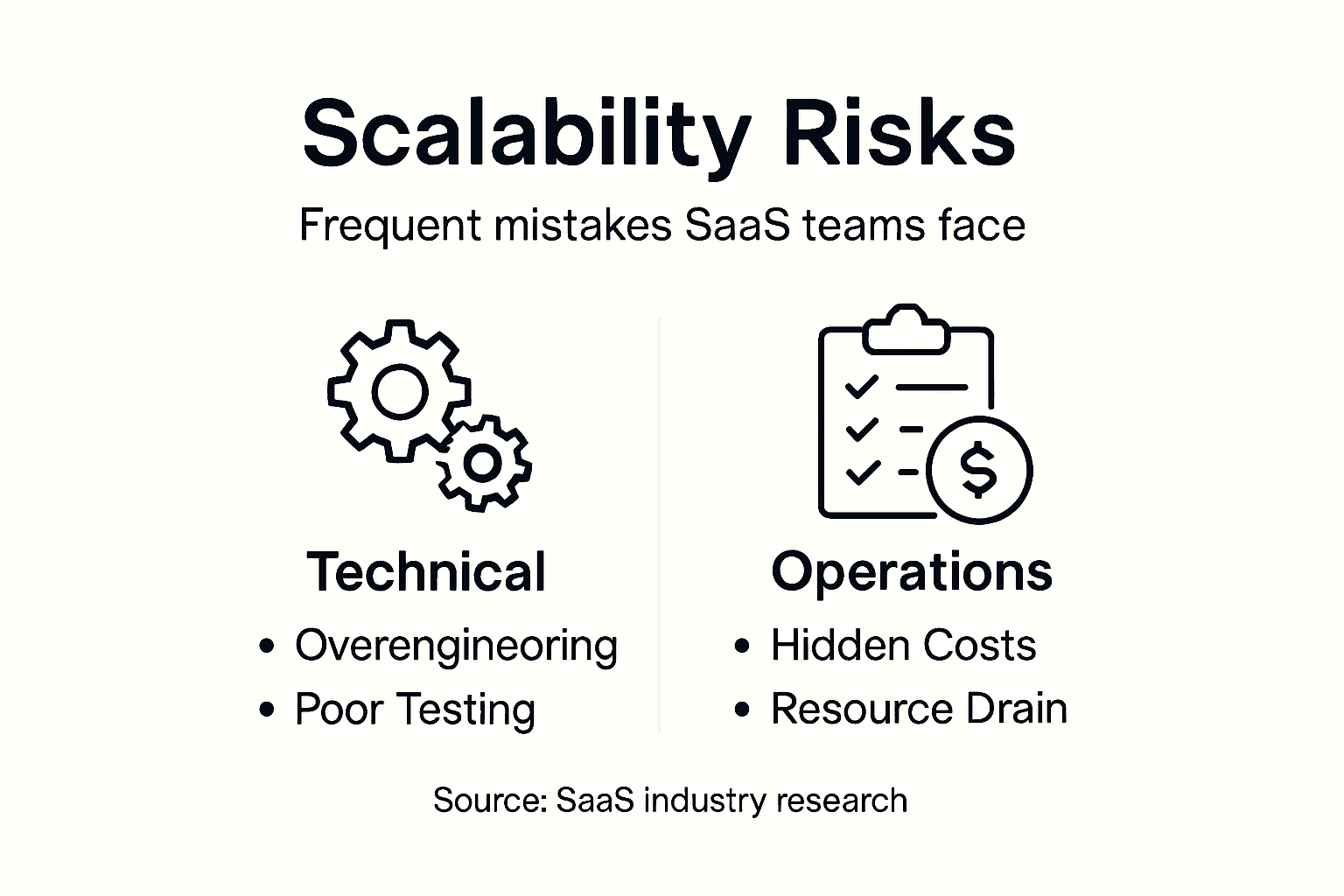
Software scalability challenges reveal critical insights into the intricate balance between performance, security, and system complexity. Resource consumption emerges as a primary concern, with scaling efforts often requiring substantial hardware investments and increased infrastructure maintenance costs.
Common scalability mistakes include:
- Overengineering technical solutions
- Neglecting system performance monitoring
- Failing to plan for incremental growth
- Ignoring security implications
- Underestimating integration complexity
- Lack of flexible architectural design
- Inadequate team training for new systems
Machine learning system scalability research highlights the nuanced trade-offs teams must consider. Scaling initiatives frequently encounter unexpected workflow disruptions, interdependency challenges, and resource allocation complexities that can quickly derail initial implementation strategies. The key is understanding that scalability is not a one-time implementation but an ongoing, adaptive process.
Financial risks are particularly significant. Organizations often underestimate the long-term costs associated with scaling, including infrastructure upgrades, additional personnel training, potential system redesigns, and increased operational overhead. Successful scaling requires a holistic approach that balances technological capabilities with financial sustainability.
Pro tip: Conduct comprehensive scalability assessments every six months, documenting system performance, resource utilization, and identifying potential bottlenecks before they become critical problems.
Unlock Seamless Content Scalability with Tailored Digital Solutions
Scaling your content production without sacrificing quality or efficiency is a complex challenge SaaS teams face every day. As discussed, adopting modular architectures, adaptive workflows, and fault-tolerant systems can transform your content operations — but implementing these strategies requires precise technical and operational expertise. This is where Rule27 Design excels. We build custom admin panels and content management systems that align perfectly with your team’s unique workflows. Our solutions emphasize workflow efficiency, dynamic resource allocation, and scalable infrastructure, empowering you to grow your content capabilities with confidence.

Ready to overcome bottlenecks and operational risks while boosting content performance? Discover how our AI-optimized, scalable digital infrastructures can accelerate your team’s growth and help you maintain consistent quality. Visit Rule27 Design now to explore our tailored services and start scaling smarter today. Learn more about how we design systems that improve workflow efficiency and create content platforms that scale with your business. Don’t wait for challenges to slow you down — take control of your content scalability with expert solutions built just for you.
Frequently Asked Questions
What is content scalability for SaaS teams?
Content scalability refers to a strategic approach that allows SaaS teams to expand their content production capabilities systematically while maintaining quality and performance. It involves designing systems that can handle increasing workloads efficiently.
What are some strategies for implementing content scalability?
Key strategies for implementing content scalability include developing standardized content templates, creating robust content management systems, implementing modular production workflows, and investing in collaborative tools to support distributed work environments.
How does scalable content architecture benefit a SaaS team?
Scalable content architecture allows SaaS teams to manage increasing content demands more effectively. It provides structured approaches to production, enabling independent scaling of components, improved fault isolation, and real-time adaptation to changing workloads.
What are common mistakes to avoid when scaling content production?
Common mistakes include overengineering technical solutions, neglecting system performance monitoring, failing to plan for incremental growth, underestimating integration complexity, and not providing adequate team training for new systems.

About the Author
Warren JonesCo-Founder & COO at Rule27 Design
12+ year's experience developing and executing Marketing Strategies. He created impactful campaigns and design for state politicians, local fundraisers, board game manufacturers, medical marijuana operators, radio personalities, mixed media organizations and construction companies. Throughout his career he has perfected the process of reading into peoples personalities to make sure that your design will reach the most impactful audience.
View Profile


