

Business intelligence in healthcare boosts efficiency, improves patient outcomes, and ensures compliance. Learn types, core tools, privacy, and risks in 2026.
Every healthcare operations manager knows the limits of relying solely on intuition for complex decisions. In an environment where rapid growth means more data and rising expectations, Business Intelligence offers a strategic way to turn patient information into real operational gains. This guide explains how thoughtful analytics can reveal hidden inefficiencies, strengthen data management, and directly support smarter, faster decisions for United States healthcare technology teams.
Key Takeaways
| Point | Details |
|---|---|
| Business Intelligence Enhances Decision-Making | BI transforms raw healthcare data into insights that improve operational and clinical decisions, boosting patient care quality. |
| Diverse BI Tools for Various Needs | Different BI solutions, such as Clinical and Financial BI tools, cater to specific user needs and objectives in healthcare organizations. |
| Data Privacy Compliance Is Crucial | Organizations must adhere to established regulations, such as HIPAA, to protect patient information and ensure secure data management. |
| Implementation Challenges Require Strategic Planning | Successful BI integration hinges on addressing technological and organizational barriers, necessitating comprehensive change management strategies. |
What Business Intelligence Means In Healthcare
Business Intelligence (BI) represents a strategic approach to transforming raw healthcare data into actionable insights that drive smarter operational and clinical decisions. At its core, BI integrates sophisticated data collection, management, and analytical tools designed specifically to enhance healthcare delivery and organizational performance.
In healthcare settings, Business Intelligence goes far beyond simple data tracking. Emerging research highlights its transformative potential by demonstrating how systematic data exploitation can dramatically outperform traditional experience-driven practices. The methodology enables healthcare organizations to:
- Extract meaningful patterns from complex patient data
- Identify operational inefficiencies
- Predict potential clinical risks
- Optimize resource allocation
- Improve patient care outcomes
The key components of healthcare Business Intelligence encompass multiple sophisticated analytical domains. Business Analytics research indicates these domains typically include advanced tracking of critical metrics such as:
- Patient satisfaction rates
- Hospital readmission statistics
- Mortality performance indicators
- Operational efficiency measurements
- Treatment cost analysis
- Regulatory compliance assessments
By leveraging data-driven insights, healthcare organizations can transform raw information into strategic knowledge. This approach allows administrators and clinicians to make evidence-based decisions that directly impact patient care quality and institutional performance.
Pro tip: Invest in robust data integration platforms that can seamlessly consolidate information from electronic health records, patient management systems, and financial databases to maximize your Business Intelligence capabilities.
Types Of Healthcare BI Solutions And Tools
Healthcare Business Intelligence (BI) encompasses a diverse range of specialized tools designed to address the complex data management needs of medical organizations. Advanced healthcare BI solutions offer comprehensive analytical capabilities that help administrators, clinicians, and financial managers make more informed decisions across multiple organizational domains.
The primary types of Healthcare BI solutions include:
Here’s a summary of common healthcare BI tool types and their primary users:
| BI Solution Type | Main Users | Primary Objective |
|---|---|---|
| Clinical BI Tools | Doctors and Nurses | Improve clinical care outcomes |
| Financial BI Tools | Finance Managers | Optimize costs and revenue streams |
| Operational BI Tools | Administrators, HR | Enhance workflow and performance |
| Predictive Analytics | Data Scientists, Clinicians | Enable proactive patient interventions |
- Clinical BI Tools: Focus on patient care improvement and clinical outcomes
- Financial BI Tools: Dedicated to cost control and revenue optimization
- Operational BI Tools: Designed for workflow management and staff performance tracking
- Predictive Analytics Platforms: Enable proactive healthcare interventions
Operational Business Intelligence solutions represent a critical component in modern healthcare management. These tools aggregate data from multiple sources including:
- Electronic health records
- Patient billing systems
- Staff scheduling databases
- Equipment tracking platforms
- Patient feedback repositories
Technology-driven healthcare BI tools provide multiple strategic benefits, including:
- Enhanced decision-making capabilities
- Personalized patient care strategies
- Improved operational efficiency
- Significant cost reduction potential
- Advanced predictive healthcare modeling
- Streamlined regulatory compliance processes
By integrating sophisticated data analysis techniques, these solutions transform raw healthcare information into actionable strategic insights. The goal is not just data collection, but creating meaningful, context-rich intelligence that drives organizational performance and patient care quality.

Pro tip: Prioritize BI solutions with robust integration capabilities that can seamlessly connect multiple data sources and provide real-time analytics across different healthcare departments.
How Healthcare BI Systems Work
Healthcare Business Intelligence systems represent a sophisticated technological ecosystem designed to transform complex medical data into strategic insights. Predictive analytics and integration techniques enable organizations to anticipate patient needs and optimize resource allocation with unprecedented precision.
The core operational mechanics of Healthcare BI systems involve several critical data processing stages:
- Data Collection: Aggregating information from multiple sources
- Data Integration: Standardizing and consolidating diverse datasets
- Data Analysis: Applying advanced statistical and machine learning techniques
- Visualization: Presenting insights through interactive dashboards
- Reporting: Generating comprehensive performance metrics
These systems typically incorporate multiple data streams, including:
- Electronic health records
- Patient demographic information
- Treatment history databases
- Financial transaction logs
- Clinical research repositories
Advanced analytics enable organizations to transition from basic reporting towards more sophisticated predictive and prescriptive models. This approach allows healthcare providers to:
- Benchmark performance against industry standards
- Monitor key operational indicators
- Develop targeted intervention strategies
- Optimize clinical and administrative processes
Healthcare BI systems transform raw data into actionable intelligence, bridging the gap between information collection and strategic decision-making.
Successful implementation requires a comprehensive approach involving cross-functional leadership, robust data governance frameworks, and continuous workforce training to ensure effective system utilization and interpretation.
Pro tip: Invest in comprehensive staff training programs that focus not just on technical system usage, but on developing data literacy and analytical thinking across all organizational levels.
Key Use Cases For Patient Data And Operations
Business Intelligence in healthcare transforms raw patient information into strategic operational insights. Key use cases demonstrate the transformative potential of data-driven decision-making across clinical and administrative domains, enabling healthcare organizations to optimize performance and patient outcomes.
The primary strategic use cases for patient data and operations include:
- Predictive Patient Outcomes: Anticipating health risks and intervention needs
- Cost Reduction: Identifying inefficiencies and optimizing resource allocation
- Operational Efficiency: Streamlining workflows and reducing administrative burden
- Population Health Management: Segmenting and targeting patient groups
- Personalized Care Planning: Developing tailored treatment strategies
Healthcare organizations can leverage Business Intelligence for multiple critical objectives:
- Early disease risk detection
- Treatment protocol optimization
- Resource allocation planning
- Patient experience enhancement
- Preventive care intervention design
Healthcare BI enables advanced analytics across several strategic dimensions:
- Individualized health tracking
- Clinical trial management
- Revenue cycle optimization
- Fraud detection mechanisms
- Supply chain performance monitoring
Transforming complex patient data into actionable insights requires sophisticated analytical approaches that balance clinical precision with operational efficiency.
Successful implementation demands a holistic approach that integrates technological capabilities with deep understanding of healthcare’s unique operational challenges, ensuring data becomes a strategic asset rather than just an information repository.
Pro tip: Develop cross-functional teams that combine clinical expertise with data analytics skills to maximize the interpretative potential of your Business Intelligence systems.
Privacy, Security, And U.S. Compliance Standards
Healthcare data privacy represents a critical intersection of technological capability and regulatory compliance in the United States. Persistent cybersecurity challenges demand sophisticated approaches that protect patient information while enabling effective data utilization.
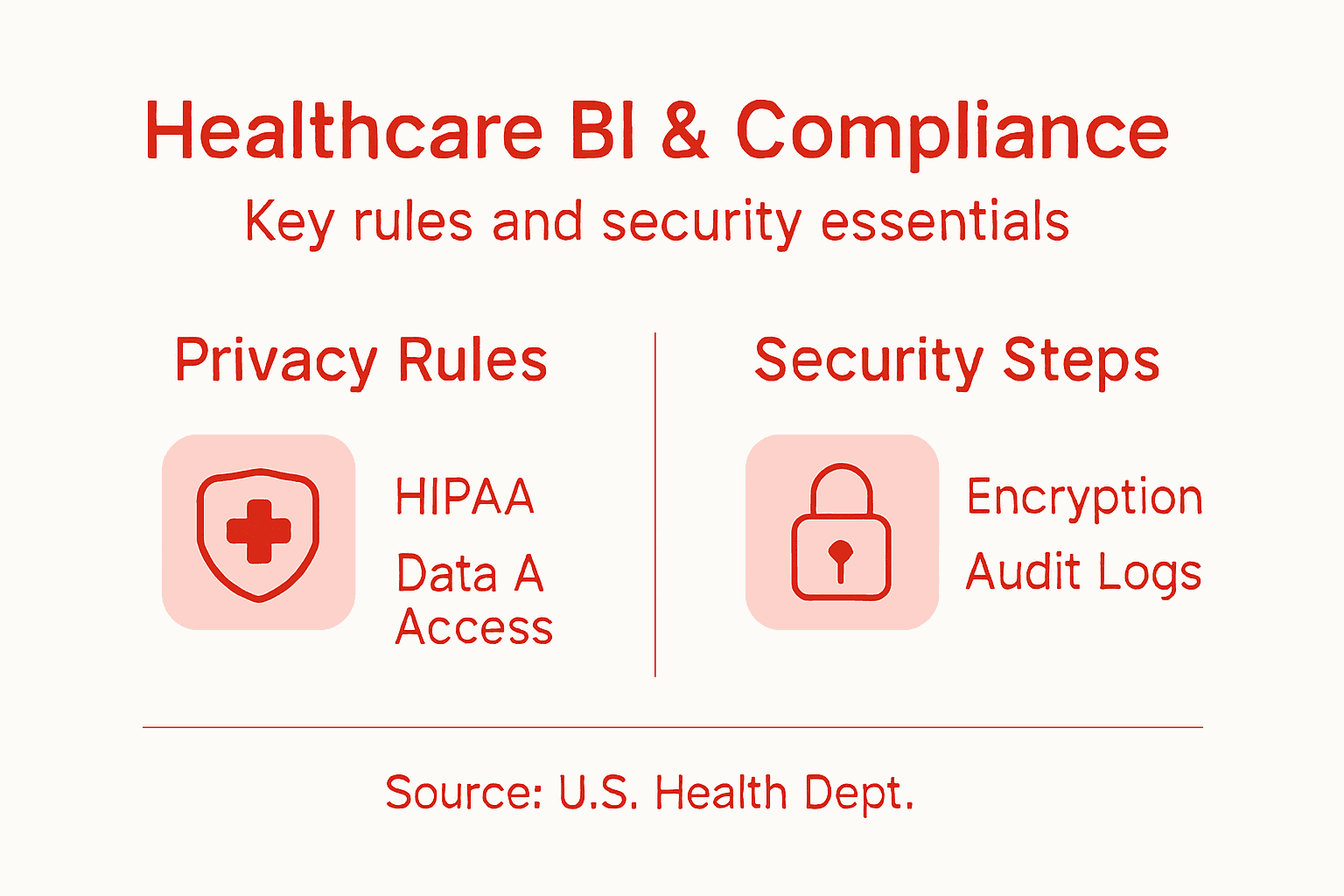
Key regulatory frameworks governing healthcare data privacy include:
This table highlights top U.S. healthcare data privacy laws and their main areas of focus for compliance:
| Regulation | Main Purpose | Typical Enforcement Scope |
|---|---|---|
| HIPAA | Protect patient health information | Federal healthcare organizations |
| HITECH | Strengthen digital data protection | Electronic health record systems |
| GDPR | Ensure privacy for EU interactions | International healthcare exchanges |
| State Laws | Address state-specific requirements | Local clinics and providers |
- HIPAA (Health Insurance Portability and Accountability Act)
- HITECH (Health Information Technology for Economic and Clinical Health Act)
- GDPR (General Data Protection Regulation) for international interactions
- State-level medical privacy regulations
- Federal cybersecurity compliance standards
Healthcare organizations must address multiple critical security dimensions:
- Patient data confidentiality
- Secure electronic health record management
- Access control and authentication
- Encryption of sensitive information
- Comprehensive breach prevention strategies
Healthcare data governance involves implementing comprehensive frameworks that protect patient safety and organizational integrity. These frameworks typically require:
- Robust identity verification protocols
- Continuous staff cybersecurity training
- Advanced threat detection systems
- Regular security infrastructure audits
- Transparent incident reporting mechanisms
Effective data protection is not just a technical challenge, but a fundamental ethical obligation to patient privacy and organizational trust.
Successful compliance requires a proactive, multilayered approach that combines technological solutions, comprehensive staff training, and continuous regulatory adaptation to emerging cybersecurity threats.
Pro tip: Conduct quarterly comprehensive security assessments and maintain an agile incident response plan that can quickly address potential data vulnerability scenarios.
Risks, Implementation Challenges, And Common Pitfalls
Business Intelligence implementation in healthcare demands strategic navigation of complex technological and organizational challenges. Strategic planning is critical for addressing implementation barriers that can potentially derail transformation efforts.
The most significant implementation challenges include:
- Data governance and quality inconsistencies
- Algorithmic bias and interpretation limitations
- Technological interoperability gaps
- Workforce training and adoption resistance
- Complex regulatory compliance requirements
Organizations frequently encounter specific risk categories during Business Intelligence integration:
- Financial investment uncertainties
- Technology infrastructure compatibility
- Staff skill development needs
- Patient data privacy vulnerabilities
- Performance measurement complexities
Healthcare technology adoption faces significant barriers that require comprehensive mitigation strategies:
- Immature technological ecosystems
- Limited financial resources
- Regulatory uncertainty
- Clinical workflow disruptions
- User acceptance challenges
Successful Business Intelligence implementation requires a holistic approach that balances technological innovation with organizational readiness and cultural transformation.
Healthcare leaders must develop robust change management strategies that address both technological and human factors, ensuring smooth transition and sustained engagement across all organizational levels.
Pro tip: Create a phased implementation roadmap with clear milestones, allocating resources for continuous training and stakeholder communication to minimize resistance and maximize system adoption.
Unlock the Power of Healthcare Business Intelligence with Custom Solutions
The challenges outlined in “Business Intelligence in Healthcare: Powering Data-Driven Decisions” make it clear that transforming complex healthcare data into actionable insights requires more than generic software. Healthcare organizations face pain points such as integrating disparate data sources, ensuring regulatory compliance, and driving operational efficiency while improving patient outcomes. Concepts like predictive analytics, operational BI, and data governance demand tailored systems that fit unique workflows rather than forcing teams to adapt to inflexible off-the-shelf tools.
At Rule27 Design, we specialize in crafting custom administrative systems and digital infrastructures that solve these exact challenges. Our expertise in creating scalable Business Intelligence tools with clean interfaces and seamless backend integrations helps healthcare providers harness real-time analytics and make confident data-driven decisions. From consolidating electronic health records to ensuring compliance and boosting clinical performance, we build solutions that empower your team to excel with clarity and speed.

Accelerate your healthcare BI transformation today by partnering with experts who understand both technology and healthcare operations. Discover how a custom-built system from Rule27 Design can bridge the gap between cumbersome enterprise software and rigid off-the-shelf products. Visit us now to explore tailored options and start turning raw data into powerful insights that improve patient care and operational success.
Frequently Asked Questions
What is Business Intelligence in healthcare?
Business Intelligence in healthcare refers to the strategic use of data collection, management, and analytical tools to transform raw healthcare data into actionable insights, enhancing decision-making and improving patient care outcomes.
How do healthcare organizations benefit from BI solutions?
Healthcare organizations benefit from BI solutions by obtaining insights that help identify operational inefficiencies, predict clinical risks, optimize resource allocation, and ultimately improve patient care outcomes.
What types of tools are included in healthcare Business Intelligence?
Healthcare Business Intelligence includes a variety of tools such as Clinical BI Tools for improving healthcare outcomes, Financial BI Tools for optimizing revenue, Operational BI Tools for enhancing workflow, and Predictive Analytics for proactive patient interventions.
What are common challenges in implementing Business Intelligence systems in healthcare?
Common challenges include data governance issues, algorithmic bias, technological interoperability gaps, workforce training needs, and complex regulatory compliance requirements.

About the Author
Josh AndersonCo-Founder & CEO at Rule27 Design
Operations leader and full-stack developer with 15 years of experience disrupting traditional business models. I don't just strategize, I build. From architecting operational transformations to coding the platforms that enable them, I deliver end-to-end solutions that drive real impact. My rare combination of technical expertise and strategic vision allows me to identify inefficiencies, design streamlined processes, and personally develop the technology that brings innovation to life.
View Profile

