

Discover how integrating SEO with content marketing drives 702% ROI for SaaS companies. Learn prioritization strategies, AI optimization, and proven benchmarks for 2026 growth.
Most SaaS marketing managers treat SEO and content marketing as separate departments, separate budgets, separate strategies. This siloed approach costs you traffic, pipeline, and revenue. The reality? Programmatic SEO generated 250K monthly organic visitors for one SaaS platform by integrating content creation with technical optimization. This guide reveals how to unify these disciplines in 2026, prioritize tactics that accelerate pipeline growth, and measure real ROI. You’ll learn evidence-backed frameworks tailored specifically for growth-stage SaaS companies ready to scale organic visibility.
Key takeaways
| Point | Details |
|---|---|
| Integration drives growth | Combining SEO with content marketing generates stronger pipeline results than isolated tactics in SaaS environments. |
| Bottom-funnel content wins fast | Product comparisons and use case pages deliver rapid revenue impact before scaling broader traffic strategies. |
| Technical foundations matter | Core Web Vitals, crawlability, and E-E-A-T principles remain essential for 2026 SaaS SEO success. |
| Organic outperforms paid | SEO delivers over 700% ROI across three years while costing half as much per lead as paid channels. |
| AI search changes optimization | New frameworks for LLM visibility complement traditional Google SEO without replacing proven methods. |
Why SEO and content marketing integration matters for SaaS growth
When you separate SEO from content marketing, you create artificial barriers that limit both disciplines. Your SEO team optimizes for keywords without considering engagement. Your content team produces brilliant pieces that never rank. Neither achieves full potential because they operate in isolation.
The consequences show up in your analytics. Traffic plateaus despite consistent publishing. Engagement metrics look strong but conversions stay flat. You invest in both channels yet neither delivers expected returns. This happens because search engines reward content that serves user intent while meeting technical standards, and users engage with content they can actually find.
Contrasting views reveal pure SEO risks low engagement while pure content risks invisibility. Growth-stage SaaS companies need a hybrid approach that combines technical optimization with compelling storytelling. When done right, this integration transforms both disciplines.
Consider programmatic SEO as a prime example. One SaaS integration platform used programmatic SEO to generate 250K monthly visitors with high signup conversion rates. They didn’t just create thousands of pages. They built a system where content quality, technical structure, and user intent aligned perfectly at scale. Each page served a specific search query while maintaining brand voice and providing genuine value.
Modern effective CMS features for SaaS content teams make this integration practical. The right tools let content creators optimize as they write, not as an afterthought. Writers see keyword opportunities, technical health scores, and performance metrics within their workflow. SEO specialists review content strategy and provide guidance without becoming bottlenecks.
Your balanced approach should address three layers simultaneously:
- Technical SEO foundation ensuring search engines can crawl, index, and understand your content
- Content strategy creating valuable resources that match user intent across the entire buyer journey
- Full-funnel tactics connecting awareness content to conversion-focused pages through strategic internal linking
This integration pays compound dividends. Each piece of optimized content strengthens your domain authority. Better technical infrastructure improves all content performance. Comprehensive topic coverage builds topical authority that lifts rankings across related keywords.
“The most successful SaaS content programs treat SEO and content creation as inseparable disciplines. Technical optimization without quality content fails. Great content without discoverability wastes resources. Integration is the only path to sustainable organic growth.”
You avoid two common failure modes with this approach. Pure SEO tactics might drive traffic but produce thin content that bounces users immediately. Pure content marketing might build audience loyalty but never reaches scale because discovery depends on social shares or paid promotion. Integration captures both search visibility and user engagement.
Core SEO pillars powering content marketing success in 2026
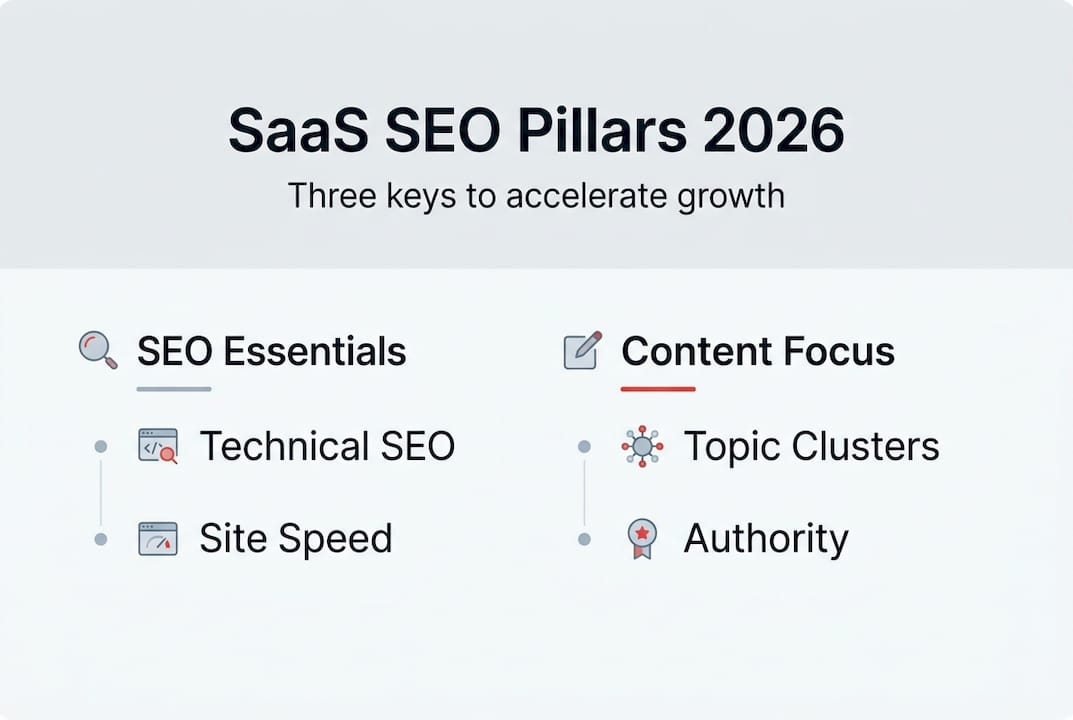
Three fundamental pillars support every successful SaaS SEO and content marketing program. Miss any one of them and your entire strategy becomes unstable. Master all three and you create a foundation for exponential organic growth.

Technical SEO forms your first pillar. Search engines must crawl your site efficiently, index your pages correctly, and deliver fast experiences to users. This means optimizing Core Web Vitals for performance, ensuring mobile responsiveness, implementing proper schema markup, and maintaining clean site architecture. Without this foundation, even brilliant content struggles to rank.
Your site speed directly impacts both rankings and conversions. Pages loading in under 2.5 seconds see significantly better engagement than slower alternatives. Largest Contentful Paint, First Input Delay, and Cumulative Layout Shift comprise the Core Web Vitals metrics Google prioritizes. Each affects user experience and search performance.
Content strategy represents your second pillar. SaaS SEO requires full-funnel content organized into topic clusters that address every stage of the buyer journey. Top-funnel content builds awareness around problems your product solves. Middle-funnel pieces educate prospects on solution approaches. Bottom-funnel content directly compares options and demonstrates specific use cases.
Topic clusters work by establishing pillar pages covering broad subjects, then creating cluster content addressing specific subtopics. All cluster pages link back to the pillar, creating semantic relationships search engines recognize. This architecture builds topical authority faster than isolated posts.
Your content must match search intent precisely. Informational queries need educational content. Commercial investigation queries need comparison guides. Transactional queries need product pages. Mismatched intent kills rankings no matter how well optimized your technical SEO.
Authority development forms your third pillar. Search engines evaluate your credibility through backlinks and E-E-A-T signals. Experience, Expertise, Authoritativeness, and Trustworthiness determine whether your content deserves top rankings. Building genuine authority requires consistent publishing, expert author profiles, industry recognition, and quality backlinks from relevant sources.
Here’s how these pillars compare in focus and implementation:
| SEO Element | Primary Focus | Content Marketing Focus | Integration Point |
|---|---|---|---|
| Technical Foundation | Site speed, crawlability, indexing | Publishing workflow, asset optimization | CMS features enabling optimization |
| Keyword Strategy | Search volume, difficulty, intent | Topic relevance, audience needs | Content briefs with keyword targets |
| Content Quality | Readability, structure, freshness | Value, engagement, brand voice | Editorial standards meeting SEO requirements |
| Authority Building | Backlinks, domain rating | Thought leadership, industry presence | Linkable assets and expert content |
Pro Tip: Use AI-powered content checklists during creation to maintain E-E-A-T standards. These tools verify you’ve included expertise signals, cited authoritative sources, and optimized for both traditional search engines and emerging AI platforms. Consistency across these quality signals compounds over time.
These three pillars work synergistically. Strong technical SEO amplifies great content. Comprehensive content builds authority. Growing authority improves rankings across your entire domain. Focus on one pillar while neglecting others creates imbalance that limits growth potential.
Navigating AI search & prioritizing bottom-funnel content for rapid SaaS wins
AI-powered search engines like ChatGPT, Claude, and Perplexity are reshaping how prospects discover SaaS solutions. Yet traditional Google search still drives the majority of organic traffic. Your 2026 strategy must address both realities without overinvesting in unproven channels.
Optimizing for LLMs requires E-E-A-T, structured data, and content answering real user queries. Large language models prioritize authoritative sources with clear expertise signals. They favor content demonstrating experience through specific examples, case studies, and practical frameworks. Generic advice gets ignored while detailed, actionable guidance gets cited.
Your author profiles matter more than ever. AI systems evaluate whether writers have relevant credentials and experience. Include detailed bios, link to professional profiles, and showcase subject matter expertise. This isn’t vanity, it’s ranking criteria.
Structured data helps AI systems understand your content context. Schema markup for articles, FAQs, how-to guides, and product information makes your content more parseable. While traditional SEO has used schema for years, AI search relies on it even more heavily to extract accurate information.
Yet you can’t abandon traditional SEO techniques since Google dominates search traffic. Title tags, meta descriptions, header hierarchy, and internal linking remain crucial. Your content must satisfy both algorithmic ranking factors and AI comprehension simultaneously.
Strategic prioritization determines which content you create first. Many SaaS companies start with top-funnel awareness content because it seems easier or more creative. This approach delays revenue impact for months while you build traffic that doesn’t convert.
Prioritize bottom-funnel SEO content first for quick pipeline wins. Product comparison pages, specific use case demonstrations, and alternative pages targeting competitor keywords drive qualified traffic ready to convert. These pages have lower search volume but dramatically higher conversion rates.
Follow this prioritization sequence:
- Create bottom-funnel content targeting high-intent commercial keywords related to your product category and competitor alternatives
- Build supporting middle-funnel content explaining solution approaches and evaluation criteria prospects need
- Develop pillar pages establishing topical authority around your core subject areas
- Scale topic clusters with comprehensive coverage of subtopics within each pillar area
- Implement programmatic SEO for long-tail keyword coverage once your authority foundation is solid
This sequence delivers measurable pipeline contribution within 90 days rather than waiting six months for awareness content to mature. You prove SEO value to stakeholders while building the foundation for scaled traffic growth.
“Bottom-funnel content acts as your SEO beachhead. It generates revenue while you expand into broader topics. Many SaaS companies reverse this order and struggle to justify continued investment when early content doesn’t convert.”
Your keyword research should identify commercial intent signals like “vs,” “alternative,” “comparison,” “for [use case],” and “pricing.” These modifiers indicate prospects actively evaluating solutions. Content targeting these terms connects with buyers at decision-making moments.
Pro Tip: Continuously analyze content performance to refine your prioritization. Track not just traffic but conversion rates, pipeline influence, and revenue attribution for each content type. Double down on formats and topics driving business results while deprioritizing vanity metrics like raw pageviews.
Balancing AI optimization with traditional SEO and strategic content prioritization positions you for success across all discovery channels. You capture immediate wins while building sustainable long-term growth.
Measuring ROI and success benchmarks for SaaS SEO & content marketing
SEO skeptics often question whether organic investment justifies the time and resources required. The data tells a compelling story. B2B SaaS SEO delivers 702% average ROI over three years with break-even occurring around month seven. This dramatically outperforms paid channels over equivalent timeframes.
Cost per lead comparisons reveal the efficiency advantage. Organic CPL averages $147 compared to $280 for paid advertising in B2B SaaS. That’s nearly half the acquisition cost for leads that often convert at similar or better rates. The compounding nature of SEO means each piece of content continues generating leads long after publication.
AI search introduces even more favorable economics. AI search converts 4.4x higher than traditional search traffic. When prospects discover your solution through ChatGPT or Claude recommendations, they arrive with strong intent and trust signals already established. This emerging channel represents significant upside as adoption grows.
Organic traffic typically accounts for 40-60% of total site visits for SaaS companies with mature SEO programs. This percentage grows over time as content compounds and authority builds. Companies publishing consistently see accelerating returns in years two and three as their content library reaches critical mass.
Here’s how organic SEO compares to paid channels:
| Metric | Organic SEO | Paid Advertising | Advantage |
|---|---|---|---|
| 3-Year ROI | 702% | 200-300% | SEO 2.3-3.5x higher |
| Cost Per Lead | $147 | $280 | SEO 47% lower |
| Traffic Sustainability | Compounds over time | Stops when spend stops | SEO builds assets |
| Break-Even Timeline | 7 months average | Immediate but doesn’t compound | Paid faster start, SEO better long-term |
| Conversion Quality | High intent, trusted source | Variable, ad fatigue | SEO generally higher quality |
Your publishing frequency directly impacts results velocity. Companies publishing two to four well-optimized posts monthly see steady growth. Those publishing weekly or more accelerate their timeline to meaningful traffic and conversions. Quality matters more than quantity, but consistent volume at high quality creates the fastest path to results.
Key benchmarks to track include:
- Organic traffic growth rate month over month and year over year
- Keyword rankings for target terms across all funnel stages
- Conversion rate from organic traffic to qualified leads
- Pipeline influence and revenue attribution from organic sources
- Domain authority and backlink profile growth
Your workflow efficiency in SaaS operations directly impacts how much content you can produce at quality standards. Teams using modern content systems publish 40% more optimized content than those relying on disconnected tools. This efficiency advantage compounds into traffic and pipeline gains.
Set realistic expectations with stakeholders. Months one through three focus on foundation building with limited traffic. Months four through seven show accelerating growth as content indexes and ranks. Months eight through twelve demonstrate clear ROI as traffic compounds and conversions accumulate. Years two and three deliver exponential returns as your content library and authority reach critical mass.
SEO investment pays dividends for years after initial publication. A single comprehensive guide can generate thousands of leads over its lifetime. Paid advertising stops producing results the moment you pause spending. This fundamental difference makes SEO the superior long-term growth channel for SaaS companies willing to invest consistently.
Enhance your SaaS growth with expert SEO and content marketing support
You now understand the integrated strategies, technical foundations, and prioritization frameworks that drive SaaS SEO success. Implementing these approaches requires specialized expertise, consistent execution, and sophisticated tools that most growth-stage companies don’t have in-house.
Rule27 Design specializes in building custom digital solutions that operationalize these strategies for ambitious SaaS companies. Our content management systems integrate SEO optimization directly into editorial workflows, ensuring every piece meets technical standards while maintaining quality. We’ve helped clients achieve 40% improvements in operational efficiency and significant gains in organic visibility by creating tools that match how teams actually work.
Our expertise spans technical SEO architecture, AI-optimized content systems, and workflow automation that scales your organic growth efforts. We understand both the marketing strategy and the technical infrastructure required to execute consistently. Partnering with specialists who’ve solved these challenges accelerates your path to measurable pipeline impact.
FAQ
How often should a growth-stage SaaS company publish new SEO content?
Aim for two to four well-crafted posts per month to build consistent organic traffic and compounding SEO benefits. This frequency allows for proper research, optimization, and quality control while maintaining momentum. Companies publishing weekly see faster results but must ensure quality doesn’t suffer from increased volume.
What is programmatic SEO and how can SaaS companies benefit from it?
Programmatic SEO creates large-scale, automated page sets targeting many keywords simultaneously. It works by using templates and data to generate hundreds or thousands of unique pages that each serve specific search queries. When executed properly with quality content and strong technical foundations, programmatic approaches can drive substantial traffic and signups as demonstrated by platforms reaching 250K monthly visitors.
How does AI search affect SaaS content marketing strategies in 2026?
AI search demands content optimized for large language model queries with strong E-E-A-T signals, structured data, and detailed expertise demonstrations. However, traditional SEO methods remain crucial since Google still dominates search traffic. Your strategy should address both channels without overinvesting in unproven AI platforms at the expense of established search engines.
What technical SEO factors are most important for SaaS websites?
Focus on crawlability ensuring search engines can access all important pages, fast Core Web Vitals including load times under 2.5 seconds, mobile-friendly responsive design, and structured schema markup. These technical foundations amplify content performance and directly impact both rankings and user experience. Sites with poor technical SEO struggle to rank regardless of content quality.
Topics

About the Author
Josh AndersonCo-Founder & CEO at Rule27 Design
Operations leader and full-stack developer with 15 years of experience disrupting traditional business models. I don't just strategize, I build. From architecting operational transformations to coding the platforms that enable them, I deliver end-to-end solutions that drive real impact. My rare combination of technical expertise and strategic vision allows me to identify inefficiencies, design streamlined processes, and personally develop the technology that brings innovation to life.
View Profile

